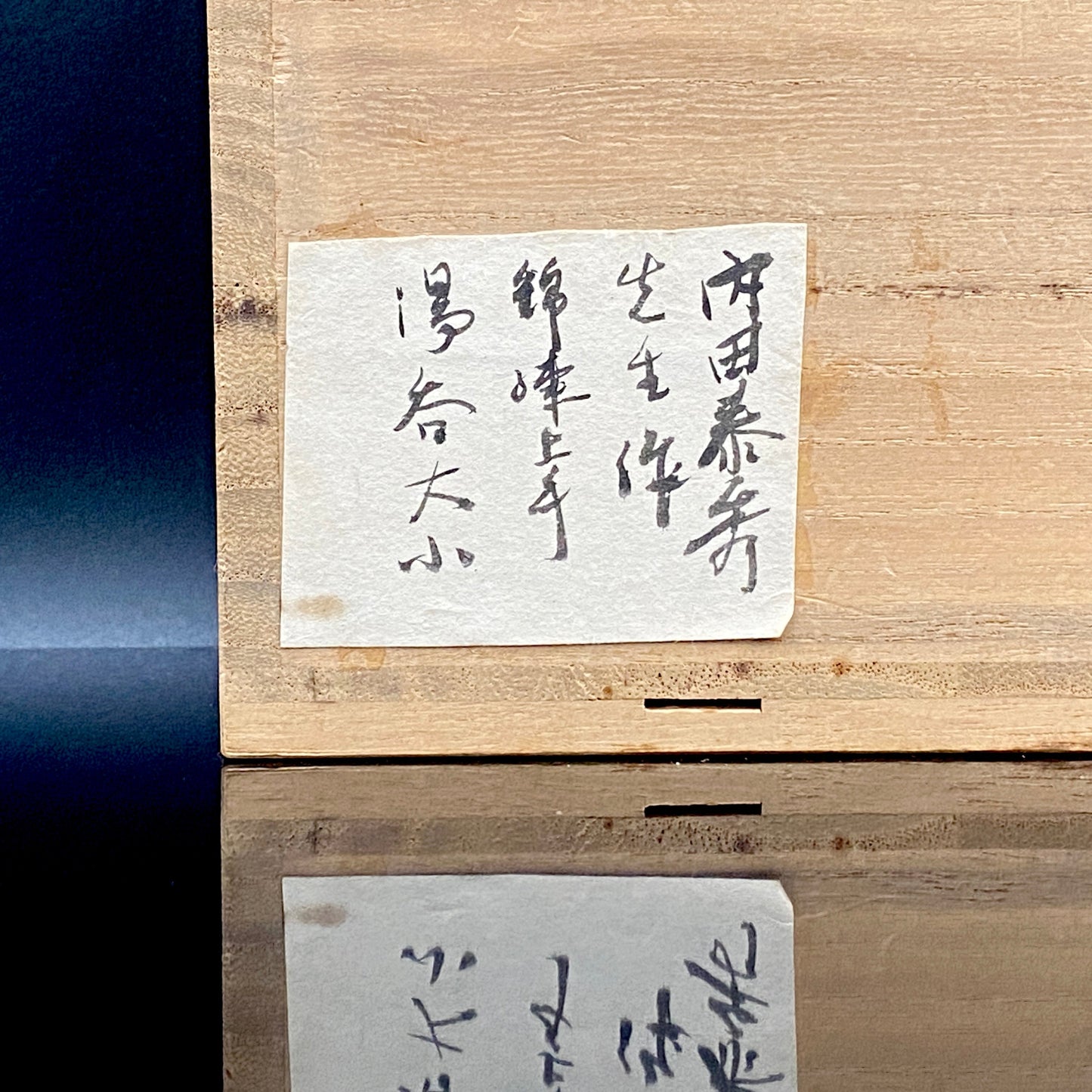
Yasuhide Uchida is a ceramic artist hailed as a solitary legend in the history of Showa era ceramics. Following immense acclaim at the 1970 Osaka Expo and his subsequent research at the prestigious Manufacture nationale de Sèvres in France, he reached a unique artistic pinnacle that harmoniously fused Japanese and French aesthetics. This specific work, Hyori Kantsu Nishiki Neriage (Surface-to-Reverse Penetration Brocade Marbling), was created in July 1977 (Showa 52), a time when Uchida's technique had reached its full maturity and was approaching its absolute peak. On the reverse side of the accompanying original wooden box (tomobako), there is an ink inscription that reads July 24, Showa 52, Intangible Cultural Property, making this a pair of historical significance where years of dedicated study are kneaded into every single grain of clay.
At first glance, the intricate patterns might appear to be beautiful designs painted with a brush. However, the true marvel of this work lies in the fact that these colors and motifs are not created using any pigments or surface painting at all. They are the result of the lost, phantom technique known as Hyori Kantsu Nishiki Neriage. Clays colored with various metal oxides are assembled like a complex puzzle based on precise calculations, forming the pattern itself as the very structure of the clay body. Because different colored clays shrink at different rates during firing, the risk of cracking at the joints is extremely high, and any flaws cannot be hidden with glaze. While most works with such multi-colored and complex patterns would crack during firing, Uchida utilized the exceptional skills he honed at Sèvres to achieve vivid, clear colors without turbidity and a robust, flawless finish.
Unique discolorations caused during firing can be seen on the surface, but in Uchida's work, these are by no means defects. They are the traces of a battle in which different clays fiercely pulled against one another under grueling heat, eventually merging and sublimating into a single entity. This expression, which looks as if the flickering of the flames themselves has been captured, is the scenery (keshiki) unique to fine kōgei (craft) and absent in industrial products; it is the steadfast proof that this work is a one-of-a-kind piece that survived the harsh kiln fire. Furthermore, the most defining characteristic, surface-to-reverse penetration, means that the complex patterns on the exterior extend perfectly through to the interior and even the base without the slightest deviation. This is evidence of the flawless layering of the clay strata and represents a supreme structural beauty imbued with a wish for peace without a back side (sincerity without duplicity) by Uchida, who was a native of the atomic-bombed city of Hiroshima.
We propose this historical Japanese masterpiece not merely as a teacup, but as a supreme whisky rock glass worthy of its esteemed status. When held in the hand, one can feel the profound weight of the kneaded clay and the intricate textures of the patterns beneath the fingertips. The moment amber whisky is poured in, the geometric motifs that penetrate through to the interior shimmer like a kaleidoscope within the liquid, revealing a new, breathtaking landscape at the bottom of the glass. This time spent where fine spirits meld with passion that has not faded after nearly fifty years will be a luxurious cultural privilege that transcends a mere evening drink.
- Artist: Uchida Yasuhide (1893–1997)
- Notable Career Highlights: [1952] Solo exhibition at Mitsukoshi Nihonbashi Main Store; [1960s] Studied color and porcelain techniques at the Manufacture nationale de Sèvres in France; [1965] Designated as an Intangible Cultural Property of Miyoshi City; [1970] Exhibited at the Osaka Expo (EXPO'70); [1973] Recognized as a Holder of an Important Intangible Cultural Property of Hiroshima Prefecture.
- Date of Production: July 1977 (Showa 52). *Note: The back of the original wooden box (tomobako) bears an ink inscription that reads: July 24, Showa 52, Intangible Cultural Property.
- Condition: Excellent (no chips or cracks)
- Accessories: Original wooden box, wrapping cloth (with signature and seal)
- Material: Nishiki Neriage-de (Ceramic, Through-and-Through technique)
- Dimensions: [Large] Height: Approx. 7.5cm, Diameter: Approx. 7.4cm / [Small] Height: Approx. 7cm, Diameter: Approx. 6cm
- Note: Although the products we offer may be unused, they were produced many years ago and are listed as vintage/pre-owned items. Please be aware that products may show signs of aging. We appreciate your understanding and careful review before purchase.