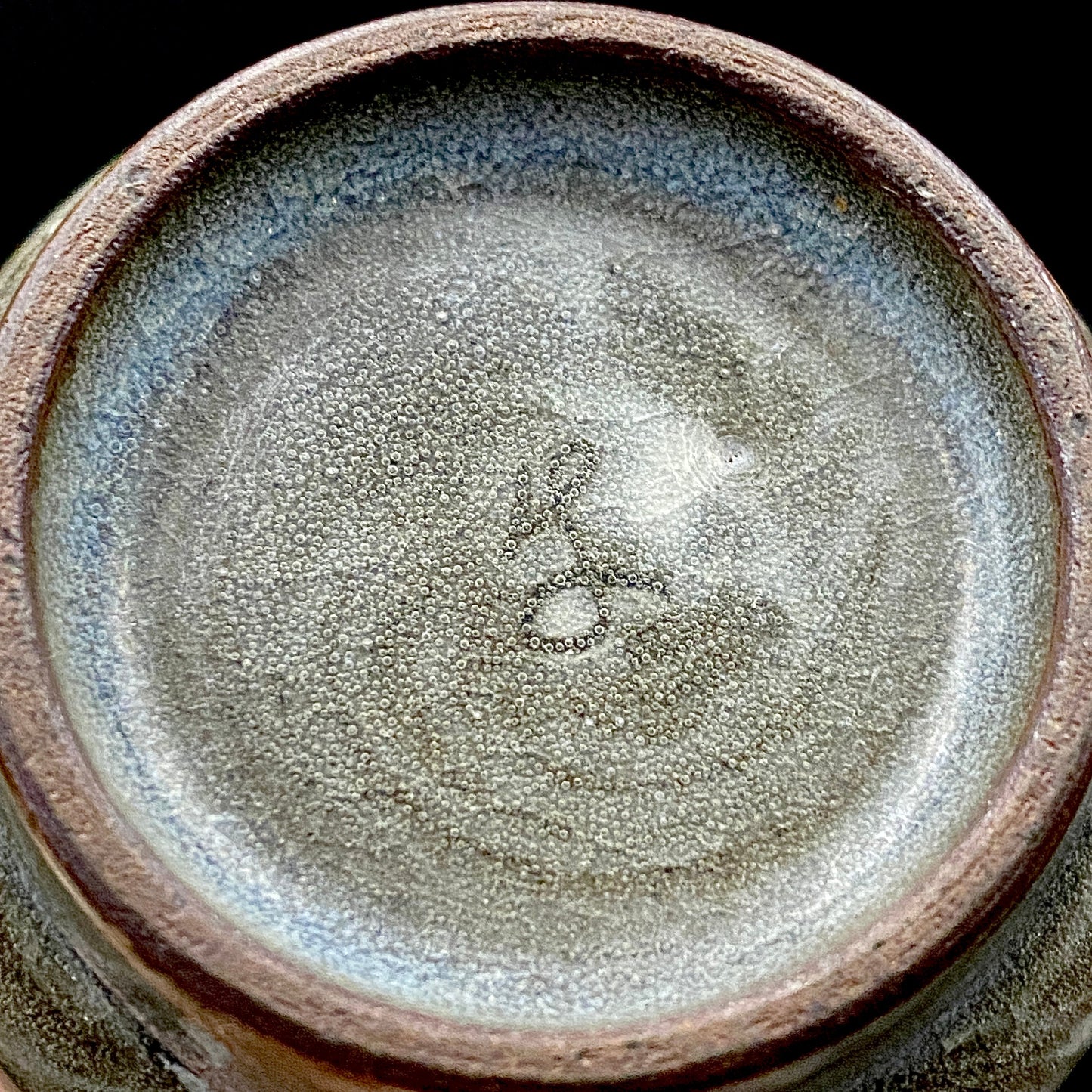


The 13th generation Yokoishi Gagyu's work, a revival of Genkawa ware and the ultimate brushstrokes that capture the "wind" of the pottery. Ceramic sake cup #177
The 13th generation Yokoishi Gagyu's work, a revival of Genkawa ware and the ultimate brushstrokes that capture the "wind" of the pottery. Ceramic sake cup #177
The legendary Utsutsugawa ware, produced in Nagasaki during the mid-Edo period for only about 50 years, suddenly vanished. The solitary potter who revived this "phantom pottery" and elevated it to the realm of art was Yokoishi Gagyu XIII (1927-2016). This work is a masterpiece that vividly reflects the aesthetics of Yokoishi Gagyu's heyday, when he reigned as the leading figure in Utsutsugawa ware in both name and reality, and was designated a Nagasaki Prefecture Intangible Cultural Property holder in 1975.
When discussing Jusandai's work, it is essential to mention his delicate shaping ability, surpassing even porcelain, by molding iron-rich red clay to the thinnest possible thickness. Despite being ceramic, the thinness of the clay produces a clear, metallic sound when struck with the fingers, and this is the reason why Genkawa ware was once praised as "exquisite in the East, Genkawa in the West." Applied to this unique surface are the elegant "hakeme" (brush marks) that have become synonymous with Jusandai. Created by running a brush laden with white engobe clay over the base without a moment's hesitation, the patterns sometimes resemble raging waves and sometimes gently flowing clouds, visualizing the invisible flow of "wind" within the vessel.
The design of the Japanese pampas grass depicted in this work is one of Jusandai's specialties, a motif that continues to fascinate enthusiasts around the world. The ears of Japanese pampas grass, blown by the wind and swaying in one direction like ocean waves, are not simply a realistic botanical illustration. They are a "record of dynamic movement" created through extreme concentration, with no redo possible, by "raking" the grass with a sharp bamboo spatula or similar tool in the mere seconds before the decorative clay dries completely. The scene woven by the brushstrokes and Japanese pampas grass in the background evokes the autumn wilderness, a quintessential Japanese landscape, while also possessing a meticulously calculated, abstract beauty.
For whiskey lovers, this piece is sure to be the perfect conversational partner. The deep reddish-brown base, unique to Genkawa ware, brings out the amber color of aged single malt in a truly vibrant way, while the extremely thin rim guides the liquid's delicate aroma directly into the mouth. With the artist's passing in 2016, the supply of his personal creations, which embodied his keen sensibility and superb craftsmanship, has completely ceased. With a glorious history that includes numerous presentations to Emperor Showa and His Majesty the Emperor Emeritus, this vessel embodies the "beauty of obsession" that one artist dedicated his life to reviving, it is more than just a sake vessel; it will become a special piece that reflects the pride of its owner.
- Artist: Yokoishi Gagyu 13th (1927-2016)
- The artist's notable achievements include: reviving the extinct "Genkawa-yaki" style. [1975] Certified as a holder of Nagasaki Prefecture's designated intangible cultural property "Genkawa-yaki" (sole certification); [1982] Received the Japan Crafts Association Encouragement Award at the 29th Japan Traditional Crafts Exhibition; [1993] Received the Order of the Sacred Treasure, Fifth Class. He presented his wares to Emperor Showa and the former Emperor (then Crown Prince) on numerous occasions, solidifying the status of Genkawa-yaki.
- Collections: Nagasaki Prefectural Art Museum, Sasebo City Museum Shimase Art Center, etc.
- Production period: 1980s to 1990s (late Showa period to early Heisei period) *This design (dynamic brushstrokes of pampas grass blown by the wind) is a typical feature of his "golden period" from around the time he received an award at the Crafts Exhibition in 1982 to the time he received an award in 1993, when his technique and artistry were at their most mature and he was highly acclaimed both at home and abroad.
- Condition: Very good (no chips or cracks)
- Accessories: None
- Material: Ceramic (Genkawa-yaki, brushed bamboo-patterned)
- Dimensions: Diameter approx. 5.5 cm, height approx. 7.5 cm
- Please note: Even if the products we offer are brand new and unused, they are very old and are listed as second-hand items. Please note that the products may have damage due to aging, so please understand and check before purchasing.
Couldn't load pickup availability
Low stock: 1 left
View full details