Thirteenth Generation Yokoishi Gagyu (十三代横石臥牛, 1925–2016; Birth name: Hiromi Yokoishi) was the holder of the Nagasaki Prefectural Designated Intangible Cultural Property for Utsutsugawa-yaki. Gagyu XIII was the great restorer who revived Utsutsugawa-yaki—a legendary pottery that flourished for only about 50 years during the mid-Edo period before disappearing. Although Utsutsugawa-yaki was once praised as the "Treasure of the West," its techniques were lost for approximately 200 years. The Yokoishi family conducted exhaustive research over several generations, and it was the 13th generation who elevated its artistry to its absolute pinnacle. For the artist's outstanding achievements, Gagyu XIII was awarded the Medal with Purple Ribbon and the Order of the Rising Sun, Gold Rays with Rosette. Gagyu XIII's works are housed in the Kyushu Ceramic Museum and the Nagasaki Prefectural Art Museum, and have been frequently selected as gifts for imperial and royal families both in Japan and abroad.
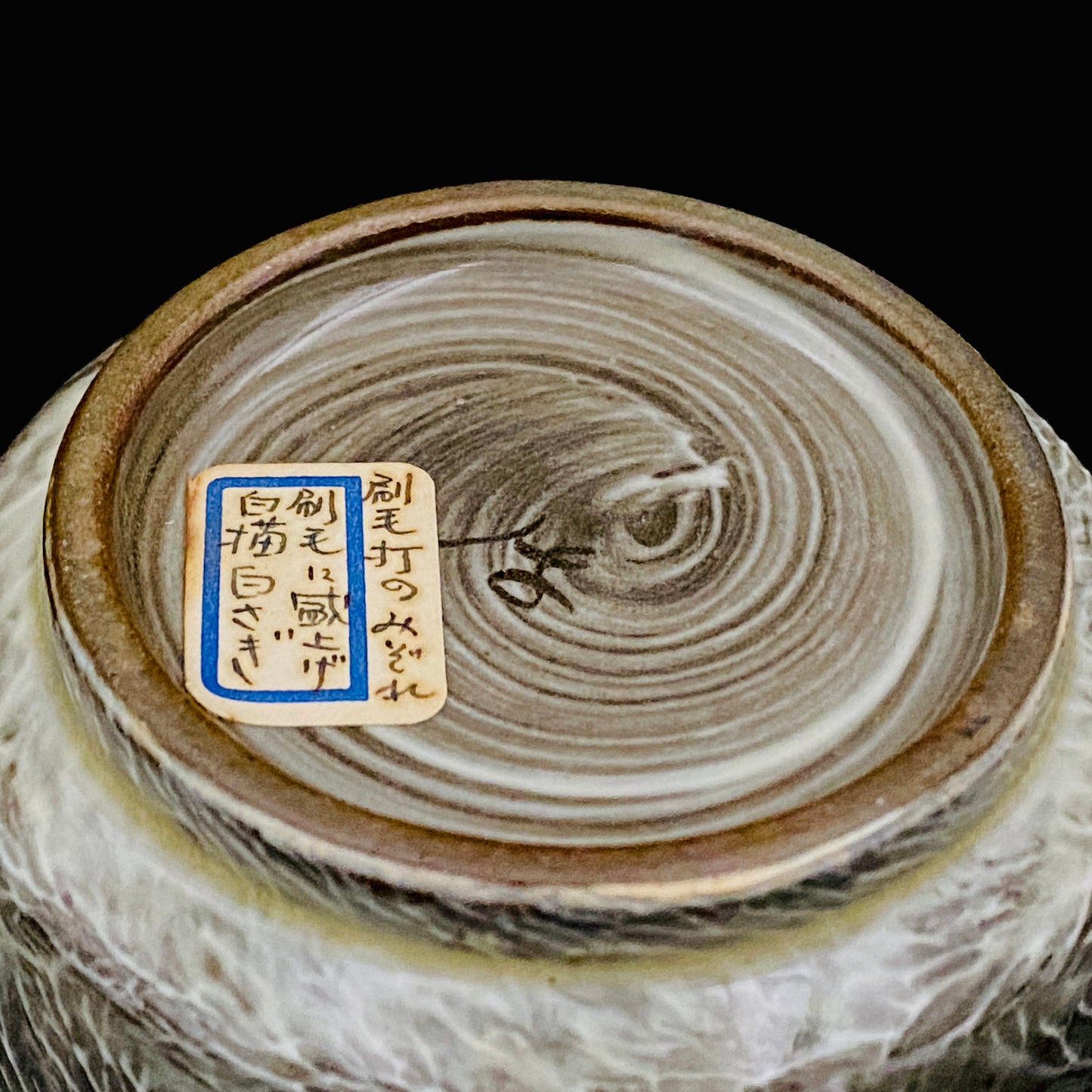
The White Heron motif (Shirasagi-mon) depicted in this work is the most significant design and is considered synonymous with the 13th generation Gagyu. The most defining characteristic of Utsutsugawa-yaki is the "Hakeme" (brush mark) technique, where dark brown earthenware clay rich in iron is fired as thinly as porcelain, and then white slip is applied with a brush. The artist was particularly renowned for the delicate "Mizore-hakeme" (sleet brush marks), which evokes the image of sleet falling from the sky. Gagyu XIII was able to depict the graceful form of a white heron solely through the dynamic force of the brushwork. Because iron-rich clay and slip have different shrinkage rates, fixing such precise patterns on a thinly-made vessel while preventing peeling or cracking requires an exceptionally high level of mastery.
We propose this historic "Tsutsuhai" (cylindrical cup) as a special vessel for enjoying old whisky or vintage sake. The deep, iron-colored tone of the base and the contrast of the dynamic white heron are further accentuated when amber liquid is poured in. The thinness of the rim conveys the delicate flavors of the spirit directly to the palate, and the sight of the white heron shimmering through the liquid offers a luxurious experience of savoring traditional Japanese beauty in the palm of your hand. Crafted by the master who passed away in 2016, this is a rare piece representing the golden age of the revived Utsutsugawa-yaki.
Representative Career: 1975 Certified as a holder of Nagasaki Prefectural Designated Intangible Cultural Property, 1982 Awarded the Japan Ceramic Society Award, 1987 Awarded the Medal with Purple Ribbon, 1995 Awarded the Order of the Rising Sun, Gold Rays with Rosette.
Museum Collections: Kyushu Ceramic Museum, Nagasaki Prefectural Art Museum, etc.
Period of Creation: 1990s–2000s (The peak mature period of the artist)
Condition: Very good (No chips, no cracks)
Accessories: None
Material: Pottery (Utsutsugawa-yaki / Hakeme)
Dimensions: Height approx. 7 cm, Mouth diameter approx. 5 cm
Note: Please note that all products, even those in unused condition, are from vintage production periods and are listed as used. Items may show minor age-related wear; please confirm the condition before purchasing.
Please check the photos: We prepare every description with great care, but errors may still remain in the text. Please examine the photos carefully before purchasing. Where the photos and the description differ, please take the photos as the basis for the product information.
Couldn't load pickup availability
Shipping
This item can be shipped overseas (a flat international shipping fee applies; see our Shipping Policy).
If you are visiting Japan, we can also deliver to your hotel or other accommodation in Japan.
In that case, after placing your order and at least 5 days before your preferred delivery date, please send us the reservation holder's details, your check-in date, and whether you have confirmed that the hotel will accept the parcel, by email (support@antiqueliquor1926.com) or via our contact form.