This piece is a cylindrical Shino yunomi cup with iron-painted decoration by Ando Hidetake, a ceramic artist who is a Holder of Gifu Prefecture Important Intangible Cultural Property for "Kiseto." Although originally crafted as a Shino yunomi, our shop proposes it as a Japanese-style rocks glass (cylindrical sake vessel) for enjoying vintage spirits on the rocks.
Ando Hidetake was born in 1938 (Showa 13) in Tajimi City, Gifu Prefecture. He is the third-generation head of Sentaro Kiln, founded in Ichinokura by Sentaro I in the early Meiji period, and is also introduced under the name "Sensan Kiln" in his biographical records. According to the artist profile of Sentaro Kiln, up until his father's generation, it was a kiln firing small porcelain sake cups and small dishes. Around the age of 22, Kato Tokuro visited his father and told him, "If you are going to make ceramics, you must make ceramics born in Mino." This served as a turning point, leading Ando to immerse himself in the study of Momoyama-period Shino, Kiseto, and Oribe wares.
Ando had no specific master. Walking through the mountains of Mino to excavate kiln sites, he taught himself how to use clay, design, and firing techniques directly from ceramic shards. Furthermore, believing that gas kilns had limitations in recreating Momoyama ceramics, he built a semi-aboveground anagama (cave kiln) utilizing the natural contours of the terrain in the wilderness of Kukuri-Kakishita, Kani City, near the Taihei ancient kiln site. According to records of the Museum of Modern Ceramic Art, Gifu, the firing lasts for six days and nights, burning 1,500 bundles of firewood. Committed to creating both clay and glazes from natural materials by himself, his unique style "Ko-Mino," forged through the clay of Tono and this anagama, is highly praised by the museum as reaching a "realm of ancient purity."
Regarding his major career accomplishments, he was selected for the first time for the 1st Asahi Ceramic Art Exhibition in 1963, the 11th Japan Traditional Art Crafts Exhibition in 1964, and the 1st Japan Ceramic Art Exhibition in 1971, continuing to be selected for each repeatedly thereafter. In 1970, he won the Governor's Award at the 8th Asahi Ceramic Art Exhibition and exhibited a large Shino platter at the Living and Industry Pavilion of the Japan World Exposition (Expo '70). He received an Encouragement Award at the 11th Asahi Ceramic Art Exhibition in 1973, became a regular member of the Japan Kogei Association in 1974, and received the 8th Kobei Prize in 1990.
In 1993, "Ko-Mino Large Jar" was designated as a Mino Ceramic Art Permanent Preservation Work. In 1998, he won the Grand Prix for "Ko-Mino Tea Bowl" at the Mino Ceramic Art Shoroku Award Tea Bowl Exhibition, and in the same year was designated a Holder of Tajimi City Intangible Cultural Property. In 2003, he was designated a Holder of Gifu Prefecture Important Intangible Cultural Property for "Kiseto," and received the Gifu Prefecture Cultural Merit Award in 2013 and the Order of the Rising Sun, Silver Rays in 2016.
In Gifu Prefecture's official commentary, Ando's Kiseto is described as a unique style possessing a depth and dignity distinct from conventional Kiseto. From 2025 to 2026, the exhibition "Lineage of Mino Ceramic Art: Ando Hidetake Exhibition" was held at the Museum of Modern Ceramic Art, Gifu. As an artist who has continued to craft Momoyama-period Kiseto and Shino using clay and firing methods identical to those of the era, his representative works and recent creations were presented in this exhibition.
Shino is a representative ceramic of Mino during the Momoyama period, fired with a thick application of white glaze composed primarily of feldspar. Works drawn with patterns in iron wash under the white glaze are called "E-Shino" (picture Shino / iron-painted Shino).
On the surface of this piece, minute air bubble marks characteristic of Shino, known as yuzuhada (citrus-skin texture), can be seen. The texture of the thickly applied feldspar glaze conveys dignity alongside warmth. In particular, the orange hi-iro (fire-color) that appears at the rim of the piece and around the iron painting gives warm variation to the white glaze surface as an unforced, natural landscape.
The iron-painted decoration under the white glaze is rendered with rustic and powerful brushwork, evoking the charm of Ko-Shino (ancient Shino) from the Momoyama period. Its moderate thickness and cylindrical shape that rests comfortably in the hand make it an easily usable form for a rocks glass. The deep amber color of vintage spirits reflects beautifully against the white Shino glaze, allowing one to enjoy the time spent savoring Western vintage spirits in a traditional Japanese vessel alongside the sound of ice touching the vessel.
There is no documentation specifying the exact year of production. It can only be confirmed that it was made from the 1960s onward, when the artist began his research into Momoyama ceramics. The body of the piece is free of chips and cracks and remains in very good condition. Dedicated tomobako (original wooden box) and shiori (leaflet) are included.
- Artist: Ando Hidetake (安藤日出武, Andō Hidetake, 1938–)
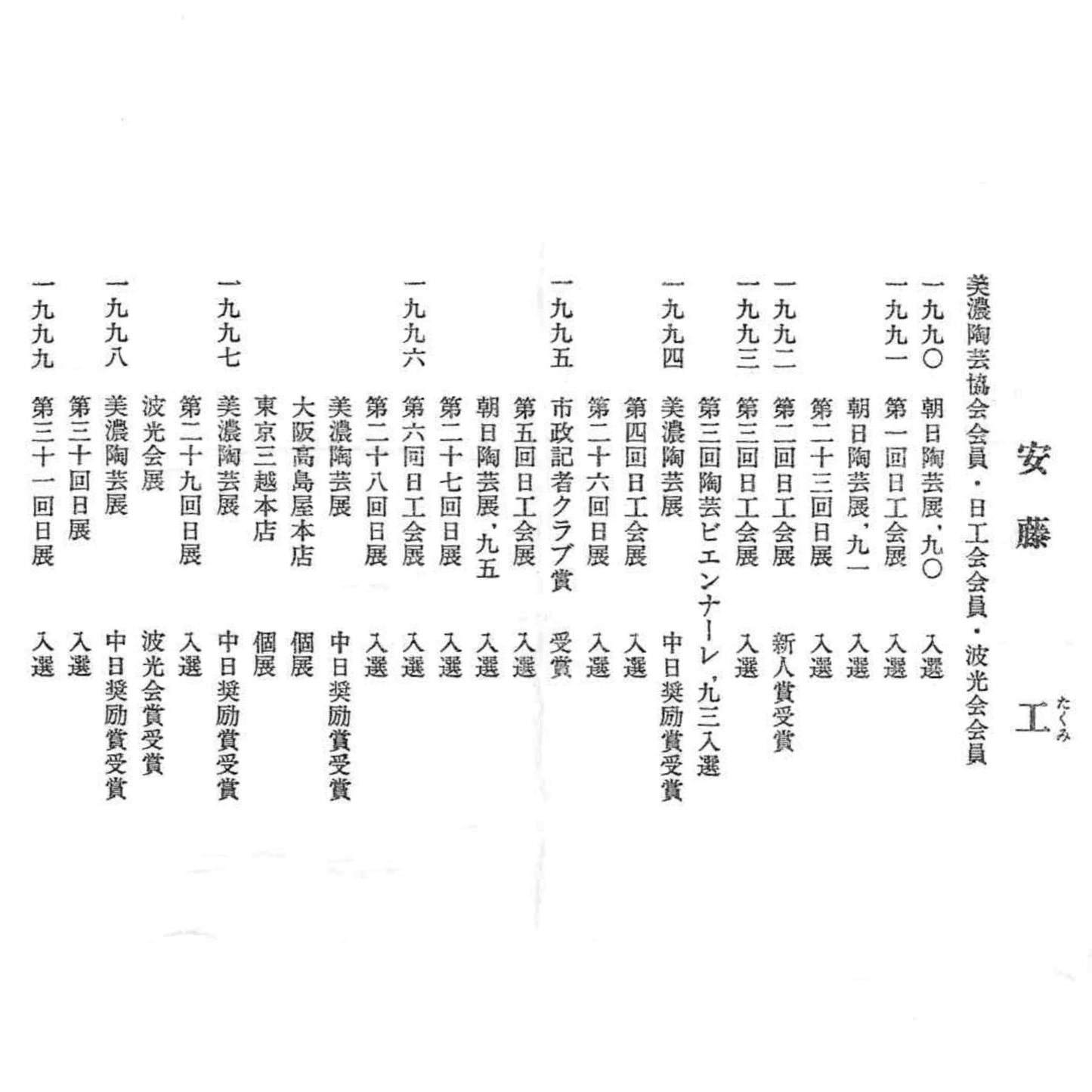
- Major Career Highlights: [1963] First selected for the 1st Asahi Ceramic Art Exhibition; [1964] First selected for the 11th Japan Traditional Art Crafts Exhibition; [1970] Governor's Award at 8th Asahi Ceramic Art Exhibition; exhibited large Shino platter at Living and Industry Pavilion, Expo '70; [1971] First selected for the 1st Japan Ceramic Art Exhibition; [1973] Encouragement Award at 11th Asahi Ceramic Art Exhibition; [1974] Regular member of the Japan Kogei Association; [1975] First selected for the 1st Chunichi International Ceramic Art Exhibition; [1990] 8th Kobei Prize; [1992] Tajimi City Cultural Arts Merit Award; [1993] "Ko-Mino Large Jar" designated as Mino Ceramic Art Permanent Preservation Work; [1998] Grand Prix for "Ko-Mino Tea Bowl" at Mino Ceramic Art Shoroku Award Tea Bowl Exhibition; designated Holder of Tajimi City Intangible Cultural Property; [2002] Gifu Shimbun Grand Prize Culture Award; [2003] Designated Holder of Gifu Prefecture Important Intangible Cultural Property for "Kiseto"; [2011] Gifu Prefecture Educational and Cultural Merit Award; [2013] Gifu Prefecture Cultural Merit Award; [2016] Order of the Rising Sun, Silver Rays; Tokai Television Culture Award; [2017] Published "Mikannomamani" (Chubu Keizai Shimbun); [2025] "Lineage of Mino Ceramic Art: Ando Hidetake Exhibition" at Museum of Modern Ceramic Art, Gifu (through 2026)
- Museum Collections: Museum of Modern Ceramic Art, Gifu ("Kiseto Tea Bowl," "Kiseto Large Jar")
- Period of Production: From the 1960s onward (no date specified)
- Item Condition: Very good (no chips, no cracks)
- Accessories: Dedicated tomobako (original wooden box), shiori (leaflet) included
- Material: Pottery / Stoneware (Mino ware, Shino, iron-painted)
- Dimensions: Height approx. 9.0 cm, Mouth diameter approx. 7.0 cm
- Note: All items offered by our shop, even if new and unused, were produced a very long time ago, and all are therefore listed as pre-owned. Items may show age-related wear or damage. Please understand and confirm this before considering a purchase.