We are pleased to present a pitcher (water jug) by Takeda Toshio (b. 1932), a ceramic artist born in 1932 (Showa 7) in Takaoka, Toyama Prefecture. After studying ceramics at Kanazawa College of Art, Takeda honed his craft in Kyoto and Kanazawa, and also studied under Tamura Koichi, who would later be designated a Living National Treasure. Since 1964 he has continued to make ceramics at the kiln he built in Mashiko, Tochigi Prefecture. His work has been accepted many times into the Nitten (Japan Fine Arts Exhibition), the Japan Ceramic Art Exhibition and the Japan Traditional Kogei Exhibition. His entry to the Japan Ceramic Art Exhibition was selected for a touring exhibition in Canada and the United States and then entered the collection of The National Museum of Modern Art, Kyoto. He is a full member of the Japan Kogei Association and has also served on the selection and judging committee of the Japan Kogei Association New Works Exhibition. This piece has the robust, warm presence of a pottery vessel. We propose it as a water jug for pouring a chaser alongside koshu (aged sake) or water for adding to drinks, and also as a serving vessel that graces the table at any gathering over drinks.
According to Takeda’s record of his ceramic career, he graduated from Kanazawa College of Art in 1955 (Showa 30) and continued his research in the college’s research course. In 1956 (Showa 31) he moved to Kyoto, where he studied under Yonezawa Soho, and his work was accepted into the Nitten. In 1957 (Showa 32) he returned to Kanazawa and worked at his alma mater as assistant to the Kutani ware artist Kitade Tojiro, then a professor at Kanazawa College of Art. In 1960 (Showa 35) he sought out Tamura Koichi in Sano, Tochigi Prefecture, and became his pupil. Through Tamura’s introduction he joined the Tsukamoto Pottery in Mashiko, where he devoted himself to ceramic research. In 1963 (Showa 38) he entered the Nagoya Industrial Research Institute to master glaze and firing techniques, studying under Kato Etsuzo and Morita Shiro. The following year, 1964 (Showa 39), he built his own kiln in Mashiko and became independent. In 1966 (Showa 41) he formed the Shodokai with like-minded colleagues living in Mashiko. In 1969 (Showa 44) his work was accepted into the Japan Traditional Kogei Exhibition. In 1971 (Showa 46) his work was accepted into the Japan Ceramic Art Exhibition, organized by The Mainichi Newspapers. This entry was selected for a touring exhibition in Canada and the United States and was later purchased by The National Museum of Modern Art, Kyoto. In 1974 (Showa 49) he became a full member of the Japan Kogei Association, and between 1983 and 1986 he served on the selection and judging committee of the Japan Kogei Association New Works Exhibition. From 1973 (Showa 48) to 1990 (Heisei 2) he held solo exhibitions at Nihombashi Takashimaya in Tokyo, ten in all, and he also held a series of solo exhibitions at Yokohama Takashimaya. Furthermore, in 1990 his “Bowl with Grape Design in Iron and Copper Decoration” was accepted into the 37th Japan Traditional Kogei Exhibition.
The work that can be confirmed as a representative piece attesting to Takeda’s standing is this “Bowl with Grape Design in Iron and Copper Decoration.” Tetsu-dosai (iron and copper decoration) is a mode of expression that combines the colors developed by two metals, iron and copper, to adorn the surface of a vessel. Takeda’s teacher, Tamura Koichi, was recognized for, among other things, using copper coloring alongside iron painting (tetsu-e) to vary his palette. In 1986 Tamura was designated a Holder of Important Intangible Cultural Property (Living National Treasure). Takeda’s tetsu-dosai belongs to this lineage. This piece takes the grape as its subject, with green coloring layered over an iron-painted design to compose the pictorial field. In both subject and composition, it displays a style in common with his representative work accepted into the Japan Traditional Kogei Exhibition.
In the grape design that takes center stage in this work, the vines and fruit are drawn in free-flowing, powerful iron-painted brushwork. The green leaves layered over them create a vivid contrast against the white ground. Because the grapevine bears its fruit in abundant clusters, the grape has long been cherished as an auspicious motif symbolizing bountiful harvests and the flourishing of future generations. The lower body, the handle and the inner rim are glazed separately with an iron glaze that fires to tones ranging from deep chocolate brown to black. This clear contrast with the painted areas on the white ground lends the whole work a sense of visual stability. The handle and spout are joined to a wheel-thrown body, making the piece substantial yet comfortable to hold, and it is also practical to use as a pouring vessel.
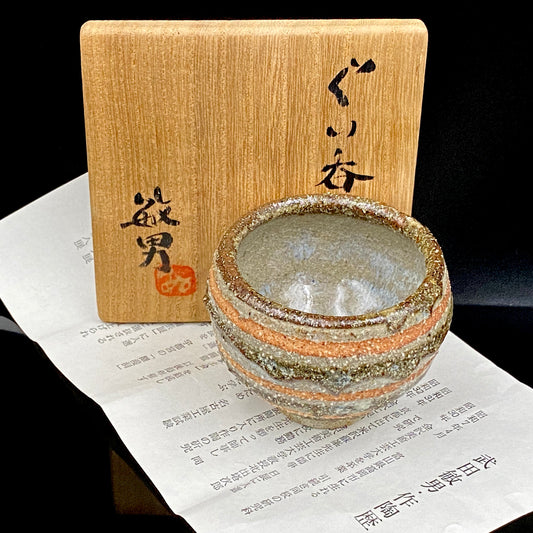
Unlike mass-produced ware, this is a one-of-a-kind piece that has passed through the artist’s own hands. Very little information on Takeda Toshio’s work circulates outside Japan, and opportunities to encounter examples such as pitchers are especially limited. The piece comes with its tomobako (the original box inscribed by the artist) and a shiori, a leaflet recording the artist’s ceramic career.
- Artist: Takeda Toshio (武田 敏男、b. 1932)
- Selected Career Highlights: [1955] Graduated from Kanazawa College of Art, pursued research in the college’s research course; [1956] Studied under Yonezawa Soho in Kyoto, accepted into the Nitten; [1957] Worked at his alma mater as assistant to Kitade Tojiro; [1960] Studied under Tamura Koichi in Sano, Tochigi Prefecture, conducted ceramic research at the Tsukamoto Pottery in Mashiko; [1963] Researched glazes and firing at the Nagoya Industrial Research Institute; [1964] Built his own kiln in Mashiko, Tochigi Prefecture, and became independent; [1966] Formed the Shodokai; [1969] Accepted into the Japan Traditional Kogei Exhibition; [1971] Accepted into the Japan Ceramic Art Exhibition, entry selected for the touring exhibition in Canada and the United States and added to the collection of The National Museum of Modern Art, Kyoto; [1973] First solo exhibition at Nihombashi Takashimaya (continuing through the tenth in 1990); [1974] Became a full member of the Japan Kogei Association; [1983] Served on the selection and judging committee of the Japan Kogei Association New Works Exhibition (also in 1984 and 1986); [1990] Accepted into the 37th Japan Traditional Kogei Exhibition (Bowl with Grape Design in Iron and Copper Decoration)
- Public Collections: The National Museum of Modern Art, Kyoto
- Date: 1990s (estimated; the career history in the leaflet runs to the 37th Japan Traditional Art Crafts Exhibition in 1990)
- Condition: Excellent (no chips, no cracks)
- Included: Tomobako (box inscribed by the artist), shiori (leaflet recording the artist’s ceramic career)
- Medium: Pottery
- Dimensions: Height approx. 20 cm, width approx. 22 cm
- Please Note: All items we offer, even those that are new and unused, were produced a very long time ago and are therefore listed as pre-owned. Items may have age-related damage; please understand and check this before considering a purchase.