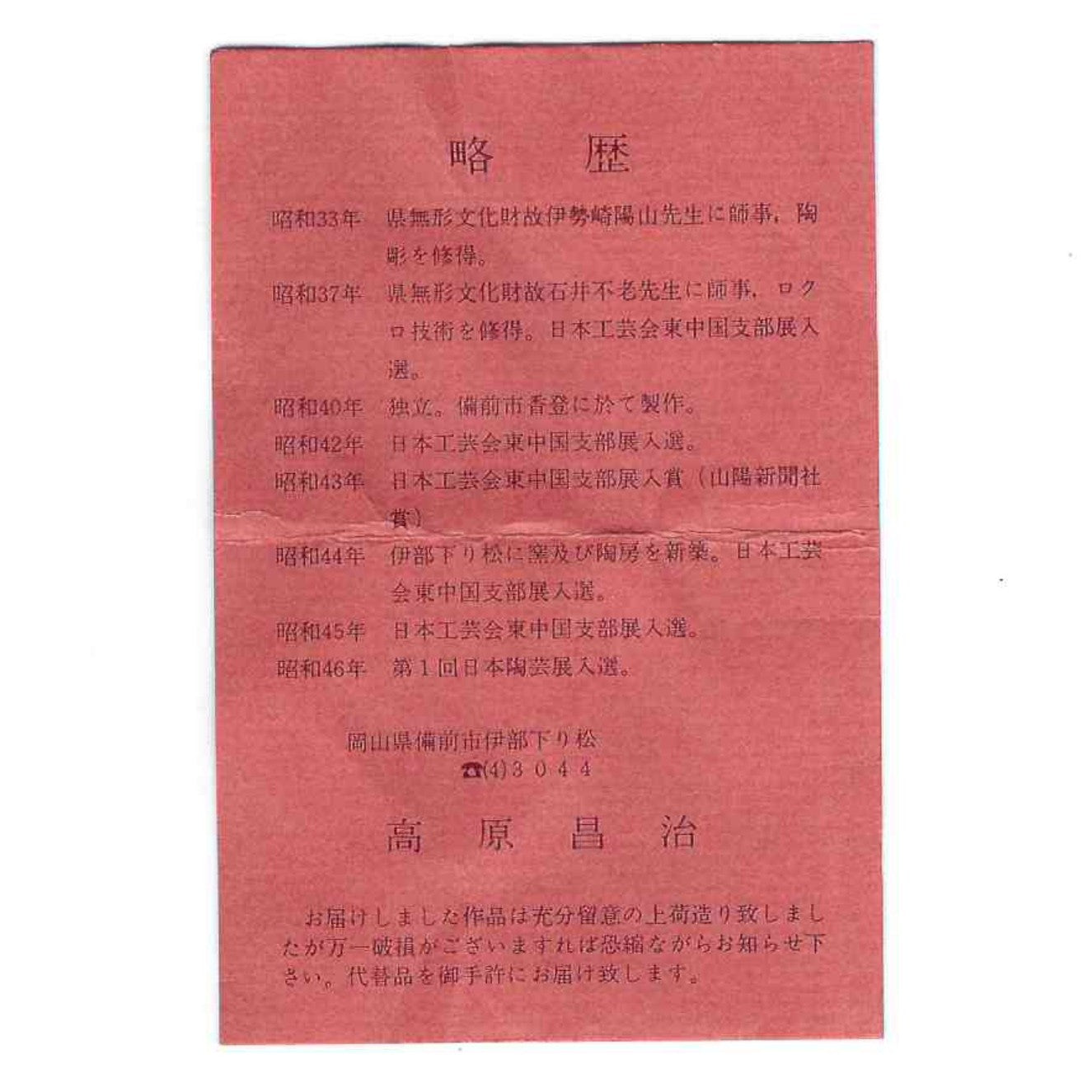
We are pleased to introduce a very rare sake cup (guinomi) by Shoji Takahara (1941-2000), a master Bizen ware artisan born in Okayama Prefecture in 1941. He boasts a brilliant record, including receiving the "Sanyo Shimbun Award" for two consecutive years in 1967 and 1968 at the Japan Crafts Association's Eastern Chugoku Branch Exhibition, and being selected for the "1st Japan Ceramic Art Exhibition," the pinnacle of contemporary ceramic art, in 1971. In 1987, his work was publicly acquired and permanently stored by the Museum Angewandte Kunst (Frankfurt, West Germany at the time). As a deceased artist who passed away at the young age of 59, the supply of new works to the market has completely ceased, making his creations increasingly rare in the art market. We propose this supreme Japanese craftwork, with its undeniable history and prestige, to the world as a vintage premium sake vessel for savoring aged amber sake or premium Japanese whisky neat.
The fundamental artistic value of Shoji Takahara lies in his exceptionally privileged and legitimate lineage, having directly inherited techniques from two top-tier Bizen ware masters of different styles. In 1958, he apprenticed under Yozan Isezaki (1902-1961), a holder of Okayama Prefecture's Important Intangible Cultural Property, and deeply absorbed the sculptural sense of intricate ceramic carving and three-dimensional craftsmanship. Then, in 1962, he apprenticed under Furo Ishii (1899-1964), also a holder of Okayama Prefecture's Important Intangible Cultural Property, thoroughly mastering Furo's signature excellent throwing (rokuro) technique. The reason Takahara's works are most highly praised by experts is precisely this exquisite balance achieved by integrating Yozan's three-dimensional spatial understanding in his detailed works with Furo's precise and confident lines on the potter's wheel.
A professional and detailed analysis of the piece confirms that the transcendent technique inherited from two great masters and the drama of the climbing kiln (noborigama) firing are clearly manifested across the entire surface of the vessel. In terms of form, the vessel retains the beautiful yet powerful wheel-throwing marks directly passed down from Furo Ishii around its waist, conveying the moist, clinging texture of meticulously selected rice-paddy clay (tado) when held in the palm of your hand. Without the use of any glaze, the external appearance (keshiki) is expressed with extraordinary density through the sharp contrast of authentic, traditional Bizen firing effects—such as yohen (natural kiln transformation), sangiri (ash-covered firing mark), and hidasuki (fire-cord pattern)—created solely by the fierce flames and convective wood-ash currents generated by splitting red pine firewood.
Particularly noteworthy is the design on the inside of the sake cup. Near the bottom interior, several small, dark, glossy spots can be observed. These are not stains or defects from artificial glaze, but rather genuine natural scenery called "natural glaze fusion marks" (technically referred to as black sesame spots or early fusion marks of "Bidoro" glass). These occur when the ash of red pine, the fuel, completely vitrifies and melts as a liquid onto the clay surface in pinpoint locations within the Bizen climbing kiln at extreme temperatures exceeding 1200 degrees Celsius. In Bizen ware, an aesthetic of subtraction that uses no glaze whatsoever, these glossy spots are the very "memory of fire," vividly conveying the intense convection of flames, the placement of the work within the kiln, and the moment of extreme heat management. They are an important highlight that further enhances the work's appreciation value and prestige.
On the bottom of the vessel, Takahara's unique potter's mark, a deformed character "Sho" (昌) deeply carved with a spatula to prove his authorship, is clearly visible. Furthermore, the complete set includes a tomobako (wooden box) with the artist's own fluid brush calligraphy "Bizen Sake Cup Shoji" and an official red seal, along with a bookmark detailing his ceramic history at the time. This pristine condition serves as decisive evidence guaranteeing its authenticity and artistic value. Please fully enjoy this unique crystallization of Japanese traditional craftsmanship, which embodies the spirit of a master artisan in his most energetic period, marked by two consecutive major awards, as a privileged everyday companion for savoring exquisite sake.
- Artist: Shoji Takahara (1941-2000)
- Artist's Major Activities: [1958] Apprenticed under Yozan Isezaki, holder of Okayama Prefecture's Important Intangible Cultural Property; [1962] Apprenticed under Furo Ishii, holder of Okayama Prefecture's Important Intangible Cultural Property, selected for the Japan Crafts Association's Eastern Chugoku Branch Exhibition; [1965] Established his own climbing kiln and became independent; [1967 & 1968] Received the Sanyo Shimbun Award for two consecutive years at the Japan Crafts Association's Eastern Chugoku Branch Exhibition; [1971] Selected for the 1st Japan Ceramic Art Exhibition; [1981] Traveled to the United States for ceramic research; [1987] Work publicly acquired by the Museum Angewandte Kunst (Frankfurt, West Germany at the time).
- Works Held By: Museum Angewandte Kunst (Germany), among others.
- Production Period: Early 1970s (estimated peak period immediately after selection for the 1st Japan Ceramic Art Exhibition)
- Condition: Very good (no chips, no cracks, natural glaze fusion marks from the climbing kiln visible on the interior, slight opening of the clay boundary on the surface as a characteristic of the work)
- Accessories: Tomobako (wooden box with artist's handwritten signature and seal), wrapping cloth, bookmark
- Material: Pottery (Bizen ware - Kiln change, Sangiri, Hidasuki, Natural glaze fusion marks)
- Dimensions: Height approx. 6.3 cm, Mouth diameter approx. 6.0 cm
- Note: All products offered by our store, even if unused, are from a very old production period and are listed as pre-owned. Please be aware that products may have damage due to age, and consider this before making a purchase.