This work is a nerikomi chawan by the first generation Sokaku Mizuno (1912-1996), a holder of Seto City Designated Intangible Cultural Property and a master who elevated the traditional technique, which was on the verge of extinction in Seto, into contemporary art. With a height of approximately 10.5 cm and a mouth diameter of approximately 10.7 cm, its unique proportions, which are slightly deeper than a typical chawan, lead us to propose it as a premium Japanese craft Ceramic Whiskey Tumbler for slowly enjoying aged sake that has transformed into a rich amber color over time, or carefully selected whiskey with large ice cubes. The overwhelming presence and dignity as an artwork, combined with the attempt to integrate a vessel deeply rooted in Japanese tea ceremony culture, the chawan, into modern luxurious alcoholic enjoyment, will provide a lavish experience for international collectors and special guests seeking the ultimate in Japanese hospitality.
The artist, Sokaku Mizuno I, was born in 1912 in Seto City, Aichi Prefecture, a pottery town. He studied under Tatsukichi Fujii, a pioneer of modern crafts, and was educated in free artistic expression untethered by tradition. Throughout his ceramic career, he achieved remarkable success on major domestic stages, including 27 selections for the Nitten Exhibition, three top awards at the Seto Ceramics Exhibition followed by designation as a non-juried artist, two Governor's Awards at the Asahi Ceramics Exhibition, the Toto Award at the National Ceramics Exhibition, the Tokai TV Award and a meritorious service award at the Japan New Crafts Exhibition, and numerous other awards including the Kansai Art Exhibition. He also held important positions such as councilor of the Japan New Craft Artists Federation, contributing to the development of younger artists and the craft industry. In 1987, his long-standing efforts in independently researching and refining the traditional nerikomi technique were officially recognized, and he was certified as a holder of the Seto City Designated Craft Technique, Ceramic Nerikomi Technique. He passed away on January 18, 1996, at the age of 84, leaving behind a legacy of exceptional skill as the great founder of the prestigious Nerikomi Mizuno family, whose traditions are still carried on by his son Norio Mizuno, who is also a holder of intangible cultural property, and his grandson Tomoji Mizuno, who enjoys global popularity with his unique sensibility. All works currently on the market are precious posthumous pieces with no new supply, making them extremely rare as top-class Japanese art, with very little information available overseas.
The most highly regarded technique in Sokaku Mizuno's pottery is nerikomi, which involves meticulously layering multiple clays with different components and firing characteristics, resulting in beautiful continuous patterns that appear no matter where the piece is cut, much like Kintaro-ame candy. Since each of the different clays has varying drying speeds and shrinkage rates during firing, even a slight miscalculation can cause cracks or firing tears in the kiln, making it an extremely difficult technique that requires extreme blending precision and strict temperature control. A detailed examination of this piece reveals that these advanced techniques and the artist's raw sensibility are expressed with overwhelming power across the entire surface of the vessel. On the surface of the vessel, orderly striped patterns woven from different colored clays and organic flow patterns reminiscent of flowing geological strata are dynamically expressed, achieving both the cold beauty of calculation and the warmth of handwork. As a unique characteristic of the nerikomi technique, the same pattern appears completely through the outside and inside at exactly the same position. Therefore, when sake is poured and ice floats, the geometric layers spreading inside the vessel shimmer beautifully, creating a visually stunning and refined experience.
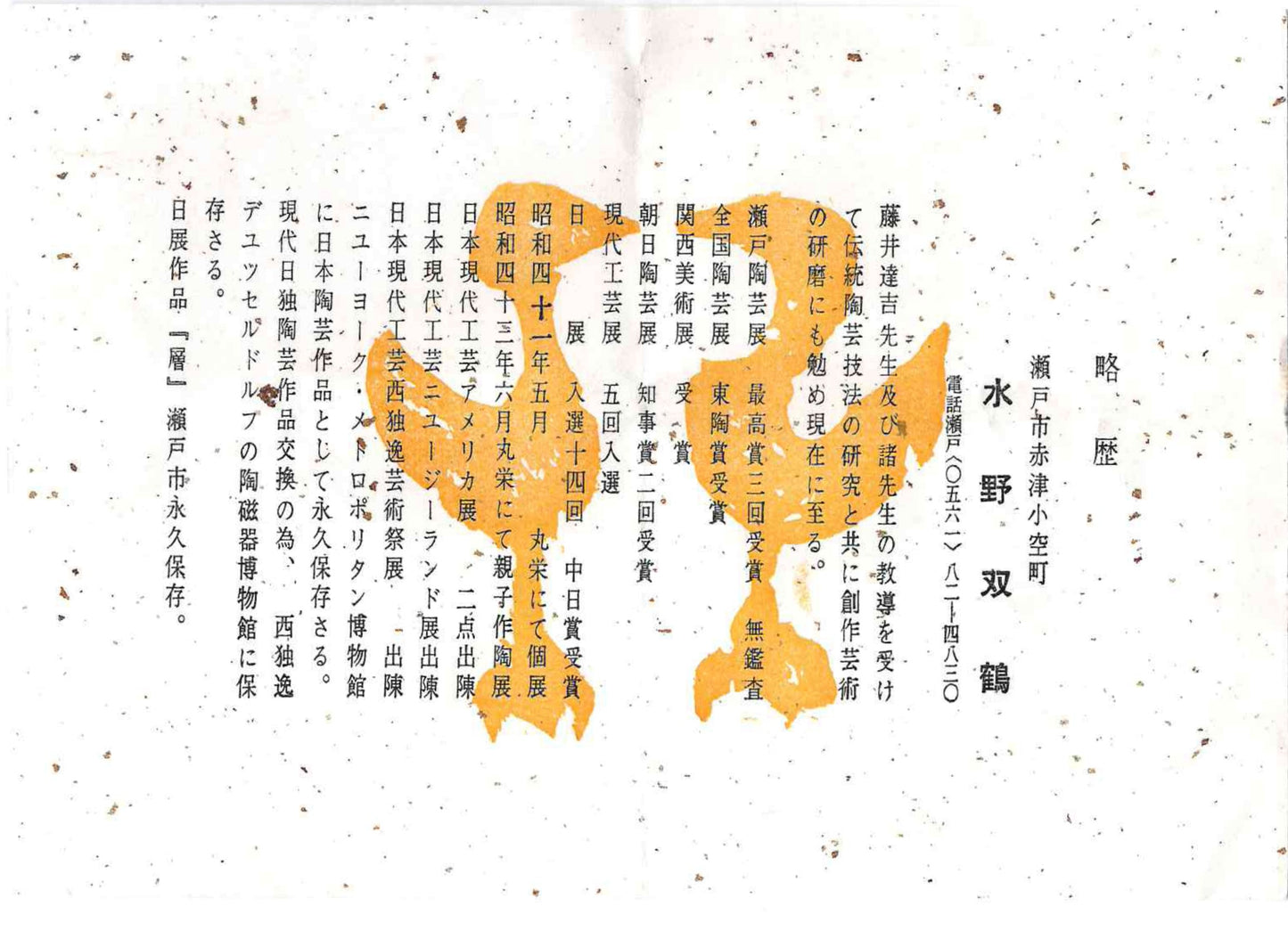
Based on the artist's ceramic activity and physical evidence from his lifetime, the production period of this work is clearly estimated to be during his mature period, from the late 1970s to the early 1980s, just before he was designated as an intangible cultural property, when his technique was at its peak. The strongest evidence for this is the clear, unadorned handwritten signature style on the tomobako (wooden box), which does not include the title of cultural property holder, strongly reflecting the style of his era as a powerful artist who relied solely on the quality of his work rather than authority. Furthermore, the design of the logo mark featuring a pair of yellow cranes facing each other on the accompanying artist's profile booklet (shiori) perfectly matches the period from the late 1970s to the early 1980s, when he was actively rising to prominence on the forefront of the Japanese modern craft world as a councilor of the Japan New Craft Artists Federation. Due to the varying shrinkage rates of different clays, large and deep vessels like this one were impossible to fire without distortion during his younger years. The fusion of orderly striped patterns and dynamic flow patterns seen in this work is a monumental design feature that crystallizes the pinnacle of mature technique that directly led to his highest honor, the designation as an intangible cultural property in 1987.
This work is perfectly accompanied by physical evidence that proves the artist's established style. The bottom of the vessel is engraved with the Sokaku pottery seal, indicating its authenticity, and it comes with a dedicated tomobako, wrapping cloth, and a detailed artist's profile booklet (shiori), all showing that it has been carefully preserved. In particular, the design of a pair of yellow cranes on the booklet, named after his artist name, expresses the artist's delightful playfulness. The lid of the tomobako has "Nerikomi Chawan" written on it, and the inside of the lid bears Sokaku's handwritten inscription, along with two perfect seals (round stamps). It is a complete piece in very good condition, without any chips or cracks, and as a supreme Japanese craft piece that is extremely difficult to encounter overseas, it possesses unwavering asset value.
- Artist: Sokaku Mizuno I (1912-1996)
- Artist's Major Activities: [1912] Born in Seto City, Aichi Prefecture, he studied under Tatsukichi Fujii, a pioneer of modern crafts, and was educated in free artistic expression untethered by tradition. Throughout his ceramic career, he achieved remarkable success on major domestic stages, including 27 selections for the Nitten Exhibition, three top awards at the Seto Ceramics Exhibition followed by designation as a non-juried artist, two Governor's Awards at the Asahi Ceramics Exhibition, the Toto Award at the National Ceramics Exhibition, the Tokai TV Award and a meritorious service award at the Japan New Crafts Exhibition, and numerous other awards including the Kansai Art Exhibition. He also held important positions such as councilor of the Japan New Craft Artists Federation, contributing to the development of younger artists and the craft industry. [1987] His long-standing efforts in independently researching and refining the traditional nerikomi technique were officially recognized, and he was certified as a holder of the Seto City Designated Craft Technique, Ceramic Nerikomi Technique. [1996] He passed away on January 18, at the age of 84, leaving behind a legacy of exceptional skill as the great founder of the prestigious Nerikomi Mizuno family, whose traditions are still carried on by his son and grandson, attracting global attention.
- Production Period: Late 1970s - Early 1980s (Estimated)
- Condition: Very Good (No chips, no cracks)
- Accessories: Dedicated tomobako, wrapping cloth, artist's profile booklet (shiori) included
- Material: Ceramic (Nerikomi, Neriage)
- Dimensions: Height approx. 10.5 cm, Mouth diameter approx. 10.7 cm Note: All products offered by our shop, even if new and unused, are from very old production periods and are listed as used items. Please understand that products may have age-related damage and consider your purchase after checking them.