This is a nerikomi chawan (tea bowl) by Sokaku Mizuno (1912-1996) the First, a holder of Seto City's Designated Intangible Cultural Property and a master who elevated traditional techniques, which were on the verge of dying out in the Seto region, into modern art. With a height of approximately 8.6 cm and a diameter of approximately 12.2 cm, this vessel boasts the classic and dignified proportions of a matcha bowl. Our store proposes it as a premium Japanese craft Ceramic Whiskey Tumbler for slowly enjoying aged sake, which has deepened to a rich amber color over time, or carefully selected whiskies with large spherical ice cubes. The wide mouth and moderate shallow depth of this shape significantly enhance the rich aroma of the poured alcohol by allowing it to interact with the air, while the warmth of the clay and the pleasant weight are directly conveyed to the hand. Equipped with an overwhelming presence as a work of art, this attempt to merge a traditional chawan, deeply rooted in Japanese tea ceremony culture, with modern luxurious bar time will be an extravagant experience for entertaining international collectors and special guests with the utmost Japanese hospitality.
Sokaku Mizuno the First, born in Seto City, Aichi Prefecture in 1912, studied under Tatsukichi Fujii, a pioneer of modern craft, and directly received his artistic spirit as a free expressionist, unconstrained by tradition. He achieved a brilliant record, including 27 selections for the Nitten Exhibition, and swept numerous top awards at major open-call exhibitions. In 1987, his exceptional skills were recognized, and he was designated as a holder of Seto City's Intangible Cultural Property. The Mizuno family, led by Sokaku Mizuno the First, is a prestigious lineage that has continued to captivate collectors worldwide for three generations, including his son Norio Mizuno, who also became an intangible cultural property holder, and his grandson Tomoji Mizuno, who enjoys global popularity with his unique sensibilities. Sokaku Mizuno the First is the great founder and source of all this. Since his passing in 1996, all works available in the market are precious posthumous works with no new supply, making them extremely rare as top-class Japanese designer crafts for which information is almost unobtainable overseas.
The most highly regarded technique in Sokaku Mizuno's pottery is the nerikomi technique, in which multiple clays with different compositions and firing colors are meticulously layered, creating beautiful, continuous patterns that appear no matter where the piece is cut, much like Kintaro-ame candy. Since each of the different clays has a different drying speed and shrinkage rate during firing, even a slight miscalculation can cause cracks or tears in the kiln. This makes it the most challenging technique, requiring extreme blending skill and strict temperature control. A detailed examination of this work reveals that these advanced techniques and the artist's raw sensibility are expressed with overwhelming power across the entire surface of the vessel. The surface of the vessel dynamically displays orderly striped patterns woven by different colored clays and intricate flowing patterns reminiscent of tree rings or the texture of beautiful silk fabrics, achieving a balance between cold, calculated beauty and the warmth of handcraft. A unique feature of the nerikomi technique is that the exact same pattern appears through both the exterior and interior surfaces. When sake is poured and ice is floated, the organic geometric layers spreading within the vessel shimmer beautifully, creating a visually sophisticated experience.
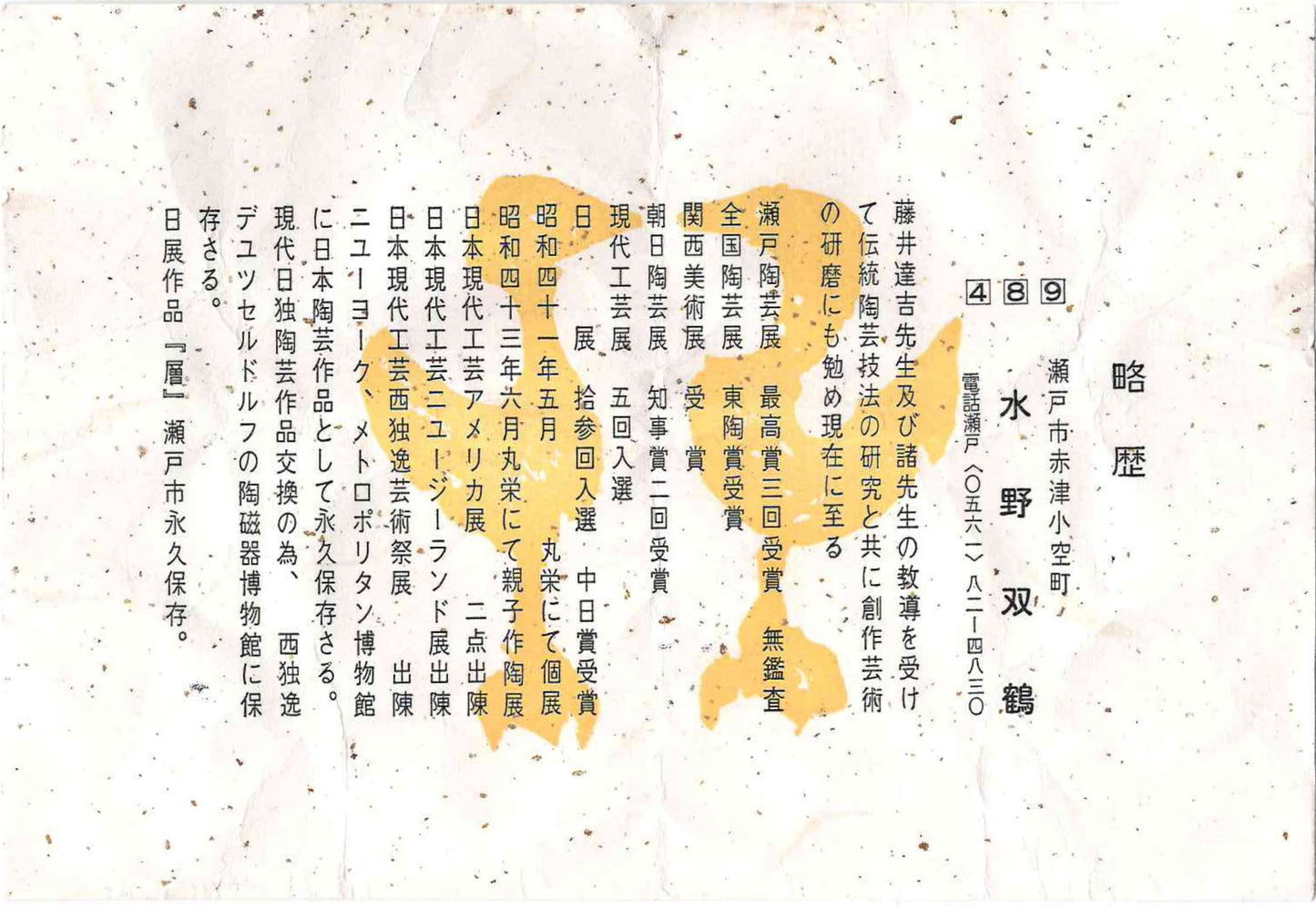
Based on the traces of his ceramic activities and circumstantial evidence during his lifetime, the production period of this work is clearly estimated to be from the late 1970s to the early 1980s, his mature period just before he was designated an intangible cultural property, when his skill was at its peak. The strongest evidence for this lies in the style of the autographed signature on the wooden box and the square seal, which does not include the title of cultural property holder. This strongly reflects the style of his era as a master who competed on the quality of his work itself, without relying on authority. Furthermore, the design of the logo on the accompanying bookmark, depicting a pair of yellow cranes facing each other, is identical to that from the period when he was actively involved in the forefront of the Japanese modern craft world. Due to differences in shrinkage rates between clays, it is prone to cracking, and it would have been impossible for him in his youth to fire a vessel with such a wide mouth and imposing proportions without distortion. The fusion of uniform and complex flowing patterns seen in this work is precisely the monumental design feature that crystallizes the pinnacle of his mature technique, which directly led to his highest honor, the designation as an Intangible Cultural Property in 1987.
This work is perfectly accompanied by evidence that proves the artist's unique style. A clear "Sokaku" potter's mark, indicating the authenticity of the artist, is engraved on the bottom of the vessel, next to the footring. It also comes with its dedicated tomobako (wooden box), wrapping cloth, and an artist's profile booklet (shiori) detailing his ceramic history, all showing that it has been carefully preserved. In particular, the design of the booklet, featuring a pair of yellow cranes facing each other, named after his artist's name, expresses the artist's endearing playfulness. The lid of the wooden box is inscribed "練込 茶盌" (Nerikomi Chawan) on the outside, and "双鶴" (Sokaku) in his own handwriting on the inside, with a perfectly stamped square seal. It is a complete piece in very good condition, with no chips or cracks, and possesses unwavering asset value as a supreme Japanese craft piece that is extremely difficult to encounter overseas.
- Artist: Sokaku Mizuno I (1912-1996)
- Artist's Representative Activities: [1912] Born in Seto City, Aichi Prefecture, he studied under Tatsukichi Fujii, a pioneer of modern craft, and received training in free artistic expression, unconstrained by tradition. Throughout his ceramic career, he was selected for the Nitten Exhibition a total of 27 times, won the top prize at the Seto Ceramics Exhibition three times, later being designated without examination, received the Governor's Award twice at the Asahi Ceramics Exhibition, the Toto Award at the National Ceramics Exhibition, and the Tokai TV Award and Achievement Award at the Japan New Craft Exhibition, as well as numerous other awards including at the Kansai Art Exhibition, accumulating a brilliant record on major domestic stages. He also served in important positions such as a councilor of the Japan New Craft Artists Federation, contributing to the development of future generations and the craft world. [1987] His achievements in independently researching and refining the traditional nerikomi technique over many years were officially recognized, and he was designated as a holder of Seto City's Designated Craft Technique (Ceramics, Nerikomi Technique). [1996] He passed away on January 18th at the age of 84, leaving behind a lineage of exceptional skill as the great founder of the prestigious Nerikomi Mizuno family, which continues to attract global attention through his son and grandson.
- Works in Collections: Aichi Prefectural Ceramic Museum, Seto City Museum of Art, etc.
- Production Period: 1970s - Early 1980s (estimated)
- Product Condition: Very good (no chips, no cracks, please note the natural crackle (not a defect))
- Accessories: Dedicated tomobako (wooden box), artist's profile booklet (shiori) included
- Material: Ceramic (nerikomi)
- Dimensions: Height approx. 8.6 cm, Diameter approx. 12.2 cm Note: Even if the products offered by our store are new and unused, they are from a very old production period and are all listed as used items. The product may have damage due to age, so please understand and confirm this before considering purchase.