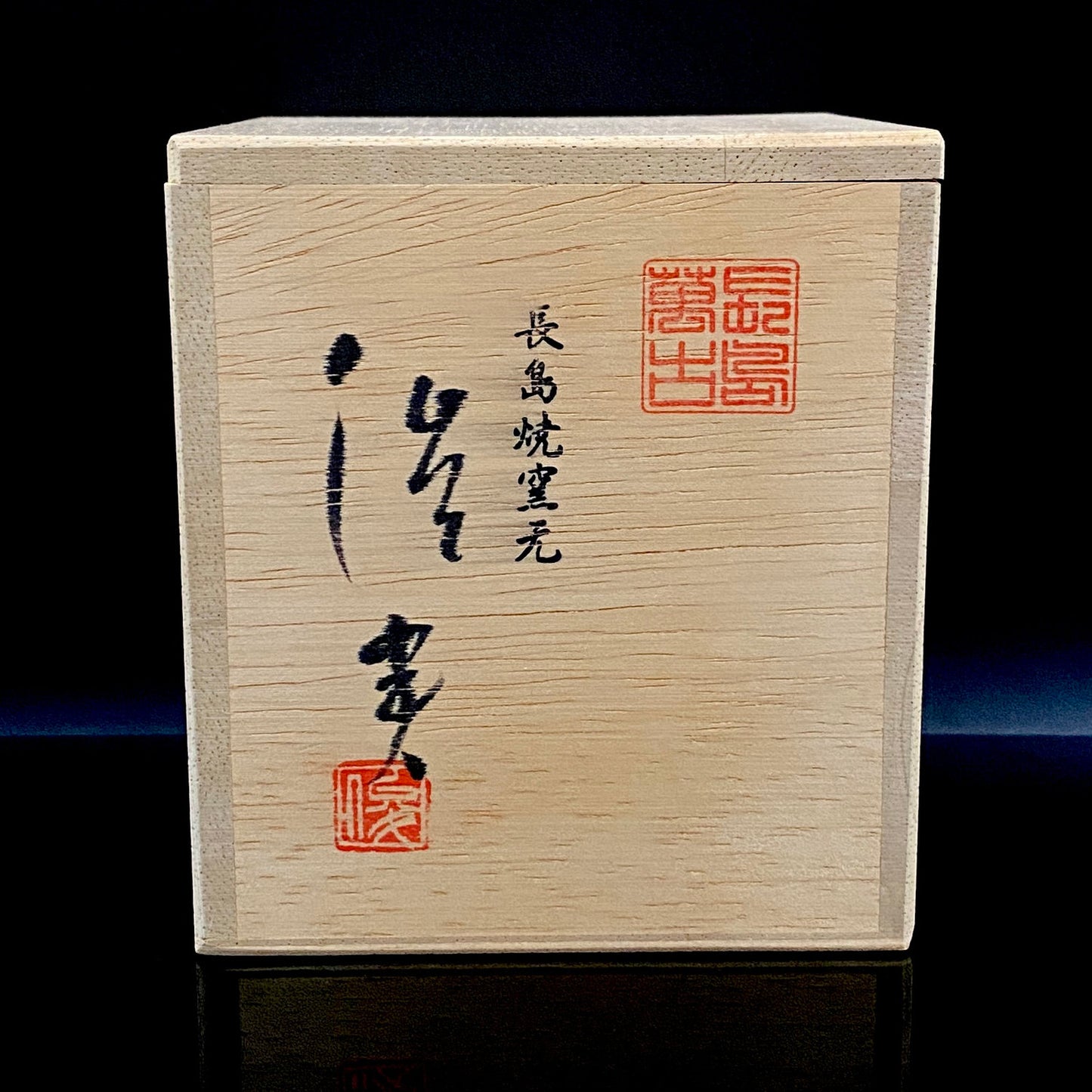
This is an exquisitely designed three-legged sake cup by Toshihide Hisamura (1956-), a highly skilled ceramist who has won the highest awards, such as the Minister of International Trade and Industry Award and the semi-grand prize, in traditional Japanese ceramics competitions. He is also known for having provided large jars and basins to adorn important spaces in the Kisshokaku building of Naritasan Osaka Betsuin Temple. The accompanying wooden box (tomobako) bears the artist's elegant handwritten inscription "Nagashima-yaki Kiln Toshihide." The cup features a unique multifaceted form that fits perfectly in the hand, and an overwhelming presence where modern design is fused with functional beauty. We proudly present this rare craft piece as a premium Japanese Ceramic Whiskey Tumbler, perfect for slowly enjoying rare aged sake that has matured into a deep amber color over many years, or a special single malt whisky with large ice cubes. This is a very rare masterpiece of Nagashima-yaki from Kuwana, Mie Prefecture, rarely seen in overseas markets, and a supreme vessel that brings the spirited sculptural beauty of Japanese contemporary crafts (Japanese KOGEI) to luxurious spaces.
Toshihide Hisamura, the artist, was born in Shizuoka Prefecture in 1956 and graduated from the prestigious Kanazawa College of Art, giving him a very unique and intellectual background in the traditional ceramics world. After graduating from university, he worked in product design, involved in the design of industrial products, and further built a career as an international creator by traveling to the United States and Europe to study cutting-edge overseas designs. Later, in Nagashima-cho, Kuwana City, Mie Prefecture, Toshihide and Atsuko Hisamura opened the Nagashima-yaki Tajin Kiln. While based on traditional Banko-yaki techniques, they developed simple and gentle works that reflect his meticulous sculptural calculations as a product designer and his thoughts on the changing seasons of Suigo Nagashima, surrounded by the Kiso Three Rivers. His exceptional technical skill and modern sensibility have been widely and publicly recognized, including selections for the Asahi Ceramic Exhibition and consecutive awards in the Banko Ceramic Comprehensive Competition, where he received the highest award, the Minister of International Trade and Industry Award, as well as the semi-grand prize and three other awards. After receiving the highest award, he completely stopped submitting to public exhibitions, which are influenced by trends in the art market, and has since immersed himself in ideal creations with his wife, making him known as a phantom artist whose works are extremely scarce in the market. In 1996, his outstanding craftsmanship was recognized, and he was nominated to create large jars and basins for important spaces, the Gatsurin-no-ma and reception room Kaori, for the construction of Kisshokaku at Naritasan Osaka Betsuin Temple, thus establishing a solid position in the Japanese architectural craft world as well.
A professional analysis of the sculptural beauty of this work reveals that Hisamura's unique spatial composition ability, highly praised as a former product designer, and the advanced traditional techniques of Banko-yaki are perfectly harmonized in this small vessel. The beautiful seams that clearly run from the side to the inner bottom of the vessel are clear evidence that instead of typical wheel-throwing, a forming technique was used where clay sheets (tatara) were rolled and their ends boldly overlapped and joined. By intentionally leaving these joints as sharp, un-smoothed lines, a three-dimensional edge and modern shadow are created on the front, reminiscent of folded origami or fabric, or even modern architecture. Furthermore, the unique three legs supporting the bottom of the vessel, and the entire unglazed base, clearly show that coarse fabric was pressed very strongly with the artist's specific intention, and the "nunome (fabric texture) technique" is perfectly executed, clearly engraving the deep and sharp texture of the weave down to every detail. The powerful pleat-like undulations extending radially from the three legs towards the center, and even the central annular detail, show that the fabric texture is preserved three-dimensionally without being crushed, indicating that this is not an accidental byproduct of the work but a meticulously calculated and advanced decorative expression. The dramatic contrast in texture created between the rustic iron-containing stoneware body characteristic of Banko-yaki and the smooth glazed layer on top is simply magnificent. In terms of decoration, a base of deep olive-green feldspar glaze is adorned with fluid black iron-painting curves drawn directly, and gold accents are luxuriously placed between the glaze, emitting an elegant metallic sparkle. A sharp red painting and gold horizontal band encircles the lower part of the vessel, embodying the modern design philosophy that tightens the overall organic form in a sophisticated way. The artist's handwritten signature, seal, and mark on the lid of the tomobako, along with a red seal certifying its authenticity, are perfectly intact, making this an art craft piece of unwavering asset value in superb condition without any flaws.
- Artist: Toshihide Hisamura (1956-)
- Artist's Major Career History: [1956] Born in Shimizu Ward, Shizuoka City, Shizuoka Prefecture, [c. 1979] Engaged in product design after graduating from Kanazawa College of Art, studied overseas design in the U.S. and Europe, [1980s] Established Nagashima-yaki Tajin Kiln in Nagashima-cho, Kuwana City, Mie Prefecture, selected for the Asahi Ceramic Exhibition, consecutively awarded the highest prize "Minister of International Trade and Industry Award," "Semi-Grand Prize," and "3 Awards" in the Banko Ceramic Comprehensive Competition (subsequently ceased submitting to public exhibitions to concentrate on unique creations), [1996] Commissioned to create large jars and basins for the Gatsurin-no-ma and reception room Kaori, important spaces for the construction of Naritasan Osaka Betsuin Temple Kisshokaku.
- Works in Collection: Naritasan Osaka Betsuin Temple (permanent installation in public spaces of Kisshokaku)
- Production Period: 1990s-2000s (estimated, works from the mature period before and after completing the major project for Naritasan, following the award of the Minister of International Trade and Industry Award)
- Product Condition: Excellent (no chips, no cracks)
- Accessories: Dedicated tomobako (wooden box) (lid inscribed "Nagashima-yaki Kiln Toshihide"), with wrapping cloth
- Material: Ceramic (Oribe-style feldspar glaze, red overglaze painting with gold accents)
- Dimensions: Height approx. 7.8 cm, mouth diameter approx. 6.5 cm
- Note: Even if the products offered by our store are unused, they are from a very old production period and are all listed as used items. The product may have age-related damage, so please consider purchasing after understanding and checking.