This is an extra-large rectangular flower bowl, approximately 50.5 cm in width, boasting an overwhelming scale and adorned with the highest level of technique and design by Mitsuo Kano (1903-1970), a legendary master who, despite reigning supreme in the scientific analysis of glazes in the history of modern Japanese ceramics, held only six solo exhibitions in his lifetime. Born into the Kano family, a distinguished name in Kiyomizu ware, Mitsuo Kano graduated from the Kyoto Ceramic Testing Institute and studied under the renowned Shinobu Komori, a pioneer of scientific ceramics in Japan. Later, in 1920, he joined the Chinese Ceramic Research Institute in Dalian, where he thoroughly investigated the glazes and firing mechanisms of ancient Chinese ceramics. In 1943, he was commissioned by Manchukuo to select sites for official kilns, and his overwhelming knowledge and astonishing technical prowess sent shockwaves through the Japanese art world immediately after the war. Beginning with his special selection award at the Nitten Exhibition in 1949, his works were acquired by the Ministry of Education for the National Museum of Modern Art, Kyoto, purchased by the Musée Palissy at the Contemporary Ceramics Paris Exhibition, donated to the International Museum of Ceramics in Faenza, Italy, and permanently housed in prestigious museums and national institutions around the world, including the Museum of Fine Arts, Boston, the Museum of Art, São Paulo, Brazil, and the Japan Art Academy. In 1967, he received the Minister of Education Award at the Nitten Exhibition, and in 1968, he became a councilor of the Nitten Exhibition. His dignified sculptural spirit was highly acclaimed, and in 1969, he was commissioned to create a white porcelain vase for the construction of the new Imperial Palace, which he humbly presented to the Imperial Household, leaving behind an unparalleled legacy of honor and achievement.
At the root of Mitsuo Kano's ceramic philosophy was the modern updating of Eastern tradition based on thorough scientific evidence, and the pursuit of functional beauty that brings out the potential of clay and glaze to their limits within the constraints of a vessel. This overwhelming spirit of functional beauty and perfect technical skill significantly changed the life of his real nephew and direct disciple, Tetsuo Kano (the second generation Kano Matsutani), a founding member of the Sodeisha group. In the early Sodeisha, which was centered on Kazuo Yagi and others and was pushing toward the establishment of pure three-dimensional objects that completely eliminated practicality, Tetsuo Kano experienced deep spiritual conflict in abandoning the ultimate functional beauty that his master, Mitsuo Kano, had built through painstaking research. As a result, he left the group at the very early stage around 1951 and turned to the legitimate inheritance of practical vessels that fused tradition and modernity. Furthermore, Mitsuo Kano's global and outstanding modern aesthetic sense is also evident in the numerous cutting-edge Western tableware he created at the request of Noémi Raymond, the wife of the famous architect Antonin Raymond and a renowned designer. He embodied a universal modernism that harmonized with contemporary living spaces, going beyond merely reproducing classics.
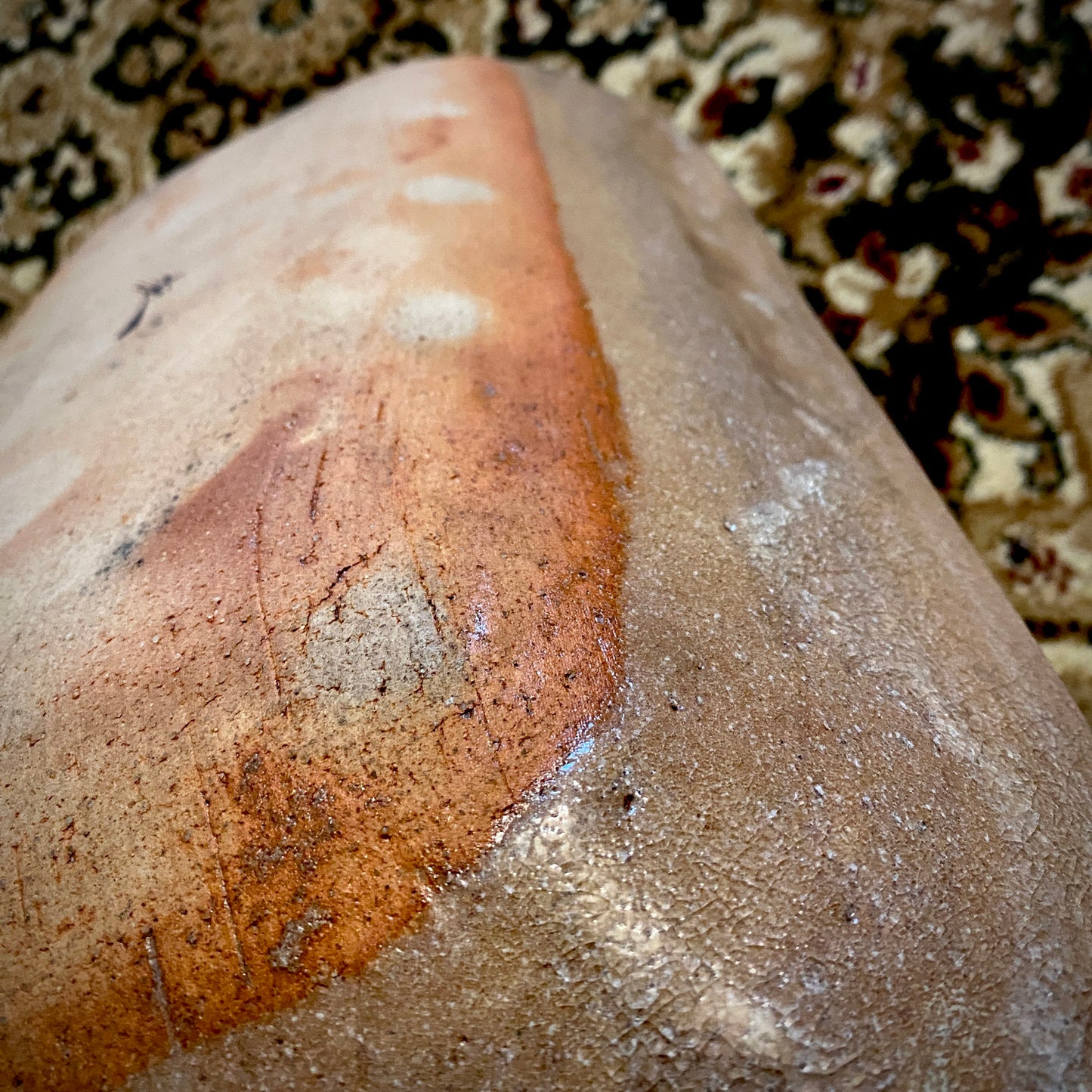
This work is a museum-quality large rectangular bowl where Kano's decorative beauty and unique glaze theory are synchronized to the utmost. Looking into the inside of the work, one finds a bold, flowing, and geometric concentric ripple pattern (swirl pattern) drawn with a sharp contrast of black and white, which is the essence of "Sumiyaki" (ink-fired). This pattern radiates regularly and with organic undulations from a tiny central circle towards the outer edge, displaying an astonishing graphic sense reminiscent of the raked sand patterns in Japanese Zen rock gardens or the serene ripples spreading across a water surface. Furthermore, covering this monochrome world, a unique glass glaze (hariyū), derived from a precise blending ratio of Nangō feldspar and lead-free glass flux, is melted extraordinarily thick, forming a layer of incredibly fine and dense ice crackle crazing like jewels across the entire surface of the vessel. Depending on the angle of incoming light, a kaleidoscopic diffused reflection emanates from the depths of this transparent glass layer, giving immeasurable three-dimensional depth and an absorbing spirituality to the flat vessel. In contrast, from the rim of the vessel to the outer wall, a rich and warm ochre to deep amber iron glaze (ash glaze) gradient is applied uniformly, creating a vivid chromatic and visual contrast with the cool monochrome worldview of the interior, and serving as a supreme frame that powerfully tightens the overall sculptural beauty of the work.
What further determines the artistic value of this work is the presence of a handwritten signature on the flat base, where the footrim is intentionally omitted. In the center of the perfectly flat, carved-out base, the inscription "光夫" (Mitsuo) is clearly marked with black pigment, either iron or cobalt, in a fluid and masterful brushstroke free of hesitation. Mitsuo Kano's uncompromising commitment to perfectly controlling his artistic signature, even in invisible details, is condensed in this single signature, eloquently testifying that this work is an undeniable authentic masterpiece from his own hand. The exposed clay body around the inscribed signature reveals the meticulous yet well-fired, slightly reddish, high-quality ceramic clay, carefully selected by a prestigious Kiyomizu ware family. The contrast between this rustic charm of the clay and the refined hariyū (glass glaze) covering the surface is also superb. The production period of this work is logically identified as his mature period in the mid-Showa era (circa 1942-1970), when his unique hariyū technique was established, and his overwhelming technical prowess reached its golden age, exemplified by his appointment as a Nitten judge and recipient of the Minister of Education Award. The historical background of this work, being an authentic piece created directly by the master's hand, having transcended the turbulent periods of war and postwar, further solidifies its value.
We propose this magnificent extra-large bowl, a legacy of the grand master at the origin of avant-garde ceramic history, as a special accent in modern, sophisticated table settings, and as a supreme example of Japanese Kōgei (craftsmanship) to enjoy rich practicality. In addition to appreciating its sculptural beauty as a large vase to adorn a refined interior, if placed in a space as an extra-large ice platter or a luxurious wine cooler, filled with ice to display multiple bottles when savoring premium aged whisky, vintage wine, or champagne, the beautiful ice crackle of the hariyū and the sumiyaki ripples on the interior will beautifully resonate with the ice and condensation, creating a breathtakingly luxurious executive experience. This is a supreme, one-of-a-kind item that you will never encounter again, domestically or internationally, allowing you to directly experience the essence of Mitsuo Kano's functional beauty, whose high technical skill has been praised and permanently housed in leading museums around the world, in your daily life.
- Artist: Mitsuo Kano (1903-1970)
- Artist's Major Activities: [1920] Joined the Chinese Ceramic Research Institute in Dalian and engaged in research on ancient Chinese ceramics, [1943] Traveled to Manchuria as a commissioned expert for Manchukuo to select sites for official kilns, [1946] First exhibited at the Japan Art Exhibition (Nitten), [1949] [Received special selection award at the Japan Art Exhibition, [1953] Received Hokuto Prize at the Japan Art Exhibition, [1957] Appointed as a judge for the Japan Art Exhibition, [1958] Appointed as a member of the Nitten corporate body, [1967] Appointed as a Nitten judge and received the Minister of Education Award, [1968] Appointed as a Nitten councilor, [1969] Humbly created a white porcelain vase for the construction of the new Imperial Palace.
- Works Housed In: The National Museum of Modern Art, Kyoto; Museum of Fine Arts, Boston (USA); Museum of Art, São Paulo (Brazil); Japan Art Academy; Musée Palissy (France); International Museum of Ceramics in Faenza (Italy).
- Circa: A work created in 1947
- Condition: With defects (one chip on the inner rim, no cracks or breaks, minor scratches and kiln flaws due to age)
- Accessories: Original signed wooden box (Tomobako)
- Material: Pottery (hariyū / glass glaze, sumiyaki / ink-fired, glazed color)
- Dimensions: Height approx. 9.0 cm, Width (long side) approx. 50.5 cm
- Note: All items offered by our store, even if new and unused, are from a very old production period and are listed as used. Items may have age-related damage, so please consider purchasing after understanding and checking.