Crafted by Takatori Hassen XIII (b. 1934; real name: Sosen Takatori), the direct thirteenth-generation head kiln of Chikuzen tea ceramics Takatori ware—which originated in 1600 (Keicho 5) when Haksan (Japanese name: Jusei Hachitachibana), a potter who arrived from Korea during the Bunroku-Keicho Era (1592–1597), submitted to Nagamasa Kuroda, the lord of Chikuzen Province awarded for his distinguished service in the Battle of Sekigahara, and established a kiln in Joken, Eimanji at the western foot of Mount Takatori—this is a set of hand-carved, flowing-glaze Yunomi tea cups (pair of two). Moving its kiln from Eimanji to Uchinoko, Kamiyamada Tojindani, and Shiratagiyama in Kofukuro, Iizuka, Takatori ware established the aesthetic of Enshu Takatori, praised as "Kirei-sabi," under the guidance of tea master Kobori Enshu during the Shiratagiyama period. Subsequently, the tradition split into the Tsuzumi Takatori family, which served as official domain potters in charge of glaze formulation (Yugata), and the Sarayama Takatori family in Kobaru Nakano, which handled delicate shaping and hand-carving (Saikugata). The Sarayama Takatori family transmitted the techniques and legacy of Yasunojo Takatori (Shigenori)—the last official domain potter of the Kuroda Domain—orally and directly down to Takatori Hassen XIII through Hassen XII (Sashichi) and his mother Hassen Komaki. Certified as a Traditional Craftsman by the Ministry of International Trade and Industry in 1979, commended as an Outstanding Technical Performer of Fukuoka Prefecture (Governor's Award) and recipient of the International Art and Culture Award in 1989, winner of the Grand Prix at the Paris Arts Festival in 1996, and decorated with the Order of the Sacred Treasure, Single Ray in 2005, he is a master at the pinnacle of modern Takatori ware whose creations are housed in public collections, including the Fukuoka Prefectural Museum of Art. Our shop presents this piece to the global market not only for use as traditional Yunomi tea cups, but also as small, palm-fitting free cups for quiet enjoyment as luxury Japanese rocks glasses (pair of sake cups) to savor the rich aroma and deep flavor of aged sake, matured whisky, or authentic shochu over large ice cubes.
Observing the details of this piece reveals a brilliant realization of the extreme thin-walled hand-carving technique that is the hallmark of Sarayama Takatori, combined with advanced section-draping and flowing-glaze techniques utilizing inherited homemade glazes. While Takatori ware selectively employs secret glazes such as Namikuro glaze, Takatori yellow glaze, white glaze, Shunkei glaze, Takamiya glaze, Doke glaze, Shinko (true black) glaze, Ryokushō (verdigris) glaze, and Furashi glaze, this work constructs a striking contrast between the dense Shinko glaze (amber-black glaze) applied to the upper rim and the bold, diagonal pouring of Takatori yellow glaze and straw-ash flowing glazes over the entire body. Fired at high temperatures, the yellow glaze undulates like embossed painting, giving rise to three-dimensional, bubbly, abstract textures reminiscent of sea-cucumber speckles and "snake-eye" (Janome) motifs around the entire vessel, demonstrating an extraordinarily high-difficulty kiln change (Furashi effect) woven by fire and wind. Through the neatly carved, unglazed foot ring (Tatami-tsuki), the rustic clay texture of high-quality Takatori porcelain body is visible, and even the inner bottom of the foot ring is decorated with droplet-like spotted glaze, demonstrating the thoroughness of Sarayama Takatori's artisan traditions down to the smallest detail. Each of the two cups, large and small, displays subtly different scenery in its glaze flow, elevating its aesthetic value as a unique, one-of-a-kind handcrafted work to the utmost degree.
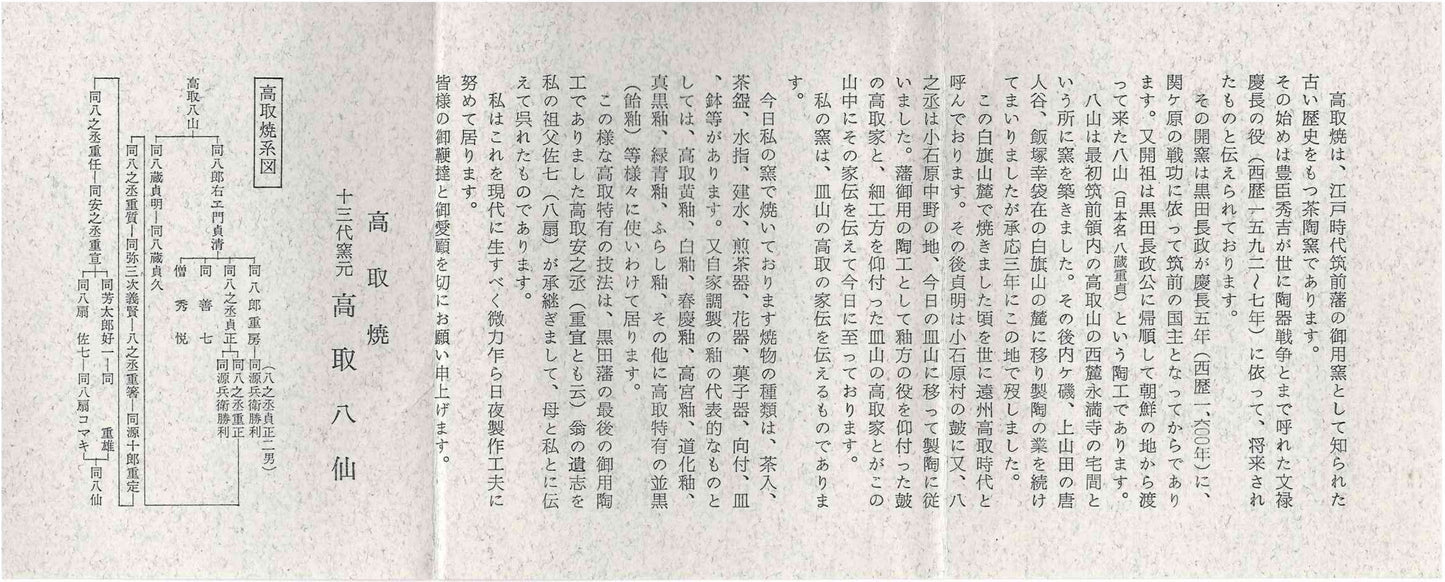
Regarding the period of production, taking the kiln address stated in the accompanying brochure—written as "Sarayama, Koishiwara Village, Asakura District, Fukuoka Prefecture" prior to the municipal merger in March 2005—alongside his peak period of mature technique and style following his commendation as an Outstanding Technical Performer of Fukuoka Prefecture in 1989 and the Paris Arts Festival Grand Prix in 1996 as decisive evidence, it is identified as an authentic creation made between the 1990s and the early 2000s (early Heisei to early Heisei 10s era). The vessels themselves have no cracks or chips, maintaining extremely good condition in both glaze coloration and texture. The set arrives in complete condition, accompanied by its dedicated Tomobako (wooden box) hand-inscribed on the lid with "Yunomi" in ink and signed "Takatori Hassen XIII saku" with a seal stamped on the back of the lid, alongside a brochure detailing the history and family tree of Takatori ware.
- Artist: Takatori Hassen XIII (b. 1934; real name: Sosen Takatori, 13th-generation head kiln of Sarayama Takatori family)
- Artist's Key Activities: [1953] Succeeded to the name Takatori Hassen XIII; [1959] Recommended as a member of the Fukuoka Art Association; [1975] Won the Governor's Award at the Fukuoka Art Association Exhibition; [1979] Certified as a Traditional Craftsman by the Ministry of International Trade and Industry; [1989] Commended as an Outstanding Technical Performer of Fukuoka Prefecture and received the International Art and Culture Award; [1996] Won the Grand Prix at the Paris Arts Festival Exhibition; [2005] Awarded the Order of the Sacred Treasure, Single Ray
- Works Housed In: Fukuoka Prefectural Museum of Art, Public Traditional Crafts Archives, Domestic and International Connoisseur Collections, etc.
- Period of Production: Circa 1990s–early 2000s (Estimated)
- Condition: Very good (no chips, no cracks)
- Accessories: Dedicated Tomobako, brochure (recording origins and family tree) included
- Material: Pottery (Takatori ware, hand-carved, true black glaze, Takatori yellow glaze, flowing glaze, Furashi/kiln-change effect)
- Dimensions: Large: Height approx. 7.5 cm, Mouth diameter 7.0 cm / Small: Height approx. 7.0 cm, Mouth diameter 5.5 cm
- Caution: All products offered by our shop are pre-owned items due to their historical production period, even if unused. Products may have age-related damage, so please consider purchasing after understanding and verifying these condition details.