A master of Mino ware, Hidetake Ando (1938–2024) dedicated his life to ceramic art as the fifth-generation head of the prestigious Sentaro Kiln, which has continued since the Edo period in Ichinokura-cho, Tajimi City, Gifu Prefecture. Recognized as a holder of Gifu Prefectural Intangible Cultural Property for Kizeto ware, he was a leading figure in contemporary Mino ceramics whose creations are held in the collections of major museums, including the National Crafts Museum (formerly Crafts Gallery of the National Museum of Modern Art, Tokyo) and the Museum of Modern Ceramic Art, Gifu. Hidetake Ando is most highly acclaimed for his advanced technique and rigorous firing control that revived the style of Momoyama-period Mino ceramics in the modern era, skillfully reproducing the vitality of ancient pottery not only in Kizeto but also in Shino and Oribe wares. Our shop presents this heavy, dignified piece—originally created as a traditional Shino Yunomi (tea cup)—to the global market as a luxury Japanese rocks glass (cylindrical sake vessel) for quietly savoring aged amber sake or matured whisky straight or over ice.
Shino ware is known as the first white-glazed ceramic in Japan to utilize feldspar glaze, characterized by the milk-white warmth brought by thick glaze application and the expressive scenery that emerges through firing. Carefully examining the details of this work reveals bold hand-carved faceting (Metsuri) across the entire body, creating dimensional shadows of handcrafted artistry on its cylindrical form. Tiny pinholes characteristic of Shino glaze, known as "yuzu-hada" (citrus-skin texture), appear densely across the entire vessel, extending to its interior. From deep within the thick glaze layer, brilliant orange fire marks ("hi-iro" / scarlet markings)—caused by oxidation reactions of iron in the clay—float like delicate dotted patterns at the bottom of the pinholes, around the rim, and along the ridges of the faceted surfaces. Around the base and inside the foot ring, a rustic raw clay body remains with a subtle gradation of fire marks, condensing a unforced natural beauty made possible through masterly firing control. Its moderate thickness and palm-fitting faceted structure provide excellent heat insulation, serving as a perfect stage for experiencing the deep flavor of aged spirits and the resonant sound of ice through all five senses.
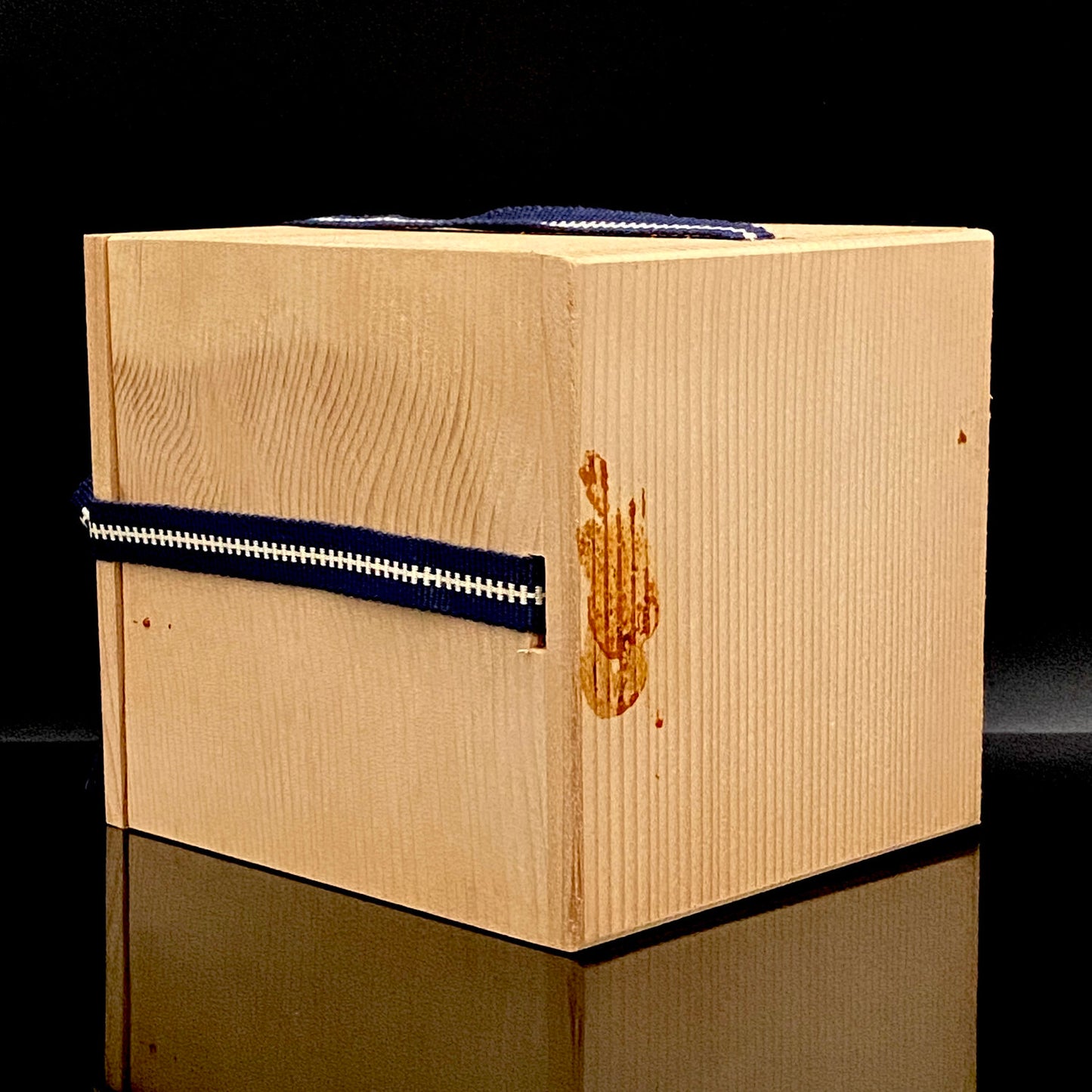
Regarding the period of production, taking his peak era after being designated a holder of Gifu Prefectural Intangible Cultural Property for Kizeto in 1998—when his artistic style reached complete maturity—as a basis, it is estimated to be an authentic work created between 1998 and the 2010s. With Hidetake Ando's passing in February 2024, the creation of new works has completely ceased, establishing its enduring value as a legacy of a master who supported the golden age of Mino ceramics. The vessel itself has no cracks or chips, maintaining extremely good condition in its glaze coloration, citrus-skin texture, and appearance of fire marks. It arrives in complete condition, accompanied by its dedicated Tomobako (wooden box) inscribed on the lid with "Shino Yunomi" in ink and stamped with Hidetake's red seal, alongside a brochure detailing the history of Sentaro Kiln.
- Artist: Hidetake Ando (1938–2024)
- Artist's Key Activities: [1974] First selected for the 21st Japan Traditional Art Crafts Exhibition; [1995] Won the Japan Art Crafts Association Encouragement Award at the Japan Traditional Art Crafts Exhibition; [1998] Designated as a holder of Gifu Prefectural Intangible Cultural Property for "Kizeto"; [2003] Received the Japan Ceramic Society Award; [2013] Commended for Regional Cultural Merit (Minister of Education, Culture, Sports, Science and Technology Award)
- Works Housed In: National Crafts Museum (formerly Crafts Gallery of the National Museum of Modern Art, Tokyo), Museum of Modern Ceramic Art, Gifu, Aichi Prefectural Ceramic Museum, Tajimi City Mino Ware Museum, etc.
- Period of Production: Circa 1998–2010s (Estimated)
- Condition: Very good (no chips, no cracks)
- Accessories: Dedicated Tomobako, brochure included
- Material: Pottery (Mino ware, Shino, faceted)
- Dimensions: Height approx. 9.0 cm, Mouth diameter approx. 7.0 cm
- Caution: All products offered by our shop are pre-owned items due to their historical production period, even if unused. Products may have age-related damage, so please consider purchasing after understanding and verifying these condition details.