Crafted by Mr. Jinnai Sakata, a unique genius of Mashiko ware who studied under Mr. Shoji Kamoda—a legendary giant of Showa-era Japanese ceramics—and directly inherited his uncompromising sculptural spirit and pursuit of clay, this is a Chawan (tea bowl) work titled "Enyu Tomoemon Ki" (Salt-Glaze Vessel with Tomoe Pattern). Following his independence, after being selected for the Japan Ceramic Art Exhibition and the Japan Traditional Art Crafts Exhibition as well as overseas touring exhibitions, he transitioned from public competitions to focus on creating one-of-a-kind masterpieces for solo exhibitions. He is an exceptionally rare master whose works are housed in international institutions such as the British Museum and the Rockefeller Foundation, and who holds distinguished records of dedication to major shrines and temples, including the "Heisei Grand Rebuilding" of Izumo Taisha Shrine, Ise Jingu Shrine, and Enryaku-ji Temple on Mount Hiei. Although originally sculpted as a dignified Matcha bowl, our shop presents this piece to the global market not only as a tea vessel for enjoying a bowl of tea, but also as a luxury Japanese rocks glass (sake vessel) for quietly savoring amber aged sake, matured whisky, or authentic shochu over large ice cubes, utilizing its profound interior and heavy, handcrafted texture.
Carefully inspecting the details of this work reveals a magnificent realization of the salt-glaze technique—built by Mr. Jinnai Sakata through a dialogue between clay and flame—and the fluid, sculptural beauty of the Tomoe (comma-shaped whorl) pattern. Salt-glazing is an advanced method where rock salt is introduced into the kiln during high-temperature firing, causing the vaporized sodium to chemically react with silica in the clay to instantaneously form a thin, glassy glaze film, resulting in a distinct, dense texture known as "orange peel" along with beautiful crazing on the vessel's surface. Upon the deep, clear emerald-green salt-glazed surface, powerful S-shaped Tomoe patterns shifting from jet-black to amber-brown are painted, creating a dynamic visual effect that spirals continuously from the interior bottom that cradles the tea out to the exterior sides. In addition to the cylindrical bowl shape rising with strength and the foot rim crafted to feel natural in the hands, the artist's own hand-carved mark "Jin" (甚) is clearly inscribed on the bottom surface inside the foot, with the rough texture of the clay body and the tightly fused vitrification characteristic of salt-glazing testifying to its intentional craftsmanship and authenticity.
Regarding the period of production, it is estimated to have been created between circa 1975 and 1985, an era when he established his own artistic world around solo exhibitions after leaving public competitions and vigorously released a series of his signature works utilizing salt glaze and Tomoe patterns. It prominently exhibits the peak technical brilliance that led to the purchase of his work by the Japan Foundation and its inclusion in overseas touring exhibitions, possessing extraordinarily high artistic value. The vessel body itself has no damage such as cracks or chips, maintaining extremely good condition in both the coloration of the salt glaze and its surface texture. It arrives in complete condition accompanied by its dedicated paulownia Tomobako inscribed in ink on the lid with "Enyu Tomoemon Ki" and on the back with "Jinnai" and stamped with a red seal, as well as its dedicated cloth (tomobure) with his artist's seal.
- Artist: Jinnai Sakata (1943–)
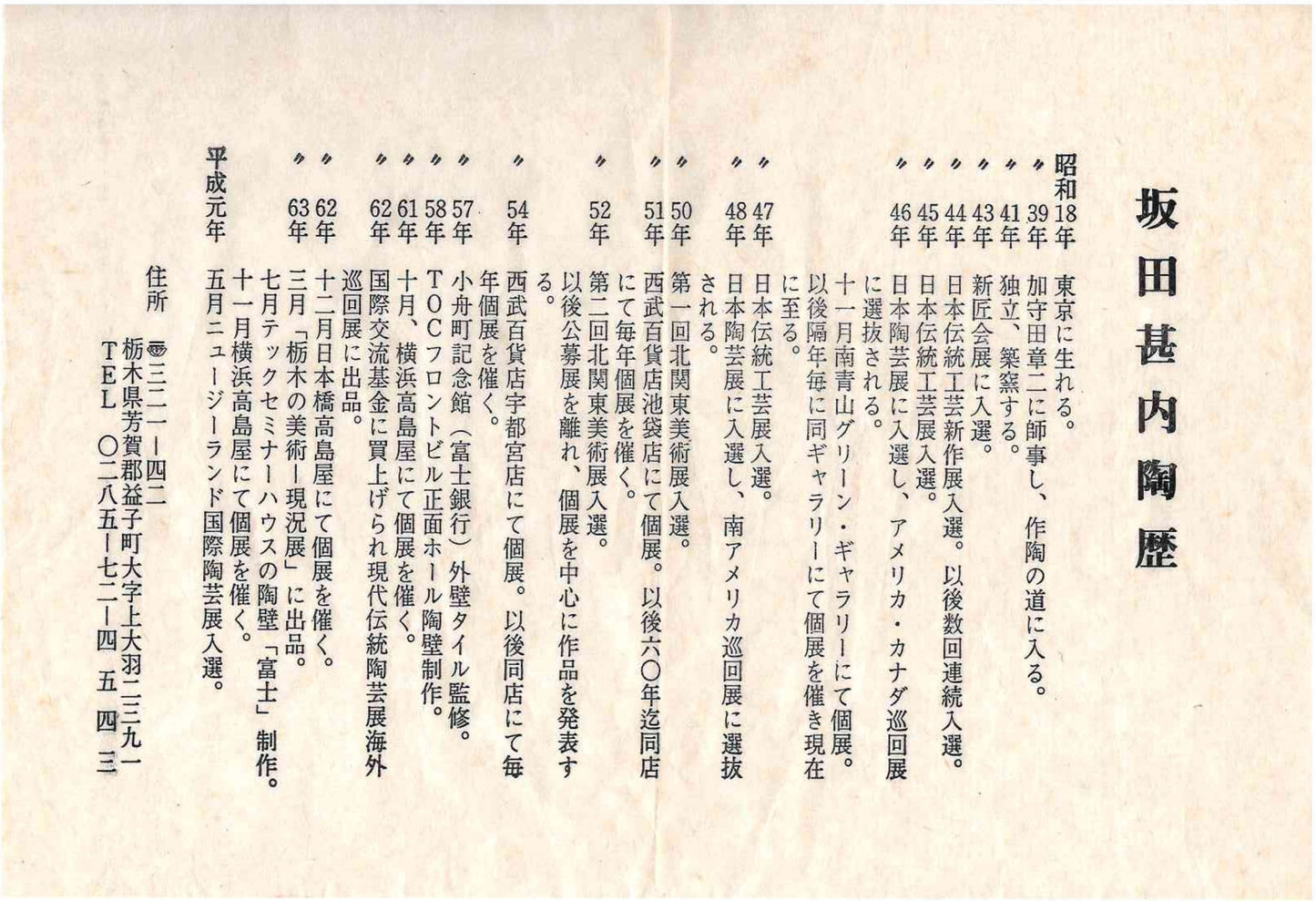
- Artist's Key Activities: [1964] Studied under Mr. Shoji Kamoda; [1966] Became independent and built his kiln; [1971] Selected for the Japan Ceramic Art Exhibition and chosen for touring exhibitions in the USA and Canada; [1973] Selected for the Japan Ceramic Art Exhibition and chosen for South American touring exhibition; [1987] Work purchased by the Japan Foundation and exhibited in the "Contemporary Traditional Ceramic Art" overseas touring exhibition; [1989] Selected for the New Zealand International Ceramics Exhibition
- Works Housed In: British Museum (London), Rockefeller Foundation, Embassy of the United States, Japan Foundation (purchased), etc. (Dedications: Izumo Taisha Shrine, Ise Jingu Shrine, Mount Hiei Enryaku-ji Temple, Kodai-ji Temple, Takachiho Shrine)
- Period of Production: Circa 1975–1985 (Late 1970s–early 1980s, estimated)
- Condition: Very good (no chips, no cracks)
- Accessories: Dedicated Tomobako (wooden box), Tomobure (cloth), and bookmark included
- Material: Pottery (Mashiko ware, salt glaze, Chawan, with artist's mark)
- Dimensions: Height approx. 9.0 cm, Mouth diameter approx. 8.2 cm
- Caution: All products offered by our shop are pre-owned items due to their historical production period, even if unused. Products may have age-related damage, so please consider purchasing after understanding and verifying these condition details.