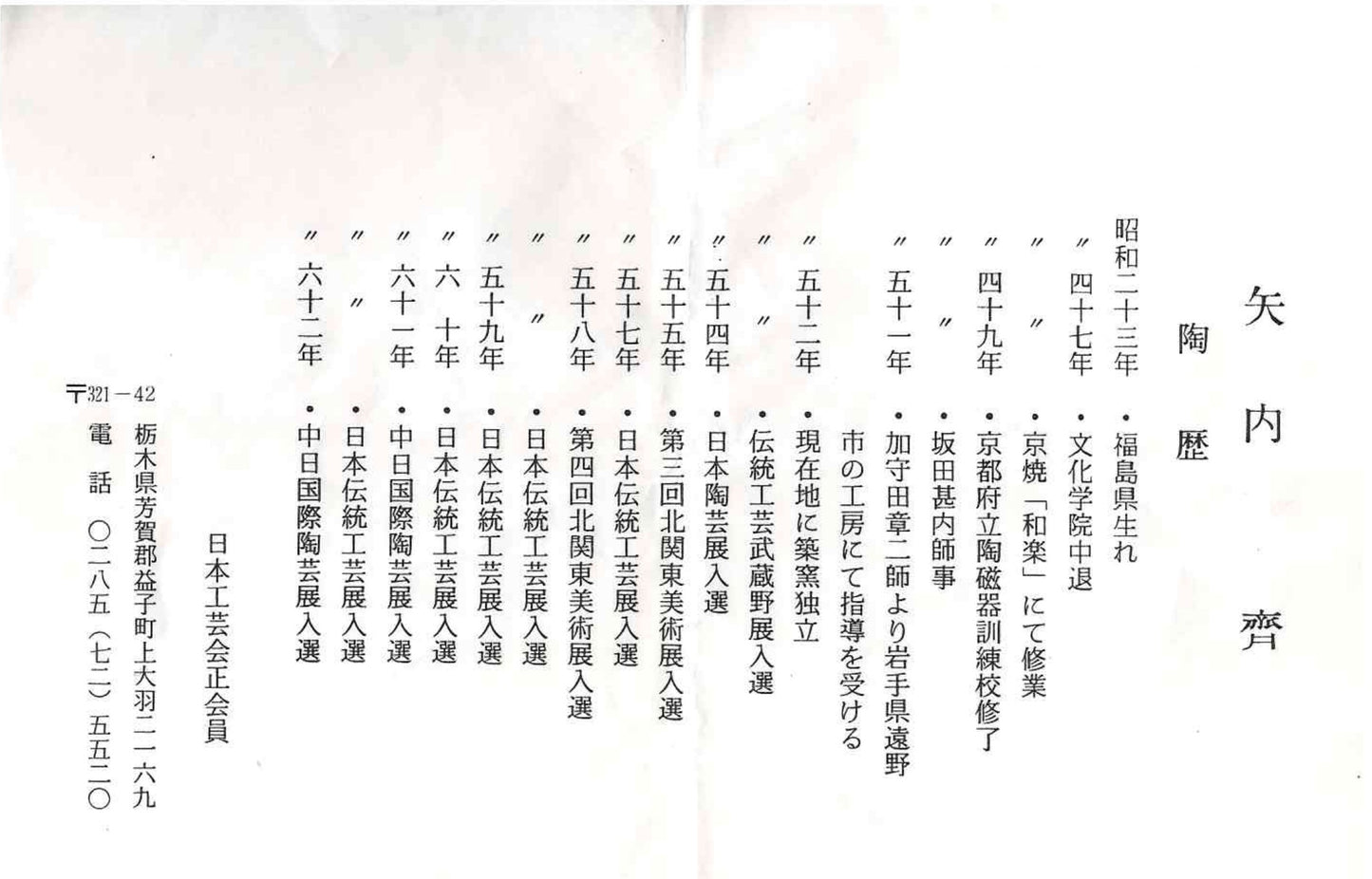
After training at Kyoyaki "Waraku" and completing his studies at the Kyoto Prefectural Ceramics Technical Institute, Mr. Sai Yanai (1948–)—an up-and-coming Mashiko ware master and regular member of the Japan Art Crafts Association—studied under Mr. Jinnai Sakata, a direct disciple of Mr. Shoji Kamoda, and in 1976 received direct guidance from Mr. Shoji Kamoda himself at his workshop in Tono City, Iwate Prefecture. This "Kokubun Saidei Zogan" (carved pattern with colored clay inlay) Chawan (tea bowl) represents the culmination of the sculptural aesthetic fostered by his learnings from his mentor, Mr. Jinnai Sakata, and guidance from Mr. Shoji Kamoda, built upon the foundation of precise wheel-throwing techniques and traditional craftsmanship developed in Kyoto. Although originally crafted as a dignified Matcha bowl, our shop presents this piece to the global market not only as a tea vessel for enjoying a bowl of tea, but also as a luxury Japanese rocks glass (sake vessel) for quietly savoring amber aged sake, matured whisky, or authentic shochu over large ice cubes, capitalizing on its profound interior and heavy, handcrafted texture.
Carefully observing the details of this work reveals the masterful craftsmanship of sculptural carving and vivid colored clay inlay that evoke the techniques of his mentor, Mr. Jinnai Sakata, and the teachings from Mr. Shoji Kamoda's guidance. Against a heavy grey ceramic body containing coarse sand grains with a carbonized unglazed finish, one side is three-dimensionally carved with overlapping crescent and half-moon incisions inlaid with deep, lustrous cobalt blue clay (lapis lazuli saidei), while the opposite side features a matching series of overlapping carved patterns in white clay (white slip) to create a striking contrast. The contrasting colors of blue and white are deeply incised into the clay body as geometric, fluid wave motifs, producing an extraordinary level of handcrafted precision and three-dimensional presence. The entire interior (mikomi) of the vessel is finished with a soft, brush-stroked white slip coating, combining practical functionality that enhances the color of poured sake or tea with aesthetic appreciation. On the bottom surface beside the foot, the artist's own hand-carved mark "Sai" (齊) is clearly inscribed, testifying to its intentional craftsmanship and authenticity.
Regarding the period of production, it is identified as an authentic work created between circa 1985 and 1995 (mid-1980s to early 1990s), a peak era when he achieved repeated selections for the Japan Traditional Art Crafts Exhibition and the Chunichi International Ceramics Exhibition, elevating the techniques of "carved motifs and colored clay inlay" into his own unique expression as a regular member of the Japan Art Crafts Association. It is a work from a period when his advanced sculptural aesthetic reached its highest brilliance, possessing exceptionally high artistic value. The vessel body itself has no damage such as cracks or chips, maintaining excellent condition in both the coloration of the colored clay and the powerful texture of the clay body. It arrives in complete condition accompanied by its dedicated paulownia Tomobako inscribed in ink on the back of the lid with "Sai Yanai" and stamped with a red seal, its dedicated cloth (tomobure) with his artist's seal, and a bookmark (shiori) detailing his ceramic biography.
- Artist: Sai Yanai (1948–)
- Artist's Key Activities: [1972] Trained at Kyoyaki "Waraku"; [1974] Graduated from Kyoto Prefectural Ceramics Technical Institute and studied under Mr. Jinnai Sakata; [1976] Received guidance from Mr. Shoji Kamoda at his workshop in Tono City, Iwate Prefecture; [1977] Established his kiln and became independent in Mashiko Town, Tochigi Prefecture; [1979] Selected for the first time for the Japan Ceramic Art Exhibition; [1982] Selected for the first time for the Japan Traditional Art Crafts Exhibition (frequently selected thereafter); [1986] Selected for the first time for the Chunichi International Ceramics Exhibition
- Works Housed In / Official Qualifications: Regular Member of the Japan Art Crafts Association (Numerous selections for the Japan Traditional Art Crafts Exhibition, Japan Ceramic Art Exhibition, Chunichi International Ceramics Exhibition, Kita-Kanto Art Exhibition, and Traditional Art Crafts Musashino Exhibition)
- Period of Production: Circa 1985–1995 (Estimated)
- Condition: Very good (no chips, no cracks)
- Accessories: Dedicated Tomobako (wooden box), Tomobure (cloth), and bookmark included
- Material: Pottery (Mashiko ware, carved pattern colored clay inlay, Chawan, with artist's mark)
- Dimensions: Height approx. 8.2 cm, Mouth diameter approx. 10.3 cm
- Caution: All products offered by our shop are pre-owned items due to their historical production period, even if unused. Products may have age-related damage, so please consider purchasing after understanding and verifying these condition details.