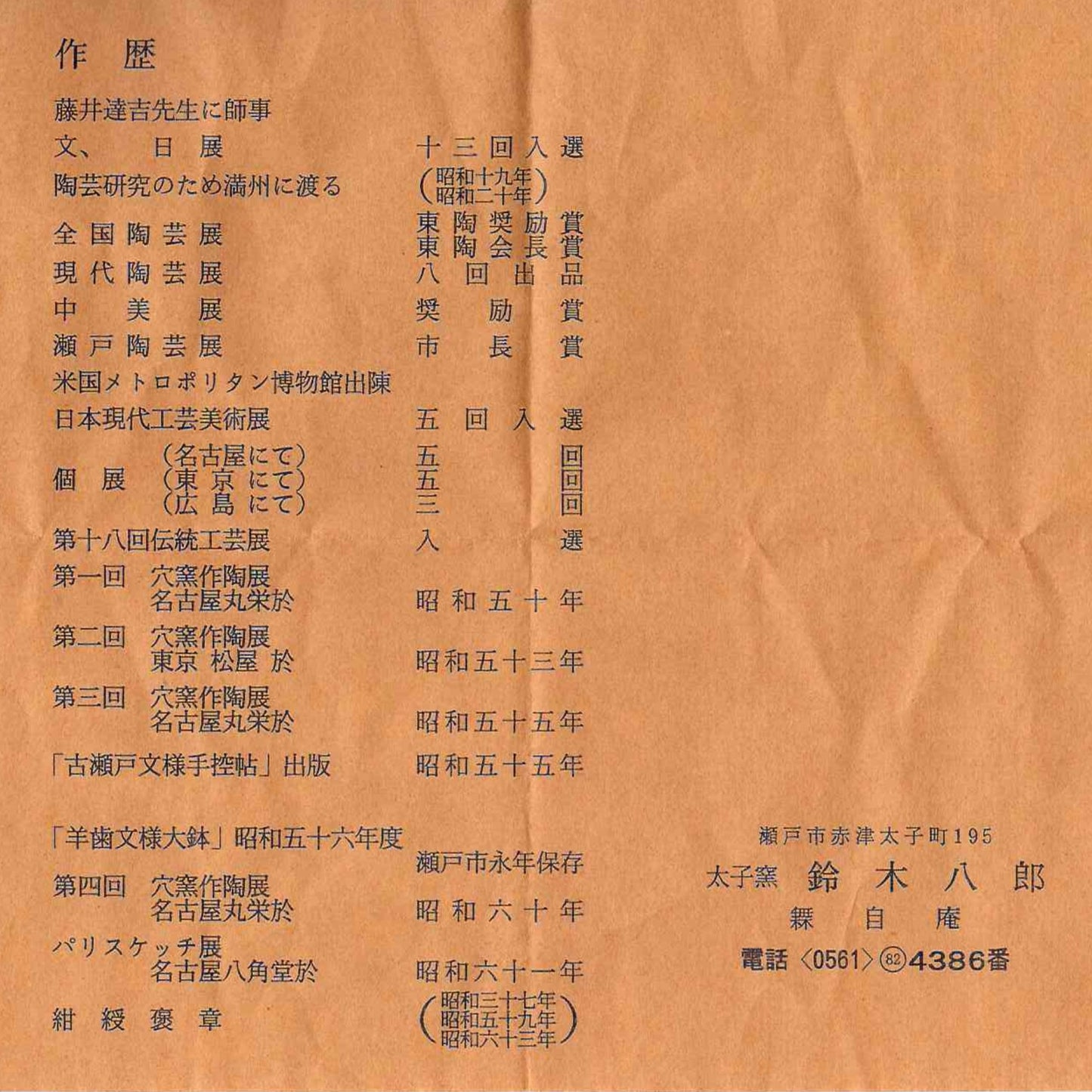
This Ash Glazed Tenmoku Chahai is crafted by Hachiro Suzuki (1915–2005), a master of the Seto ceramic world, holder of the Seto City Designated Intangible Cultural Property "Ceramic Ash Glaze Technique," and founder of Taishi Kiln. Having studied under Tatsukichi Fujii, a giant of modern craft art, to acquire design theory and craft philosophy, and after training under the traditional potter Seiichi Kamei, he traveled to Manchuria between 1944 and 1945 to deeply study ancient Chinese ceramics. Winning selection a total of 13 times at the Bunten and Nitten Exhibitions, and earning exceptionally high acclaim with his works exhibited at the Metropolitan Museum of Art in the United States and housed in the Aichi Prefectural Museum of Art, the Aichi Prefectural Ceramic Museum, and the Hekinan City Tatsukichi Fujii Museum of Contemporary Art, Hachiro Suzuki mastered the research of traditional Old Seto ash glaze techniques and anagama kiln firing.
Although the inscription on the box lid reads "Tenmoku Chahai (Chawan)", unlike typical black-glazed Tenmoku vessels originating from Jian kilns (such as oil-spot Tenmoku or hare's-fur Tenmoku), this piece is fired with "Ash Glaze" (Haiyu), an ancient traditional technique native to Seto. Tenmoku tea bowls imported from China to Japan established themselves in Japan under the concept of "Tenmoku-nari" (Tenmoku form), which refers not only to black glaze but to a distinct stylistic beauty characterized by a slightly flaring rim ("Suppon-guchi" or turtle-beak rim), a mortar-shaped silhouette tapering sharply from the waist to the foot ring, and a small, low foot. Grounded in the historical context of Seto as the sole region in Japan to replicate and develop Chinese Tenmoku forms during the Kamakura and Muromachi periods, Hachiro Suzuki fused his profound insights into ancient Chinese ceramics gained during his time in Manchuria with the craft aesthetic inherited from his mentor Tatsukichi Fujii, establishing the domain of "Ash Glazed Tenmoku" by applying a translucent ash glaze to the Tenmoku form rather than a black glaze.
Inspecting the details of this work clearly reveals the essence of the "Ceramic Ash Glaze Technique" certified as a Seto City Designated Intangible Cultural Property. From the upper section to the mid-body of the mortar-shaped Tenmoku silhouette, a translucent ash glaze with a delicate yellowish-green tint covers the vessel moistly, with fine crazing (crackles reminiscent of ice-crack patterns) and pinholes creating a beautiful gradation of scenery. From the lower portion where the glaze shifts toward the foot ring, a dark brown band emerges through carbonization reduction and fire paths from the anagama kiln firing, while the lowest base exposes raw, heavy clay containing coarse sand. The interior bottom (mikomi) radiates a soft luster from the pooled ash glaze, and beside the foot, the artist's stamp mark "Hachi" (八) is clearly impressed by his own hand.
The greatest charm of this "non-black Tenmoku" piece lies in the light translucency and the dramatic color shifts when liquid is poured inside. While traditional black Tenmoku absorbs light to generate heavy shadows, the interior of this piece finished with ash glaze features glass-like delicate crazing that irregularly reflects light, imparting a deep brilliance to poured liquids. Not only does it accentuate the vivid green of Matcha, but when floating a large ice cube and quietly pouring in amber aged sake, matured whisky, or authentic shochu, the translucent, pale yellowish-green glaze pool and the amber liquid overlap, creating a kaleidoscope of beautiful hues depending on the viewing angle and lighting. When held in hand, the taut form characteristic of the Tenmoku shape and the rustic clay texture near the foot offer a tactile comfort, acting as a luxury Japanese rocks glass (sake vessel) that engages all five senses to savor the aroma and flavor of aged spirits during a supreme moment.
Regarding the period of production, as the final record in the accompanying pamphlet notes his award of the Medal with Dark Blue Ribbon in 1988 (Showa 63), this piece is identified as an authentic work from circa 1980 to 1988 (late Showa 50s to early Showa 60s), during his peak period when he brought his intangible cultural property technique of ash glaze and anagama firing to a unique level of mastery through his solo exhibition series "Anagama Sakutoten" that began in 1975. The vessel body itself suffers no damage such as cracks or chips, maintaining an outstanding condition in both ash glaze coloration and clay texture. It is a complete, pristine offering accompanied by its dedicated paulownia Tomobako inscribed on the lid face with "Tenmoku Chahai" and on the back with "Made by Hachiro" with his red seal, a dedicated cloth with his seal mark, and a pamphlet recording his full ceramic career up to 1988.
- Artist: Hachiro Suzuki (1915–2005)
- Artist's Key Activities: [1944] Traveled to Manchuria for ceramic research; [1962, 1984, 1988] Awarded the Medal with Dark Blue Ribbon; [1975] Held the 1st Anagama Sakutoten solo exhibition (followed by many subsequent exhibitions); [1981] "Fern Pattern Large Bowl" designated as a permanently preserved work by Seto City; [1988] Certified as holder of the Seto City Designated Intangible Cultural Property "Ceramic Ash Glaze Technique"
- Works Housed In: The Metropolitan Museum of Art (USA), Aichi Prefectural Museum of Art, Aichi Prefectural Ceramic Museum, Ichinomiya City Museum, Hekinan City Tatsukichi Fujii Museum of Contemporary Art, Seto City
- Period of Production: Circa 1980–1988 (Estimated)
- Condition: Very good (no chips, no cracks)
- Accessories: Dedicated Tomobako, pamphlet included
- Material: Pottery (Seto ware, ash glaze, Tenmoku form, with artist's mark)
- Dimensions: Height approx. 8.0 cm, Mouth diameter approx. 12.0 cm
- Caution: All products offered by our shop are pre-owned items due to their historical production period, even if unused. Products may have age-related damage, so please consider purchasing after understanding and verifying these condition details.