This Mino ware E-Shino Chawan is endowed with a precious inscription and titled "Yuki no Hi" (Snowy Day) by Grand Master Sokuchusai (Sen Sosa, 1901–1979), the 13th Headmaster of Omotesenke, who preserved the traditions of Omotesenke through the turbulent Showa period and laid the foundations of modern tea ceremony. Taking the National Treasure "Shino Chawan Titled Uhanagaki"—one of only two domestic tea bowls designated as National Treasures in Japan—as its Honka (the original reference model), this masterpiece replicates its dignified form and possesses the highest-ranking official authentication (Kiwame) in the Japanese tea ceremony world. It is presented to our global clientele not only as a Matcha bowl for enjoying traditional tea, but also as a luxury Japanese rocks glass (sake vessel)—taking advantage of its heavy, dignified semi-cylindrical form and warm white glaze reminiscent of fallen snow—for floating large ice cubes and quietly pouring amber aged sake, matured whisky, or authentic shochu.
Born as the second son of the 12th Headmaster Seisai, Master Sokuchusai succeeded as the 13th Headmaster in 1937 under the foundation of a high classical education in history at Keio University and Kyoto Imperial University. During the chaotic period during and after the war, he established the nationwide organization "Senke Domonkai" to gather scattered disciples and established the non-profit corporation Fushin'an to protect the symbolic tea room of the Sen family, earning acclaim as the founder of modern tea ceremony organizations. An inscription (Kakitsuke or Hakogaki) brushed in ink on the reverse side of the paulownia box lid by the Headmaster—the supreme authority in the tea world—is not a mere assertion of ownership, but an official authentication (Kiwame) certifying that the Headmaster personally handled, examined, and appreciated the vessel, deeming it to possess exquisite craftsmanship and nobility suitable for use as the primary bowl (Shu-chawan) in a formal tea gathering. In this work as well, Master Sokuchusai inscribed "Shino Chawan, Titled Yuki no Hi, Sa (Kaō)", breathing life and narrative into the vessel and endowing it with the orthodox prestige of Omotesenke.
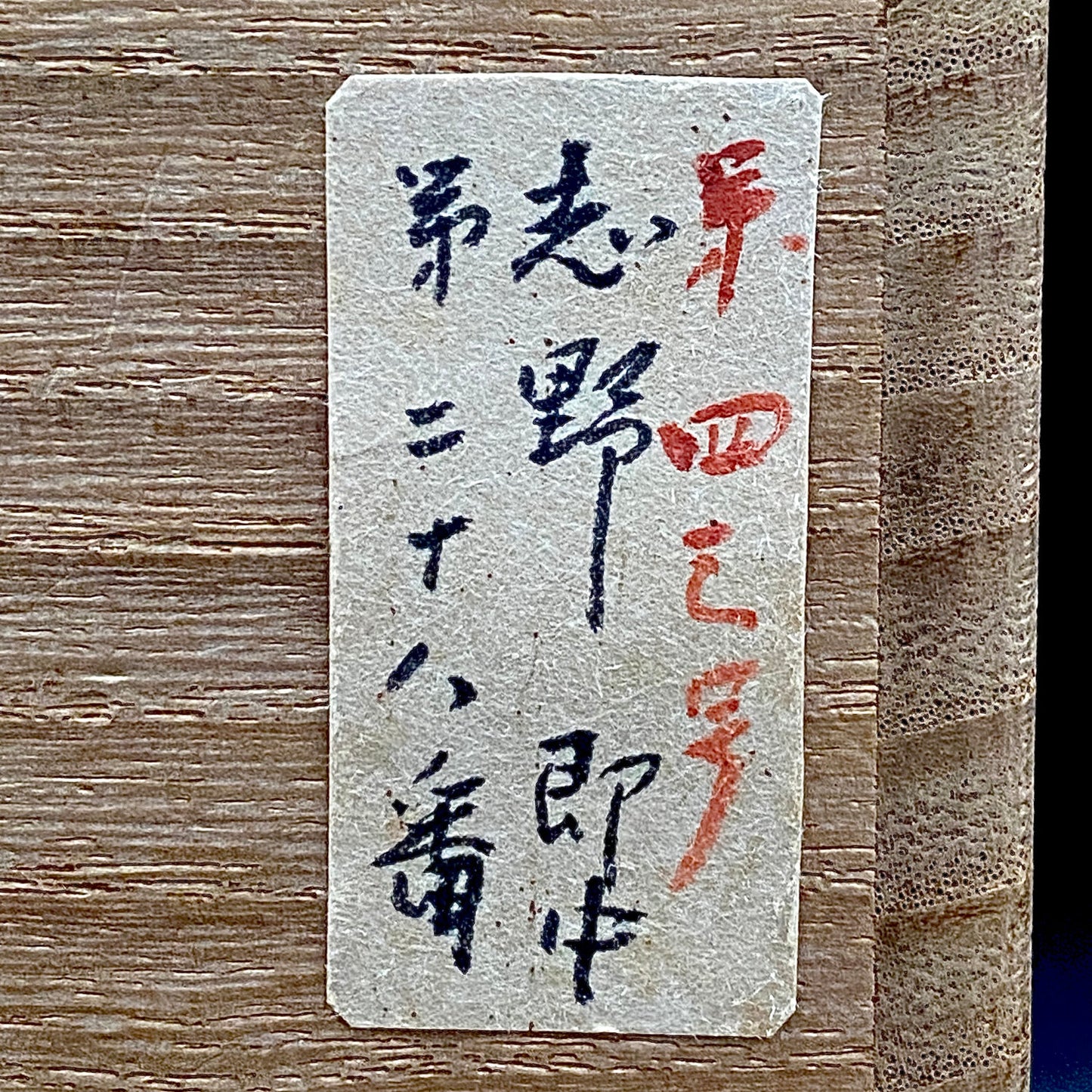
As a strict convention in the world of tea utensils, when a work is crafted by the Headmaster's own hands through shaping or carving (a self-made work), the inscription on the Tomobako inevitably includes the words "Jisaku" (self-made) or "Tezo" (hand-crafted). On the other hand, works such as this piece, which lack self-made designations on the box inscription and are recorded simply as "Shino Chawan, Titled Yuki no Hi", indicate an appreciated work—a replica masterpiece fired by a top-tier Mino master potter using the pinnacle of technique, which Master Sokuchusai deeply cherished and granted authentication (Kiwame). Furthermore, a Dogufuda (inventory tag) inscribed with "Shino Sokuchu / No. 28 / No. 43" is affixed to the side of the box, proving a verified provenance carefully managed in the inventory ledgers of prominent tea masters, major collectors, or prestigious art dealers. In particular, this piece, adorned with the character "Sa" (the hereditary signature character of Omotesenke headmasters) and a flowing Kaō (stylized mark), boasts perfect provenance as a primary tea bowl for tea gatherings, establishing extremely high credibility and rarity in the antique art market.
Shino ware, which flourished in Mino (Gifu Prefecture) during the Momoyama period, is the traditional Japanese ceramic art that first applied a translucent white glaze (feldspar glaze), and this work embodies the traditional style of "E-Shino," in which motifs are painted with iron oxide (Oni-ita). As a replica of the National Treasure "Uhanagaki," this work faithfully inherits the aesthetic characteristics of its original model: a powerful semi-cylindrical shape with sharp spatula carving, a lattice pattern (Igeta grid pattern) seeping from under the thick feldspar glaze, and subtle fire marks (Hiiro) generated by the kiln flames. Examining the details of the piece, the feldspar glaze covering the entire vessel exhibits a moist milk-white hue, showing a rich texture reminiscent of a fresh layer of soft snow through fine "Yuzu-hada" (citrus peel texture) and crackles (Crazing) formed as the glaze melted and contracted during firing. From beside the foot to the base, the raw clay body containing coarse sand remains exposed with rough carving marks, while the interior bottom (mikomi) features a deep glaze pool and soft crackles, creating a pure and powerful scenery.
Given the history of the National Treasure "Uhanagaki" being named after snow piling on a hedge, likened to the feeling of "stepping through the snow" expressed in a classical waka poem, the title "Yuki no Hi" (Snowy Day) bestowed by Master Sokuchusai is an elegant naming that brilliantly echoes the scene and poetic taste of the National Treasure through Honkadori (poetic allusion). The greatest pleasure in enjoying this Shino tea bowl as a sake vessel lies in the substantial tactile feel provided by its thick semi-cylindrical form and the beautiful contrast between the white glaze and reddish fire marks when liquid is poured inside. Unlike typical black Tenmoku that absorbs light, the warm white glaze surface of Shino gently reflects light and poured liquids. When floating large rocks of ice and quietly pouring amber aged sake, matured whisky, or authentic shochu, the moist white glaze, net-like crackles in the interior, and delicate reddish fire marks on the vessel surface emerge fantastically through the amber liquid, generating a beautiful, radiant coloration as if warm sunlight were shining upon a snowy plain. Regarding the period of production, based on the calligraphic style of "Sa" in Master Sokuchusai's handwriting, his fluidly looping Kaō style, and alignment with his peak period from the mid-to-late Showa era when he granted inscriptions to famous kilns across Japan to expand Omotesenke tea ceremony, it is identified as a work created and inscribed around the 1950s to 1970s (Showa 30s to Showa 50s). The vessel itself suffers no damage such as chips or cracks, maintaining outstanding condition in both Shino glaze coloration and iron painting texture. It is a highly dignified masterpiece accompanied by its dedicated paulownia box bearing the authentic ink inscription "Shino Chawan, Titled Yuki no Hi, Sa (Kaō)" on the underside of the lid by Master Sokuchusai, a wrapping cloth, and an inventory tag detailing its provenance.
- Artist: Mino Master Kiln Potter (Vessel) / Omotesenke 13th Sokuchusai Soshu (Calligraphy, 1901–1979)
- Artist's Key Activities: [1937] Succeeded as 13th Headmaster of Omotesenke; [1942] Founded Senke Domonkai (now Public Interest Incorporated Association Omotesenke Domonkai); [1949] Established Fushin'an Foundation
- Works Housed In: Fushin'an, Omotesenke Kaikan, etc.
- Period of Production: Vessel production date unknown; Calligraphy estimated circa 1950s–1970s
- Condition: Very good (no chips, no cracks)
- Accessories: Dedicated paulownia box (with Sokuchusai lid-back inscription and Kaō), wrapping cloth
- Material: Pottery (Mino ware, E-Shino, feldspar glaze, iron oxide painting)
- Dimensions: Height approx. 9.0 cm, Mouth diameter approx. 12.5 cm
- Caution: All products offered by our shop are pre-owned items due to their historical production period, even if unused. Products may have age-related damage, so please consider purchasing after understanding and verifying these condition details.