This is a guinomi sake cup by Kawajiri Hiroshi (川尻浩史), a potter of Mashiko ware. Black and amber glazes are boldly layered over a white glaze, and several dents that look as if pressed in with the fingers mark the body. The lid of the signed wooden box (tomobako) is inscribed 「ぐい呑」 (guinomi) and signed 「浩史」 with a red seal, and the cup comes with a leaflet listing the artist's career. We propose it as a Japanese-style shot glass for savoring old-bottle whisky and long-aged spirits neat, a little at a time.
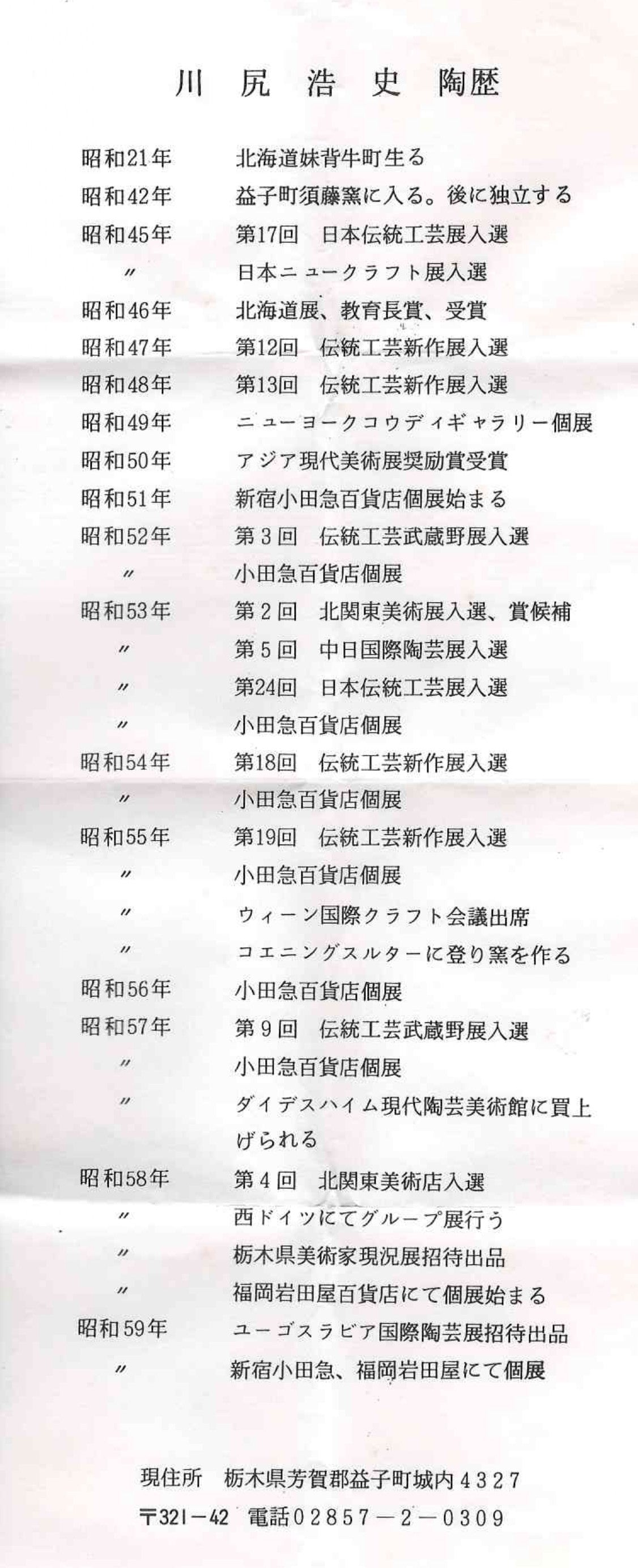
Kawajiri Hiroshi was born in 1946 (Showa 21) in Moseushi, Hokkaido. In 1967 (Showa 42) the artist joined the Sudō kiln (須藤窯) in Mashiko, Tochigi Prefecture, trained there, and later became independent, establishing Kazegama (風窯). The artist's official website introduces Kazegama as a climbing-kiln (noborigama) pottery that carries on the tradition of Mashiko ware, and explains that in a wood-fired climbing kiln, ash settles on the works and the way the flames travel gives them distinctive fired colors. Kawajiri was selected for the 17th Japan Traditional Kōgei Exhibition in 1970 (Showa 45) and for the same exhibition again in 1978 (Showa 53), was repeatedly selected for the Traditional Kōgei New Works Exhibition, the Traditional Kōgei Musashino Exhibition, the North Kantō Art Exhibition and others, and received an Encouragement Prize at the Asian Contemporary Art Exhibition in 1975 (Showa 50).
The artist was active abroad from an early stage. In 1974 (Showa 49) Kawajiri held a solo exhibition at a gallery in New York (コウディギャラリー), and in 1980 (Showa 55) attended an international craft conference in Vienna and built a climbing kiln in Königslutter, West Germany (written コエニングスルター in the leaflet). According to the enclosed leaflet, a work was purchased in 1982 (Showa 57) by the Museum of Modern Ceramics in Deidesheim, West Germany (ダイデスハイム現代陶芸美術館). In 1985 (Showa 60) the artist was selected for the 43rd International Competition of Contemporary Ceramic Art in Faenza, Italy, and for the 8th Japan Ceramic Art Exhibition, and in 1989 (Heisei 1) took part by invitation in an exhibition of seven contemporary Japanese potters held at a museum in Braunschweig, Germany. Later, Kawajiri received the Shin-Nichibi Grand Prize at the Shin-Nichibi Exhibition (新日美展) in 2005 (Heisei 17) and was nominated as a juror for its craft section the following year.
Mashiko ware was designated a national Traditional Craft in 1979 (Showa 54), and the designation standards specify the glazes 並白釉, 柿赤釉 (persimmon red), 黒釉 (black), あめ釉 (amber), 糠白釉, 灰釉 (ash) and 糠青磁釉. In this cup, a glossy black-brown glaze and an amber glaze with fine gradations are boldly layered over a white glaze ground; where the glazes overlap they run and bleed into one another, creating a scene in which black, amber and white mingle. Depending on the light, the black-brown glaze shows a bluish-purple sheen. The thick body has several dents that look as if pressed in with the fingers, and the fingers settle naturally into them when the cup is held. Amber and black glaze also touch the rim here and there. The interior is covered with a pale grayish-white glaze scattered with small black iron specks, and faint throwing lines remain. The foot is left unglazed to show the clay, revealing a coarse texture rich in sand, and inside the foot a white glaze has crawled into beads.
The enclosed leaflet records the artist's career from birth in 1946 (Showa 21) to 1984 (Showa 59). Since it does not include the 1985 (Showa 60) selections for the Faenza competition and the Japan Ceramic Art Exhibition listed on the artist's official website, the leaflet appears to have been made around 1984–1985, and this cup is estimated to date from about the same time.
- Artist: Kawajiri Hiroshi (川尻浩史; born 1946) / Kazegama (風窯), Mashiko, Haga District, Tochigi
- Representative Career Highlights: [1946] Born in Moseushi, Hokkaido; [1967] Trained at the Sudō kiln (須藤窯) in Mashiko, later became independent; [1970] Selected for the 17th Japan Traditional Kōgei Exhibition / selected for the Japan New Craft Exhibition (日本ニュークラフト展); [1971] Superintendent of Education Prize, Hokkaido Exhibition (北海道展); [1972, 1973, 1979, 1980] Selected for the Traditional Kōgei New Works Exhibition; [1974] Solo exhibition at a gallery in New York (コウディギャラリー); [1975] Encouragement Prize, Asian Contemporary Art Exhibition; [1976] Began solo exhibitions at the Odakyu Department Store in Shinjuku; [1977, 1982] Selected for the Traditional Kōgei Musashino Exhibition; [1978] Selected for the Japan Traditional Kōgei Exhibition / selected for the 2nd North Kantō Art Exhibition; [1980] Attended an international craft conference in Vienna / built a climbing kiln in Königslutter, West Germany; [1982] Work purchased by the Museum of Modern Ceramics in Deidesheim, West Germany / two-person exhibition at the Mashiko Gallery in Berlin; [1983] Selected for the 4th North Kantō Art Exhibition / invited to the Tochigi Prefecture Artists' Current Works Exhibition (栃木県美術家現況展) / group exhibition in West Germany; [1984] Exhibited at an international ceramics exhibition in Zagreb (former Yugoslavia); [1985] Selected for the 8th Japan Ceramic Art Exhibition / selected for the 43rd International Competition of Contemporary Ceramic Art in Faenza; [1989] Invited to an exhibition of seven contemporary Japanese potters at a museum in Braunschweig, Germany; [1999] Tokyo Metropolitan Board of Education Prize, Shin-Nichibi Exhibition; [2002] Special Selection, Shin-Nichibi Exhibition; [2005] Shin-Nichibi Grand Prize, Shin-Nichibi Exhibition; [2006] Nominated as a juror for the craft section of the Shin-Nichibi Exhibition
- Public Collections: Museum of Modern Ceramics, Deidesheim (West Germany; purchased in 1982), according to the enclosed leaflet
- Production Period: Around 1984–1985 (estimated; the career list in the leaflet ends in 1984 and does not include the 1985 selections)
- Item Condition: Very Good (no chips, no cracks)
- Accessories: Signed wooden box (lid inscribed 「ぐい呑」, signed 「浩史」 with a red seal), leaflet (career list)
- Material: Ceramics (Mashiko ware)
- Dimensions: Height approx. 4.7 cm, rim diameter (width) approx. 6 cm
- Note: Even if the products provided by our shop are unused, they were produced a very long time ago and are all listed as pre-owned items. Please understand and confirm that the item may have age-related wear before considering your purchase.