Elevating modern Japanese glass art into the realm of fine arts and revered as the father of modern Japanese glass art, this masterpiece titled "Glass Network Flower Vase" is crafted by master artisan Toshichi Iwata (1893–1980). Born in Nihonbashi, Tokyo in 1893, he studied metalwork, lacquerware, Western painting, and sculpture at the Hakubakai Western Painting Institute and the Tokyo Fine Arts School, ultimately transitioning into the world of glass backed by the sense of form he cultivated through metalwork and painting. Pioneer of freeform techniques such as free-blowing (chubuki), Toshichi Iwata achieved numerous monumental milestones, including winning consecutive Special Prizes at the Teiten Exhibition, a Silver Medal at the Paris Exposition, the Japan Art Academy Prize, the Mainichi Art Award, selection as a Person of Cultural Merit, and receiving the Order of the Sacred Treasure, Gold and Silver Star (Second Class). While originally crafted as a fine flower vase (hanaike), its mesh-like structure gracefully transmitting light allows it to be presented to the world as an exclusive fruit basket adding color alongside aged sake, or as a luxury candle holder (candelabra) for enjoying intricate plays of light and shadow when illuminated within.
Examining the fine details of this work reveals the exceptional mastery of the "hot-worked network technique" established by Toshichi Iwata after long years of research displayed without reserve. This technique, where molten transparent glass rod stock at temperatures of approximately 1,200 to 1,300 degrees Celsius is manually crossed three-dimensionally and fused into a lattice structure just before cooling and hardening through a moment of breath and swift handwork, requires an extraordinary degree of artisan intuition and rapid temperature control. Created without using any molds, this vessel possesses an organic openwork structure formed by glass strands undulating and intertwining in multiple layers, showing magnificent harmony between the soft upward curvature of the rim and the thick transparent glass base set at the bottom. The clear refracted light inherent to the colorless, transparent glass material itself reflects intricately off the lattice joints and overlapping curved surfaces, resulting in a structure that complexly amplifies incoming light.
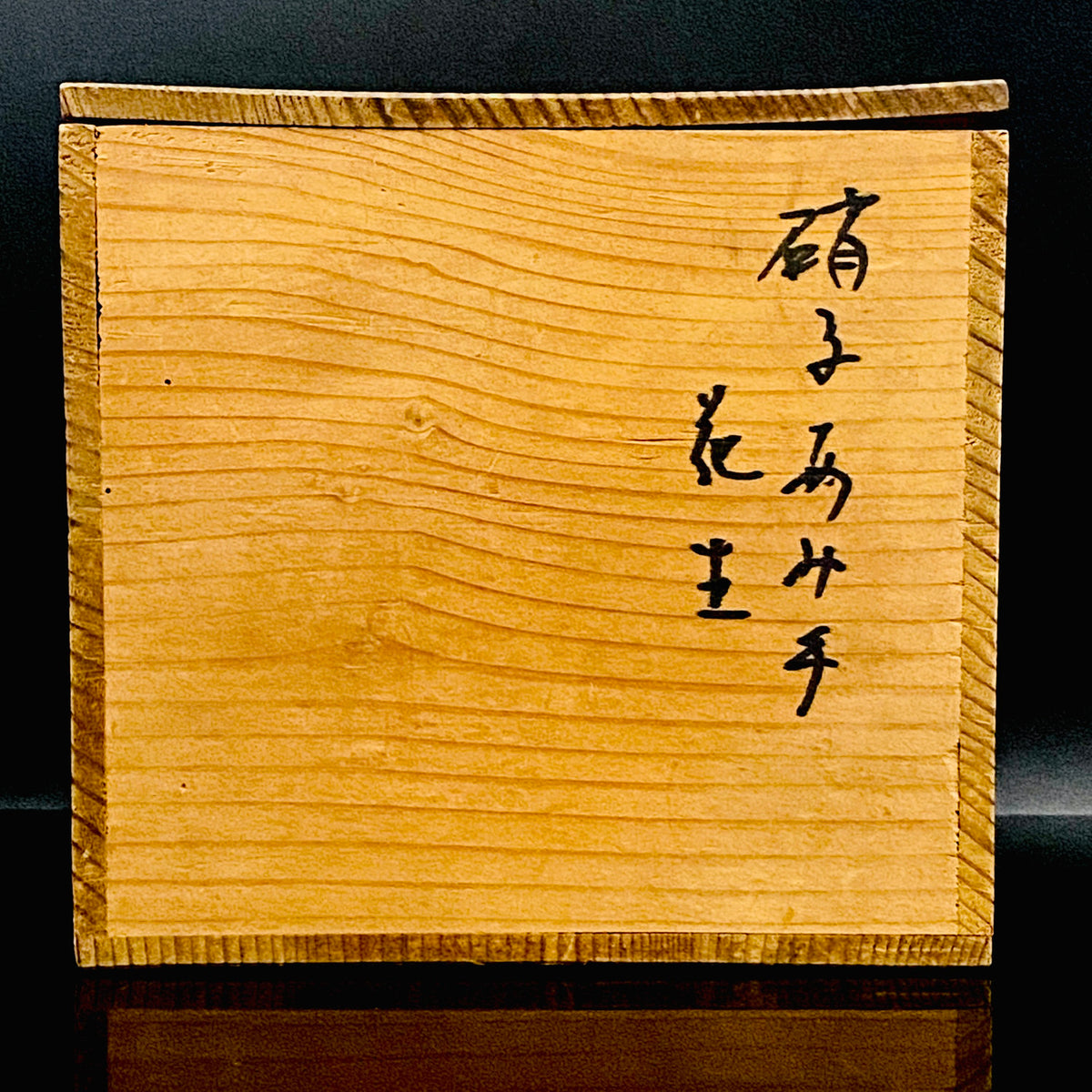
Regarding the period of production, following a trial period in the 1930s, it can be specified as created circa 1965 to 1975 (late Showa 40s to early Showa 50s), a time when Mr. Iwata's free-blowing and network techniques reached the peak of artistic maturity and he vigorously produced creative flower vessels around the time of his selection as a Person of Cultural Merit (1970). Inside the lid of the original box (Tomobako), the author's handwritten signature "Toshichi Iwata zo" and red seal are clearly inscribed, corroborating precious craft value representative of the artist's mature period. The vessel body itself shows no damage such as cracks or chips, maintaining an excellent condition in its highly transparent glass material and joint texture. It comes complete with a dedicated original box featuring the artist's handwritten inscription.
- Artist: Toshichi Iwata (1893–1980)
- Artist's Key Activities: [1928–1930] Won Special Prizes three consecutive times at the 9th–11th Teiten Exhibitions; [1937] Awarded Silver Medal at the International Exposition of Art and Technology in Paris; [1951] Received the Japan Art Academy Prize; [1954] Appointed member of the Japan Art Academy; [1958] Won Grand Prix at the Brussels World's Fair; [1969] Received the Mainichi Art Award; [1970] Selected as a Person of Cultural Merit; [1980] Conferred the Order of the Sacred Treasure, Second Class
- Works Housed In: The National Museum of Modern Art, Tokyo; The National Museum of Modern Art, Kyoto; Hokkaido Museum of Modern Art; Toyama City Museum of Glass Art; Machida City Museum; Tochigi Prefectural Museum of Fine Arts; The Museum of Modern Art, Kamakura & Hayama; The Metropolitan Museum of Art (New York), among many others
- Period of Production: Circa 1965–1975 (estimated)
- Condition: Good (no chips, no cracks, age-related scuffs present, box shows staining)
- Accessories: Dedicated original box (Tomobako) included
- Material: Glass (free-blown, hot-worked network structure)
- Dimensions: Height approx. 13.0 cm, Width approx. 12.5–15.0 cm (oval)
- Caution: All products offered by our shop are listed as pre-owned items due to their historical production period, even if unused. Products may have age-related damage, so please consider purchasing after understanding and verifying these condition details.