Ryosai Inoue III (1888–1971, real name Ryotaro Inoue) was a ceramic artist who produced "Kanagawa ware" in Yokohama from the Taisho through the Showa era. He served as a member of the Japan Art Academy and an advisor to the Nitten (Japan Fine Arts Exhibition). In the late Edo period, Ryosai I moved from Owari Seto to Edo and established a kiln in Asakusa, where he produced "Sumida ware," export ceramics renowned for high-relief decoration. Ryosai II was known for fine underglaze-painted works and won a Gold Medal at the 1900 Paris Exposition. Ryosai III was born in Asakusa, Tokyo, in 1888 as the eldest son of the second generation. In 1905, he engaged in pottery making to succeed the family business as the third generation, studying under Hazan Itaya, a pioneer of modern Japanese ceramic art, and refining his craft over many years.
In 1914, he relocated to Yokohama for its convenient export access, establishing a kiln in Takashima-cho. After suffering damage in the Great Kanto Earthquake, he built a new climbing kiln (noborigama) in Nagata (now Nagata-Higashi, Minami Ward, Yokohama City). In this Nagata workshop, he continued to create pottery for nearly half a century until his death. This climbing kiln and workshop site is the only climbing kiln remaining in Yokohama City, and in 2023, it was registered as a Yokohama City Historic Building.
As an artist, he participated from its inception in the "Totokai," an association of Kanto ceramic artists founded in 1927 by Hazan Itaya and others. In 1928, he was selected for the first time for the Teiten (Imperial Art Exhibition), and from the following year onward, he held approximately 20 solo exhibitions at the Mitsukoshi Main Store. In 1943, he became a "Mukansa" (exempt from screening) exhibitor at the Buntan (Ministry of Education Art Exhibition). After World War II, he was primarily active in the Nitten, receiving the 1st Yokohama Cultural Award in 1953 while serving five times as a Nitten judge. In 1959, he was awarded the Japan Art Academy Award for "Round-Pattern Flat Plate," and in 1966, he became a director of the Nitten and a member of the Japan Art Academy. In 1967, he received the Order of the Sacred Treasure, Third Class. His works are held in collections including the Yokohama Museum of Art and the Kanagawa Prefectural Museum of Cultural History.
Regarding his artistic style, the Yearbook of Japanese Art by the Tokyo National Research Institute for Cultural Properties notes that he displayed unique coloration in jars and plates of celadon, white porcelain, and green glaze, and was cherished by enthusiasts for a dignified, noble style that directly mirrored his gentle and warm personality. Research by curators at the Kanagawa Prefectural Museum of Cultural History also highlights several key characteristics: his ornamentation was understated through glazes or carving, he favored simplified motifs, and his sculpting primarily sought to bring out the inherent quality of the glaze tone and the form itself. Over half of the works examined by the museum were unpatterned pieces decorated solely by glaze or simple lines. Furthermore, it has been confirmed that he mastered a wide variety of glazes, including green glaze, celadon, white porcelain, cinnabar (copper red) glaze, crystalline glaze, and his own original glaze formulations. While continually studying ancient ceramics, he was a master potter representing Yokohama who dedicated his life to experimenting with forms and glazes.
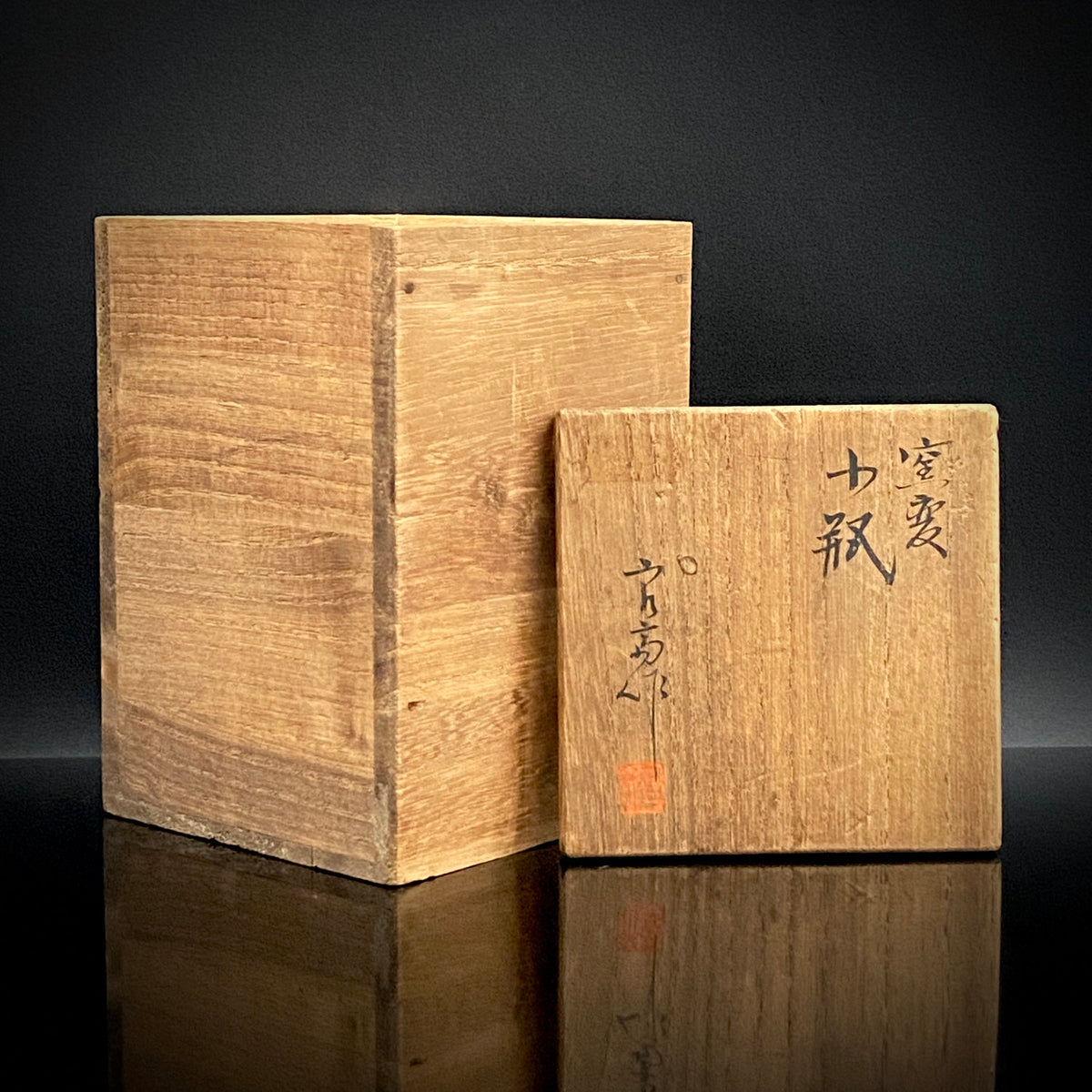
This piece is a small bottle with the inscription "Yohen Small Bottle" on the top of the tomobako lid. It features no surface patterning or painting; all of the vessel's expression arises from the kiln transmutation (yohen) of the glaze during firing. Dense, fine brown speckles appear across the blackish-brown to dark brown glaze, displaying a granular, tactile texture. From the shoulder to the neck, the glaze pools thickly with a strong luster, casting a metallic sheen depending on the angle of light. Gentle vertical indentations run down the body, where the pooled glaze forms dark bands to create a landscape (keshiki). The lower part of the body is left unglazed to reveal the reddish-brown clay body, where the coarse clay texture containing white feldspar grains forms a vivid contrast with the blackish-brown glaze above. Its coloration calls to mind the fruit of autumn Japanese chestnuts. Fashioned in an upright, dignified small bottle form with taut shoulders, the rim of the short neck flares slightly outward, and wheel marks remain on the body. A seal stamp is impressed on the base. Relying on no extraneous decoration, showcasing the interplay between glaze transmutation, clay contrast, and form itself, this work clearly exemplifies the core of his style as identified in curatorial research.
The accompanying shiori lists "Nitten Judge" among his titles and records his career up to his service as a Nitten judge in Showa 31 (1956). It does not mention his appointment as a Nitten councilor in 1958, the Japan Art Academy Award in 1959, or his membership in the Japan Art Academy in 1966. Furthermore, the seal of "Member of the Japan Art Academy" often seen on tomobako from his later years is absent from this box. Based on these details, this work is considered to have been produced between around 1956 and 1958. It is a piece from the period when he was active as a Nitten judge, just prior to receiving the Japan Art Academy Award.
Measuring approximately 7 cm in diameter and 11 cm in height, this piece is a size that fits comfortably in the palm of your hand. Our shop proposes it as a water dropper for pouring chaser water alongside vintage whisky, or as a small liquor bottle for holding a modest pour of spirits. It is an exquisite item that allows you to enjoy close at hand, as a tool accompanying your daily dram, a creation by an artist who left a lasting name in the history of modern Japanese ceramics.
- Artist: Ryosai Inoue III (井上 良斎, 1888–1971), Real name: Ryotaro Inoue(井上 良太郎)
- Major Career Highlights: [1888] Born in Asakusa, Tokyo, as the eldest son of Ryosai Inoue II; [1905] Engaged in pottery making to succeed the family business as the third generation, studying under Hazan Itaya; [1914] Relocated kiln to Takashima-cho, Yokohama; [From 1923 onward] After suffering damage in the Great Kanto Earthquake, built a climbing kiln in Nagata (now Nagata-Higashi, Minami Ward, Yokohama City); [1927] Participated in founding Totokai; [1928] First selected for 9th Teiten; [1929] Held solo exhibition at Mitsukoshi Main Store (approx. 20 times thereafter); [1943] Mukansa (exempt from screening) at Buntan; [1951] Entrusted artist at Nitten; [1953] Received 1st Yokohama Cultural Award; served as Nitten judge (5 times total); [1958] Councilor of Nitten; [1959] Received Japan Art Academy Award (Round-Pattern Flat Plate); [1966] Director of Nitten, Member of Japan Art Academy; [1967] Received Order of the Sacred Treasure, Third Class; Vice President of Japan Contemporary Craft Artists Association; [1968] President of Kanagawa Prefectural Craft Association; [1971] Passed away on February 6 (aged 82); [2023] Nagata climbing kiln and workshop site registered as a Yokohama City Historic Building
- Museum Collections: Yokohama Museum of Art, Kanagawa Prefectural Museum of Cultural History, Kanagawa Prefectural Government, and others
- Period of Production: c. 1956 to c. 1958 (estimated)
- Item Condition: No noticeable chips or cracks. Fine crack-like lines inherent to the clay surface are visible on the unglazed portion of the base (refer to images)
- Accessories: Dedicated tomobako (lid top inscribed "Yohen Small Bottle", signature and red seal stamp), shiori (with career history) included
- Material: Pottery / Stoneware (Kanagawa ware)
- Dimensions: Diameter approx. 7.0 cm, Height approx. 11.0 cm
- Note: All items offered by our shop, even if new and unused, were produced a very long time ago, and all are therefore listed as pre-owned. Items may show age-related wear or damage. Please understand and confirm this before considering a purchase.