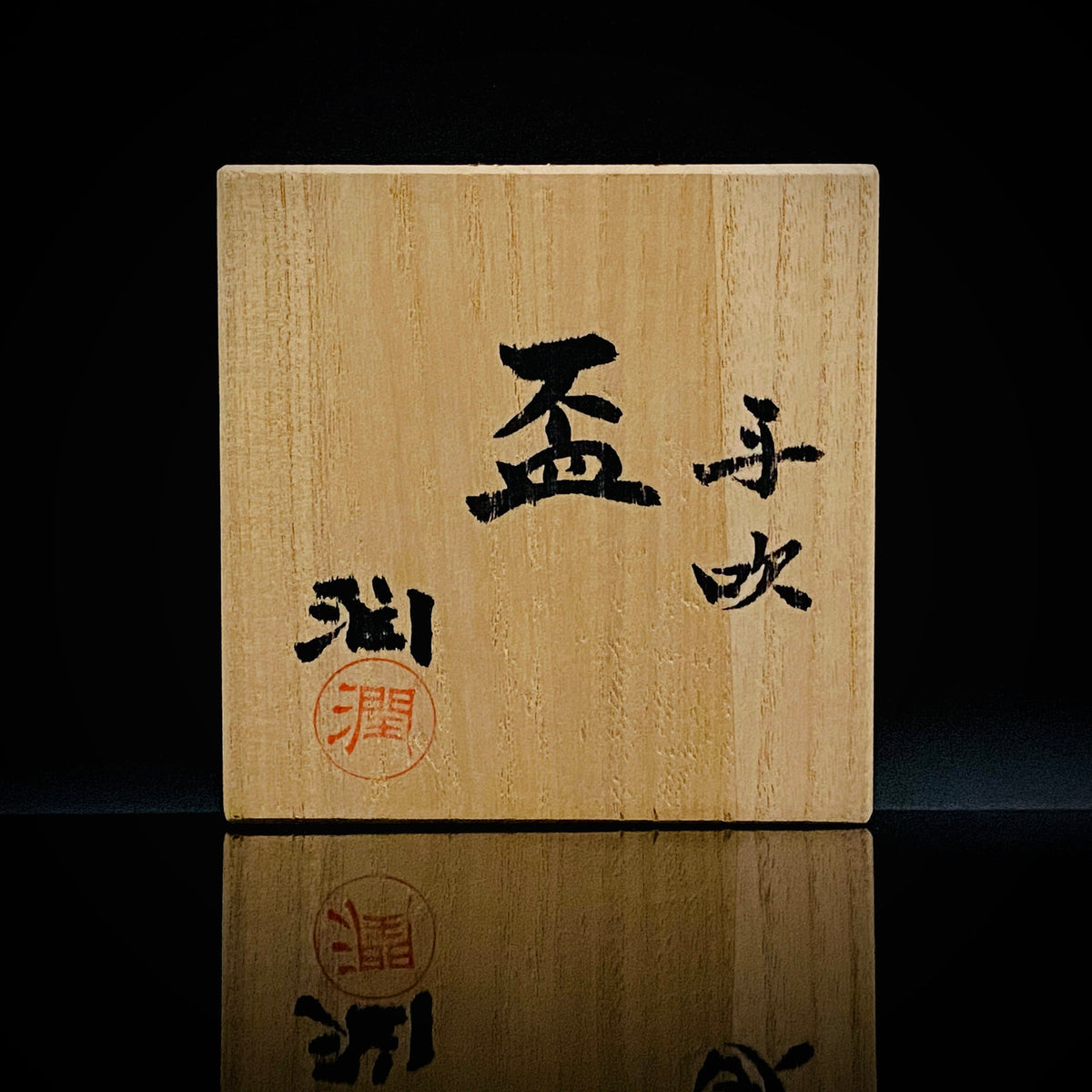
This piece is a hand-blown glass sake cup by Jun Fujita (born 1951), a glass artist whose works are held in the collections of the National Crafts Museum and the Yokohama Museum of Art. The underside of the foot bears the incised signature “Jun” in Roman letters. The lid of the tomobako (the artist-inscribed wooden box) bears the ink inscription “Tebuki Sakazuki” (hand-blown sake cup), together with the artist’s signature “Jun” (潤) and his red seal. The body is clear glass with a frosted matte finish, its lower half clad in finely fragmented gold-tone foil. Measuring approximately 3.5 cm in height and 8.0 cm in rim diameter, this shallow cup is well suited for use as a Japanese-style shot glass for savoring aged spirits a little at a time.
Mr. Fujita was born in Edogawa Ward, Tokyo, in 1951, and moved to Ichikawa City, Chiba Prefecture, in 1955. After graduating from the Department of Philosophy in the Faculty of Letters at Gakushuin University in 1975, he set out on the same path of glass art as his father, Kyohei Fujita, the first glass artist to receive the Order of Culture. Since holding solo exhibitions at Takashimaya in Tokyo and Osaka in 1984, he has held solo exhibitions on a regular basis. In 1991 he took part in the 4th World Contemporary Glass Exhibition at the Hokkaido Museum of Modern Art. His awards include the Bridgestone Museum of Art Prize at “Glass ‘96 in Japan” in 1996, the Merit Prize at the KOGANEZAKI Vessel Form International Glass Exhibition in 2000, and the Gold Prize at the International Exhibition of Glass Kanazawa in 2001, and in 2008 he received a Commendation from the Commissioner for Cultural Affairs. He has also served as Chairman of the Japan Glass Artcrafts Association, devoting himself to the advancement of the glass art community in Japan. His works in public collections include “Impression” and “Two People” (both 1993) at the National Crafts Museum (The National Museum of Modern Art, Tokyo), and “Path of the Wind” (1999) at the Yokohama Museum of Art.
Mr. Fujita has sought a sense of weightlessness in glass, continuing to work on the themes of wind, air, and water. He himself has said that glass is a material well suited to expressing sensations such as “floating,” “flowing,” and “drifting.” According to the Yokohama Museum of Art, his works make full use of free-blowing (chūbuki), in which the glass is inflated in midair while the blowpipe is rotated, and slumping, in which glass placed over a mold is heated so that it takes shape under its own weight. He further decorates the surface by sandblasting and acid etching, creating delicate effects of light. Like his father, he works in both Japan and Venice, Italy, and in recent years he has also presented a series of kazaribako (decorative boxes), the form for which his father was renowned.
As the inscription “Tebuki” (hand-blown) on the tomobako indicates, this cup was formed by blowing, without the use of a mold. The vessel is a shallow cup set on a small, low cylindrical foot, with a rounded rim that curves slightly inward. The entire surface has a matte finish with subdued luster. From the rim to the upper half of the body, the clear glass is left unadorned, while a band of gold-tone foil is applied from the lower half of the body down to the edge of the foot. The foil is broken into a fine network of cracks, and these cracks become lines radiating outward from the foot, so that when the cup is viewed from below, the pattern resembles rays of light extending in all directions from the foot at its center. The foil fragments gather in larger pieces near the foot and scatter into finer particles toward the upper edge, merging into the glass ground. The upper edge of the foil breaks off irregularly, creating a soft undulation along its border with the clear glass. Looking into the interior, the band of foil shows through the frosted wall, appearing as a golden ring encircling the bottom of the cup. When the cup is filled, the shimmer of the foil wavers beneath the surface of the liquid, offering an expression different from that seen from the outside. The foot is of frosted clear glass, and the signature “Jun” is incised on its flat underside.
The piece bears no date. It is a work made after 1975, when the artist set out on the path of glass art, and it comes complete with the artist’s incised signature and a tomobako bearing his signature. This hand-blown sake cup by an artist whose works are held by a national crafts museum and a public art museum, and whose career includes major awards and the chairmanship of the Japan Glass Artcrafts Association, is a piece that allows contemporary Japanese glass art to be enjoyed at the table every day.
- Artist: Jun Fujita (藤田 潤, born 1951)
- Representative career highlights: [1975] Graduated from the Department of Philosophy, Faculty of Letters, Gakushuin University, [1984] Solo exhibitions at Takashimaya, Tokyo and Osaka (held regularly thereafter), [1991] Exhibited at the 4th World Contemporary Glass Exhibition (Hokkaido Museum of Modern Art), [1996] Bridgestone Museum of Art Prize, “Glass ‘96 in Japan”, [2000] Merit Prize, KOGANEZAKI Vessel Form International Glass Exhibition, [2001] Gold Prize, International Exhibition of Glass Kanazawa, [2006–2015] Chairman, Japan Glass Artcrafts Association, [2008] Commendation from the Commissioner for Cultural Affairs
- Museum collections: National Crafts Museum (The National Museum of Modern Art, Tokyo), Yokohama Museum of Art
- Period of production: Late Showa to Reiwa era (after 1975, when the artist set out on the path of glass art)
- Condition: Excellent (no chips, no cracks)
- Accessories: Tomobako (artist-inscribed wooden box)
- Material: Glass (metal foil decoration)
- Dimensions: Height approx. 3.5 cm, rim diameter approx. 8.0 cm
- Remarks: Incised signature “Jun” on the underside of the foot. The lid of the tomobako bears the ink inscription “Tebuki Sakazuki” (hand-blown sake cup) with the artist’s signature “Jun” (潤) and red seal
- Note: All items offered by our shop, even if new and unused, were produced long ago and are therefore listed as pre-owned. Items may show age-related wear or damage; please review and understand this before considering your purchase.