

Studied under Tokuda Yasokichi III – Certified Traditional Craftsman of Kutani Ware – Kawashima Hiroshi – Footed Sake Cup, Suisaka-de Style, with Round-Window Design in Overglaze Enamels and Gold – With Tomobako – Japanese Shot Glass #487
Studied under Tokuda Yasokichi III – Certified Traditional Craftsman of Kutani Ware – Kawashima Hiroshi – Footed Sake Cup, Suisaka-de Style, with Round-Window Design in Overglaze Enamels and Gold – With Tomobako – Japanese Shot Glass #487
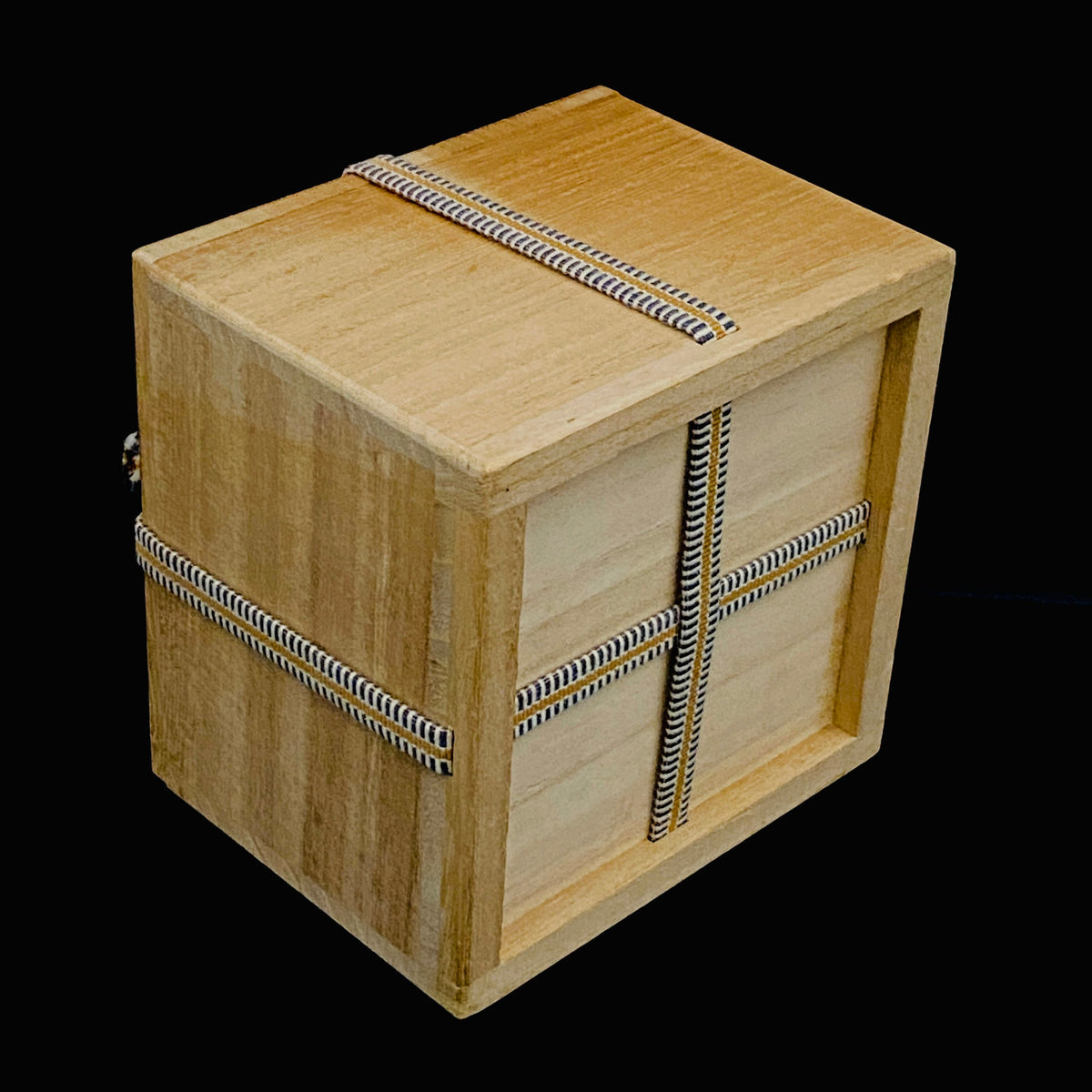
This footed sake cup is by Kawashima Hiroshi, a Kutani ware artist based in Kaga City, Ishikawa Prefecture. The whole vessel is covered in a blackish-brown glaze with a silvery sheen. At the center of the inner surface, a round window holds a design in overglaze enamels and gold. The tall foot carries a band of leaf-shaped motifs in gold and silvery white on a pale blue-green ground. Inside the foot is a signature that can be read as “Hiroshi.” The inside of the Tomobako (the artist’s original signed wooden box) lid bears the signature “Hiroshi” and a red “Hiroshi” seal. The outside of the lid bears an ink inscription that can be read as “Suisaka-de” (Suisaka style) and the large character for “sakazuki” (sake cup). The wrapping cloth is also stamped with a red seal.
Kawashima Hiroshi was born in 1951 in Kamikawasaki-machi, Kaga City, Ishikawa Prefecture. He went on to study with the aim of becoming a designer, and his interest in ceramics grew while he was studying graphic design, oil painting, and watercolor. He later studied under Tokuda Yasokichi III, a Holder of Important Intangible Cultural Property (Living National Treasure), and under Nakajima Shuko, a Holder of Intangible Cultural Property of Terai Town. At the 29th Japan Traditional Kogei Exhibition in 1982, his “Bowl with Small Floral Patterns in Overglaze Enamels” was accepted for exhibition. A work by his wife, Kawashima Mari, was accepted at the same exhibition. The couple have continued to work together as the Shishikara Pottery Studio (Shishikara Tobo).
The artist’s own record of his career lists three acceptances at the Japan Traditional Kogei Exhibition. It also lists acceptance at the Japan Traditional Kogei Exhibition Ishikawa Branch Exhibition, eight consecutive acceptances at the Traditional Kutani Ware Craft Exhibition, ten consecutive acceptances and two awards at the Sozo Bijutsu (Creative Art) Exhibition, and an award at the Kutani Design Exhibition. In terms of technical skill, he placed first in the first-grade ceramics skills examination and obtained the qualification of First-Grade Ceramics Technician, certified by the Minister of Labour. He was also commissioned to create “Design of Doves” as a commemorative gift for the 80th birthday of Ambassador Mansfield, the United States Ambassador to Japan. His solo exhibitions have been held at the Art Salon of the Daiwa Department Store, the Towa Gallery in Aoyama, Tokyo, and the Seibu department stores in Ikebukuro and Takatsuki, among other venues. His group exhibitions include “Six Ceramic Artists Who Will Shape Tomorrow” at the Odakyu Department Store, Shinjuku.
He is currently a Full Member of the Japan Kogei Association and a Certified Traditional Craftsman of Kutani Ware. He is also a member of the Japan Ceramics Association and the Japan Ceramic Art Association, and he has served as a director of the Ishikawa Prefecture Ceramic Art Association and as a standing director of the Kaga City Art Association. He also belonged to the ceramics sections of the Issui-kai and the Sozo Bijutsu-kai. According to his biography, he received an Encouragement Prize at the Traditional Kogei Ishikawa Branch Exhibition in 1995 and exhibited at the National Art Museum of China in Beijing in 2000. In 2006 his “Bowl with Floral Design in Overglaze Enamels and Sgraffito” received the Hazama Memorial Prize at the Issui-kai Ceramics Section Exhibition, and he received the same prize again the following year, in 2007.
Kawashima is best known for work in the Yoshidaya style. The Yoshidaya kiln was founded in the late Edo period by Toyota Den’emon, a wealthy merchant of Daishoji who traded under the name Yoshidaya, with the aim of reviving Ko-Kutani (Old Kutani). The kiln was highly regarded for artistry and quality that approached those of Ko-Kutani. Drawn to Yoshidaya ware, Kawashima carries out every stage himself, from throwing on the wheel to overglaze painting. Through research into clay bodies, clay mixtures, and colored glazes, he established his own Yoshidaya style, and his works in this style are known as “So-Yoshidaya.”
This cup belongs to a different line from that Yoshidaya style. The Tomobako bears an inscription that can be read as “Suisaka-de.” Explanations of Kutani ware styles describe Suisaka ware, said to have been produced before Ko-Kutani in Suisaka in Kaga (now Suisaka-machi, Kaga City), as having a body coated in brownish glaze with refinements such as reserved white areas, and with designs added in overglaze enamels or silver. The composition of this cup, with a round window on a blackish-brown glazed body decorated in overglaze enamels and gold, recalls this early Kaga style. The colors within the round window are ochre, green, white, and gold, and no red is used.
Inside the round window on the inner surface of the bowl, flowing line motifs and fine dot motifs are drawn in gold on an ochre ground. Three white lines cross over them to form a triangle, and the inside of the triangle is filled with a gold seigaiha (wave) pattern on a green ground. The exterior and interior are covered in a blackish-brown glaze, with a silvery sheen over a fine, granular texture. The outward-flaring cylindrical foot is painted on a pale blue-green ground with radiating leaf-shaped motifs in gold and silvery white, together with dot motifs. The top and bottom of the foot are marked off by thin dark-brown lines, and the foot rim is unglazed, showing the clay body. The inside of the foot is dark green, and in a pale green circle at its center is a signature in white that can be read as “Hiroshi.”
We suggest this cup as a Japanese-style shot glass for sipping aged spirits or whisky neat, a little at a time. When the cup is filled, the enamel-painted round window at the bottom of the dark vessel can be admired through the surface of the liquor.
Neither the cup nor the Tomobako records a year of production, so we date it to the period after the artist began his ceramic career.
There are no chips or cracks. The exterior has small black specks that appear to have occurred during firing, as well as a very small red spot. Near the foot, on the lower body, there is one small brushmark in gold. On the inner surface, some of the gold extends slightly beyond the edge of the round window. The foot rim shows uneven brown coloring. The outside of the Tomobako lid shows discoloration due to age. Please refer to the images for details.
- Artist: Kawashima Hiroshi (河島 洋、1951–)
- Selected Career Highlights: [1951] Born in Kamikawasaki-machi, Kaga City, Ishikawa Prefecture; studied under Tokuda Yasokichi III (Holder of Important Intangible Cultural Property) and Nakajima Shuko (Holder of Intangible Cultural Property of Terai Town); [1982] Accepted at the 29th Japan Traditional Kogei Exhibition, “Bowl with Small Floral Patterns in Overglaze Enamels”; [c. 1983] Created “Design of Doves” as a gift commemorating the 80th birthday of Ambassador Mansfield, U.S. Ambassador to Japan; three acceptances at the Japan Traditional Kogei Exhibition (per the artist’s career record); eight consecutive acceptances at the Traditional Kutani Ware Craft Exhibition; ten consecutive acceptances and two awards at the Sozo Bijutsu Exhibition; award at the Kutani Design Exhibition; first place in the first-grade ceramics skills examination, First-Grade Ceramics Technician; Full Member of the Japan Kogei Association; Certified Traditional Craftsman of Kutani Ware; [2006 and 2007] Hazama Memorial Prize, Issui-kai Ceramics Section Exhibition (per his biography)
- Public Collections: No records of holdings in public institutions have been confirmed
Date: 1970s or later (after the start of the artist’s ceramic career; no date on the cup or the Tomobako) - Condition: Very good (no chips, no cracks)
- Included: Tomobako, wrapping cloth
- Medium: Porcelain and pottery (glazed, overglaze enamels, gold)
- Dimensions: Rim diameter approx. 8.5 cm, H approx. 5 cm
- Please Note: Although some of our items may be new and unused, all are listed as pre-owned because they were produced a very long time ago. Items may show signs of age-related wear. Please understand and check the condition before considering a purchase.
Couldn't load pickup availability
Low stock: 1 left
View full details