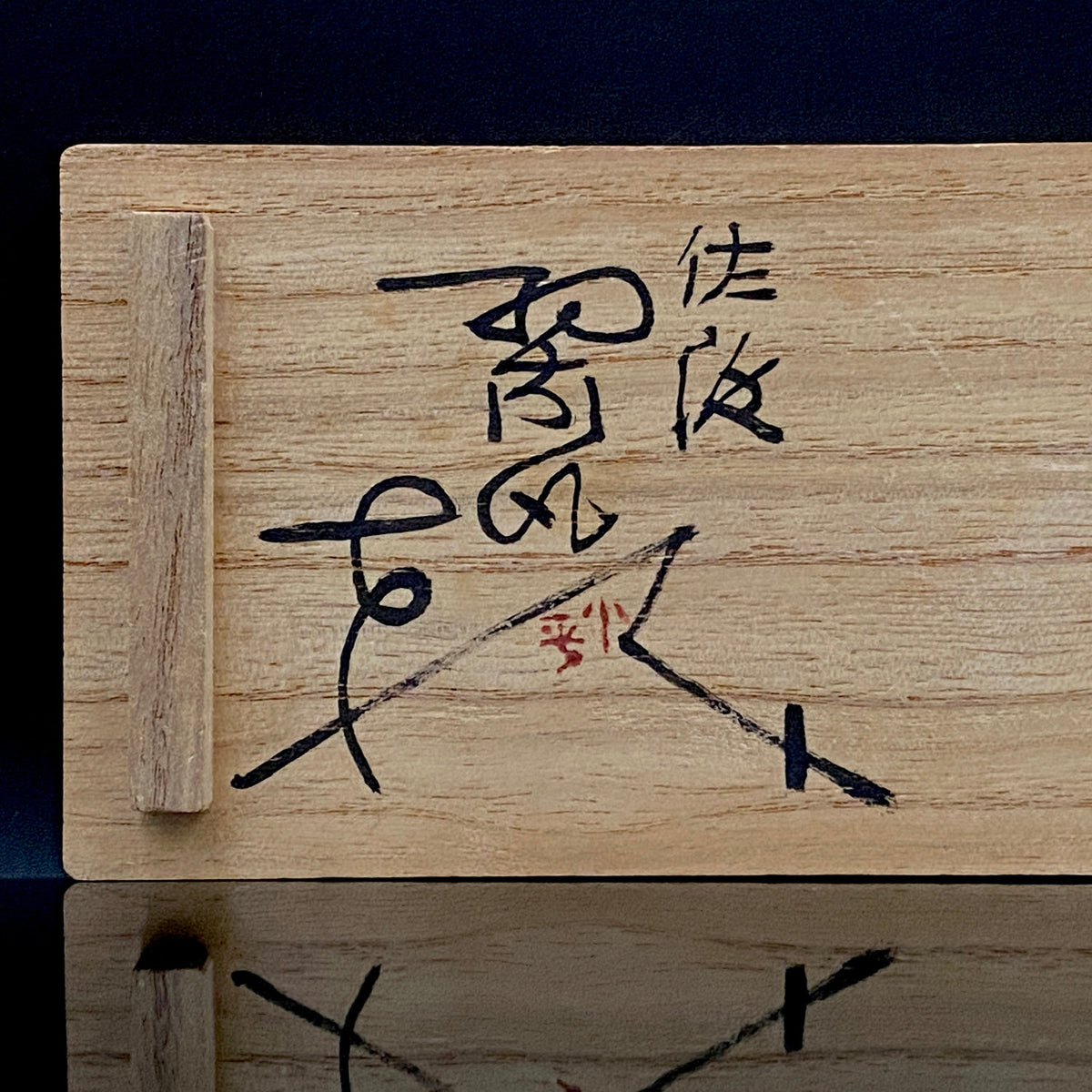
This is a set of three sake cups (sakazuki) from Mumyoi Jozan Kohei Kiln (Kohei-gama), a pottery workshop in Sado, Niigata Prefecture. Kohei Kiln was founded by Miura Kohei, the father of the potter Miura Koheiji, who was designated a Holder of Important Intangible Cultural Property (Living National Treasure) for celadon. The accompanying leaflet introduces Miura Koheiji as the second-generation head of the kiln. However, this set cannot be definitively attributed to Miura Koheiji himself, and we present it as a work of Kohei Kiln. The base of each cup is impressed with the kiln mark “Kohei.” The outside of the wooden box lid bears the ink inscription “Sakazuki” (sake cup) and a square red seal. The inside of the lid bears an ink inscription beginning with “Sado” and a red “Kohei” seal. The set also comes with a leaflet that recounts the history of the kiln.
We attribute this set to Kohei Kiln on the basis of the kiln mark and the seals on the box. Museum records of works by Miura Koheiji include examples signed “Koheiji” on the base. Our own research also indicates that the potter’s seal impressed on Miura’s personal works reads “Ko,” and the seal used in his box inscriptions reads “Koheiji.” By contrast, both the impressed mark on these cups and the red seal on the box read “Kohei,” which differs from the seals used on Miura’s personal works. The accompanying leaflet introduces the history of the kiln and the career of its head. It does not identify the maker of individual pieces.
According to the leaflet, “mumyoi,” the word that precedes the kiln’s name, is a type of iron-oxide mineral earth found in the gold and silver mine shafts of the Sado mines. Since ancient times it has been used in China and Japan as a medicinal substance. In the 11th year of Meiji (1878), Miura Jozan I used this earth to improve what had until then been a soft-bodied ware, and he created a hard-fired red-purple clay ware (shushidei-yaki), known as Mumyoi ware. Under Jozan III, the ware became one of Sado’s industries and was widely distributed both in Japan and abroad. Kohei I, the son of Jozan III, carried on the family business while also studying fine-art painting. He founded Kohei Kiln and named it after Koheiji, the given name of Jozan I.
Miura Koheiji, the second generation of Kohei Kiln, was born in 1933 in Aikawa, now part of Sado City, Niigata Prefecture. He was the eldest son of Miura Kohei, a potter of Sado Mumyoi ware. In 1951 he entered the Sculpture Department of the Faculty of Fine Arts at Tokyo University of the Arts, where he studied under the sculptor Hirakushi Denchu. As a student, he formed a ceramics study group with fellow students, studied under Kato Hajime, and built the university’s first kiln. At his father’s urging, he also learned ceramic techniques from the ground up at a pottery manufacturer in Kyoto and at the Gifu Prefectural Ceramics Research Institute. He later served as an assistant and part-time lecturer at his alma mater. During this period, the focus of his work moved from ash-glazed ceramics to Jun ware and finally to celadon.
The work that established Miura’s reputation was “Large Celadon Bowl,” which received the Minister of Education Award at the 23rd Japan Traditional Kogei Exhibition in 1976. He threw the body thinly on the wheel from the red shudei clay of his native Sado and applied a generous coat of bright bluish-white celadon glaze. He is said to have first thought of using shudei clay after studying Song-dynasty celadon at the National Palace Museum in Taipei in 1972. Miura traveled widely across Asia and Africa, including East Africa and Afghanistan, and he developed a distinctive style of painting scenes from these places in overglaze enamels on celadon.
He went on to receive the Japan Ceramic Society Award Gold Prize in 1993 and the Grand Prize in the Crafts Category of the MOA Mokichi Okada Award in 1994. In 1995 his “Celadon Ornamental Jar ‘Temple’” received the Japan Kogei Association Holders’ Prize at the 42nd Japan Traditional Kogei Exhibition, and in 1996 he was awarded the Medal with Purple Ribbon. In 1997 he was designated a Holder of Important Intangible Cultural Property. According to Sado City materials, he was the first potter to receive this designation in the field of celadon. As an educator, he became a professor at Tokyo University of the Arts in 1990. In 2000 he was named professor emeritus of the university and appointed head professor of the Ceramics Department at Bunsei University of Art. In 2006 the exhibition “Fifty Years of Pottery: Living National Treasure Miura Koheiji” was held at Mitsukoshi Nihombashi and Niigata Mitsukoshi, and he passed away on October 3 of that year at the age of 73. His works are held in the collections of the National Crafts Museum (The National Museum of Modern Art, Tokyo), The National Museum of Modern Art, Kyoto, the Niigata Prefectural Museum of Modern Art, the Aichi Prefectural Ceramic Museum, and The University Art Museum, Tokyo University of the Arts. After his death, his family also donated works to Sado City and to Kunitachi City, Tokyo.
All three cups are wheel-thrown from a reddish-brown clay body and glazed. The area around the foot is unglazed, so the reddish-brown clay is exposed there. Two of the cups, one large and one small, have wide flaring bowls on tall feet. Their exteriors are covered with a subdued, low-sheen glaze that ranges from greenish gray to olive, and their rims are edged in a deep iron color. The interiors are coated with a milky-white glaze with fine crackle. The exterior of the larger cup has a strong brownish tone. On the smaller cup, a reddish band of color shows where the exterior glaze is thin. The cylindrical cup narrows at the middle of its body. Its greenish-gray exterior glaze is overlaid with varying shades of deep brown, and its interior is glazed milky white.
This set does not use the pale bluish-white celadon glaze or the enamel-painted motifs seen in Miura Koheiji’s representative works. However, the glaze applied over a reddish-brown body links the set to the lineage of Kohei Kiln’s red-purple clay ware. It also echoes the work Miura developed by applying celadon glaze over a shudei clay body.
The accompanying leaflet offers a clue to the date of production. The leaflet introduces Miura Koheiji as a Living National Treasure, professor emeritus of Tokyo University of the Arts, and professor at Bunsei University of Art, and it states in the present tense that he “is active internationally.” He was named professor emeritus and appointed professor at Bunsei University of Art in 2000, and he passed away in 2006. The leaflet can therefore be dated to between 2000 and 2006. This set has been handed down together with this leaflet.
We suggest these cups as Japanese-style shot glasses for sipping aged spirits or whisky neat, a little at a time. Because the three cups have different shapes, they can be matched to different labels or used for side-by-side tastings.
There are no chips or cracks. Light staining along the crackle appears on the inner surface of some of the cups. On the base of the cylindrical cup, there is a small granular bump of clay beside the kiln mark, and there is a small black speck on its exterior. Please refer to the images for details.
- Artist: Mumyoi Jozan Kohei Kiln (小平窯、Kohei-gama) *The second-generation head was Miura Koheiji (1933–2006). This is a kiln work that cannot be definitively attributed to Miura Koheiji himself.
- Selected Career Highlights (Miura Koheiji, Second Generation): [1933] Born in Aikawa, Sado District, Niigata Prefecture (now Sado City); [1955] Graduated from the Sculpture Department, Faculty of Fine Arts, Tokyo University of the Arts; [1976] Minister of Education Award, 23rd Japan Traditional Kogei Exhibition (Large Celadon Bowl); [1990] Professor, Tokyo University of the Arts; [1993] Japan Ceramic Society Award Gold Prize; [1994] Grand Prize in the Crafts Category, MOA Mokichi Okada Award; [1995] Japan Kogei Association Holders’ Prize, 42nd Japan Traditional Kogei Exhibition; [1996] Medal with Purple Ribbon; [1997] Designated Holder of Important Intangible Cultural Property for Celadon (Living National Treasure); [2000] Professor Emeritus, Tokyo University of the Arts, and Head Professor, Ceramics Department, Bunsei University of Art; [2006] Exhibition “Fifty Years of Pottery: Living National Treasure Miura Koheiji” (Mitsukoshi Nihombashi and Niigata Mitsukoshi), passed away the same year
Public Collections (Works by Miura Koheiji): National Crafts Museum (The National Museum of Modern Art, Tokyo); The National Museum of Modern Art, Kyoto; Niigata Prefectural Museum of Modern Art; Aichi Prefectural Ceramic Museum; The University Art Museum, Tokyo University of the Arts; Sado City; Kunitachi City
- Date: c. 2000–2006 (based on the contents of the accompanying leaflet)
- Condition: Very good (no chips, no cracks)
- Included: Fitted Tomobako (original wooden box), wrapping cloth, leaflet
- Medium: Pottery (reddish-brown clay body, glazed)
- Dimensions: (Large) H approx. 4.8 cm, rim diameter approx. 5.9 cm / (Cylindrical) H approx. 3.8 cm, rim diameter approx. 4.5 cm / (Small) H approx. 3.7 cm, rim diameter approx. 5.5 cm
- Please Note: Although some of our items may be new and unused, all are listed as pre-owned because they were produced a very long time ago. Items may show signs of age-related wear. Please understand and check the condition before considering a purchase.