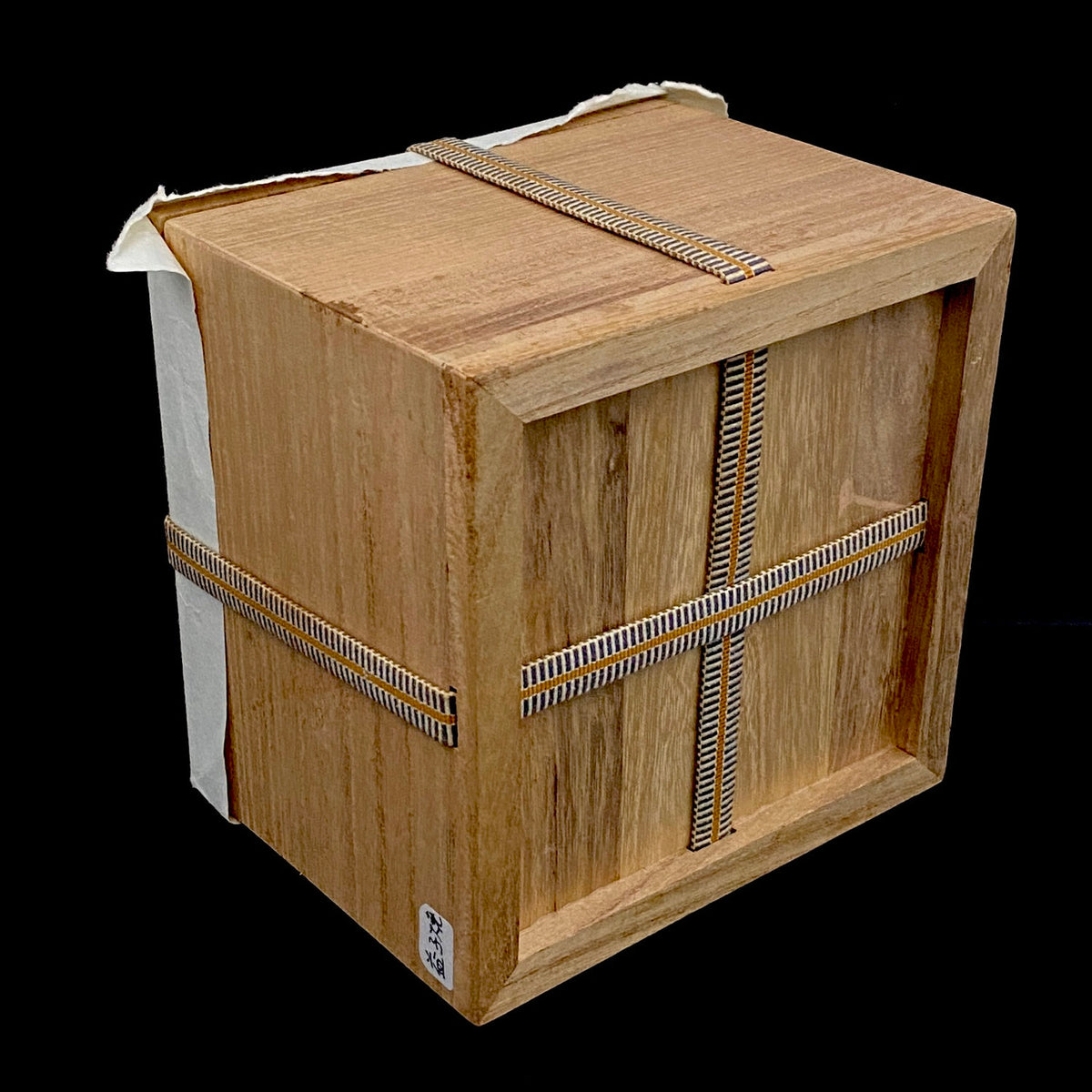
We are pleased to present a nuka-glazed matcha bowl by Mimura Hokudo (real name Mimura Takao), a potter who was born in Mashiko, Tochigi Prefecture, trained at the institution devoted to developing the craftsmen of Mashiko ware, and later went on to teach the next generation himself. The tomobako, the original wooden box prepared by the artist, bears the inscription “Nuka-yu Matcha Chawan” (Nuka Glaze Matcha Bowl) together with the signature “Hokudo” and the artist’s seal, and the potter’s seal “Hokudo” is impressed beside the foot ring. A bold sweep of milky-white nuka glaze contends with the sandy, tea-brown ground across this single bowl, conveying with quiet candor the character of Mashiko’s clay and glazes. We propose this bowl as a vessel of Japanese Kogei: a Japanese-style rocks glass for leisurely savoring amber aged spirits over a generous piece of ice.
Mimura Hokudo was born in Mashiko in 1920 (Taisho 9). In 1938 (Showa 13) he graduated from the Research Course of the Mashiko Ceramics Training Institute, and in the same year he became a technician in the Ceramics Division of the Aomori Prefectural Industrial Research Institute. In 1945 (Showa 20) he was engaged in ceramic production on the outskirts of Bangkok, Thailand, and this experience of working abroad as a Japanese ceramic engineer is one of the most distinctive features of his career. After returning to Japan, he became a technical officer at the Tochigi Prefectural Ceramics Guidance Institute in 1949 (Showa 24), and as an instructor in its successor-training program he helped nurture the next generation of Mashiko ware makers. Beginning as the Mashiko Pottery Training Institute and continuing through the Tochigi Prefectural Ceramics Guidance Institute to today’s Ceramic Technology Support Center, this institution has long been responsible for training successors and conducting technical research for the ceramic industry of Tochigi Prefecture, Mashiko ware foremost among it. Mimura studied there and later taught there, a figure deeply involved in passing on the techniques of Mashiko ware.
In 1970 (Showa 45), Mimura built the Hokudo Kiln in Sayado, Mashiko, and set out as an independent, self-employed potter. He received the Tochigi Prefectural Arts Festival Award and was repeatedly selected for the Traditional Crafts Exhibition, the North Kanto Art Exhibition, and the Japan Ceramic Art Exhibition. In 1980 (Showa 55) he was certified as a Dento Kogeishi (Certified Traditional Craftsman). Only the year before, in 1979 (Showa 54), Mashiko ware had been designated a Traditional Craft Product by the national government. The kiln was later run together with his family as Hokudo Kiln Mimura Toen, and under his real name, Mimura Takao, he and his entire family contributed to an illustrated guide to Mashiko ware written for children.
The philosophy that the Hokudo Kiln set out for itself is clearly expressed in the words of its shiori, the printed leaflet that accompanied its works. There, the kiln declares that a simple yet substantial character is the true nature of Mashiko ware, and that it pursues this through handmade work and firing in a wood-fired climbing kiln (noborigama). It further states that the kiln devotes itself to refining the techniques handed down by its forebears, taking the spirit of traditional mingei (folk craft) to heart, and to making things that are honest, wholesome, and beautiful, suited to people’s daily lives. This sincere approach to making, rooted in the mingei spirit, lies at the core of understanding this artist’s work.
Close observation of this piece reveals that this philosophy is expressed throughout its form and glaze. The bowl rises from the foot ring with a firm, full lower body, forms a gentle step at mid-body, and then draws slightly inward toward the rim. Soft throwing lines remain across the entire body, and in places the walls show gentle hollows and distortions, as if pressed by hand. This deliberate, slight departure from perfect symmetry is an expression found only in handmade work. The rim is thinly thrown, and where the glaze thins at the lip, the color of the clay shows faintly through, lending a gentle warmth to the drinking edge. The foot ring is firmly trimmed, and from the foot rim up to the area beside the foot the clay is left unglazed. The coarse, sandy texture typical of Mashiko clay is conveyed to the hand together with the bowl’s reassuring weight.
The composition of the glazes is the highlight of this work. The ground of the bowl is covered in an iron-bearing glaze ranging from tea-brown to deep umber, with a gritty texture in which fine particles are scattered like stars. Over this, the nuka glaze named in the box inscription has been boldly applied. The milky-white glaze cascades from the body down to the area beside the foot, where it gathers into pools with a lustrous, glassy sheen. Where the white glaze overlaps the ground glaze, countless fine bluish streaks appear within the white, tracing a raindrop-like landscape along the direction of the flow. The milky opacity characteristic of nuka glaze and the bluish-white flowing patterns born where it melts into the ground glaze arise only when chance in glazing and firing meets the maker’s intention. The bowl’s expression changes markedly with the viewing angle: one face carries a great flowing sweep of white, another a quiet expanse of tea-brown ground, and yet another small dabs of white glaze, so that its landscape can be enjoyed by turning it in the hand. Mashiko ware has long preserved traditional local glazes such as kaki (persimmon) glaze, namijiro glaze, and nukajiro glaze, together with techniques such as nagashi-gake (poured glazing). This piece may be regarded as a work that distills the Mashiko tradition of glazes and techniques into the refined form of a matcha bowl. The interior is calmly finished in a grayish-white glaze scattered with small iron specks, offering a fine contrast to the powerful landscape of the exterior.
With a diameter of about 12.0 cm and a height of about 8.1 cm, the generously proportioned bowl is just the right size to hold a large ice sphere. The contrast of milky white and tea brown beautifully enhances the color of amber aged spirits. It also offers the gentle chill retention of thick-walled pottery and a steady presence that seems to cradle itself in both hands. As pottery is absorbent, we recommend dipping the vessel in water before use and drying it thoroughly after use before storing it. This is a bowl by a Certified Traditional Craftsman who supported the transmission of Mashiko’s techniques, and whose work is almost unknown outside Japan. We hope it will be cherished for years to come, both as a vessel for special moments with aged spirits and as a work of craft that carries the tradition of Mashiko ware.
- Artist: Mimura Hokudo (三村 北土, Born name Mimura Takao / 三村孝夫, 1920–2003)
- Selected Career Highlights: [1938] Graduated from the Research Course of the Mashiko Ceramics Training Institute; the same year, became a technician in the Ceramics Division of the Aomori Prefectural Industrial Research Institute, [1945] Engaged in ceramic production on the outskirts of Bangkok, Thailand, [1949] Technical officer at the Tochigi Prefectural Ceramics Guidance Institute and instructor in its successor-training program, [1970] Built the Hokudo Kiln in Mashiko and established his own independent practice; received the Tochigi Prefectural Arts Festival Award; selected for the Traditional Crafts Exhibition, the North Kanto Art Exhibition, and the Japan Ceramic Art Exhibition, [1980] Certified as a Dento Kogeishi (Certified Traditional Craftsman)
- Date: 1970s–1990s (estimated)
- Condition: Excellent (no chips, no cracks)
- Included: Tomobako (original wooden box inscribed “Nuka-yu Matcha Chawan,” signed “Hokudo,” with the artist’s seal)
- Medium: Pottery (Mashiko ware)
- Dimensions: Diameter approx. 12.0 cm, height approx. 8.1 cm, weight approx. 337 g
- Please Note: Although some items we offer may be new and unused, all were produced a considerable time ago, and every item is therefore listed as pre-owned. Items may show signs of age-related wear; please review the details carefully and consider your purchase with this understanding.