This is a handled sake vessel directly crafted by Suzuki Osamu (鈴木治, 1926–2001), a master who reigns at the pinnacle of Japan's contemporary ceramic art world, whose works are permanently housed in major modern art museums both in Japan and abroad. The dedicated wooden box (kyobako) bears the artist's own inscription, "Bakushu-nomi," written in elegant, powerful cursive script. The vessel itself has a substantial cylindrical form that sits weightily in the hand, and a thick, powerfully drawn handle. While the artist created it as a vessel for savoring beer at its finest, in today's luxurious lifestyle, it also possesses an overwhelming presence as a supreme on-the-rocks Ceramic Whisky Tumbler for slowly enjoying rare aged spirits that have transformed into a beautiful amber color over many years, or premium single malt whiskies with large ice cubes. The extremely precise skeletal structure born from the bloodline of master potters, the carefully studied thickness, and the direct texture of the rough clay surface, which immediately conveys itself to the touch and sets it apart from blown glass or ordinary hand-formed vessels, elevates the time spent enjoying alcohol into an exceptional artistic experience. This is an avant-garde craft piece from Japan that is extremely difficult to obtain in overseas art markets and possesses the highest asset value to satisfy the discerning eye of an avid collector.
The artist, Suzuki Osamu, was born in 1926 as the third son of Suzuki Ugenji, a renowned potter in Kyoto. Until Suzuki's sudden passing in 2001, the artist relentlessly pursued avant-garde expressions that rewrote the history of Japanese craft. In 1948 (Showa 23), the artist formed the avant-garde ceramic art group "Sodeisha" with Yagi Kazuo, Yamada Hikaru, Matsui Bisuke, and Kano Tetsuo, initiating a movement that fundamentally broke the spell of practicality ("beauty of utility") – the absolute norm in the Japanese ceramic world, where ceramics were primarily for serving food or pouring water. They redefined clay not merely as a material for vessels but as a medium for pure self-expression, giving birth to a completely new genre of art: objet ceramics, the first of its kind in Japan. Sodeisha subsequently led the forefront of Japan's contemporary art scene for half a century, and with its 50th exhibition in 1998, it dissolved amicably, having fully fulfilled its historic mission of elevating ceramics to contemporary art within the art world. Amidst this tumultuous movement, Suzuki preferred to use the term "deisho" (mud-form) for Suzuki's own works, meaning to manifest the form of the world through clay (mud), rather than simply calling them "objects." Suzuki continued to pursue unique, poetic forms by deforming and deconstructing Suzuki's superb potting wheel techniques. By 1999, the artist's global status was firmly established, as evidenced by a large-scale retrospective exhibition held at the National Museum of Modern Art, Tokyo.
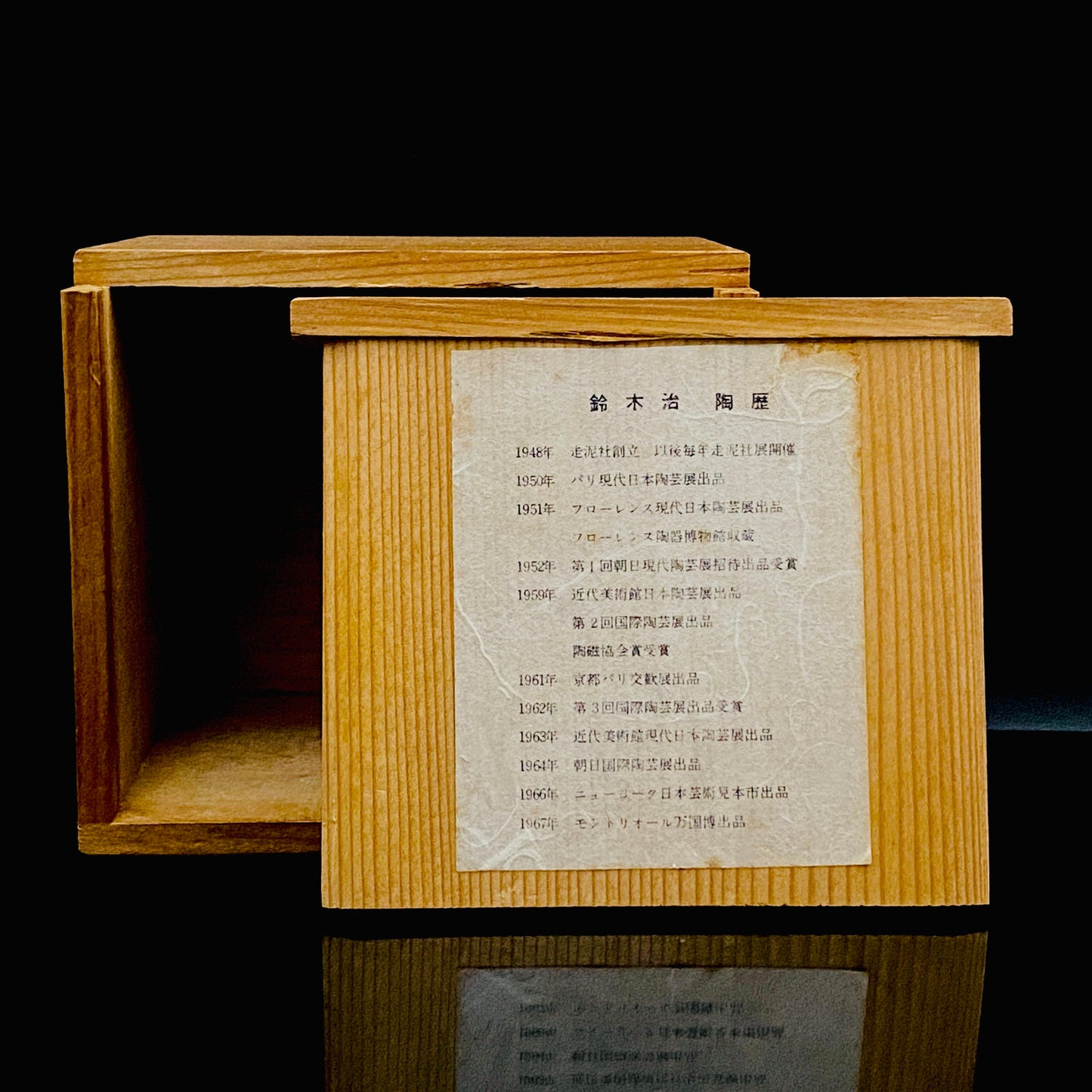
The distinctive face-shaped motif that dominates the front of this work perfectly embodies Suzuki's lifelong pursuit of reverence for nature and a return to primitive art. The eyes and nose carved into this circular bas-relief, along with the continuous spiral patterns arranged at the bottom, personify the life force of great nature, such as the sun and wind, with Suzuki's unique poetic humor, imbuing the modern vessel with the pure magical energy of Jomon clay figurines and ancient masks. The surface of the vessel intentionally exposes a powerful, clay texture like Mikage clay containing coarse particles, over which a thin layer of feldspar glaze with a pale greenish-gray tint is applied. This masterfully merges the organic warmth of the clay with the sparkling beauty of the finely appearing crazing (fine crack patterns) on the surface. Furthermore, at the bottom edge of the vessel, a vibrant reddish "hi-iro" (fire color) has emerged, a result of the chemical reaction between the edge of the glaze and the unglazed body caused by the intense flames of the climbing kiln, thus encapsulating the dramatic moment when fire and earth became one within the vessel. At the base of the handle, Suzuki's circular "治" (Osamu) seal is clearly impressed, confirming its authenticity. The handwritten signature and seal on the lid of the wooden box, along with the official ceramic history (bookmark) from Yodo Gallery in Osaka, which conveys the atmosphere of the artist's solo exhibitions at the time, are perfectly preserved. This is a supreme piece in excellent condition, condensing the artist's lifelong artistry, where Suzuki's object philosophy (Deisho) admirably returns to its origin as a functional vessel.
- Artist: Suzuki Osamu (鈴木治, 1926–2001)
- Artist's Major Career History: [1926] Born in Kyoto as the third son of master potter Suzuki Ugenji, [1948] Formed the avant-garde ceramic art group "Sodeisha" with Yagi Kazuo and Yamada Hikaru, holding their first exhibition, [1961] Received the Japan Ceramic Society Award, [1962] Won a Gold Medal at the Prague International Ceramics Exhibition, [1968] Appointed Assistant Professor of Ceramics at Osaka University of Arts, [1970] Won a Gold Medal at the Vallauris International Ceramics Biennale and invited to exhibit at "Contemporary Ceramics - Europe and Japan" organized by the National Museum of Modern Art, Kyoto, [1971] Won the Minister of International Trade and Industry Award at the Faenza International Ceramics Exhibition and invited to exhibit at the Japan Ceramics Exhibition (subsequently exhibiting every time), invited to exhibit at "Contemporary Ceramics - America, Canada, Mexico and Japan" exhibition organized by the National Museums of Modern Art, Kyoto and Tokyo, [1975] Exhibited at "International Ceramics Exhibition '75", [1979] Exhibited at "Art Now '79", [1999] A large-scale retrospective exhibition "Poetic Objects: Suzuki Osamu's Ceramics" was held at the National Museum of Modern Art, Tokyo, [2001] Passed away at the age of 73
- Museum Collections: Permanently housed in public collections of major modern art museums around the world, including The National Museum of Modern Art, Tokyo, and The National Museum of Modern Art, Kyoto.
- Circa: c. 1955 (Presumed identical or same-series works are currently in the collection of institutions such as The National Museum of Modern Art, Kyoto)
- Accessories: Original wooden box, wrapping cloth, official ceramic history (bookmark) issued by Yodo Gallery.
- Material: Pottery (feldspar glaze)
- Dimensions: Approx. 9.0 cm diameter, approx. 9.5 cm height
- Note: Even if the products offered by our shop are new and unused, they are from a very old production period and are all listed as used items. The products may have damage due to age, so please understand and confirm this before considering a purchase.
- Please check the photos: We prepare every description with great care, but errors may still remain in the text. Please examine the photos carefully before purchasing. Where the photos and the description differ, please take the photos as the basis for the product information.





 The Vanished "Showa Obsession": Why Japanese Ceramics from That Era Transcend the Modern DayShowa-era ceramics from around the 1980s represent a Golden Age where obsessi...
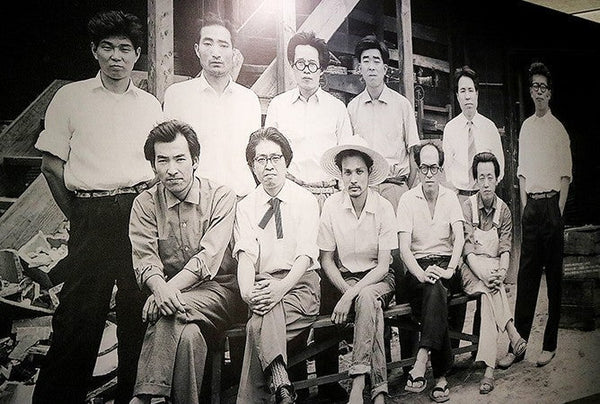 The Kyoto Avant-Garde Ceramics Monument: Sodeisha's Half-Century Journey and the Masters of Obje-yakiWe meticulously examine the trajectory of the Sodeisha, an avant-garde cerami...
 Japanese Pottery Seals, Box Signatures and Marks: A Photo Index of 153 MakersThe seal or incised signature on the base of a piece, and the signature and s...
