

Japanese Pottery Seals, Box Signatures and Marks: A Photo Index of 153 Makers
When choosing a sake cup or vessel, the seal or mark on the base and the signature and seal on the fitted wooden box are the best clues to who made it. This page gathers 341 photos of marks from pieces we have handled—impressed seals, incised and painted signatures, signed and sealed boxes and seals on cloth wrappers—covering 153 makers, from Living National Treasures to ceramic and glass artists, metal artists and kilns, together with their dates, careers and awards. 4 more makers whose pieces we handled show no mark are also listed, with a note to that effect.
Type a maker's name (in romaji or Japanese), a kiln or region, or a character from a mark into the search box below to filter the list. You can also jump to a maker from the A–Z and category indexes. Click a photo or a piece number to open that piece's product page.
Types of seals, marks and signatures
| Term | Meaning |
|---|---|
| Potter's seal (toin, rakkan-in) | A seal impressed on the base or body that identifies the maker or kiln. |
| Incised mark (kokumei, kakimei) | A signature carved with a spatula or nail; on glass, a signature engraved with a diamond point or similar tool. |
| Painted mark (kakimei) | A signature brushed in cobalt blue, red or green enamel and so on. |
| Fitted box (tomobako, hakogaki) | A box on which the maker wrote the title and signature and stamped a seal; valued as evidence of authenticity. |
| Authentication box (shikibako) | A box inscribed by a later generation or an expert attesting to the maker. |
| Cloth wrapper (tomonuno) | The cloth in which the piece is wrapped, often printed with the maker's seal. |
| Leaflet (shiori) | A sheet with the maker's biography or notes on the work; the latest year in the biography also helps date the piece. |
* The marks shown are examples from pieces we have handled. A maker's seals and signatures can differ by period and by the grade of the work, so a mark alone cannot establish whether a piece is genuine. Biographies are compiled by Antique Liquor from the leaflets accompanying each piece and from published sources.
Index
A–Z: A · E · F · G · H · I · K · M · N · O · R · S · T · U · Y · European houses
By category:
- Living National Treasures (6): Imaizumi Imaemon XIII, Inoue Manji, Ito Sekisui V, Kitamura Shinichi, Nakada Kazuo, Shimaoka Tatsuzo
- Ceramic artists (117): Aida Yusuke, Akashi Shosaku, Ando Hidetake, Ando Moriyuki, Aoyama Norihiro, Eguchi Katsumi, Fukuda Rikisaburo, Haniu Takahiro, Hayashi Makuu, Heian Sokyu III, Hisamura Toshihide, Hotta Kenji, Iida Seppo, Inoue Ryosai III, Isezaki Mitsuru, Ishino Taizo, Isomi Tadashi, Iwamoto Tetsuya, Kamei Miraku XIV, Kamoda Taro, Kano Mitsuo, Kato Juitsu, Kato Kenji, Kato Sho, Kato Shuntei II, Kato Yasuhiro, Kato Yoshitaka, Kawai Takeichi, Kawai Toru, Kawajiri Hiroshi, Kawashima Hiroshi, Kida Hiroyuki, Kikuchi Akira, Kimura Ichiro, Kimura Mitsuyoshi, Kitade Fujio, Kitade Seiko, Kitade Tojiro, Kitagawa Hiroyuki, Kobayashi Shuji, Kojima Shigeo, Konishi Toko II (Konishi Mitsue), Konishi Yohei, Kozuru Hajime, Kumakura Junkichi, Kuroda Gaku, Kuze Tensei, Maki Yukichi, Matsubara Naoyuki, Matsui Koyo, Matsumoto Isami, Matsumoto Saichi, Matsuura Shinya, Matsuzaki Kan, Matsuzaki Ken, Mimura Hokudo, Mitsui Tamekichi III, Miyagawa Kozan I, Miyanaga Tozan II (Miyanaga Tomoo), Miyanaga Tozan III (Miyanaga Rikichi), Mizukawa Toei II, Mizuno Juzan II, Mizuno Sekikazu, Mizuno Sokaku I, Mizuno Takuzo, Mizutani Tosui, Mori Iroku IV, Mori Taiga, Morino Taimei, Morishima Isshin, Nagae Shigekazu, Nagahisa Shosai, Nakajima Ichiyo, Nakamura Hidekazu, Nakamura Teruko, Nakano Tochi IV, Oe Bunsho, Ogasawara Choshun XIX, Oketani Teiichi II, Sakata Jinnai, Sakuma Totaro, Sakurai Yoshie, Samukawa Seiho II, Sawamura Tosai III, Shibukusa Ryuzo VI, Shimizu Yasutaka, Shiohara Bunji, Suzuki Hachiro, Suzuki Kenji (Kyoto), Suzuki Kenji (Tsukasa Kiln), Suzuki Osamu, Taishima Tosho, Takagi Kazuyasu, Takagi Noritoshi, Takahara Shoji, Takakura Kunimitsu, Takatori Hassen XIII, Takeda Toshio, Takegoshi Fuyuki, Takegoshi Toshiaki, Takemura Toyonori, Tanaka Hajime (Tanaka Ikko), Tanaka Hozan, Tani Shukei, Tsuchiyama Shosen, Tsuji Hitachi XIV, Uchida Yasuhide, Yamachika Takeshi, Yamada Hikaru, Yamamoto Hogaku, Yanagihara Mutsuo, Yanai Sai, Yano Keisen, Yokoishi Gagyu XIII, Yoshida Katsuzan, Yoshida Shuen, Yoshimoto Tadashi
- Glass artists (13): Fujita Jun, Ichiya Akira, Ishii Koji, Iwata Hisatoshi, Iwata Toshichi, Kagami Mitsuru, Kumakura Ryuichi, Kuroki Kuniaki, Okawa Kaoru, Otsubo Osamu, Takeuchi Denji, Yonehara Shinji, Yoshida Takeo
- Metal artists (2): Kitamura Ichiro, Tanaka Hideaki
- Lacquer artists (1): Akashi Bokkei
- Kilns and studios (13): Gorobei Kiln, Gyokuzan Kiln, Hara Seiwa (Seiwa Kiln), Kagami Crystal, Kamide Choemon Kiln, Kobei Kiln, Multiglass, Mumyoi Jozan Kohei Kiln, Nanzan Kiln, Rinkuro Kiln, Seiran Kiln, Sentaro Kiln, Sonoe Hisaodo
- European houses (5): Cristal de Sèvres, Daum, Ditta Albertini & Spezzamonte, Holmegaard, Saint-Louis
A
Aida Yusuke (1931–2015)会田雄亮
A potter known for neriage (marbled clay). After studying under Miyanohara Ken, the artist taught at the School of the Museum of Fine Arts, Boston, won the gold prize at the Faenza International Ceramics Competition in 1968, and later served as president of Tohoku University of Art and Design.
Career and awards: 1956: studied under Miyanohara Ken / 1968: Gold Prize, Faenza International Ceramics Competition / 1976: chair, Japan Craft Design Association / 1993: Design Merit Award / 1998: president, Tohoku University of Art and Design


Notes on the marks: A rectangular potter's seal is impressed on the base.
Akashi Bokkei (1911–1992)明石朴景
Born Akashi Seiichi in Takamatsu, Kagawa Prefecture, a lacquer artist who studied lacquer under Isoi Joshin, later a Living National Treasure, at the Kagawa Prefectural Craft School and graduated in design from the Tokyo School of Fine Arts. The artist won a Special Prize and the Members' Prize at the Nitten and served as a judge. Our bowl is a Sanuki kiln piece painted by Bokkei.
Career and awards: 1934: graduated in design from the Tokyo School of Fine Arts / 1946: first selection, Nitten / 1958: Special Prize, Nitten / 1966: Nitten judge / 1968: Nitten member / 1987: Members' Prize, Nitten


Notes on the marks: A round potter's seal is impressed beside the foot ring (a Sanuki kiln piece). The fitted box bears the signature "朴景" (Bokkei) and a red seal.
Akashi Shosaku (1946–)明石庄作
A potter who studied under Hamada Shoji and his son Hamada Shinsaku, training at the Hamada kiln in Mashiko for 20 years. Independent in Mashiko since 1981, the artist is known for tsutsugaki (slip-trailed) decoration.
Career and awards: 1981: built a kiln in Mashiko and became independent / 1987: New Artist Award, Kokuten crafts section / 1998: Tochigi Prefecture Cultural Encouragement Award

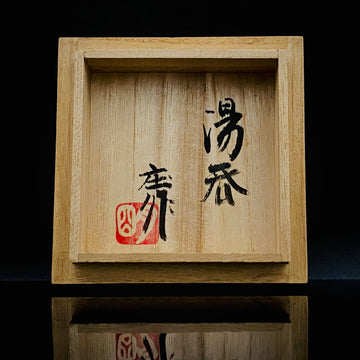
Notes on the marks: A square potter's seal is impressed on the base. The fitted box bears the signature and a red seal.
Ando Hidetake (1938–)安藤日出武
Born in Tajimi, Gifu Prefecture. Prompted by advice from Kato Tokuro, this Mino potter devoted years to studying Momoyama-period Shino, Ki-Seto and Oribe, and was designated Holder of Gifu Prefecture Important Intangible Cultural Property for Ki-Seto in 2003.
Career and awards: 1970: Governor's Prize, Asahi Ceramics Exhibition / 1974: full member, Japan Kogei Association / 1990: Kobei Prize / 1998: Tajimi City Intangible Cultural Property holder / 2003: Gifu Prefecture Important Intangible Cultural Property (Ki-Seto) / 2016: Order of the Rising Sun, Gold and Silver Rays


Notes on the marks: The fitted box bears the signature "日出武" (Hidetake) and red seals; the combination of seals differs from work to work.
Ando Moriyuki (1944–)安藤百利行
Born in Mizunami, Gifu Prefecture. After studying under the ceramic designer Hineno Sakuzo and training in Kyoto and Tokoname, the artist began working as a potter in 1967. A certified Traditional Craftsman of Mino ware, the artist works at the studio 百窯 in Inatsu-cho, Mizunami, on original ash-glaze styles such as onihada, kairagi and Mino hidasuki.
Career and awards: 1967: began working as a potter / fiscal 1994: 「灰釉彩文『舞』」 selected as a permanently preserved work by the Tono Shinkin Bank's Mino Ceramic Art Permanent Preservation Program / 2008: Merit Award, Minister of Economy, Trade and Industry's Commendation for Persons of Merit in the Traditional Craft Industry (Traditional Craftsman of Mino ware) / three vases (made in 2002 and 2003) in the Museum of International Folk Art, Santa Fe, USA


Notes on the marks: An incised mark is carved beside the foot ring. The fitted box bears the signature "百利行" (Moriyuki) and a red seal, and the wrapping cloth is also stamped with a red seal.
Aoyama Norihiro (1954–)青山徳弘
Studied under the artist's father, Aoyama Reizo, a Tajimi City Intangible Cultural Property holder, and worked at the Kusanokashira kiln (草の頭窯) for about 28 years before founding the Aoyama kiln in Mizunami in 2001. Known for fine line drawing and the wheat-ear motif.
Career and awards: 1972: graduated in ceramics from Gifu Prefectural Tajimi Technical High School / 1976: joined the Kusanokashira kiln / 2001: founded the Aoyama kiln

Notes on the marks: A mark is painted in cobalt inside the foot ring.
E
Eguchi Katsumi (1936–)江口勝美
A master of Karatsu ware who in 1968 revived the Koyamaji kiln (小山路窯) in Takeo, Saga, a line of southern Old Karatsu dating back to the late Momoyama period. The artist's work was acquired by the Victoria and Albert Museum in London.
Career and awards: 1972: Asahi Shimbun Award, Japan Traditional Art Crafts Exhibition / 1979: Award of Excellence, Japan Ceramic Art Exhibition / 1983: Prime Minister's Award, Nishi-Nihon Ceramic Art Exhibition / 1985: Japan Ceramic Society Award


Notes on the marks: The kiln name is incised near the base of the body. The fitted box bears the signature and a seal.
F
Fujita Jun (1951–)藤田潤
Born in Edogawa, Tokyo. After graduating in philosophy from Gakushuin University, the artist began working in glass in 1979, won the Gold Prize at the International Exhibition of Glass Kanazawa, received the Commissioner for Cultural Affairs Award in 2008, and served as chair of the Japan Glass Artcrafts Association.
Career and awards: 1996: Bridgestone Museum of Art Prize, Japan Glass Exhibition '96 / 1999: Silver Prize, Contemporary Japanese Glass Exhibition Notojima / 2001: Gold Prize, International Exhibition of Glass Kanazawa / 2008: Commissioner for Cultural Affairs Award


Notes on the marks: "Jun" is engraved in cursive under the glass. The fitted box bears the signature "潤" (Jun) and a round red seal.
Fukuda Rikisaburo (1912–1993)福田力三郎
Joined Hamada Shoji in 1925 at the age of 13 as the potter's first apprentice, and supported the Hamada kiln for decades as its most trusted workshop foreman, embodying the mingei ideal of beauty in use.
Career and awards: 1972: honored as a Tochigi Prefecture Person of Cultural Merit / 1984: Shimotsuke Prefectural Citizen's Award
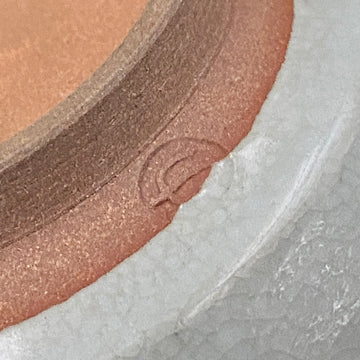

Notes on the marks: A round potter's seal is impressed beside the foot ring. The fitted box bears the signature and a seal.
G
Gorobei Kiln五郎辺衛窯
A Bizen ware kiln set up in 1979 as the pottery division of Buyo Gorobei Shoten, a brewer founded in 1867.
Career and awards: 1979: Bizen ware division established
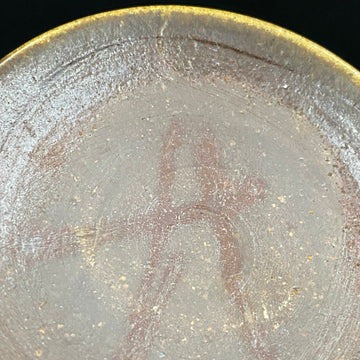
Notes on the marks: A kiln mark is incised on the base.
Gyokuzan Kiln玉山窯
A Mino kiln supervised by Tamaoki Yasuo, holder of Gifu Prefecture Important Intangible Cultural Property. In the three-kiln cup set with the Kobei and Sentaro kilns (#455), it made the Shino cup.

Notes on the marks: The fitted box of the three-kiln set (#455) bears the kiln names and each kiln's red seal.
H
Haniu Takahiro (1937–)羽二生隆宏
Born in Hokkaido, the artist was drawn to pottery by the work of Komori Shinobu and later studied under Yamamoto Masatoshi. An honorary member of the Kofukai art society, known for iridescent kiln-transformed glazes (kosai yohen).
Career and awards: 1967: established a kiln in Kashiwa, Chiba / 1974: studied under Yamamoto Masatoshi / 2003: Kofu Crafts Special Prize, Kofukai Exhibition / 2014: first selection for the Nitten / 2018: honorary member of the Kofukai


Notes on the marks: A potter's seal is impressed on the base. The fitted box bears the signature "隆宏" (Takahiro) and a red seal; the cloth wrapper is printed with the signature and seal.
Hara Seiwa (Seiwa Kiln)原清和
A Kyo-yaki (Kyoto ware) kiln with its studio in Sumiyama, Uji, Kyoto, specializing in the techniques of Goryeo and Joseon tea ceramics. Seiwa is the name used by the first Hara Seiwa; in 2015 the first Seiwa's child, 原稔, succeeded to it as Hara Seiwa II.
Career and awards: Hara Seiwa II (原稔): 1991: began studying under the father, Hara Seiwa / 1996 and 2003: Kyoto Governor's Prize, Kyo-yaki and Kiyomizu-yaki Exhibition / 1999: received the name 清晁 from 山口喜堂, chief priest of Seimei Shrine / 2015: succeeded to the name Hara Seiwa II / 2017: selected for the Kyoten exhibition

Notes on the marks: An oval seal reading "清和" (Seiwa) is impressed beside the foot ring. Both the first and the second generation use this seal, so the seal alone does not show which generation made a piece.
Hayashi Makuu (1901–1991)林沐雨
A Kyoto potter who learned porcelain making at Gojodo, a manufacturer of wares for the Imperial Household Ministry, and studied under Kiyomizu Rokubei V. Known for overglaze painting in the classical manner of Kenzan and Ninsei and for an original transparent glaze with a red fire tone.
Career and awards: 1921: joined Gojodo, a supplier to the Imperial Household Ministry / 1932: studied under Kiyomizu Rokubei V (until 1936) / 1948: recognized by Kyoto Prefecture as a holder of traditional craft techniques


Notes on the marks: A "沐雨" (Mokuu) potter's seal is impressed near the base of the body. The fitted box bears the signature and a red seal.
Heian Sokyu III (1913–1989)三代 平安宋丘
Born Kubo Yoshizo, the artist succeeded to a Kyoto ware family as Sokyu III and spent years in research and teaching at the National Ceramics Research Institute and the Kyoto Institute of Technology. Devoted to reviving the lost yohen tenmoku glaze, the potter won the Prime Minister's Award at the Japan Traditional Art Crafts Exhibition in 1978.
Career and awards: 1933: succeeded to the family kiln as Sokyu III / 1935: researcher at the National Ceramics Research Institute (17 years) / 1953: taught ceramics at the Kyoto Institute of Technology (15 years) / 1970: sent to the Republic of China as a technical adviser (5 years) / 1978: Prime Minister's Award, Japan Traditional Art Crafts Exhibition / 1984: Order of the Sacred Treasure, 5th Class


Notes on the marks: The potter's seal on the base varies from work to work: a large square seal on some, a small "宋" (So) seal on others. The fitted box bears the signature "平安 宋丘 作" and a red seal.
Hisamura Toshihide (1956–)久村俊英
Born in Shizuoka Prefecture. After graduating from Kanazawa College of Art and working in product design, the artist opened the Tabito kiln of Nagashima ware in Nagashima, Kuwana, Mie Prefecture, and won the top award, the MITI Minister's Prize, at the Banko Ceramics Competition.
Career and awards: 1956: born in Shizuoka Prefecture / 1980s: opened the Tabito kiln; MITI Minister's Prize, Banko Ceramics Competition / 1996: made large jars and bowls for the Kisshokaku hall of Naritasan Osaka Betsuin


Notes on the marks: An oval potter's seal is impressed on the base. The fitted box bears the signature and a red seal.
Hotta Kenji (1951–2017)堀田憲児
A potter who received an Encouragement Prize at the Chozo Prize Ceramics Exhibition and was selected for the exhibition five times in all.
Career and awards: 1998: Encouragement Prize, Chozo Prize Ceramics Exhibition (selected five times in all)

Notes on the marks: An oval potter's seal is impressed on the body.
I
Ichiya Akira壹谷旭
A glass artist whose work is in the Corning Museum of Glass in New York State, and winner of the Minister of Education Award at the Sankikai exhibition.
Career and awards: 1982: work entered the collection of the Corning Museum of Glass / 1984: Minister of Education Award, Sankikai exhibition
Notes on the marks: No clear signature was found on the glass.
Iida Seppo (1941–)飯田雪峰
Born on the Noto Peninsula, Ishikawa Prefecture. The artist studied under Yabe Makoto, a former lecturer at the University of Alaska, trained in the Kutani region, and in 1974 opened the Hokuto kiln in Kanazawa; known for tenmoku-glazed works.
Career and awards: 1974: helped set up the Hokuto Culture Center pottery studio / 1984: founded Hokuto Co., Ltd. / 2015: Kanazawa City Cultural Activity Award


Notes on the marks: A square potter's seal is impressed inside the foot ring. The fitted box bears the signature "雪峰" (Seppo) and a red seal; the cloth wrapper also carries a seal.
Imaizumi Imaemon XIII (1926–2001)十三代 今泉今右衛門
The 13th head of the Imaizumi family, which handled overglaze enameling for the Nabeshima clan kilns in the Edo period. Carrying on the Iro-Nabeshima tradition, the artist was designated a Living National Treasure for Iro-Nabeshima in 1989.
Career and awards: 1973: succeeded to the name Imaemon XIII / 1986: Medal with Purple Ribbon / 1989: Living National Treasure (Iro-Nabeshima) / 1998: Gold Prize, Japan Ceramic Society Award / 1999: Order of the Rising Sun, 4th Class


Notes on the marks: A mark painted in underglaze cobalt inside the foot ring. The fitted box bears the signature and a red seal.
Inoue Manji (1929–2025)井上萬二
Born in Arita, Saga Prefecture. After training at the Kakiemon kiln and studying under Okugawa Chuemon, the artist mastered white porcelain and wheel throwing and was designated a Living National Treasure for white porcelain (hakuji) in 1995.
Career and awards: 1958: technical officer at the Saga Prefectural Arita Ceramic Research Institute / 1971: opened the Inoue Manji kiln / 1987: Minister of Education Award, Japan Traditional Art Crafts Exhibition / 1995: Living National Treasure (hakuji) / 1997: Medal with Purple Ribbon / 2003: Order of the Rising Sun, Gold Rays with Neck Ribbon


Notes on the marks: The character "萬" (Man) is painted in cobalt inside the foot ring. The fitted box bears the signature "井上萬二" and a square red seal. A leaflet (shiori) is included.
Inoue Ryosai III (1888–1971)三代 井上良斎
Born in Asakusa, Tokyo, the eldest son of Inoue Ryosai II, the artist took over the family kiln and studied under Itaya Hazan. Working from a kiln in Yokohama, the potter was active mainly at the Nitten after the war and became a member of the Japan Art Academy.
Career and awards: 1928: first selection for the Teiten / 1953: Yokohama Culture Award; Nitten judge / 1959: Japan Art Academy Prize / 1966: Nitten director; member of the Japan Art Academy / 1967: Order of the Sacred Treasure, 3rd Class


Notes on the marks: The fitted box bears the signature and a red seal. No potter's seal was seen on the piece itself.
Isezaki Mitsuru (1934–2011)伊勢崎満
The eldest son of the Bizen master Isezaki Yozan and elder brother of Living National Treasure Isezaki Jun. With Jun, the artist restored a medieval semi-underground anagama kiln, and was recognized as Holder of Okayama Prefecture Important Intangible Cultural Property for Bizen ware in 1998.
Career and awards: 1966: first selection, Japan Traditional Art Crafts Exhibition / 1972: Grand Prize, Chunichi International Ceramics Exhibition / 1973: Japan Ceramic Society Award / 1994: Sanyo Culture Award / 1998: Okayama Prefecture Important Intangible Cultural Property (Bizen ware)


Notes on the marks: A mark is incised inside the foot ring. The fitted box bears the signature and a red seal.
Ishii Koji (1946–1996)石井康治
A glass artist who studied metal hammering at Tokyo University of the Arts, worked at Toyo Glass and became independent in 1977. Using free-blowing, the artist made works on the themes of light, wind and Japanese nature, and is also known for designing the silhouette bottle of Sanwa Shurui's iichiko shochu. Died suddenly in 1996 at the age of 50.
Career and awards: 1971: graduated in metalwork from Tokyo University of the Arts / 1977: became independent / 1985: Special Prize, Japan Package Design Competition, for the iichiko silhouette bottle / 1989: founded Ishii Glass Studio / 1991: opened the Aomori studio / 1994: Symphony of Light and Wind exhibition at the Narukawa Art Museum


Notes on the marks: "Koji" is engraved in cursive under the base or foot of the glass. The box and leaflet signatures "康治" (Koji) and red seals take several forms, and some boxes read "康治作".
Ishino Taizo (1942–)石野泰造
After working as an editor of literary books and magazines, the artist turned to pottery in their thirties and became a Bizen ware potter and full member of the Japan Kogei Association. The Akutagawa Prize-winning novelist Miura Tetsuo praised the artist's dedication in a written tribute.
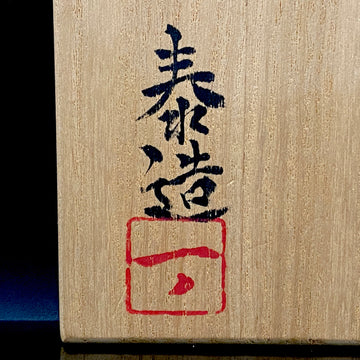

Notes on the marks: The fitted box bears the signature "泰造" (Taizo) and a red seal; the same seal appears on the cloth wrapper.
Isomi Tadashi (1923–1999)磯見忠司
The artist studied composition under the Western-style painter Ishii Hakutei and pottery under Kitade Tojiro. In 1948 the potter opened the Taisha kiln in Hakui, Ishikawa Prefecture, near Keta Taisha Shrine, and made Noto Taisha ware.
Career and awards: 1948: opened the Taisha kiln / selected many times for the Nitten / represented Ishikawa Prefecture at the 5th Ministry of Education Selected Exhibition / Ishikawa Prefecture Cultural Activity Encouragement Award / 1989: 7th Hokkoku Fusetsu Prize


Notes on the marks: A square potter's seal is impressed on the base. The fitted box bears the signature and a red seal; the cloth wrapper also carries a seal.
Ito Sekisui V (1941–)五代 伊藤赤水
Raised Mumyoi ware of Sado Island to the level of fine art and was designated a Living National Treasure for Mumyoi ware in 2003, the first from Sado. Known for kiln-transformed (yohen) surfaces in red and black.
Career and awards: 1973: Prince Takamatsu Award, Japan Traditional Art Crafts Exhibition / 2003: Living National Treasure (Mumyoi ware) / 2005: Medal with Purple Ribbon / 2011: Order of the Rising Sun, Gold Rays with Rosette


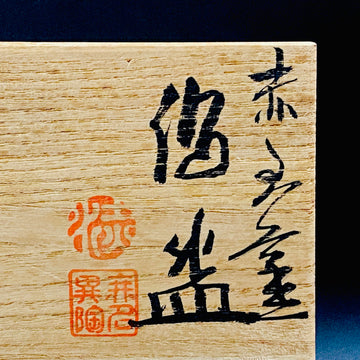
Notes on the marks: A square "赤水" (Sekisui) seal is impressed on the red mumyoi clay of the base; on some works it is impressed inside the bowl. The fitted box bears the signature and a seal.
Iwamoto Tetsuya (1960–)岩本哲也
Born in Imbe, Bizen City, Okayama Prefecture, the home of Bizen ware. The artist trained from 1979 under the father, the Bizen ware potter Iwamoto Shuichi, and works at the 万燈窯 kiln in Imbe. Selected 13 times for the Japan Traditional Art Crafts Exhibition, the artist became a full member of the Japan Kogei Association in 1990.
Career and awards: 1979: began training under the father, Iwamoto Shuichi / 1987: selected for the 34th Japan Traditional Art Crafts Exhibition (13 selections through the 55th in 2008) / 1990: full member, Japan Kogei Association / 1996: Okayama Governor's Prize, 39th Japan Traditional Art Crafts Chugoku Exhibition / 2010: Sanyo Broadcasting Prize, 53rd Japan Traditional Art Crafts Chugoku Exhibition

Notes on the marks: A mark is incised with a spatula on the base.
Iwata Hisatoshi (1925–1994)岩田久利
Born in Tokyo, the artist built on the tradition of Iwata Glass, founded by the father, Iwata Toshichi, and raised glass to the level of fine art. Winner of the Nitten Minister of Education Award and the Japan Art Academy Prize and first president of the Japan Glass Artcrafts Association; works are in the Metropolitan Museum of Art and the Corning Museum of Glass.
Career and awards: 1950: graduated from the Tokyo School of Fine Arts / 1976: Minister of Education Award, Nitten / 1982: Japan Art Academy Prize / first president, Japan Glass Artcrafts Association


Notes on the marks: The fitted box bears the signature "岩田久利" and a red seal; some boxes carry the abbreviated signature "久利".
Iwata Toshichi (1893–1980)岩田藤七
Born in Nihonbashi, Tokyo. After studying metalwork and Western-style painting at the Hakubakai institute and the Tokyo School of Fine Arts, the artist turned to glass and, through free-blown forms and other techniques, raised Japanese glass to a fine art. Founder of Iwata Glass and a Person of Cultural Merit.
Career and awards: 1928–1930: Special Prize at the Teiten three years running / 1937: Silver Medal, Paris Exposition / 1951: Japan Art Academy Prize / 1954: member of the Japan Art Academy / 1958: Grand Prix, Brussels World's Fair / 1970: Person of Cultural Merit / 1980: Order of the Sacred Treasure, 2nd Class


Notes on the marks: The fitted box bears the signature "岩田藤七 造" (made by Iwata Toshichi); some box inscriptions add the year.
K
Kagami Crystalカガミクリスタル
Founded in 1934 as Japan's first factory specializing in crystal glass. It carries on Edo Kiriko cut-glass techniques and also produces works signed by its craftsmen.

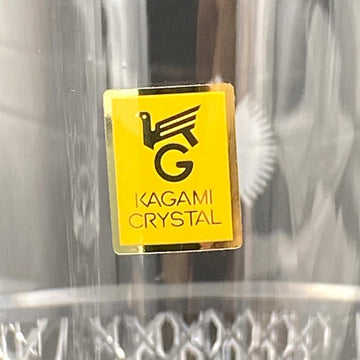

Notes on the marks: Two label designs appear: an older black label with red lettering and a yellow label. Works by named craftsmen carry a box signature and seal.
Kagami Mitsuru (1918–1999)各務満
A glass artist who graduated in sculpture from the Tokyo School of Fine Arts and joined Kagami Crystal Works (now Kagami Crystal) in 1943. After many selections at the Nitten and other shows, the artist left juried exhibitions in 1966 to focus on solo shows and was invited to museum exhibitions in Japan and abroad.
Career and awards: 1941: graduated in sculpture from the Tokyo School of Fine Arts / 1943: joined Kagami Crystal Works / 1951: Kanagawa Prefecture Best Design Award (later selected 15 times for the Nitten) / 1966: left juried exhibitions to work independently / 1980: invited to the Beauty of Contemporary Glass exhibition, National Museum of Modern Art, Kyoto / 1986: invited to Japon des Avant-Gardes 1910–1970, Centre Pompidou, Paris

Notes on the marks: The fitted box bears the signature "満" (Mitsuru) and a red seal. No signature was found on the glass.
Kamei Miraku XIV (1931–2014)十四代 亀井味楽
Born in Fukuoka Prefecture into the Kamei family of Takatori ware potters. The artist learned the family's secret glazes and thin-walled throwing from Miraku XIII, the artist's father, succeeded as Miraku XIV in 1964, and was recognized as a Fukuoka City Intangible Cultural Property holder.
Career and awards: 1964: succeeded to the name Kamei Miraku XIV / 1975: Fukuoka City Intangible Cultural Property holder / full member, Japan Kogei Association

Notes on the marks: The fitted box bears the signature "味楽" (Miraku) and a round seal.
Kamide Choemon Kiln上出長右衛門窯
A Kutani ware kiln known for presenting a vase to Meiji Jingu and for making the tableware used when the Crown Prince and Crown Princess, now the Emperor Emeritus and Empress Emerita, visited Ishikawa Prefecture in 1985.
Career and awards: 1957: Ishikawa Governor's Prize, New Tableware Exhibition / 1969: presented a vase to Meiji Jingu / 1984: MITI Bureau Director's Prize, National Traditional Crafts Exhibition / 1985: made tableware for the Crown Prince and Crown Princess's visit
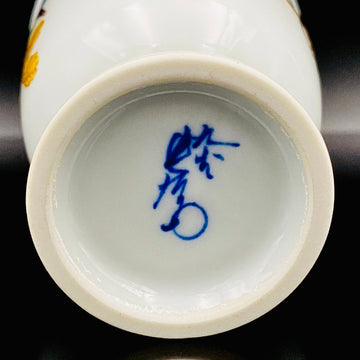


Notes on the marks: The kiln's mark is painted in cobalt inside the foot ring. The fitted box bears a signature and a seal; the cloth wrapper carries a round red seal.
Kamoda Taro (1963–)加守田太郎
The eldest son of Kamoda Shoji (1933–1983). After the father's early death, the artist returned to Mashiko and took over the Kamoda kiln; known for hand-built forms made without the wheel and original geometric inlay.
Career and awards: 1983: returned to Mashiko after the father's death / 1985: took over the Kamoda kiln / 1986: first solo exhibition at Aoyama Green Gallery

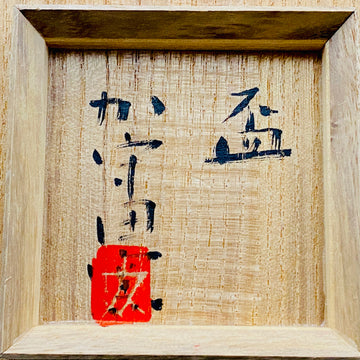
Notes on the marks: A geometric mark inlaid with white clay is incised on the base. The fitted box bears the signature and a red seal.
Kano Mitsuo (1903–1970)叶光夫
A potter known for glaze research grounded in scientific analysis. The artist studied old Chinese ceramics at the Chinese Ceramics Research Institute in Dalian and was active at the Nitten after the war; reportedly held only six solo exhibitions in a lifetime.
Career and awards: 1920: joined the Chinese Ceramics Research Institute in Dalian / 1949: Special Prize, Nitten / 1957: Nitten judge / 1967: Minister of Education Award, Nitten / 1968: Nitten councilor / 1969: made a white porcelain vase for the new Imperial Palace


Notes on the marks: The mark on the base varies from work to work: a potter's seal on some and a mark painted in cobalt on others. Box inscriptions are written in both blue and black ink.
Kato Juitsu (1946–)加藤寿逸
A Seto potter who won the Grand Prix at the 1st Ceramics Biennale; the winning work, Ennetsu, was purchased by Seto City for its permanent collection. As an associate member of the Nitten, the artist exhibited celadon and other works.
Career and awards: Grand Prix, 1st Ceramics Biennale (Ennetsu, purchased by Seto City) / Minister of Education Award, Chunichi International Ceramics Exhibition / donated Yuibi to the Nagoya City Guest House / Nitten associate member / member, Seto Ceramic Art Association
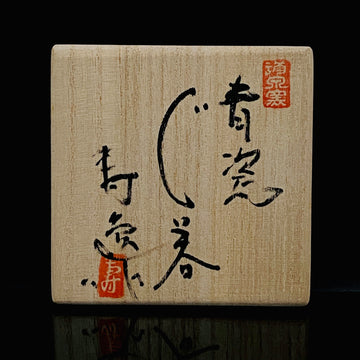

Notes on the marks: The fitted box bears the signature and a red seal; the cloth wrapper also carries a seal.
Kato Kenji (1933–2008)加藤賢司
Born in Tajimi, Gifu Prefecture. The artist studied at Kyoto City University of Arts under Tomimoto Kenkichi, Kondo Yuzo and Fujimoto Yoshimichi, all later Living National Treasures, taught in Turkey, and is known for "Turkish blue" works fusing Middle Eastern ornament with Japanese ceramics. Shinsho kiln.
Career and awards: 1956: graduated from Kyoto City University of Arts / 1968: lecturer, Ohio State University / 1971: visiting professor at the Istanbul State Academy of Fine Arts, sent by the Japanese government / 1986: Osman Hamdi Art Award from the Turkish government / 1995: Gifu Prefecture Arts and Culture Award


Notes on the marks: The potter's seal on the base differs from work to work; at least three types have been seen, including a square seal and a "賢" (Ken) seal. The fitted box bears the signature and a red seal.
Kato Sho (1927–2001)加藤釥
Born in Seto, Aichi Prefecture. Combining Seto's traditional techniques with scientific glaze theory, the artist created modern ceramic forms beyond the bounds of tea wares, served as a Nitten judge and vice-chair of the Japan Contemporary Arts and Crafts Association, and helped lead postwar Japanese ceramics.
Career and awards: 1944: graduated from Aichi Prefectural Seto Ceramics School / 1957: first selection, Nitten / 1962 and 1964: Special Prize, Nitten / 1968: work purchased by the National Museum of Modern Art, Tokyo / 1969 and 1974: Nitten judge / 1970: work purchased by the Ministry of Foreign Affairs
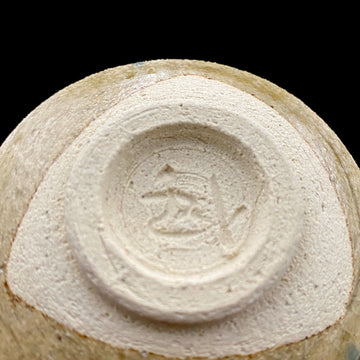


Notes on the marks: A potter's seal is impressed inside the foot ring. The box signatures and seals also take several forms.
Kato Shuntei II (1927–1995)二代 加藤春鼎
The second head of the Kanae kiln in Akazu, Seto. The artist studied under Kato Shuntei I, succeeded to the name in 1961, and excelled in Seto tea wares such as Ki-Seto, Seto-guro, Shino and Oribe; works are held by the National Crafts Museum.
Career and awards: 1961: succeeded as Shuntei II and head of the Kanae kiln / 1st Aichi Prefecture Arts Encouragement Award / Aichi Prefecture Education and Culture Merit Award / Ko-Seto bowl selected for Seto City's permanent collection


Notes on the marks: A round potter's seal is impressed near the base of the body. The fitted box bears the signature and a red seal; the cloth wrapper carries a round seal.
Kato Yasuhiro (1926–)加藤恭博
Born the first grandchild of Kato Onokichi II of a traditional Seto kiln, the artist learned Seto sometsuke and other techniques from the grandfather. Also known for ceramic murals; from 1994 the potter researched oil-spot and gold crystalline glazes.
Career and awards: 1944: graduated from Aichi Prefectural Seto Ceramics School / 1971: ceramic mural for the Ebetsu City Community Hall, Hokkaido / 1994: the Fureai mural on the Seto riverbank; a set of tableware used by the Crown Prince and Crown Princess at Kagaya, Wakura Onsen


Notes on the marks: A mark is incised inside the foot ring. The fitted box bears the signature "恭博作" and a red seal.
Kato Yoshitaka (1921–1990)加藤良高
A potter of the Kobei kiln lineage, a leading name in Mino ware, who supported the kiln's golden age alongside the artist's elder brother, Living National Treasure Kato Takuo.
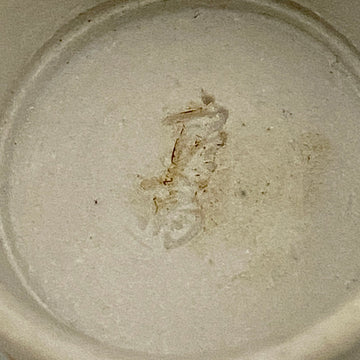
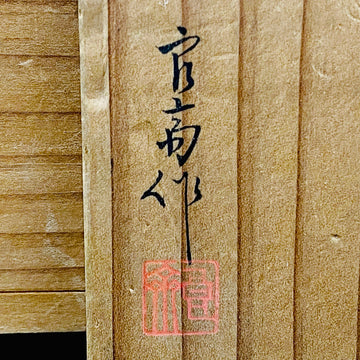
Notes on the marks: A mark is incised inside the foot ring. The fitted box bears the signature "良高作" and a red seal.
Kawai Takeichi (1908–1989)河井武一
A mingei potter who studied under the artist's uncle, Kawai Kanjiro, from 1927 and, as the senior disciple, supported the Shokei kiln in Gojozaka, Kyoto, for about 40 years.
Career and awards: 1927: began studying under Kawai Kanjiro

Notes on the marks: The fitted box bears the signature and a red seal. No potter's seal is seen on the piece itself.
Kawai Toru (1941–)河井透
Born in Kyoto as the eldest son of Kawai Takeichi, this mingei potter also learned from Kawai Kanjiro in the master's later years. Seeking no exhibition prizes or titles, the artist built the Nantan climbing kiln in Kameoka in 1976.
Career and awards: 1962: began working under the father, Kawai Takeichi / 1970: moved the workshop to Higashiyama, Kyoto / 1976: built the Nantan kiln in Kameoka, Kyoto Prefecture


Notes on the marks: A small mark is painted in cobalt inside the foot ring. The fitted box bears the signature "透" (Toru) and a red seal.
Kawajiri Hiroshi (1946–)川尻浩史
Born in Moseushi, Hokkaido. A Mashiko ware potter who trained at the Sudo kiln in Mashiko from 1967 and later became independent, opening the climbing-kiln pottery Kazegama (風窯). Active abroad from early on, the artist had a work purchased by the Museum of Modern Ceramics in Deidesheim, West Germany, in 1982.
Career and awards: 1970: selected for the 17th Japan Traditional Art Crafts Exhibition / 1975: Encouragement Prize, Asian Contemporary Art Exhibition / 1982: work purchased by the Museum of Modern Ceramics, Deidesheim, West Germany / 1985: selected for the 8th Japan Ceramic Art Exhibition and the 43rd International Competition of Contemporary Ceramic Art in Faenza / 2005: Shin-Nichibi Grand Prize, Shin-Nichibi Exhibition

Notes on the marks: The fitted box bears the signature "浩史" (Hiroshi) and a red seal.
Kawashima Hiroshi (1951–)河島洋
Born in Kaga, Ishikawa Prefecture. A Kutani ware potter who studied under Tokuda Yasokichi III and Nakajima Shuko; a full member of the Japan Kogei Association and a certified Kutani ware traditional craftsman, known for overglaze-enamel sgraffito and other works.
Career and awards: 1982: first selection, Japan Traditional Art Crafts Exhibition / 1995: Encouragement Prize, Ishikawa branch exhibition / 2006 and 2007: Hazama Memorial Prize, Issuikai ceramics exhibition


Notes on the marks: The fitted box bears the signature "洋" (Hiroshi) and a red seal; the same seal appears on the cloth wrapper.
Kida Hiroyuki (1944–)木田弘之
Born in Komatsu, Ishikawa Prefecture, the third generation of Kida Seito, a firm known for sculptural Kutani ware. Honors include the Chunichi Grand Prize, the Minister of Education Award at the Prefectural Selected Exhibition and a Special Prize at the Nitten; a work was purchased by the Ministry of Foreign Affairs.
Career and awards: 1966: first selection, Nitten / 1974: selected for the Faenza International Ceramics Competition / 1977: Chunichi Grand Prize, Chunichi International Ceramics Exhibition / 1979: Minister of Education Award, Prefectural Selected Exhibition / 1980: work purchased by the Ministry of Foreign Affairs / 1995: Special Prize, Nitten


Notes on the marks: A square potter's seal is impressed beside the foot ring. The fitted box bears the signature "九谷 弘之" and a red seal.
Kikuchi Akira (1935–)菊池晃
Born the fourth generation of the oldest kiln family in Mashiko, the artist graduated from Musashi Institute of Technology and did research on ceramic engineering there before becoming a potter; works include persimmon tenmoku.

Notes on the marks: The fitted box bears the signature "晃" (Akira) and a red seal.
Kimura Ichiro (1915–1978)木村一郎
After studying glaze chemistry and firing at the National Ceramics Research Institute, the artist built a climbing kiln in Mashiko in 1946, made wares for the Crown Prince's Palace, and was invited to show at an international ceramics exhibition held by a museum in Marseille.
Career and awards: studied at the National Ceramics Research Institute / 1946: built a climbing kiln in Mashiko / prizes at the Kokuten and the Contemporary Japanese Ceramics Exhibition / made wares for the Crown Prince's Palace / invited to an international ceramics exhibition held by a Marseille museum

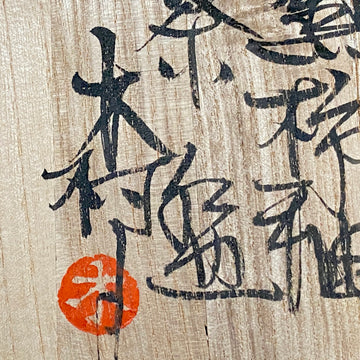
Notes on the marks: A small seal is impressed on the foot ring. The fitted box bears the signature "木村一郎" and a red seal.
Kimura Mitsuyoshi (1970–)木村充良
Born in Mashiko, the third generation of a Mashiko kiln after the grandfather, Kimura Ichiro, and the father, Kimura Mitsuru. The artist began working under the father in 1994 and became independent after the father's death in 1998.
Career and awards: 1994: began working under the father, Kimura Mitsuru / 1998: independent after the father's death / annually from 2001: Three Generations of the Mashiko Kiln exhibition at Isetan Matsudo / 2007: Three Generations exhibition at the Mashiko Ceramic Art Messe


Notes on the marks: A square potter's seal is impressed beside the foot ring. The fitted box bears the signature "充良" and a round red seal.
Kitade Fujio (1919–2014)北出不二雄
Studied under the father, Kitade Tojiro, and graduated from Kanazawa College of Art. A master of modern Kutani ware who showed enameled porcelain at the Nitten, won the Nitten Prime Minister's Award, and served as president of Kanazawa College of Art and head of the Society for the Preservation of Kutani Techniques.
Career and awards: 1950: graduated in ceramics from Kanazawa College of Art; first selection, Nitten / 1979: professor, Kanazawa College of Art / 1987: Prime Minister's Award, Nitten / 1991: president of Kanazawa College of Art; Chunichi Culture Prize / 1993: Prime Minister's Award, Japan New Crafts Exhibition


Notes on the marks: A mark is painted in green enamel inside the foot ring. Depending on the work, it reads "不二雄" (Fujio) or "不二" (Fuji) inside an oval. The box and cloth wrapper carry red seals.
Kitade Seiko (1928–2011)北出星光
Born Kitade Isamu in Daishoji, Kaga, Ishikawa Prefecture, the third son of Kitade Tojiro. The artist exhibited refined Kutani ware with overglaze enamels and gold mainly at the Nitten, and received the Order of the Sacred Treasure, 4th Class.
Career and awards: 1952: first selection, Nitten / Special Prize and Hokka Prize, Nitten / 1993: Ishikawa Prefecture Cultural Merit Award / 1998: Order of the Sacred Treasure, 4th Class / Nitten councilor; full member, Japan Kogei Association


Notes on the marks: A square mark is painted in green enamel inside the foot ring; the script and color vary from work to work.
Kitade Tojiro (1898–1968)北出塔次郎
Born in Hyogo Prefecture, the artist studied Japanese-style painting under Yano Kyoson at the Osaka Art School and later invited Tomimoto Kenkichi to the Kitade studio to research pottery together. As professor of ceramics at what is now Kanazawa College of Art, the artist trained many successors and became a leading figure in Showa-period Kutani ware.
Career and awards: 1928: first selection, Teiten / 1946: professor of ceramics, Kanazawa Art and Crafts College / 1959: Nitten councilor


Notes on the marks: A square mark is painted in green enamel inside the foot ring. The fitted box bears the signature "塔次郎" (Tojiro) and a red seal; the cloth wrapper also carries a seal.
Kitagawa Hiroyuki (1955–2017)北川宏幸
A Kyoto (Kiyomizu) ware potter born in Kyoto Prefecture. While still a student, the artist began four years of study under Kimura Seiko, opened the Tobo Yasaburo studio in 1987, and was selected and awarded at exhibitions such as the Suntory Museum of Art Grand Prix Exhibition.
Career and awards: 1977: graduated in ceramics from Kyoto College of Art / 1978: graduated from the Kyoto Prefectural Pottery Vocational School / 1987: opened Tobo Yasaburo / 1992: selected for the Suntory Museum of Art Grand Prix Exhibition / 1995: Encouragement Prize, Shinbi Kogeikai / 1997: Shimpo Kogyo Prize, same exhibition


Notes on the marks: A round potter's seal is impressed on the base or body. The fitted box bears the signature and a seal.
Kitamura Ichiro (1917–1968)北村一朗
A metal artist who studied metalwork at the Tokyo School of Fine Arts and was selected and awarded at the Japan Traditional Art Crafts Exhibition and the Bunten; father of Kitamura Shinichi, later a Living National Treasure.
Career and awards: 1967: Tokyo Board of Education Prize, Japan Traditional Art Crafts Exhibition


Notes on the marks: A mark is stamped on the underside. The box is inscribed in ink "北村一朗作" (made by Kitamura Ichiro).
Kitamura Shinichi (1952–)北村眞一
A metal artist specializing in lost-wax casting, designated a Living National Treasure for lost-wax casting (rogata chuzo) in 2019.
Career and awards: 2019: Living National Treasure (lost-wax casting)

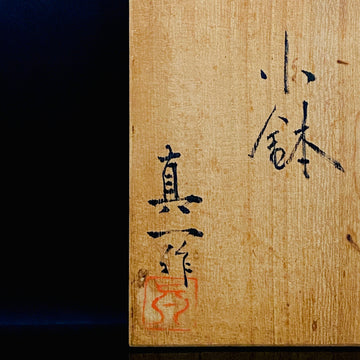
Notes on the marks: The character "眞" (Shin) is engraved on the silver body. The fitted box bears the signature "眞一作" and a seal.
Kobayashi Shuji (1950–)小林秀二
A certified traditional craftsman of Bizen ware, born in Okayama Prefecture. After completing the Okayama Prefectural Bizen Ceramics Center course, the artist trained at kilns in other regions, including Mashiko, and gained deep knowledge of glazes and clays.
Career and awards: 1973: completed the Okayama Prefectural Bizen Ceramics Center course


Notes on the marks: "秀二" (Shuji) is incised on the base. The fitted box bears the signature and a red seal.
Kobei Kiln幸兵衛窯
A renowned kiln founded in 1804 by Kato Kobei I in Ichinokura, Mino, which soon became purveyor of blue-and-white tableware to Edo Castle. Kato Takuo, the sixth generation, was a Living National Treasure. In the three-kiln cup set (#455), it made the red-enamel phoenix cup.
Career and awards: 1804: founded by Kato Kobei I

Notes on the marks: The character "魁" (Sakigake) is painted in red enamel inside the cup. The fitted box of the three-kiln set (#455) bears the kiln names and red seals.
Kojima Shigeo (1950–)小島茂夫
Born in Ashikaga, Tochigi Prefecture. After training at Mashiko Toen and at Tsuboya in Okinawa, the artist became one of the few potters to study under Kamoda Shoji in Tono, Iwate, in 1978, and set up an independent kiln in Mashiko in 1980.
Career and awards: 1978: studied under Kamoda Shoji in Tono / 1980: built a kiln in Mashiko and became independent / 1984, 1986 and 1987: selected for the Asahi Ceramics Exhibition


Notes on the marks: A small mark is incised inside the foot ring. The fitted box bears the signature "茂夫" (Shigeo) and a red seal.
Konishi Toko II (Konishi Mitsue) (1927–2018)二代 小西陶古(小西光江)
The second head of the Konishi Toko kiln of Bizen ware. Studying under Konishi Toko I, a master of sculptural pieces, the artist inherited fine modeling and unglazed firing techniques and devoted a long life to preserving and developing the tradition.
Career and awards: studied under Konishi Toko I / made sculptural pieces and unglazed wares as the kiln's second head / 2011: commended by the Minister of Economy, Trade and Industry for services to traditional crafts

Notes on the marks: A potter's seal is impressed on the body.
Konishi Yohei (1941–)小西洋平
A Tokoname ware potter who developed neriage (marbled clay) and thin-walled throwing largely on their own, known for the red-clay neriage style called Genshinsai. Works are held by the Victoria and Albert Museum and the Philadelphia Museum of Art, and the artist was recognized in 2013 as a Tokoname City Intangible Cultural Property holder for wheel-thrown Tokoname ware.
Career and awards: 1982: Silver Prize, Vallauris International Ceramics Biennale / 2013: Tokoname City Intangible Cultural Property holder (wheel-thrown Tokoname ware)


Notes on the marks: An oval potter's seal is impressed inside the foot ring. The fitted box bears the signature "洋平" (Yohei) and a red seal; the cloth wrapper is printed with the signature and seal.
Kozuru Hajime (1938–)高鶴元
The eldest son of Kozuru Kazan of the Agano ware tradition, which spans about 400 years. The artist won the Japan Kogei Association President's Award at the Japan Traditional Art Crafts Exhibition two years running and in 1980 went to the United States as a visiting fellow at Harvard University, building a kiln near Boston.
Career and awards: 1968 and 1969: Japan Kogei Association President's Award, Japan Traditional Art Crafts Exhibition / 1975: Japan Ceramic Society Award / 1980: visiting fellow at Harvard University / 1997: Fukuoka Prefecture Culture Prize


Notes on the marks: A mark is incised on the base. The fitted box bears the signature "元" (Hajime) and a red "元" seal; some works come with a "元窯" (Hajime kiln) tag.
Kumakura Junkichi (1920–1985)熊倉順吉
Born in Kyoto, the artist studied architecture, then pottery under Fukuda Rikisaburo and later worked under Tomimoto Kenkichi. In 1957 the potter joined the avant-garde Sodeisha group and won international acclaim, including the Grand Prix at the Brussels World's Fair.
Career and awards: 1955: 1st Japan Ceramic Society Award / 1957: member of Sodeisha / 1958: Grand Prix, Brussels World's Fair / 1962: Silver Medal, International Ceramics Exhibition in Prague / works in the National Museums of Modern Art in Tokyo and Kyoto and elsewhere

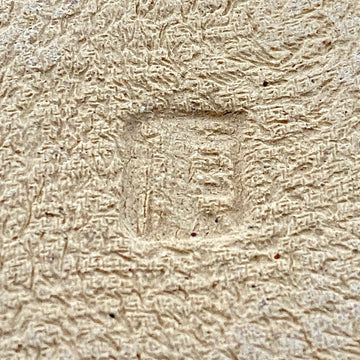


Notes on the marks: Several types of potter's seal appear on the base, including a "順" (Jun) seal. The fitted box bears the signature and a red "熊倉" (Kumakura) seal, and the cloth wrapper also carries a seal. Some works come with a printed name tag.
Kumakura Ryuichi (1947–)熊倉隆一
An Edo Kiriko cut-glass artist who won the Grand Prize at the 1st Japan Glass Exhibition in 1982. Our piece comes with a leaflet from the Edo Kiriko studio Hanashyo (華硝).
Career and awards: 1982: Grand Prize, 1st Japan Glass Exhibition


Notes on the marks: The fitted box bears the signature "隆" (Ryu) and a red seal. A leaflet from the Edo Kiriko studio 華硝 (Hanashyo) is included.
Kuroda Gaku (1946–)黒田岳
Born in Nagano Prefecture, a Hagi ware potter working in Hagi, Yamaguchi Prefecture, and a full member of the Hagi Potters Association.


Notes on the marks: A "岳" (Gaku) potter's seal is impressed on the base. The fitted box bears the signature and a seal; the cloth wrapper also carries a seal.
Kuroki Kuniaki (1945–)黒木国昭
Born in Kobayashi, Miyazaki Prefecture. After gaining experience as a craftsman at glass companies, the artist founded Glass Art Kuroki in Aya, Miyazaki, in 1984. Known for Aya Kiriko, a cut glass developed from research into the lost Satsuma Kiriko, the artist has been honored as a Contemporary Master Craftsman and with the Medal with Yellow Ribbon.
Career and awards: 1963: joined Yamaya Glass Industry / 1984: founded Glass Art Kuroki in Aya / 1989: Contemporary Master Craftsman (then the youngest in glass) / 1991: Miyazaki Prefecture traditional craftsman / 2006: Medal with Yellow Ribbon


Notes on the marks: A cursive signature is engraved under the glass. The fitted box bears the signature "黒木国昭", a red seal, and the work's title.
Kuze Tensei (1909–1987)久世天聲
A kiln of Awara ware in Awara, Fukui Prefecture. The first Kuze Tensei founded it around 1914 using clay from Jingaoka near Tojinbo, and the ware is known for pale blues and greens from malachite-rich glazes. The second generation (1909–1987) developed the ware further. Our piece bears no generation number; we attribute it to the second generation.
Career and awards: around 1914: the first generation founded Awara ware / 1933: death of the first generation


Notes on the marks: A rectangular potter's seal is impressed near the base of the body. The fitted box bears the signature and several red seals of different sizes.
M
Maki Yukichi (1916–1998)牧勇吉
A senior disciple of Itaya Hazan, the first potter to receive the Order of Culture. The artist won the Special Prize at the Nitten twice, served as a Nitten councilor and president of the Ibaraki Prefectural Art Exhibition, and received the Order of the Sacred Treasure, 4th Class.
Career and awards: 1951: Special Prize, Nitten / 1953: Special Prize, Nitten / 1987: Order of the Sacred Treasure, 4th Class / Nitten councilor; president, Ibaraki Prefectural Art Exhibition
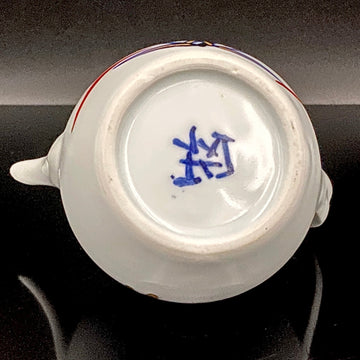

Notes on the marks: A mark is painted in cobalt inside the foot ring.
Matsubara Naoyuki (1938–2024)松原直之
A potter who studied under Kimura Ichiro and Yagi Kazuo and fused Mashiko's rustic clay with Kyoto's modern craft sensibility. Representative works are held by the Mashiko Museum of Ceramic Art.
Career and awards: 1967: Tochigi Prefecture Arts Festival Award (crafts) / 1990: Encouragement Prize, International Ceramics Exhibition

Notes on the marks: A round "直" (Nao) potter's seal is impressed beside the foot ring.
Matsui Koyo (1962–)松井康陽
The child of Matsui Kosei, Living National Treasure for neriage. After graduating from the University of Tsukuba, the artist learned the Matsui family's clay recipes and assembly techniques from the father and creates layered neriage works with muku-wood ash glaze.
Career and awards: 1985: graduated from the University of Tsukuba and began studying under the father / 1991: Encouragement Prize, Japan Traditional Art Crafts Exhibition / 2002: Japan Ceramic Society Award / 2005: Encouragement Prize, Traditional Crafts New Works Exhibition / full member, Japan Kogei Association


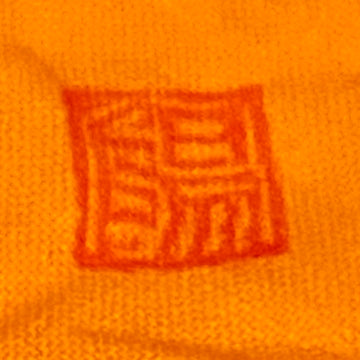
Notes on the marks: A "陽" (Yo) potter's seal is impressed inside the foot ring. The fitted box bears the signature and a seal; the cloth wrapper carries a red "陽" seal.
Matsumoto Isami (1931–2012)松本為佐視
A Kyoto potter who studied under Kusube Yaichi, recipient of the Order of Culture. Known for thin, refined porcelain with deep celadon glaze, the artist twice won the Special Prize at the Nitten and served as a judge and councilor.
Career and awards: 1967: Special Prize, Nitten / 1974: Special Prize, Nitten / Nitten judge and councilor; director, Kyoto Crafts Artists Association


Notes on the marks: A square potter's seal is impressed on the base; on some celadon cups it is impressed inside the bowl. The fitted box bears the signature "為佐視" (Isami) and a red seal; the cloth wrapper also carries a seal.
Matsumoto Saichi (1930–2021)松本佐一
Born in Kanazawa, the fourth generation of the Matsuya kiln, descended from the renowned Shoundo (松雲堂) line of Kutani ware. The artist twice won the Special Prize at the Nitten, made the sake cups presented as the Prime Minister's gifts at the normalization of Japan–China relations, made furnishings for the Akasaka State Guest House, and was recognized as a holder of Ishikawa Prefecture Intangible Cultural Property for Kutani ware.
Career and awards: 1950: graduated in ceramics from Kanazawa Art and Crafts College / 1972: made the Prime Minister's gift sake cups for the normalization of Japan–China relations / 1974: made lamps for the Akasaka State Guest House / 1977: Special Prize, Nitten / 1988: Special Prize, Nitten; ceramic mural at JR Kanazawa Station / 1999: Ishikawa Prefecture Intangible Cultural Property holder (Kutani ware)
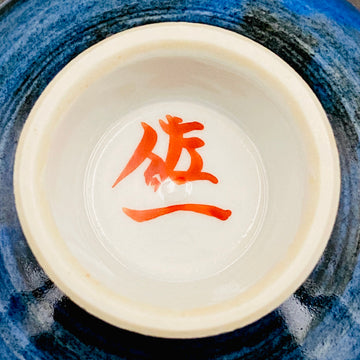

Notes on the marks: "佐一" (Saichi) is written in red enamel inside the foot ring. The fitted box bears the signature and a red seal.
Matsuura Shinya (1960–)松浦慎弥
Born in Kanazawa. After studying oil painting at Kanazawa College of Art and graduating from the Ishikawa Prefectural Kutani Ware Training Institute, the artist studied under Asakura Isokichi, recipient of the Order of Culture, and won the New Artist Award at the 2007 Japan Traditional Art Crafts Exhibition with a gold-under-glaze bowl.
Career and awards: 1986: began studying under Asakura Isokichi / 2001: full member, Japan Kogei Association / 2007: New Artist Award, Japan Traditional Art Crafts Exhibition


Notes on the marks: A square mark is painted in enamels inside the foot ring. The fitted box bears the signature "慎弥" (Shinya) and a red seal; the cloth wrapper also carries a seal.
Matsuzaki Kan (1977–)松崎幹
Born in Tsukiji, Tokyo, the eldest son of the potter Matsuzaki Ken. The artist studied photography in the United States and worked as a photographer before taking up pottery in 2015, and now shows tea bowls such as Irabo ware.
Career and awards: 2006: graduated from the New England School of Photography / 2015: began making pottery / 2016: New Artist Award, Kokuten photography section / 2020: first solo exhibition as a potter at Mitsukoshi Nihonbashi / 2021: Magic of the Tea Bowl, Ippodo Gallery New York


Notes on the marks: The fitted box bears the signature "幹" (Kan) and a red seal; the cloth wrapper also carries a seal.
Matsuzaki Ken (1950–)松崎健
Born in Tokyo, the third son of the Japanese-style painter Matsuzaki Shuki. After studying ceramics at Tamagawa University and training under Shimaoka Tatsuzo in Mashiko, the artist set up an independent kiln in Mashiko in 1977. Active in the Kokugakai, the potter's wood-fired works are also highly regarded abroad.
Career and awards: 1972: graduated in ceramics from Tamagawa University and began training under Shimaoka Tatsuzo / 1977: built a kiln in Mashiko and became independent / 1980: Nojima Prize, Kokugakai / 1982: associate member / 1984: associate member's award / 1986: full member, Kokugakai


Notes on the marks: A mark is incised on the base. The fitted box bears the signature "健" (Ken) and a red seal.
Mimura Hokudo (1920–2003)三村北土
Born Mimura Takao in Mashiko, the artist studied at the Mashiko Ceramics Training Institute and later, as a technical officer at the Tochigi Prefectural Ceramics Guidance Center, trained successors, playing a central role in passing on Mashiko techniques. Opened the Hokudo kiln in 1970.
Career and awards: 1938: completed the research course at the Mashiko Ceramics Training Institute; technician at the Aomori Prefectural Industrial Research Institute / 1945: made pottery near Bangkok, Thailand / 1949: technical officer at the Tochigi Prefectural Ceramics Guidance Center / 1970: built the Hokudo kiln / 1980: certified traditional craftsman


Notes on the marks: A square potter's seal is impressed on the body. The fitted box bears the signature and a red seal.
Mitsui Tamekichi III (1935–)三代 三ッ井為吉
Born Mitsui Eiichi, the third head of the Mitsui family of Kutani ware. After graduating from Kanazawa College of Art, the artist studied under Kitade Tojiro and Asakura Isokichi and succeeded as Tamekichi III in 1961, expressing the five Kutani colors in a refined modern manner.
Career and awards: 1959: graduated from Kanazawa College of Art / 1961: succeeded as Tamekichi III


Notes on the marks: A square mark is painted in enamel inside the foot ring; its color differs between works (green or yellow). The fitted box bears the signature "為吉" (Tamekichi) and a red seal; the cloth wrapper also carries a seal.
Miyagawa Kozan I (1842–1916)初代 宮川香山
Born into a family of potters at Makuzugahara, Kyoto, the artist moved to Yokohama in 1870 and opened the Makuzu kiln. After many awards at world's fairs, Kozan was appointed Artist to the Imperial Household in 1896, and two works are designated Important Cultural Properties of Japan.
Career and awards: 1871: opened the Makuzu kiln in Yokohama / 1889: Gold Medal, Paris Exposition / 1893: Gold Medal, World's Columbian Exposition, Chicago / 1896: Artist to the Imperial Household / 1904: Grand Prize, Louisiana Purchase Exposition, St. Louis / 1910: Grand Prix of Honour, Japan–British Exhibition

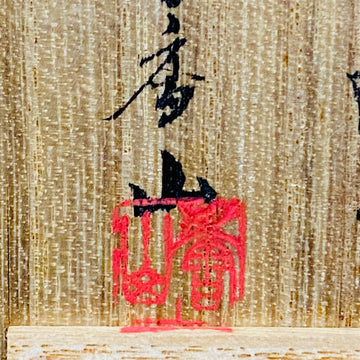
Notes on the marks: A potter's seal is impressed inside the foot ring. The box is an authentication box signed and sealed in red by Kozan II.
Miyanaga Tozan II (Miyanaga Tomoo) (1907–1995)二代 宮永東山(宮永友雄)
Born Miyanaga Tomoo in Kyoto, the son of Miyanaga Tozan I, founder of the Tozan kiln. The artist studied under Numata Ichiga at the National Ceramics Research Institute, succeeded as Tozan II in 1941, and helped found the Kyoto Traditional Potters Association.
Career and awards: 1930: graduated in design from Kyoto Higher School of Arts and Crafts / 1935: completed training at the National Ceramics Research Institute / 1939: selected for the Bunten / 1941: succeeded as Miyanaga Tozan II / 1943: certified for the preservation of craft techniques / 1960: helped found the Kyoto Traditional Potters Association (later vice-president)


Notes on the marks: An oval "東山" (Tozan) mark is written in gold inside the foot ring. The fitted box bears the signature "東山造" and an oval red seal.
Miyanaga Tozan III (Miyanaga Rikichi) (1935–)三代 宮永東山(宮永理吉)
Born Miyanaga Rikichi, the artist studied sculpture under Tsuji Shindo and others at Kyoto City University of Arts, studied in New York, founded the sculpture group Zero, and joined Sodeisha in 1970. Succeeded as Miyanaga Tozan III in 1999.
Career and awards: 1958: graduated in sculpture from Kyoto City University of Arts / 1959: studied at the Art Students League of New York / 1961: founded the sculpture group Zero / 1970: member of Sodeisha / 1998: Kyoto Prefecture Cultural Merit Award / 1999: succeeded as Miyanaga Tozan III / 2008: Kyoto City Arts Merit Award


Notes on the marks: The character "理" (Ri) is painted in cobalt inside the foot ring. The fitted box bears the signature "理吉作" and a red seal; the cloth wrapper also carries a seal.
Mizukawa Toei II (1914–2001)二代 水川陶影
Born Mizukawa Katsuji, the second son of Toei I, founder of Kibi ware in Tsushima, Okayama. After graduating in ceramics from Kyoto Higher School of Arts and Crafts, the artist studied under the father and devoted a career to developing Kibi ware.
Career and awards: 1937: graduated in ceramics from Kyoto Higher School of Arts and Crafts / studied under the father, Toei I

Notes on the marks: A mark is incised inside the foot ring.
Mizuno Juzan II (1908–1978)二世 水野寿山
Born Mizuno Sakae into a potter family in Nishikama-cho, Seto, the artist studied under Fujii Tatsukichi, a master of modern crafts, succeeded as Juzan II in 1931, worked to revive Seto tea wares, was selected several times for the Nitten, and was designated an artist for the preservation of the arts.
Career and awards: 1931: succeeded as Juzan II / selected several times for the Nitten / designated artist for the preservation of the arts


Notes on the marks: "寿山" (Juzan) is incised beside the foot ring. The fitted box bears the signature and a red "寿山" seal.
Mizuno Sekikazu (1936–)水野鉐一
A potter of the 福海窯 kiln in Seto, Aichi Prefecture. Selected 20 times for the Nitten and made an associate member, the artist also served as a juror of the Japan New Crafts Exhibition as a member of the Japan New Crafts Artists Federation, and has also made nerikomi tea bowls and bowls.
Career and awards: 1987 and 1991: listed as a potter of the 福海窯 kiln in 『人と作品』 by the Seto Ceramic Art Association / as of 1999: selected for the Nitten 20 times and Nitten associate member, juror twice and awards twice at the Japan New Crafts Exhibition, awards twice at the Asahi Ceramics Exhibition, member of the Japan New Crafts Artists Federation (according to the artist profile in 『美術の窓』, March 1999)


Notes on the marks: An incised mark is carved beside the foot ring. The fitted box bears the artist's signature and a red seal.
Mizuno Sokaku I (1912–1996)初代 水野双鶴
Born in Seto, the artist studied under Fujii Tatsukichi, a pioneer of modern crafts, and raised neriage (marbled clay) to a modern art. Selected 27 times for the Nitten and recognized in 1987 as a Seto City Intangible Cultural Property holder; founder of the Mizuno family of neriage potters.
Career and awards: selected 27 times for the Nitten / top prize three times at the Seto Ceramics Exhibition (later exempt from jury) / Governor's Prize twice at the Asahi Ceramics Exhibition / 1987: Seto City Intangible Cultural Property holder


Notes on the marks: "双鶴" (Sokaku) is incised inside the foot ring. The box signatures and seals take several forms.
Mizuno Takuzo (1927–2015)水野澤三
Born in Toki, Gifu Prefecture. The artist studied under Kato Kageaki, twelfth in the line of Seto's founding potter, graduated in Japanese-style painting from Kyoto Art School, and then studied under Tomimoto Kenkichi. Working at the Yozan kiln in nezumi-Shino and Seto-guro, the potter was recognized in 2010 as a Toki City Intangible Cultural Property holder for Seto-guro.
Career and awards: 1945: studied under Kato Kageaki / 1952: graduated from Kyoto Art School and studied under Tomimoto Kenkichi / 1981 and 1982: works presented to Emperor Showa and Empress Kojun / 2007: Gifu Prefecture award for successors of traditional culture / 2010: Toki City Intangible Cultural Property holder (Seto-guro)

Notes on the marks: The fitted box bears the signature and a red seal (the Yozan kiln seal).
Mizutani Tosui (1949–)水谷陶酔
Born Mizutani Kiyoshi in Akaiwa, Okayama Prefecture, a Bizen ware potter. The artist trained under Ohira Seinosuke, a direct disciple of Fujiwara Kei, Bizen's first Living National Treasure, and in 1978 built a kiln near the historic Shizutani School and became independent.
Career and awards: 1972: began training under Ohira Seinosuke / 1978: built a kiln near the Shizutani School and became independent; first selection, Okayama Prefectural Art Exhibition


Notes on the marks: The fitted box bears the signature and a round red seal; the cloth wrapper carries a square seal.
Mori Iroku IV (1963–)四代 森伊呂久
The fourth Mori Iroku, a name known for Banko ware teapots. Following the father, Iroku III, the artist was certified as a traditional craftsman by the Minister of Economy, Trade and Industry in 2000; works are in the Yokkaichi Municipal Museum.
Career and awards: 1986: Mayor's Prize, Banko Teapot Competition / 1987: selected for the Japan New Crafts Exhibition / 2000: certified traditional craftsman


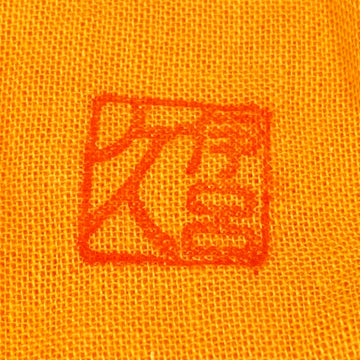
Notes on the marks: A square potter's seal is impressed on the body. The fitted box bears the signature and a red "萬古" (Banko) seal; the cloth wrapper also carries a seal.
Mori Taiga (1978–)森大雅
Born in Bizen, Okayama Prefecture, a Bizen ware potter who carries on the refining of paddy-field clay and wood firing at the Furai kiln founded by the grandfather, Mori Furai. Selected for the Japan Traditional Art Crafts Exhibition.
Career and awards: 2000s: began working at the Furai kiln / selected for the Japan Traditional Art Crafts Exhibition

Notes on the marks: A mark is incised on the lower body near the base.
Morino Taimei森野泰明
Born in 1934, the son of the master potter Morino Kako. After graduating from Kyoto City University of Arts, the artist has shown works fusing tradition and modernity; a Person of Cultural Merit and member of the Japan Art Academy. In the three-artist set connected with Sodeisha (#16), the contribution is, unusually for a potter, hand-blown glass.

Notes on the marks: The same three-artist box bears the signature "泰明" (Taimei) and a red seal.
Morishima Isshin (1937–)森島一伸
A Hagi ware potter working under the kiln name Kanbo-an. The artist opened a kiln in Tamae, Hagi, in 1967, moved it to Chinto Uenodai in 1981, and makes refined tea wares whose tea bowls were also sought by leading politicians.
Career and awards: 1967: opened a kiln in Tamae, Hagi / 1981: moved the kiln to Chinto Uenodai, Hagi / repeatedly selected for the Yamaguchi Prefectural Art Exhibition; selected for the Western Japan Traditional Crafts Exhibition and the Issuikai

Notes on the marks: The fitted box bears the signature "一伸" (Isshin) and a round red seal.
Multiglassマルティグラス
Multiglass Co., Ltd. of Fukuoka, which made marbled tumblers in its "FTG Multiple Layer Glass" line, layering several colored glasses, in the 1980s.
Notes on the marks: No maker's mark was found on the glass or the box.
Mumyoi Jozan Kohei Kilnむみょうい常山小平窯
The kiln of Miura Kohei, a maker of Mumyoi ware on Sado Island. The second generation, the eldest son Miura Koheiji (1933–2006), was designated a Living National Treasure for celadon in 1997.


Notes on the marks: An oval "小平" (Kohei) potter's seal is impressed on the base; its size and lettering vary from work to work. The fitted box bears a signature.
N
Nagae Shigekazu (1953–)長江重和
Born in Seto, Aichi Prefecture, a potter who turned industrial slip casting into sculptural porcelain art. Major awards include the Grand Prize of the Japan Ceramic Art Exhibition, the Grand Prix of the International Ceramics Competition Mino and the Grand Prix of the Nyon International Porcelain Triennial in Switzerland.
Career and awards: 1979 and 1986: Grand Prize, Chunichi International Ceramics Exhibition / 1992: Grand Prix, Asahi Ceramics Exhibition / 1997: Grand Prize and Prince Katsura Cup, Japan Ceramic Art Exhibition / 1998: Grand Prix, International Ceramics Competition Mino; Grand Prix, Nyon International Porcelain Triennial / 2004: Aichi Prefecture Arts and Culture Award


Notes on the marks: The year of making is written on the piece in cobalt as a zodiac year (乙未, 己丑 and so on), and the work titles also begin with the zodiac year. The fitted box bears the signature "重和 造" and a red seal.
Nagahisa Shosai (1937–)永久勝斎
A certified traditional craftsman of Hagi ware, born in Hagi, Yamaguchi Prefecture. The artist trained as a direct disciple of Yoshida Shuen of the Gyokuryuzan kiln, became independent in 1972, and in 1986 built Toshoan, a three-chamber climbing kiln.
Career and awards: 1965: became a disciple of Yoshida Shuen / 1972: built a kiln in Tamae, Hagi, and became independent / 1986: built the three-chamber climbing kiln Toshoan in Oya, Hagi

Notes on the marks: The fitted box bears the signature "勝斎" (Shosai) and a red seal.
Nakada Kazuo (1949–)中田一於
A Kutani ware potter who studied under Tokuda Yasokichi III and developed yuri-ginsai, sealing silver beneath the glaze. Designated a Living National Treasure for underglaze decoration (yukasai) in 2025.
Career and awards: 1990: Minister of Education Award, Japan Traditional Art Crafts Exhibition / 1993: a yuri-ginsai jar entered the permanent collection of the Smithsonian's Sackler Gallery / 2011: Medal with Purple Ribbon / 2019: Order of the Rising Sun, Gold Rays with Rosette / 2025: Living National Treasure (yukasai)


Notes on the marks: A painted mark inside the foot ring. The fitted box bears the signature "一於" and a red seal.
Nakajima Ichiyo (1949–)中島一耀
A Mino potter (said to have been born in 1949) who opened a kiln in Izumi-cho Kujiri, Toki, Gifu Prefecture, in 1975, making Shino and other wares born in the Mino kilns of the Momoyama period.
Career and awards: 1975: opened a kiln in Kujiri, Toki


Notes on the marks: A potter's seal is impressed beside the foot ring. The cloth wrapper carries a red "一耀" (Ichiyo) seal.
Nakamura Hidekazu (1968–)中村秀和
After completing the Ibaraki Prefectural Ceramics Guidance Center course, the artist studied under the potter Arata Koji and became independent in Tsuruoka, Yamagata Prefecture, in 1998. Known for celadon and selected for the Japan Traditional Art Crafts Exhibition; associate member of the Japan Kogei Association.
Career and awards: 1994: completed the Ibaraki Prefectural Ceramics Guidance Center course and began studying under Arata Koji / 1998: became independent in Tsuruoka / 2021: solo exhibition at the Homma Museum of Art / selected for the Japan Traditional Art Crafts Exhibition and the East Japan Traditional Crafts Exhibition


Notes on the marks: A round potter's seal is impressed inside the foot ring. The fitted box bears the signature "秀和" (Hidekazu) and a red seal.
Nakamura Teruko (1944–)中村照子
One of Hokkaido's leading potters, selected many times for the Japan Traditional Art Crafts Exhibition and winner of the Doten Prize and the NHK Broadcasting Station Prize.
Career and awards: selected many times for the Japan Traditional Art Crafts Exhibition / Doten Prize / NHK Broadcasting Station Prize

Notes on the marks: A mark and a square seal are painted in cobalt inside the foot ring.
Nakano Tochi IV (1916–)四代 中野陶痴
The fourth head of the Nakano kiln of Karatsu ware, founded in the Ansei era of the Edo period, which served the Ogasawara lords of the Karatsu domain and was granted their "three-tiered diamond" (sangaibishi) kiln mark. Skilled in traditional Karatsu techniques and hand-modeled sculpture.
Career and awards: succeeded as the fourth head of the Nakano kiln


Notes on the marks: The fitted box bears the signature "陶痴造" and a red seal.
Nanzan Kiln南山窯
An Arita ware kiln. We have handled its drinking vessels combining porcelain and glass.

Notes on the marks: The fitted box bears the kiln name and a red seal.
O
Oe Bunsho (1898–1979)大江文象
A Seto ware potter born in Chita, Aichi Prefecture. The artist studied Japanese-style painting under Kodera Undo as a child and later studied under Kitaoji Rosanjin. Known for carved decoration rooted in painting and a red frost-spotted glaze (kosohan-yu), the potter was recognized in 1975 as an Aichi Prefecture Intangible Cultural Property holder for comb-pattern decoration.
Career and awards: 1933: first selection, Teiten (selected nine times in all at the Teiten, Bunten and Nitten) / 1972: CBC Club Culture Award / 1975: Aichi Prefecture Intangible Cultural Property holder (comb-pattern decoration)


Notes on the marks: "文象" (Bunsho) is incised near the base of the body. The fitted box bears the signature "文象" and a red seal; the cloth wrapper also carries the signature and a seal.
Ogasawara Choshun XIX (1932–)十九代 小笠原長春
Born Ogasawara Kenzo in Okawachi, Imari, Saga Prefecture, the artist carries on a family line of potters who served the Nabeshima clan kilns and is a leading figure in Nabeshima celadon; recognized in 1998 as a holder of Saga Prefecture Important Intangible Cultural Property for Nabeshima celadon.
Career and awards: 1951: began making pottery / 1982: Saga Prefecture Arts and Culture Merit Award / 1993: commended by the Minister of Education for contributions to regional culture / 1998: Saga Prefecture Important Intangible Cultural Property (Nabeshima celadon) / 2003: Order of the Rising Sun, Silver Rays


Notes on the marks: A potter's seal is impressed on the base. The fitted box bears the signature and a red seal.
Okawa Kaoru (1940–2008)大川薫
Born in Niigata Prefecture, a glass artist who studied craft design at Musashino Art University and joined Hokuyo Glass in Aomori in 1964. Honors include the Aomori Prefecture Arts and Culture Award and the Asahi Glass Prize at the Japan Glass Art Exhibition.
Career and awards: 1964: joined Hokuyo Glass / 1985: Aomori Prefecture Arts and Culture Award / 1990: Grand Prize, Tohoku Glass Art Exhibition / 1991: Asahi Glass Prize, 1st Japan Glass Art Exhibition / 2006: adviser to Hokuyo Glass


Notes on the marks: Depending on the work, "薫" (Kaoru) or a signature in Roman letters is engraved under the glass.
Oketani Teiichi II (1935–)二代 桶谷定一
A Kyoto (Kiyomizu) ware potter born in Higashiyama, Kyoto. After graduating in ceramics from Kyoto Prefectural Fushimi High School, the artist studied tenmoku glazes under the father, Oketani Teiichi I, who was active at the Teiten and Nitten. Full member of the Japan Kogei Association.
Career and awards: 1955: graduated from Kyoto Prefectural Fushimi High School and began studying under Teiichi I / 1970–1990: ten prizes at the Kinki Traditional Art Crafts Exhibition; selected three times for the Japan Traditional Art Crafts Exhibition / full member, Japan Kogei Association


Notes on the marks: A simple mark is incised inside the foot ring.
Otsubo Osamu (1947–)大坪修
A glass artist selected repeatedly for the Nitten and the Contemporary Japanese Arts and Crafts Exhibition, working in free-blown colored glass with fused gold.
Career and awards: selected for the Nitten and the Contemporary Japanese Arts and Crafts Exhibition
Notes on the marks: No clear signature was found on the glass.
R
Rinkuro Kiln林九郎窯
A kiln carrying on the traditions of Arita and Hasami ware, known for designs in the Ko-Imari style, including exotic Nanban motifs such as foreign ships and figures.


Notes on the marks: "林九郎作" (made by Rinkuro) and a square seal are painted inside the foot ring. The fitted box bears the signature "林九郎作" and a red seal.
S
Sakata Jinnai (1943–)坂田甚内
Born in Tokyo. The artist studied under Kamoda Shoji from 1964 and built a kiln in Mashiko in 1966. Starting from salt-glazed and other pottery, the artist boldly brings in glass and gold, pursuing a fusion of ceramics and glass.
Career and awards: 1964: studied under Kamoda Shoji / 1966: built a kiln in Kamioba, Mashiko / 1971 and 1973: selected for the Japan Ceramic Art Exhibition and its overseas tours / 1987: work purchased by the Japan Foundation / 1989: selected for the New Zealand International Ceramics Exhibition

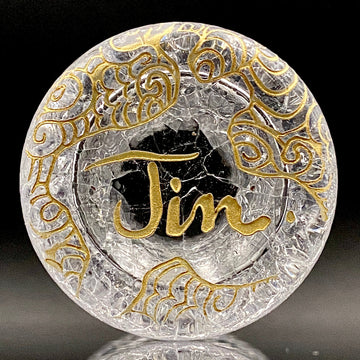


Notes on the marks: Glass works are signed "Jin" in gold under the base, on both colored and clear glass. Ceramic works carry a potter's seal on the base. The fitted box bears the signature and a red seal; the cloth wrapper also carries a seal.
Sakuma Totaro (1900–1976)佐久間藤太郎
Born the eldest son of the Sakuma kiln family in Mashiko. After hosting Hamada Shoji at home on Hamada's return from England in 1924, the artist studied under Hamada and, as Mashiko's leading potter after Hamada, helped mingei Mashiko ware flourish. Bernard Leach also worked at the Sakuma kiln on his 1954 visit to Japan.
Career and awards: 1918: graduated from the Mashiko Ceramics Training Institute / 1924: began studying under Hamada Shoji / 1927: selected for the Kokugakai crafts section / 1949: member of the Kokugakai / 1959: Tochigi Prefecture Cultural Merit Award / 1973: Order of the Sacred Treasure, 5th Class


Notes on the marks: The fitted box bears the signature "藤太郎" (Totaro) and a red "藤" seal; on some boxes the side reads "佐久間藤太郎 茶碗". Kiln works are inscribed "益子民窯 佐久間藤太郎窯" (Mashiko folk kiln, Sakuma Totaro kiln) with the kiln's red "間" seal.
Sakurai Yoshie櫻井良枝
A potter working in ash glazes. We have handled an ash-glazed stem cup by this artist (biographical details are being confirmed).

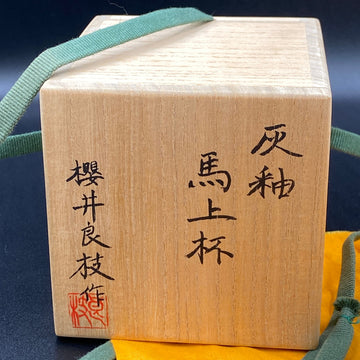
Notes on the marks: A square potter's seal is impressed on the body. The fitted box bears the signature "櫻井良枝" and a seal.
Samukawa Seiho II (1946–)二代 寒川栖豊
Born in Koyaguchi, Wakayama Prefecture. The artist studied under the father, Samukawa Seiho I, founder of the Aoi kiln, succeeded as Seiho II in 1976, and serves as a judge for art exhibitions in Wakayama Prefecture.
Career and awards: 1965: began studying under the father / 1976: succeeded as Seiho II / 1995: moved the climbing kiln to Saino, Shirahama / 2011: Wakayama Governor's commendation for cultural promotion / 2012: Shirahama Town cultural merit commendation
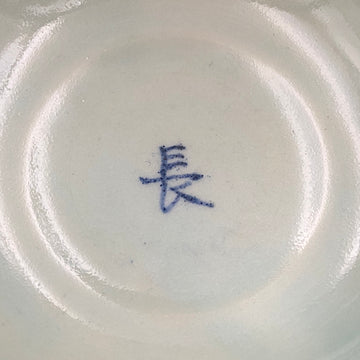


Notes on the marks: The character "長" (Cho) is painted in cobalt inside the bowl. The fitted box bears the signature and a large red seal.
Sawamura Tosai III (1951–)三世 澤村陶哉
Born in Kyoto, the third head of the Otowayama kiln, a distinguished Kyoto ware family founded in 1919 at the foot of Mount Otowa in Higashiyama. The artist studied under the father, Tosai II, trained for ten years at the shared climbing kiln in Gojozaka, and succeeded to the name in 1995. Since 2004 the artist has also fired unglazed wares in climbing and anagama kilns in Hino, Shiga Prefecture.
Career and awards: 1970: ten years of training at the Gojozaka shared climbing kiln / 1995: succeeded as Sawamura Tosai III / 2004: built the Garyu climbing and anagama kilns in Hino, Shiga


Notes on the marks: A potter's seal is impressed on the base. The fitted box bears the signature and a red seal; the cloth wrapper carries a round red seal.
Seiran Kiln青藍窯
A kiln in Arita, Saga Prefecture, that carries on traditional Arita techniques while adopting contemporary designs.

Notes on the marks: A square kiln mark is painted in gold inside the foot ring.
Sentaro Kiln仙太郎窯
A Tajimi kiln where Ando Hidetake and Ando Takumi direct and make the work. In the three-kiln cup set (#455), it made the Oribe cup with a shoe-shaped (kutsugata) rim.

Notes on the marks: A kiln mark is on the base. The fitted box of the three-kiln set (#455) bears the kiln names and red seals.
Shibukusa Ryuzo VI (1946–)六代 渋草柳造
Born Toda Soshiro, the artist carries on the line of Shibukusa ware, made in Takayama, Hida, since the late Edo period, and succeeded as Ryuzo VI in 1981, bringing Japanese-style painting into the ware's decoration.
Career and awards: 1981: succeeded as Shibukusa Ryuzo VI


Notes on the marks: A potter's seal is impressed on the base. The cloth wrapper carries a square red seal.
Shimaoka Tatsuzo (1919–2007)島岡達三
Born into a family of braided-cord makers in Tokyo, the artist studied ceramics at Tokyo Institute of Technology and then under Hamada Shoji. Developed rope-pattern inlay (jomon zogan) in Mashiko and was designated a Living National Treasure for folk-craft pottery (jomon zogan) in 1996.
Career and awards: 1962: Japan Folk Crafts Museum Award / 1980: Tochigi Prefecture Cultural Merit Award / 1994: Gold Prize, Japan Ceramic Society / 1996: Living National Treasure / 1999: Order of the Rising Sun, 4th Class
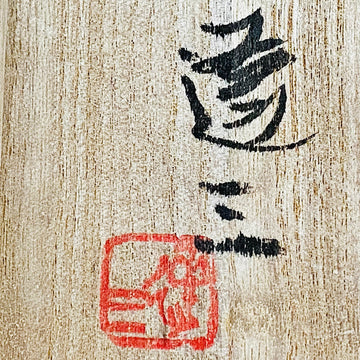

Notes on the marks: The fitted box bears the signature "達三" (Tatsuzo) and a red seal. Some boxes are inscribed to mark the 50th anniversary of the artist's career.
Shimizu Yasutaka (1947–2022)清水保孝
The child of Shimizu Uichi, Living National Treasure for iron-glazed ceramics. After graduating from Ryukoku University, the artist studied under the father, inheriting his glaze and firing techniques, and worked at the Horai kiln. Full and special member of the Japan Kogei Association.
Career and awards: 1971: began studying under the father / 1972: first selection, Japan Traditional Art Crafts Exhibition / 1975: full member, Japan Kogei Association / 1981: Matsushita Prize, Kinki branch exhibition / 1982: special member, Kinki branch

Notes on the marks: A "保" (Yasu) potter's seal is impressed beside the foot ring.
Shiohara Bunji (1907–1978)塩原文二
Born in Komatsu, Ishikawa Prefecture, the artist learned overglaze painting in the studio of Tokuda Yasokichi I (Kaisei) and became an unusual figure elected a member of the Issuikai in both oil painting and Kutani ceramics.
Career and awards: 1950: first selection at the Nitten (ceramics) and the Issuikai (oil painting) / 1957: member of the Issuikai (painting) / 1960: member of the Issuikai ceramics section / 1975: member of the Sozo Bijutsu ceramics section


Notes on the marks: A round potter's seal is impressed beside the foot ring. The fitted box bears the signature "文二" (Bunji) and a red seal; the same seal appears on the cloth wrapper.
Sonoe Hisaodo園江久雄堂
A Kutani ware overglaze-painting workshop that, rather than aiming for exhibition prizes, has refined the craft of overglaze painting for everyday use.


Notes on the marks: "九谷" (Kutani) and the painter's name are written in red enamel inside the foot ring. The fitted box bears a signature.
Suzuki Hachiro (1915–2005)鈴木八郎
A potter of the Taishi kiln in Akazu, Seto. The artist studied under Fujii Tatsukichi and Kamei Seiichi, researched early Chinese ceramics in Manchuria during the war, mastered Ko-Seto ash glazes and anagama firing, and became a Seto City Intangible Cultural Property holder for ash-glaze techniques.
Career and awards: 1944–1945: researched ceramics in Manchuria / selected 13 times for the Bunten and Nitten / exhibited at the Metropolitan Museum of Art / 1980: published a book of Ko-Seto patterns / 1981: fern-pattern bowl selected for Seto City's permanent collection


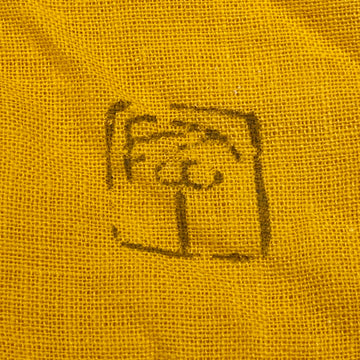

Notes on the marks: A potter's seal is impressed on the body. The fitted box bears the signature "八郎作" and a red seal. The seals on the cloth wrappers take several forms.
Suzuki Kenji (Kyoto) (1935–)鈴木健司(京都)
Born in Kyoto. The artist studied under Tomimoto Kenkichi and Kondo Yuzo at Kyoto City University of Arts and from 1959 under Kiyomizu Rokubei VI; a Kyoto ware potter who twice won the Special Prize at the Nitten, with Hakuju and Kodo.
Career and awards: 1957: graduated in ceramics from Kyoto City University of Arts; first selection, Nitten / 1959: began studying under Kiyomizu Rokubei VI / 1967: Special Prize and Hokuto Prize, Nitten (Hakuju) / 1973: Special Prize, Nitten (Kodo) / 1975: invited exhibitor, Nitten / Kyoten Mayor's Prize twice; Kyoto Crafts Exhibition Governor's Prize


Notes on the marks: A white square potter's seal sits at the center of the base. The fitted box bears the signature and a red seal; the same seal appears on the cloth wrapper.
Suzuki Kenji (Tsukasa Kiln)鈴木健司(司窯)
A potter who runs the Tsukasa kiln of Kitsuki ware in Kitsuki, Oita Prefecture, glazing with ash from the castle town's mandarin oranges and bamboo, and also making neriage and inlaid works.


Notes on the marks: A kiln mark is on the base. The fitted box bears the signature and a seal.
Suzuki Osamu (1926–2001)鈴木治
The third son of the Kyoto wheel-thrower Suzuki Ugenji. In 1948 the artist founded the avant-garde ceramics group Sodeisha with Yagi Kazuo, Yamada Hikaru and others, pursuing deisho, forms that give shape to the world in clay. A retrospective was held at the National Museum of Modern Art, Tokyo, in 1999.
Career and awards: 1948: co-founded Sodeisha / 1961: Japan Ceramic Society Award / 1962: Gold Medal, International Ceramics Exhibition in Prague / 1970: Gold Medal, Vallauris International Ceramics Biennale / 1971: award, Faenza International Ceramics Competition / 1999: retrospective at the National Museum of Modern Art, Tokyo


Notes on the marks: A small round mark is on the body. The fitted box bears the signature "治" (Osamu) and a red seal.
T
Taishima Tosho (1940–)太嶋陶昌
A Kyoto (Kiyomizu) ware potter. After graduating in ceramics from Kyoto Municipal Fushimi Technical High School, the artist studied ceramic design at the Kyoto Prefectural Pottery Vocational School and brings a designer's eye to sometsuke and other works. Certified traditional craftsman.
Career and awards: 1959: graduated in ceramics from Fushimi Technical High School / 1968: completed the ceramic design course, Kyoto Prefectural Pottery Vocational School / 1977: President's Award, Kyoto Ceramic Design Protection Association, 1st Kyo-Kiyomizu Ware Exhibition / 1985: Kyoto Governor's Prize / 1993: certified traditional craftsman


Notes on the marks: A square mark is painted in cobalt inside the foot ring. The fitted box bears the signature "陶昌造" and a red seal; the cloth wrapper also carries a seal.
Takagi Kazuyasu (1944–)高木和安
A potter who opened the Nagisa kiln in Imari, Saga Prefecture, in 1970. Known for fine incised patterns recalling Jomon pottery and kiln effects from saggar and anagama firing, the artist has worked independently of public exhibitions since 1992, making one-of-a-kind pieces.
Career and awards: 1970: opened the Nagisa kiln in Imari / 1989: Saga Governor's Prize, Japan New Crafts Exhibition / 1991: built an anagama kiln / 2005: published a technical book on electric-kiln saggar firing


Notes on the marks: A potter's seal is impressed beside the foot ring. The fitted box carries a red seal.
Takagi Noritoshi (1949–)高木典利
The fifth generation of the Heisho kiln in Ichinokura, Tajimi, Gifu Prefecture. While pursuing Shino, Oribe and Ki-Seto, the artist is known for researching and reviving the underglaze painting of Nishiura ware, made in Meiji-era Tajimi and later lost.


Notes on the marks: A mark is incised on the base. The fitted box bears the signature "典" (Nori) and a red seal.
Takahara Shoji (1941–2000)高原昌治
A Bizen ware potter born in Okayama Prefecture. The artist studied under Isezaki Yozan and Ishii Furo, built a climbing kiln and became independent in 1965; a work was purchased by the Museum of Applied Arts in Frankfurt, then West Germany.
Career and awards: 1958: studied under Isezaki Yozan / 1962: studied under Ishii Furo / 1965: built a climbing kiln and became independent / 1967 and 1968: Sanyo Shimbun Prize, East Chugoku branch exhibition / 1971: selected for the 1st Japan Ceramic Art Exhibition / 1987: work purchased by the Frankfurt Museum of Applied Arts


Notes on the marks: A mark is incised on the base. The fitted box bears the signature "昌治" (Shoji) and a red seal; the cloth wrapper also carries a seal.
Takakura Kunimitsu (1930–2021)高倉国光
A potter born into the Takakura family, long-time keepers of Koishiwara ware in Fukuoka Prefecture, who carried on Koishiwara techniques handed down since the Edo period and raised them to an art.


Notes on the marks: A potter's seal is impressed on the base. The fitted box bears the signature and a red seal; the cloth wrapper also carries a red seal.
Takatori Hassen XIII (1934–)十三代 高取八仙
Born Takatori Sosen, the direct 13th-generation head of Takatori ware, which began with the Korean potter Hassan, who came to Japan during the Bunroku–Keicho campaigns, and served the Kuroda lords of Chikuzen. The artist succeeded to the name in 1953 and is known for thin hand-trimmed forms and poured family glazes.
Career and awards: 1953: succeeded as Takatori Hassen XIII / 1975: Governor's Prize, Fukuoka Prefectural Art Association Exhibition / 1979: certified traditional craftsman / 1989: Fukuoka Prefecture Outstanding Craftsman award / 1996: Grand Art Prize, Paris art festival exhibition / 2005: Order of the Sacred Treasure, Silver Rays


Notes on the marks: The fitted box bears the signature "十三代 八仙" (Hassen XIII) and a red seal. A Takatori ware leaflet is included.
Takeda Toshio (1932–)武田敏男
Born in Takaoka, Toyama Prefecture. After studying ceramics at Kanazawa College of Art and serving as assistant to Kitade Tojiro, the artist studied under Tamura Koichi, later a Living National Treasure, and became independent in Mashiko in 1964. Iron-painted and copper-colored works were selected for the Japan Traditional Art Crafts Exhibition and other shows, and a work is in the National Museum of Modern Art, Kyoto.
Career and awards: 1955: graduated from Kanazawa College of Art / 1956: studied under Yonezawa Soho in Kyoto; selected for the Nitten / 1960: studied under Tamura Koichi / 1964: built a kiln in Mashiko and became independent / 1971: selected for the Japan Ceramic Art Exhibition (work now in the National Museum of Modern Art, Kyoto) / 1974: full member, Japan Kogei Association


Notes on the marks: A square potter's seal is impressed beside the foot ring. The fitted box bears the signature "敏男" (Toshio) and a round red seal; the style of the box inscription varies from work to work.
Takegoshi Fuyuki武腰冬樹
The fourth head of the Taizan kiln of Kutani ware. The artist studied under the father, Takegoshi Toshiaki, took over the kiln and won the NHK President's Prize at the Contemporary Japanese Arts and Crafts Exhibition.
Career and awards: NHK President's Prize, Contemporary Japanese Arts and Crafts Exhibition


Notes on the marks: The fitted box bears the signature "冬" (Fuyu) and a red seal, and "冬" is painted in red enamel beside the foot ring (from the three-artist set #309).
Takegoshi Toshiaki (1940–2021)武腰敏昭
The third head of the Taizan kiln of Kutani ware in Nomi, Ishikawa Prefecture. After studying industrial design at Kanazawa College of Art, the artist turned to pottery at the urging of Kitade Tojiro. Also known for research into lead-free overglaze enamels, the potter won the Nitten Prime Minister's Award and the Japan Art Academy Prize and became a member of the Academy.
Career and awards: 1957: first selection, Nitten / 1997: Prime Minister's Award, Nikko-kai Exhibition / 2001: Prime Minister's Award, Nitten / 2005: professor, Kanazawa Gakuin University / 2010: Japan Art Academy Prize; member of the Japan Art Academy / 2011: executive director, Nitten


Notes on the marks: The fitted box bears an abbreviated signature and a red seal.
Takemura Toyonori (1957–)武村豊徳
Born in Nagasaki Prefecture. After completing the Bizen Ceramics Center course at 17, the artist studied glazes under Kato Shuntei, a master of Seto and Mino ware, and has been selected and awarded many times at the Japan Traditional Art Crafts Exhibition and the Tokai Traditional Crafts Exhibition.
Career and awards: completed the Bizen Ceramics Center course / studied under Kato Shuntei / many selections and awards at the Japan Traditional Art Crafts Exhibition and the Tokai Traditional Crafts Exhibition


Notes on the marks: A potter's seal is impressed on the base. The fitted box bears the signature and a seal. A leaflet is included.
Takeuchi Denji (1934–2001)竹内傳治
Born in Onoda, Yamaguchi Prefecture. As the leading designer at Sasaki Glass, the artist shaped Japanese in-house design while winning international design awards; works are in the Corning Museum of Glass and the National Museum of Modern Art, Tokyo.
Career and awards: 1958: joined Sasaki Glass (retired as director in 1993) / 1968: Gold Medal, Utrecht international crafts exhibition / 1978: Spanish International Grand Prize, Valencia design competition (also 1981 and 1987) / 1979: selected for New Glass at the Corning Museum of Glass, which acquired the work; Kunii Kitaro Industrial Craft Award / 1982: work acquired by the National Museum of Modern Art, Tokyo


Notes on the marks: "傳" (Den) is engraved under the glass. The fitted box bears the signature "傳治" (Denji) and a red seal.
Tanaka Hajime (Tanaka Ikko) (1933–2002)田中一(田中一晃)
After training at a porcelain works in Arita, the artist opened the Ichii kiln in Ureshino, Saga Prefecture, in 1965. Combining Hizen porcelain techniques with a craft-design sensibility, the potter won the MITI Minister's Prize at the Kyushu–Yamaguchi Ceramics Exhibition and changed the art name to Tanaka Ikko in 1981. Nitten associate member and full member of the Japan Kogei Association.
Career and awards: 1965: opened the Ichii kiln in Ureshino / 1968: selected for the Good Design and Japan New Craft exhibitions / MITI Minister's Prize, Kyushu–Yamaguchi Ceramics Exhibition / selected 17 times for the Nitten; Nitten associate member / 1981: changed name to Tanaka Ikko


Notes on the marks: A mark is painted in cobalt inside the foot ring. The fitted box bears the signature and a red seal.
Tanaka Hideaki (1916–)田中秀明
Born Tanaka Shigeo, a Kyoto metal artist who studied under the father, Tanaka Eizo, and made tea utensils in the workshop of Nakagawa Jo-eki, metalsmith to the Senke tea schools. Among the artist's students were Living National Treasure Miyoshi Masatoyo and Kanaya Gorosaburo XV.
Career and awards: 1962: first selection, Nitten / 1974: exhibited at the Japan Traditional Art Crafts Exhibition / 1985: Kyoto City Arts Merit Award / full member, Japan Kogei Association


Notes on the marks: "秀明" (Hideaki) is stamped on the base of the silver piece. The fitted box bears the signature "田中秀明造" and a round red seal.
Tanaka Hozan (1884–1964)田中穂山
Born Tanaka Sakutaro in Gojozaka, Higashiyama, Kyoto, the artist learned from the father, the potter Heian Kozan. Tanaka helped found the Totokai with Itaya Hazan and others and, after the war, established Japan's first natural-gas-fired kiln in Mobara, Chiba.
Career and awards: 1884: born in Gojozaka, Kyoto / helped found the Totokai / 1947: built the Chosei kiln in Mobara, Chiba, and established natural-gas firing

Notes on the marks: The box is inscribed in ink with the kiln name and "穂山作" (made by Hozan).
Tani Shukei (1888–1959)谷秋渓
Born Tani Masaki, a master of Kutani ware in Daishoji, Kaga, Ishikawa Prefecture. The artist studied under Takeuchi Ginshu, who revived Meiji-era fine red painting (akae saibyo), and Ginshu's third son Hirosawa Roshu, inheriting the Daishoji tradition of fine red painting done without underdrawing.
Career and awards: 1888: born in Daishoji / studied under Takeuchi Ginshu and Hirosawa Roshu


Notes on the marks: "秋渓" (Shukei) is written in red enamel inside the bowl or the foot ring. The fitted box bears the signature "秋渓造" and a red seal.
Tsuchiyama Shosen (1933–)土山松泉
Born Tsuchiyama Tadao in Kyoto Prefecture and also known as Heian Shosen, a Kyoto (Kiyomizu) ware potter. Working at the wheel from age 14, the artist studied under Nishimura Kyuho II, became independent in 1964 and was given the name Shosen by the head priest of Koto-in at Daitokuji. Certified traditional craftsman and Kyoto master craftsman.
Career and awards: 1955: studied under Nishimura Kyuho II / 1964: became independent; named Shosen by the head priest of Koto-in, Daitokuji / 1976–1978: Excellence Award three years running, Kyoto Traditional Crafts Technique Competition / 1992: certified traditional craftsman / 1998: Kyoto master craftsman / 2004: Order of the Sacred Treasure, Silver Rays


Notes on the marks: The fitted box bears the signature "平安 松泉 造" and a red seal. No potter's seal is seen on the piece itself.
Tsuji Hitachi XIV (1909–2007)十四代 辻常陸
Born Tsuji Tsuneshige, the 14th head of the Tsuji family of Arita, which carries the name Hitachi and in the Meiji era became the first porcelain maker appointed supplier to the Imperial Household Ministry. A graduate in sculpture of the Tokyo School of Fine Arts, the artist is known for fukizumi (sprayed cobalt) and sculptural forms.
Career and awards: 1933: graduated in sculpture from the Tokyo School of Fine Arts / 1981: Saga Prefecture Cultural Merit Award / 1983: Order of the Sacred Treasure, 4th Class / 1988: made porcelain commemorating Emperor Showa's 80th birthday


Notes on the marks: "辻製" (made by Tsuji) is painted in cobalt on the piece. The fitted box bears the signature and a red seal; the cloth wrapper also carries a seal.
U
Uchida Yasuhide (1893–1997)内田泰秀
A potter from Miyoshi, Hiroshima Prefecture, and holder of Hiroshima Prefecture Important Intangible Cultural Property for nishiki neriage. Known for neriage built up from many layers of colored clay, the artist kept working until death at 104.
Career and awards: 1952: solo exhibition at Mitsukoshi Nihonbashi / 1960s: studied color and porcelain techniques at the Manufacture nationale de Sèvres / 1965: Miyoshi City Intangible Cultural Property / 1970: exhibited at Expo '70 / 1973: Hiroshima Prefecture Important Intangible Cultural Property holder


Notes on the marks: The fitted box bears the signature and a red seal; the cloth wrapper also carries a seal. No potter's seal is seen on the bases of the neriage pieces.
Y
Yamachika Takeshi (1930–2020)山近剛
A Kutani ware artist who led the Sozo Bijutsu association and won its top award, the Prime Minister's Award, at the 67th Sozo exhibition. A three-artist set with Takegoshi Toshiaki and Fuyuki (#309) includes the artist's work.
Career and awards: head of the Sozo Bijutsu association / Prime Minister's Award, 67th Sozo exhibition


Notes on the marks: The fitted box bears the signature "剛" (Takeshi) and a red seal, and a mark is painted in red enamel inside the foot ring (from the three-artist set #309).
Yamada Hikaru (1923–2001)山田光
In 1948 the artist founded the avant-garde ceramics group Sodeisha with Yagi Kazuo, Suzuki Osamu and others and remained a member until it disbanded in 1998. Alongside sculptural objects, the potter set up the Mon studio in 1962 to make functional crafts. Kyoto City Person of Cultural Merit.
Career and awards: 1948: co-founded Sodeisha / 1962: founded the Mon studio / Japan Ceramic Society Award (later the Gold Prize) / Kyoto Art and Culture Award / Kyoto City Person of Cultural Merit


Notes on the marks: A small square potter's seal is impressed on the base. The fitted box bears the signature "山田 光造" and a red seal; the seal differs in shape from work to work.
Yamamoto Hogaku (1960–)山本芳岳
A Kutani ware artist specializing in fine red painting (akae saibyo). The artist studied under Fukushima Hoshun from 1982 and in 1985 made and presented a finely painted red sencha cup with chrysanthemum, paulownia and phoenix motifs to the then Crown Prince, now the Emperor Emeritus. Certified Kutani ware traditional craftsman.
Career and awards: 1982: studied under Fukushima Hoshun / 1985: presented a finely painted sencha cup to the Crown Prince / 1992: Honorable Mention, Issuikai ceramics exhibition / 1996: certified Kutani ware traditional craftsman
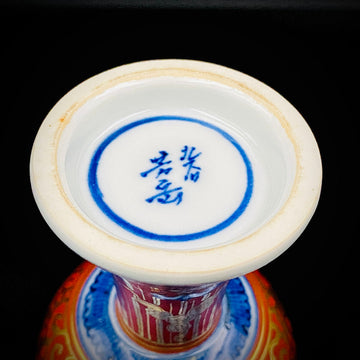
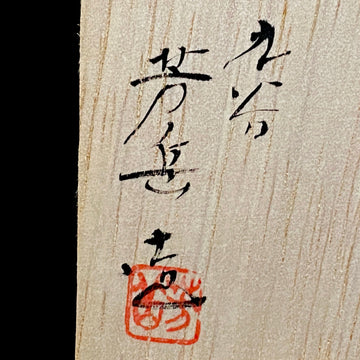
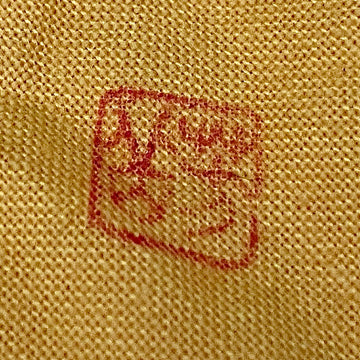
Notes on the marks: A double ring and "芳岳" (Hogaku) are painted in cobalt inside the foot ring. The fitted box bears the signature "九谷 芳岳" and a red seal; the cloth wrapper also carries a seal.
Yanagihara Mutsuo柳原睦夫
A potter born in 1934 who took part, with Miyanaga Rikichi and Morino Taimei, in a three-artist collaborative set connected with Sodeisha (#16).

Notes on the marks: The fitted box of the three-artist set bears the signature "睦夫" (Mutsuo) and a red seal.
Yanai Sai (1948–)矢内齊
After training in Kyoto ware, the artist studied under Sakata Jinnai and in 1976 received direct guidance from Kamoda Shoji at the studio in Tono, Iwate. Independent in Mashiko since 1977, the artist makes incised and colored-slip inlay works. Full member of the Japan Kogei Association.
Career and awards: 1972: trained at the Kyoto ware studio Waraku / 1974: completed the Kyoto Prefectural Pottery Training School; studied under Sakata Jinnai / 1976: guided by Kamoda Shoji in Tono / 1977: built a kiln in Mashiko and became independent / 1979: first selection, Japan Ceramic Art Exhibition / 1982: first selection, Japan Traditional Art Crafts Exhibition


Notes on the marks: The fitted box bears the signature and a red seal; the cloth wrapper also carries a seal.
Yano Keisen (1872–1965)矢野景川
A potter born in Aichi Prefecture. In 1942 the artist made a tea bowl for Toyama Mitsuru's 88th birthday and received the art name Keisen (景川); later the abbot of Eiheiji, Takashina Rosen, gave the name Keisen (景仙) as well. A Shino tea bowl was presented on the occasion of the Crown Prince's wedding in 1959.
Career and awards: 1942: received the art name 景川 / 1952: also used the name 景仙 / 1957: joint exhibition with Mushanokoji Saneatsu and Munakata Shiko / 1959: presented a Shino tea bowl on the Crown Prince's wedding


Notes on the marks: "景川" (Keisen) is incised beside the foot ring. The fitted box bears the signature.
Yokoishi Gagyu XIII (1925–2016)十三代 横石臥牛
Born Yokoishi Hiromi, the artist brought back Utsutsugawa ware of Nagasaki, which had died out after only about 50 years in the mid-Edo period, building on generations of research by the Yokoishi family, and was recognized in 1975 as a Nagasaki Prefecture Intangible Cultural Property holder for Utsutsugawa ware. Known for brushed slip (hakeme) designs.
Career and awards: 1975: Nagasaki Prefecture Intangible Cultural Property holder (Utsutsugawa ware)


Notes on the marks: A mark is incised inside the foot ring; on some works the kiln's paper label remains on the base. The fitted box bears the signature.
Yonehara Shinji (1961–)米原眞司
After studying glass at Tama Art University and training at Fujita Kyohei's glass studio, the artist founded the Seisho glass studio in Sapporo in 1991. Honors include Special Prizes at the Nitten, the first Fujita Kyohei Prize and the Prime Minister's Award at the Contemporary Japanese Arts and Crafts Exhibition.
Career and awards: 1984: worked at Fujita Kyohei's glass studio (until 1991) / 1991: founded the Seisho glass studio in Sapporo / 1994: Special Prize, Nitten / 1998: Silver Prize, International Exhibition of Glass Kanazawa / 2000: Special Prize, Nitten / 2002: 1st Fujita Kyohei Prize / 2008: Prime Minister's Award, Contemporary Japanese Arts and Crafts Exhibition / 2013: Hokkaido Culture Prize
Notes on the marks: No signature could be made out in the product photos.
Yoshida Katsuzan (1916–1999)吉田勝山
A Kutani ware artist who learned glaze techniques under Tokuda Yasokichi I and made works in deep verdigris green in the aode (green Kutani) tradition. Honors include a Special Prize at the Nitten, the Kanazawa City Culture Award and the Ishikawa Prefecture Cultural Merit Award.
Career and awards: studied under Tokuda Yasokichi I / 1970: Special Prize, Nitten / 1980: Kanazawa City Culture Award / 1991: Ishikawa Prefecture Cultural Merit Award

Notes on the marks: Two square seals, "九谷" (Kutani) and "勝山" (Katsuzan), are impressed side by side beside the foot ring.
Yoshida Shuen (1940–1986)吉田萩苑
A Hagi ware potter who at 15 became a live-in apprentice of Miwa Kyusetsu X, later Living National Treasure Miwa Kyuwa, and opened the Gyokuryuzan kiln in Tamae, Hagi, in 1968.
Career and awards: 1955: apprenticed to Miwa Kyusetsu X / 1968: opened the Gyokuryuzan kiln in Tamae, Hagi


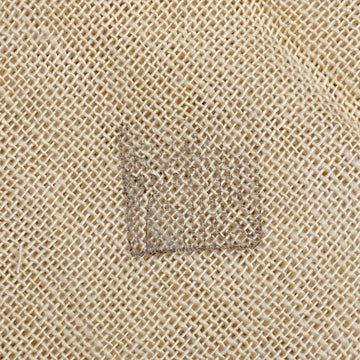
Notes on the marks: A potter's seal is impressed beside the foot ring. The fitted box bears the signature and a seal; the cloth wrapper also carries a seal.
Yoshida Takeo (1916–2002)吉田丈夫
A glass artist who graduated in lacquer from the Tokyo School of Fine Arts and joined Kagami Crystal Works in 1949, making cut-glass works. Honors include a Special Prize at the Nitten, Contemporary Master Craftsman, and the Tokyo Governor's Prize at the Japan Traditional Art Crafts Exhibition.
Career and awards: 1939: graduated in lacquer from the Tokyo School of Fine Arts / 1949: joined Kagami Crystal Works / 1953: Special Prize, Nitten / 1974: Contemporary Master Craftsman / 1981: Tokyo Governor's Prize, Japan Traditional Art Crafts Exhibition / 1986: Medal with Yellow Ribbon / 1992: Order of the Sacred Treasure, 5th Class / 1995: Holders' Prize, Japan Traditional Art Crafts Exhibition


Notes on the marks: The fitted box bears the signature "丈夫作" (made by Takeo) and a red seal; some works come with a Kagami Crystal leaflet.
Yoshimoto Tadashi (1943–)吉本正
A Bizen ware potter who studied for 19 years under Fujiwara Kei, Bizen's first Living National Treasure. Recognized in 2007 as an Okayama Prefecture Important Intangible Cultural Property holder for Bizen ware techniques, and named an honorary citizen of Bizen in 2025.
Career and awards: 1964: began 19 years of study under Fujiwara Kei / 1975: became independent / 1986: Okayama Prefecture Culture Encouragement Award / 1988: Kaneshige Toyo Prize / 2007: Okayama Prefecture Important Intangible Cultural Property (Bizen ware) / 2025: honorary citizen of Bizen
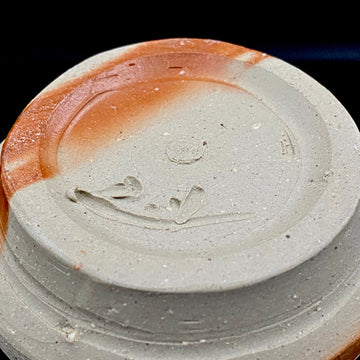
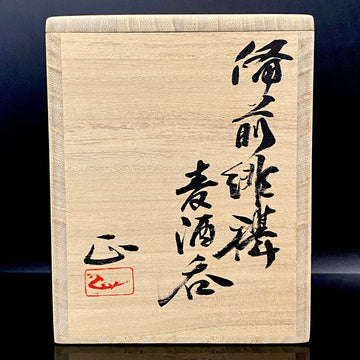
Notes on the marks: A mark is incised on the base. The fitted box bears the signature "正" (Tadashi) and a red seal.
European houses
Cristal de Sèvresセーヴル(Cristal de Sèvres)
Crystal glass from Sèvres, France. The pieces we have handled bear the mark "CRISTAL SÈVRES FRANCE".

Notes on the marks: "CRISTAL SÈVRES FRANCE" is acid-etched on the base.
Daumドーム(DAUM)
A renowned crystal maker founded in Nancy, France, in 1878, and one of the leading names in French glass since the Art Nouveau period.

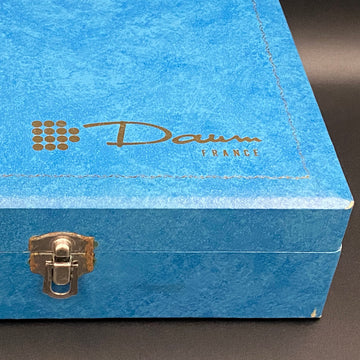
Notes on the marks: A cursive "Daum France" signature is engraved under the foot. The box carries the Daum logo.
Ditta Albertini & Spezzamonteディッタ・アルベルティーニ&スペッツァモンテ工房
A workshop based on the island of Murano, Venice. We have handled its 1950s reproduction of the Barovier wedding cup, a work traditionally attributed to Angelo Barovier around 1470.

Notes on the marks: "COPPA BAROVIER MURANO" is written in gold under the cup. The accompanying leaflet reads "COPPA NUZIALE BAROVIER MURANO".
Holmegaardホルムガード(Holmegaard)
Founded in 1825 with permission from the Danish Crown, Holmegaard is the oldest glass brand in Scandinavia.
Career and awards: Its Prince series was designed by the architect Bent O. Severin in 1957 and went into production in 1968.


Notes on the marks: A paper label with a crown and "HOLMEGAARD". No mark was found on the glass itself.
Saint-Louisサン・ルイ(Saint-Louis)
A historic crystal maker in Lorraine, France, with origins in 1586 and now part of the Hermès group, known for hand-blown, high-purity crystal.
Career and awards: 1990–1992: limited production of the Éole series


Notes on the marks: A paper label with a crown and "SAINT LOUIS". The 1910s Lorraine glass we have handled shows no engraved mark.
Related pages
- Makers & Studios — browse the works we carry by maker
- Reading Tomobako, Shiori and Signatures — A Guide to Verifying Artist-Made Drinking Vessels — how to read box inscriptions and leaflets
- Works by Living National Treasures
- Sake Vessels and Tableware by Master Craftsmen