Hand-kneaded deformed Bizen guinomi (sake cup) created by Tosui Mizutani (real name: Kiyoshi Mizutani, born 1949), a Bizen ware artist born in Akaiwa District, Okayama Prefecture in 1949 (Showa 24). In 1972 (Showa 47), Tosui Mizutani apprenticed under Seinosuke Ohira, a direct disciple of Kei Fujiwara—the very first Living National Treasure of Bizen ware—and under strict guidance mastered the traditional pottery techniques of Old Bizen and the art of drawing out the clay's natural character. Encouraged by his master, he became independent in 1978 (Showa 53), building his kiln in a scenic area on the outer grounds of the National Treasure Shizutani School and firing his first kiln load. Subsequently, he was selected numerous times for the Okayama Prefecture Art Exhibition and held solo exhibitions in cities such as Himeji, Takarazuka, Nishinomiya, and Kurashiki, establishing a firm artistic style as a member of the Bizen Toyukai Association. Our shop presents this work, fired solely through the chemical reaction between wood-kiln flames and clay without applying any glaze, to the global market not only as a traditional sake vessel, but also as a vintage rocks glass (Japanese free cup) for quietly savoring the rich depth of amber-colored aged sake or matured whisky.
Observing the details of this work reveals a splendid harmony between the powerful sculptural sensibility praised in Tosui Mizutani's art and the yohen (kiln transformation) landscape unique to Bizen ware. Hand-sculpted while deliberately avoiding the linear geometry of the potter's wheel, a bold indentation as if forcefully pressed by fingers is applied around the center of the body, combining exceptional functionality that fits naturally in the fingertips when held. On the vessel's sides, vivid reddish-orange hidasuki (fire-cord markings) created by wrapping rice straw during firing emerge clearly in ring-like patterns, creating a dramatic contrast with the smoky dark brown and bluish-gray sangiri (ash-covered reduction marks) enveloping it, as well as the minute goma (natural ash glaze) from melted pine ash. From the organic rim broken from a true circle to the interior base, the texture of undulating clay and scorched landscapes spreads out; when sake is poured, the clay surface absorbs moisture and transforms into a moist, deeply resonant hue.
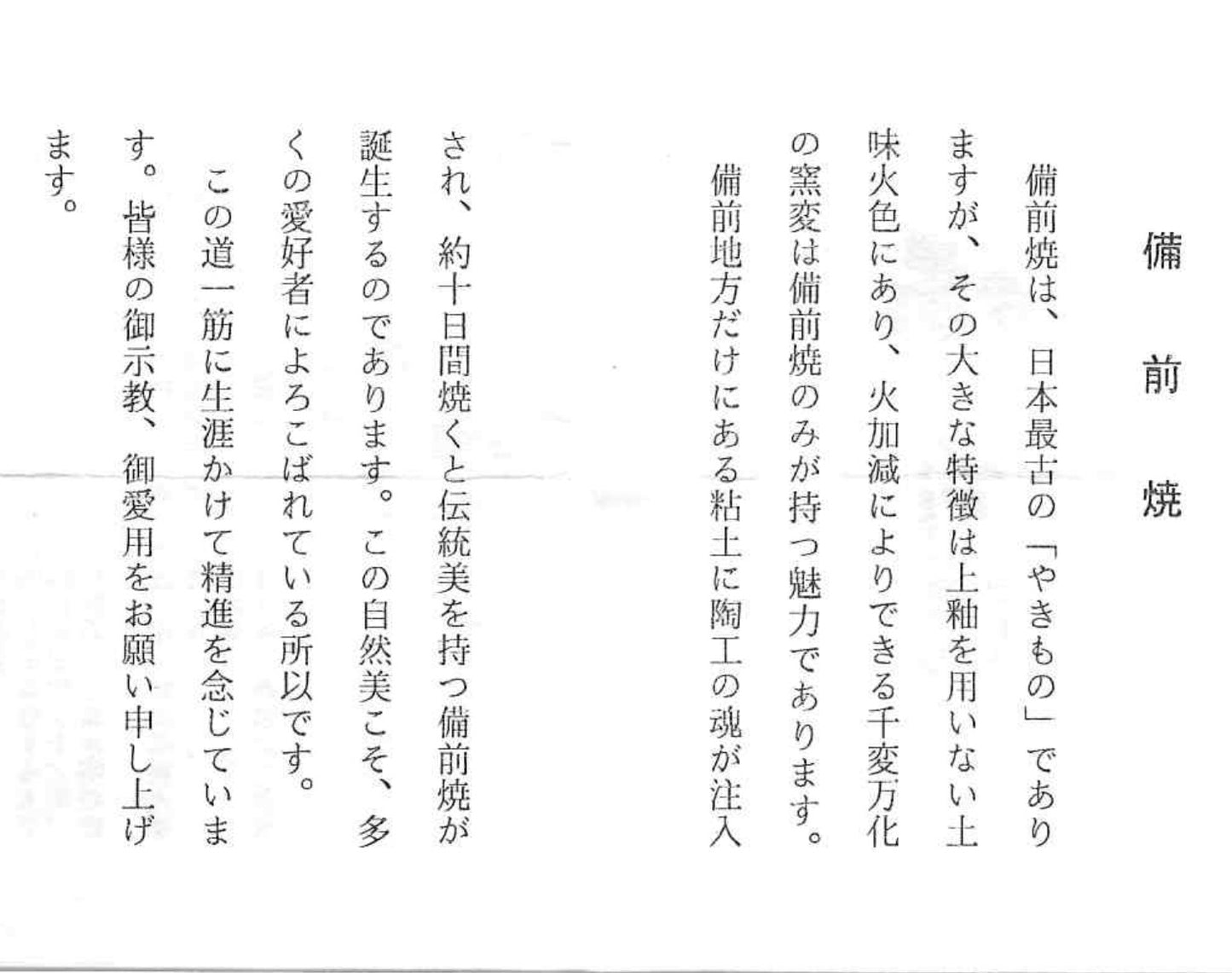
Regarding the period of production, taking clues from his independent kiln founding in 1978 (Showa 53) recorded in the biography leaflet, his repeated selections at the Okayama Prefecture Art Exhibition, his vigorous solo exhibition activities in major cities, and the mature stage of his original sculptural beauty and firing techniques evidenced by signing his art name "Tosui" on the box inscription, it is identified as an authentic work created circa 1980 to 1999 (late Showa 50s to early Heisei period). The vessel itself has no cracks or chips, maintaining extremely good condition in both hidasuki coloration and raw clay texture. It arrives as a complete masterpiece accompanied by a dedicated Tomobako (wooden box) inscribed in ink on the lid "Bizen Guinomi" with the signature "Tosui" and red seal stamped below, along with a biography leaflet detailing the artist's history.
- Artist: Tosui Mizutani (Born Name: Kiyoshi Mizutani, 1949–)
- Artist's Key Activities: [1972] Apprenticed under Seinosuke Ohira, a direct disciple of Living National Treasure Kei Fujiwara; [1978] Became independent, built a kiln on the outer grounds of the National Treasure Shizutani School, and fired his first kiln load (first selection for the Okayama Prefecture Art Exhibition); [1980s–2000s] Selected numerous times for the Okayama Prefecture Art Exhibition and held solo exhibitions in Himeji, Takarazuka, Nishinomiya, Kurashiki, etc.
- Works Housed In: Local exhibition facilities and private antique/craft collections, etc.
- Period of Production: Circa 1980–1999
- Condition: Very good (no chips, no cracks)
- Accessories: Dedicated Tomobako, biography leaflet included
- Material: Ceramic (Bizen ware, unglazed stoneware, hidasuki fire marks, sangiri ash marks, incised seal)
- Dimensions: Height approx. 7.0–7.5 cm, Mouth diameter approx. 5.8–6.7 cm (Deformed)
- Caution: All products offered by our shop are pre-owned items due to their historical production period, even if unused. Products may have age-related damage, so please consider purchasing after understanding and verifying these condition details.