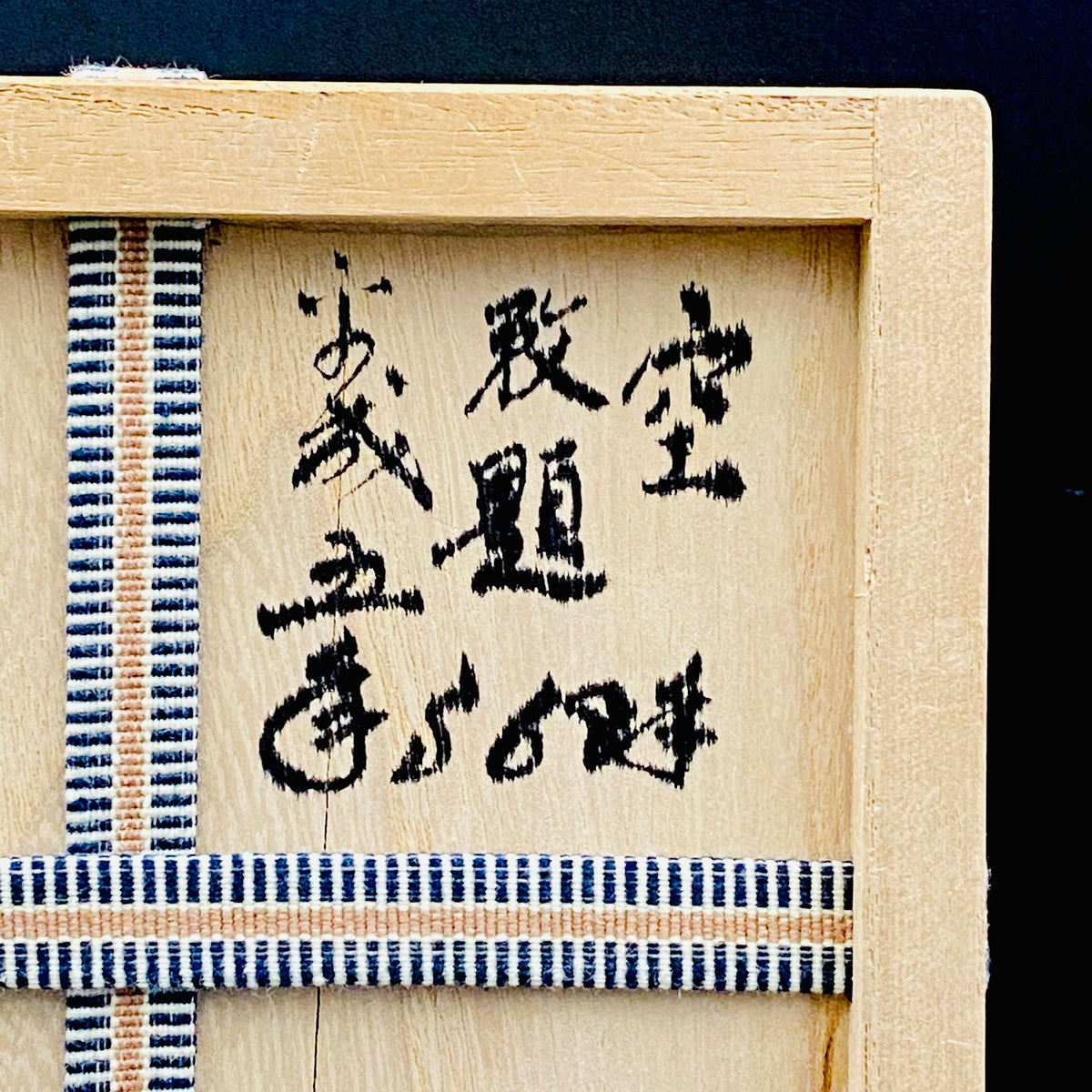
This is a tea bowl by Mizuno Sekikazu (水野鉐一, 1936–), a potter in Seto. The lid of the tomobako (the box signed by the artist) is inscribed 「御題 空 茶盌」 (tea bowl on the imperial theme "Sky") with the artist's signature and a red seal. The inside of the lid bears ink inscriptions including 「空」, 「敕題」 (imperial theme) and 「平成五年」 (Heisei 5), and an incised mark appears beside the foot ring. In the list of themes for the Utakai Hajime, the New Year's Poetry Reading at the Imperial Palace, published by the Imperial Household Agency, the theme for Heisei 5 (1993) is 「空」 (Sky), and this bowl was made on that theme. Besides its use as a matcha bowl, we propose it as a Japanese-style rocks glass for slowly enjoying old-bottle whisky and long-aged spirits over a large piece of ice. The wide opening, about 13.7 cm across, also holds a large ice ball, and the pale interior reflects the amber color of the spirit.
Mizuno Sekikazu is listed as a potter of the 福海窯 kiln in 『人と作品』 (People and Works), published by the Seto Ceramic Art Association (瀬戸陶芸協会), in its 1987 and 1991 editions. The directory in 『新工芸の美と心』, published in 1993 by the Japan Shinkogei Artists Federation (日本新工芸家連盟), records the artist as born in Showa 11 (1936), and the name also appears as a ceramic artist in the directory of the catalogue of the 8th Japan Shinkogei Exhibition (1986), which the federation organizes. The artist profile in the March 1999 issue of the magazine 『美術の窓』 states that the artist had been selected for the Nitten (Japan Fine Arts Exhibition) 20 times and was a Nitten associate member (会友), had served twice as a juror and won awards twice at the Japan Shinkogei Exhibition, had won awards twice at the Asahi Ceramic Art Exhibition, and was a member of the Japan Shinkogei Artists Federation.
As for the artist's works, a nerikomi tea bowl appears in the September 1984 issue of 『陶説』, the journal of the Japan Ceramic Society (日本陶磁協会), and a nerikomi bowl is discussed in an exhibition review in the January 1979 issue of 『月刊美術』. Nerikomi is a technique of kneading together or stacking clays of different colors to create patterns, and the official tourism website of Aichi Prefecture introduces it as a technique designated as an Intangible Cultural Property by Seto City. In its commentary on a work by Matsui Kōsei (松井康成), a Living National Treasure for neriage, a technique that likewise kneads clays of different colors together to form patterns, the Agency for Cultural Affairs' Cultural Heritage Online notes that the artist devised clays of different colors with the same properties so that they would not crack during the making process. This bowl, however, is not nerikomi; it is decorated with white and yellow-green glazes applied side by side.
The Utakai Hajime is a poetry reading held at the Imperial Palace every January. According to the Imperial Household Agency, it carries on the tradition of the utakai, gatherings at which people compose poems on a common theme and recite them, and since 1874 (Meiji 7) members of the public have been allowed to submit poems. In the agency's list, Heisei 5 is the only year since Showa 22 (1947) in which the single character 「空」 was the theme (the theme in Showa 26 was 「朝空」, "morning sky"). The words 「御題」 and 「敕題」 on the box refer to this Utakai Hajime theme. As for the connection with the tea ceremony, the official website of Omotesenke Fushin'an explains that for the hatsugama, the first tea gathering of the New Year, utensils related to the year's zodiac animal and imperial theme are also brought out of the storehouse to express the character of that year.
The bowl has a wide mouth and narrows toward the base. The rim undulates gently, and the body shows horizontal throwing lines and a few dents. The whole piece is covered with a white glaze with a faint pink tinge, with fine crackle. On one side of the body, a yellow-green glaze is applied in an inverted triangle from the rim to near the foot; the glaze runs down in streaks, and a crescent-shaped incised line is drawn within it. The yellow-green glaze also covers the inner rim on the same side, and where it meets the white glaze it shows a white, frothy texture. On the opposite side of the body is a round raised area encircled by a ring-shaped line. A spiral of throwing lines remains in the interior, and reddish clay shows around the foot ring.
The production period is around 1993 (Heisei 5), based on the ink inscription 「平成五年」 inside the lid and the fact that 「空」 was the Utakai Hajime theme for Heisei 5.
Because ware with crackle easily absorbs liquor and tea, we recommend soaking the bowl in water or lukewarm water for a while before use. After use, wash it well and let it dry thoroughly.
- Artist: Mizuno Sekikazu (水野鉐一, 1936–) / 福海窯 kiln (Seto, Aichi). The year of death could not be confirmed in official sources
- Representative Career Highlights: [1986] Listed as a ceramic artist in the directory of the catalogue of the 8th Japan Shinkogei Exhibition; [1987, 1991] Listed as a potter of the 福海窯 kiln in 『人と作品』 by the Seto Ceramic Art Association; [1993] Listed in the directory of 『新工芸の美と心』 by the Japan Shinkogei Artists Federation; [as of 1999] Selected for the Nitten 20 times, Nitten associate member, juror twice and awards twice at the Japan Shinkogei Exhibition, awards twice at the Asahi Ceramic Art Exhibition, member of the Japan Shinkogei Artists Federation (according to the artist profile in the March 1999 issue of 『美術の窓』)
- Public Collections: No public collection records at museums or similar institutions could be confirmed
- Production Period: Around 1993 (Heisei 5) (based on the ink inscription 「平成五年」 inside the lid and the Heisei 5 Utakai Hajime theme 「空」 published by the Imperial Household Agency)
- Item Condition: Good (at one point on the rim, directly above the round raised area, there is a short vertical line, which is not a crack; around the foot rim there are three gold-colored areas at roughly equal intervals, which are not repairs; crackle, iron specks and small pinholes throughout. Please check the images)
- Accessories: Tomobako (lid inscribed in ink 「御題 空 茶盌」 with the artist's signature and red seal; inside of the lid inscribed 「空」, 「敕題」, 「平成五年」 and more; tied with a sanada-himo cord), yellow cloth
- Material: Ceramics (white glaze and yellow-green glaze, incised line)
- Dimensions: Width approx. 13.7 cm, height approx. 8.7 cm
- Note: Even if the products provided by our shop are unused, they were produced a very long time ago and are all listed as pre-owned items. Please understand and confirm that the item may have age-related wear before considering your purchase.
- Please check the photos: We prepare every description with great care, but errors may still remain in the text. Please examine the photos carefully before purchasing. Where the photos and the description differ, please take the photos as the basis for the product information.