We are pleased to present this stem cup by Tanimoto Yoh (谷本洋, 1958–), an Iga ware potter born the child of the Iga potter Tanimoto Kosei. After learning ceramic techniques in Kyoto, Tanimoto moved to France in 1984, studied painting in Paris and served as assistant to the Spanish sculptor Joan Gardy Artigas (J. G. Artigas). On returning to Japan, Tanimoto pursued research into old Iga ware alongside studio work, became independent in 1988, and from 1992 worked and exhibited repeatedly at the Artigas Foundation in Barcelona. In 1995, with the support of the Catalan government, the artist held a seminar for Spanish potters and a solo exhibition at the foundation. Solo exhibitions in London, New York, Paris and elsewhere followed, and the artist has continued to travel abroad with the clay of Iga, naming both the father and Artigas as teachers.
J. G. Artigas, whom Tanimoto regards as a teacher, is the Catalan ceramist and sculptor Joan Gardy Artigas (born 1938). The name belongs to a workshop at the very center of twentieth-century art. The father, Josep Llorens i Artigas (1892–1980), began collaborating with the painter Joan Miró in 1944 and created the ceramic murals "The Wall of the Sun" and "The Wall of the Moon" for the UNESCO headquarters in Paris. Joan Gardy Artigas studied at the École des Beaux-Arts in Paris, met Alberto Giacometti there, and lent ceramic expertise to Georges Braque and Marc Chagall. After the father retired, Joan Gardy Artigas supported Miró's ceramic work, covering the great sculpture "Dona i Ocell" in Barcelona with broken tile and producing the "Miró Wall" of 7,200 tiles (1979). In 1989 Artigas founded a foundation in the father's honor, and also serves on the board of the Fundació Joan Miró.
While studying art in Paris, Tanimoto answered Artigas's call for help, was hired as a studio assistant, and for many years supported this work while traveling between Paris and Barcelona. In Tanimoto's words, Artigas was involved in all of Miró's ceramic works, including the murals for the Gas Pavilion at Expo '70 in Osaka and at Barcelona Airport. Artigas was also acquainted with Hamada Shoji, and the foundation's residency has a climbing kiln built by Hamada and an anagama built by Tanimoto, named "Mashiko" and "Iga." To have worked for the head of the workshop that supported the ceramics of Miró, Braque and Chagall, and to have built a kiln on the same grounds as Hamada's, is a career of striking distinction among Japanese potters. Tanimoto says that the most important lesson from Artigas was to recognize the greatness of Japan and the right attitude to making, and here lies the origin of a style that returns to the clay of Iga.
What drew us to this vessel is the meeting, within one cup, of the memory of Momoyama tea wares and a sense of form refined by the Mediterranean. Oribe green is joined with Iga clay, and iron painting as concise as a set of signs is placed upon it. The combination is neither a copy of tradition nor an avant-garde experiment, but shows a gentle boldness all the artist's own.
The form is that of a stem cup, a rounded bowl supported by a stem flaring toward the base. The outside of the bowl has a cream-colored clay surface containing grit and fine pinholes, with iron-painted lines running vertically down the body and iron dots set around them. Each line is thick where the brush enters and tapers as it lifts, shifting from reddish brown to blackish brown with the depth of the pigment. The rim undulates slightly, and an iron-colored glaze sharpens its outline. The stem is covered with green glaze, a pale, translucent aqua where it meets the bowl, running down in streaks of deep green toward the base. The contrast between the rough clay and the glossy, glassy green is a highlight of this piece. The foot rim is left unglazed.
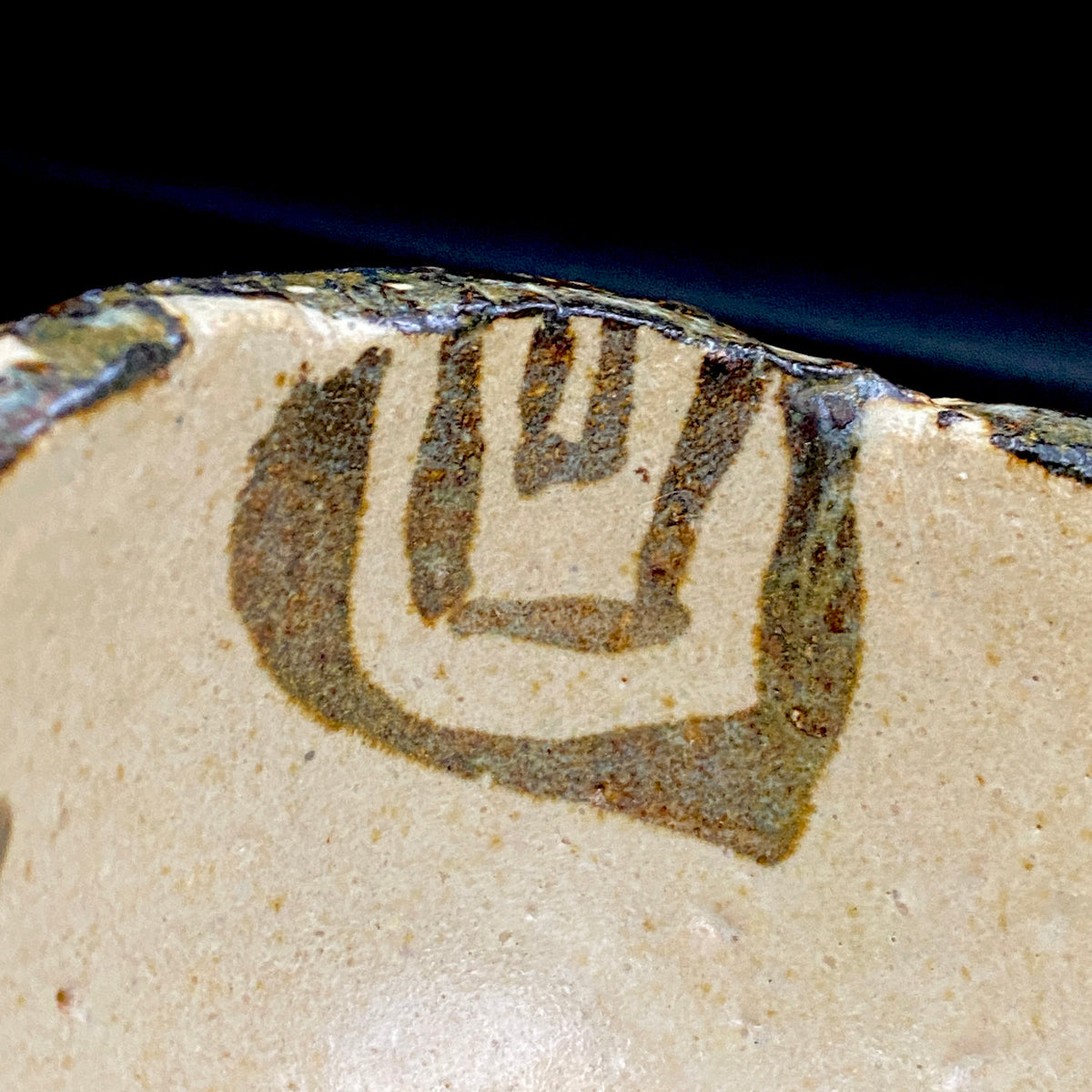
Inside the bowl, nested square motifs are painted in iron on four sides, circling just below the rim. At the center of the well are a cross-like design of intersecting curves and four dots around it. Reminiscent of ancient signs and of the brushwork of modern Spanish painting, the composition makes full use of empty space. The inside of the hollow stem is also filled with green glaze, with throwing rings spiraling within, and a potter's seal in a square frame is impressed on its inner wall.
No date is recorded, but from the style we estimate the piece to date from the 1990s to the 2000s.
We offer this piece, about 11.1 cm high with a mouth diameter of about 10.4 cm, as a "Japanese-style spirit cup" for slowly savoring aged sake and vintage spirits. Lifted with the fingers around the stem, the cross-like design shimmers beneath the amber liquid, and the motifs on the four sides come into view as the level falls.
- Artist: Tanimoto Yoh (谷本洋, 1958–)
- Artist's Representative Career Highlights: [1981] Completed the Kyoto Prefectural Ceramics Training School; [1982] completed the Kyoto Municipal Industrial Research Institute and began working under the father, Tanimoto Kosei, at the Sanshodo studio of the Mita Kiln, Iga; [1984] moved to France, studied drawing and oil painting in Paris and served as assistant to the Spanish sculptor Joan Gardy Artigas (J. G. Artigas); [1988] became independent and opened the Tanimoto Yoh Studio; [1992] worked and held a solo exhibition at the Artigas Foundation, Barcelona; [1995] held a seminar and solo exhibition at the Artigas Foundation with the support of the Catalan government; [1999] solo exhibition in London; [2004] solo exhibition in New York; [2010] solo exhibition in Paris
- Production Period: 1990s–2000s (estimated from the style)
- Item Condition: Very good (no chips, no cracks). Please regard the crazing that forms in firing, other characteristics of ceramics and the patina of age as part of the pleasure of an antique piece.
- Accessories: None
- Material: Ceramic / Pottery (Iga ware, Iga-Oribe, iron painting, green glaze)
- Dimensions: Height approx. 11.1 cm, Mouth diameter approx. 10.4 cm
- Note: The items provided by our shop were produced a very long time ago and are all listed as pre-owned items. Please understand and confirm the age-related changes before considering your purchase.
- Please check the photos: We prepare every description with great care, but errors may still remain in the text. Please examine the photos carefully before purchasing. Where the photos and the description differ, please take the photos as the basis for the product information.