
When a French Bowl Becomes a Tea Bowl — Mitate and Alexandre Kostanda’s White-Glazed Bowl
In the antiques trade, perhaps the most exciting moment comes just before the lid of a box is lifted. Whatever is written on a box is the first clue to how the object inside has been seen, and how it has been cherished.
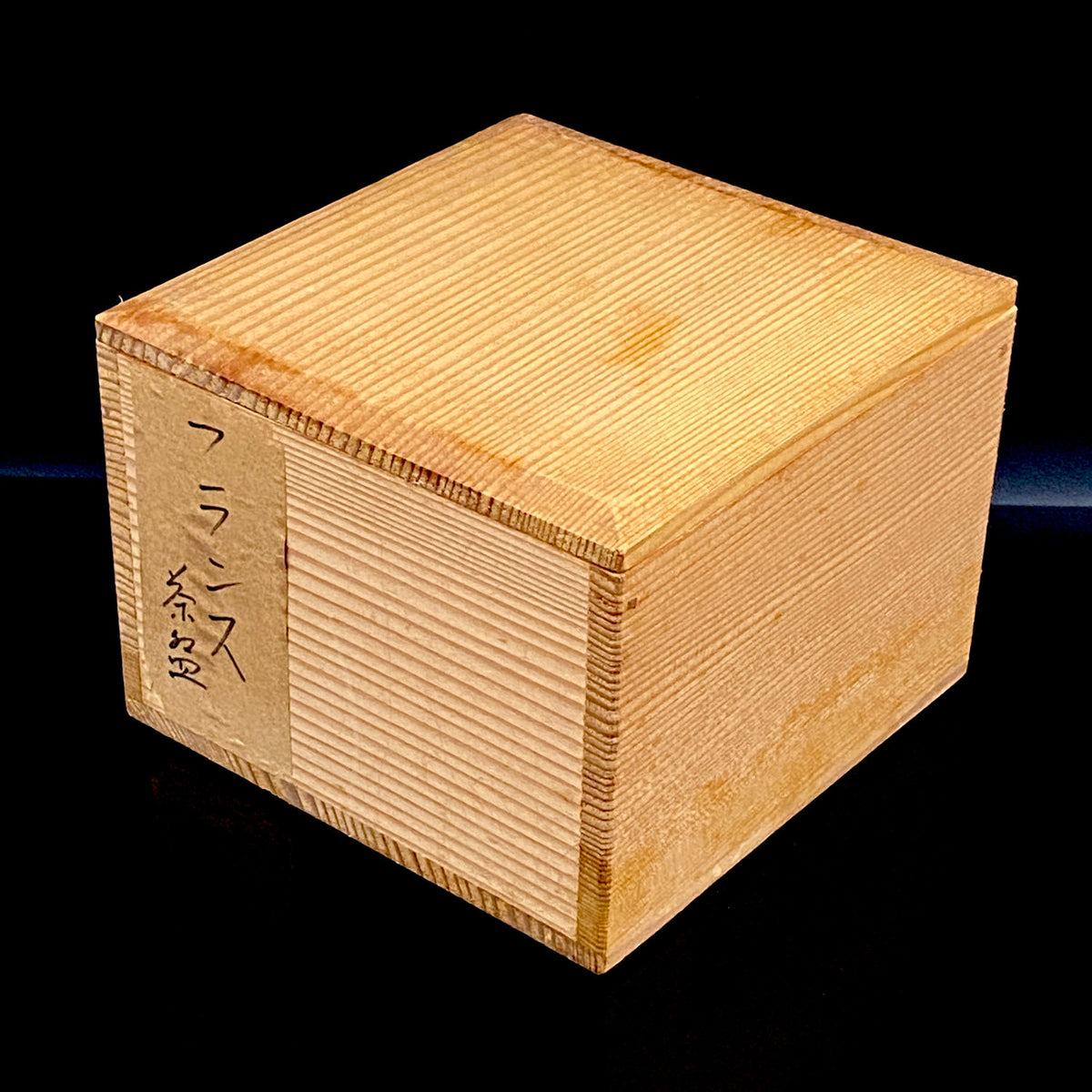
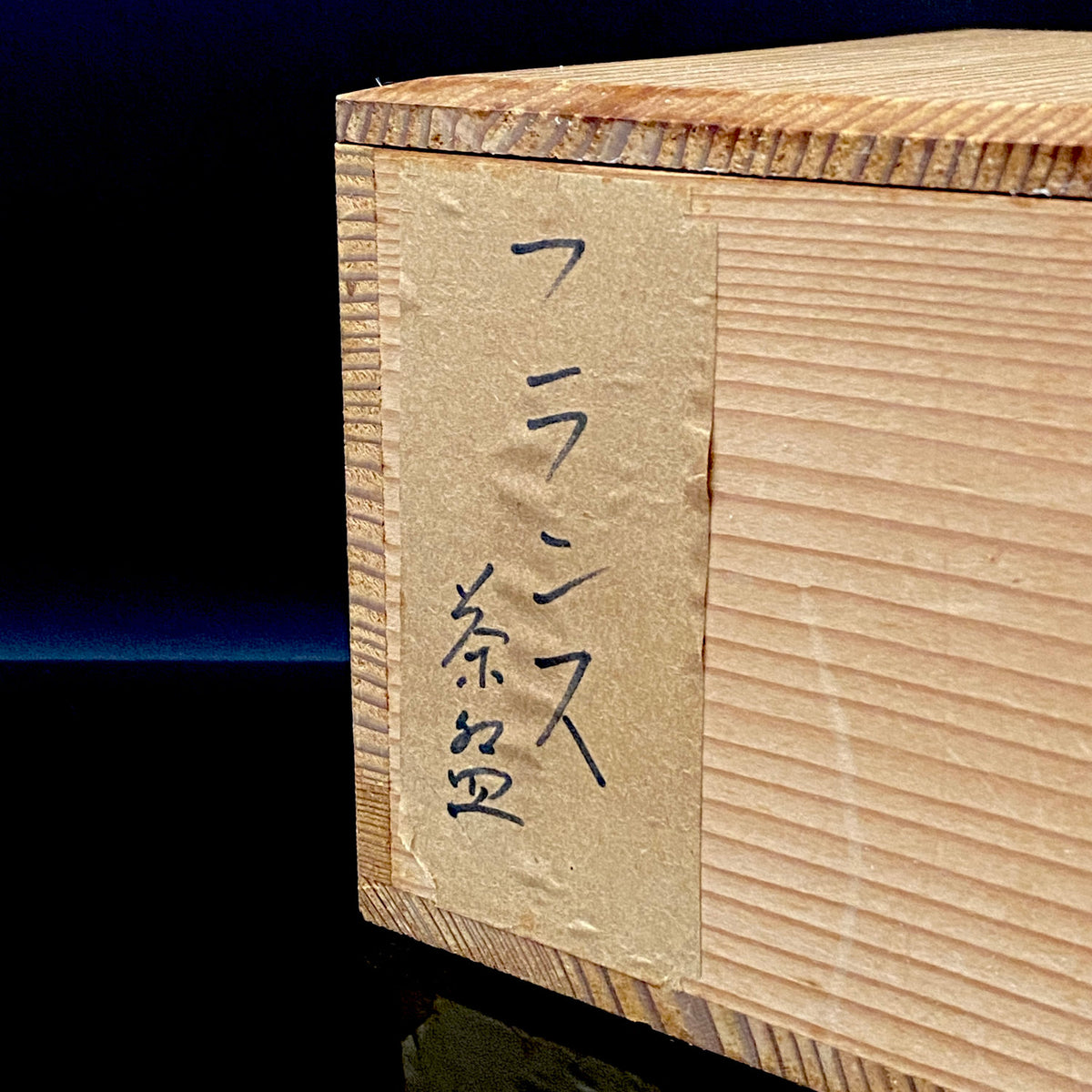
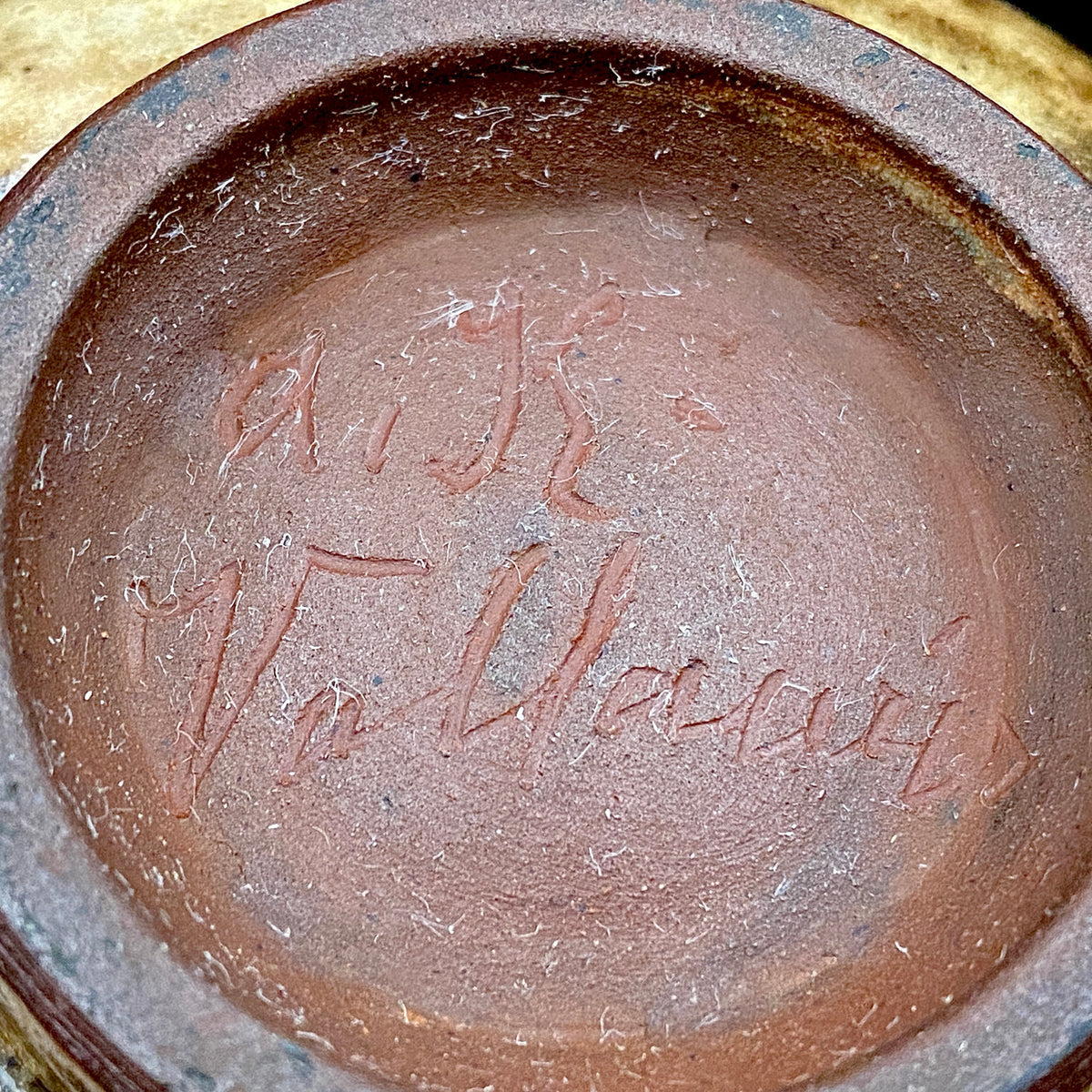
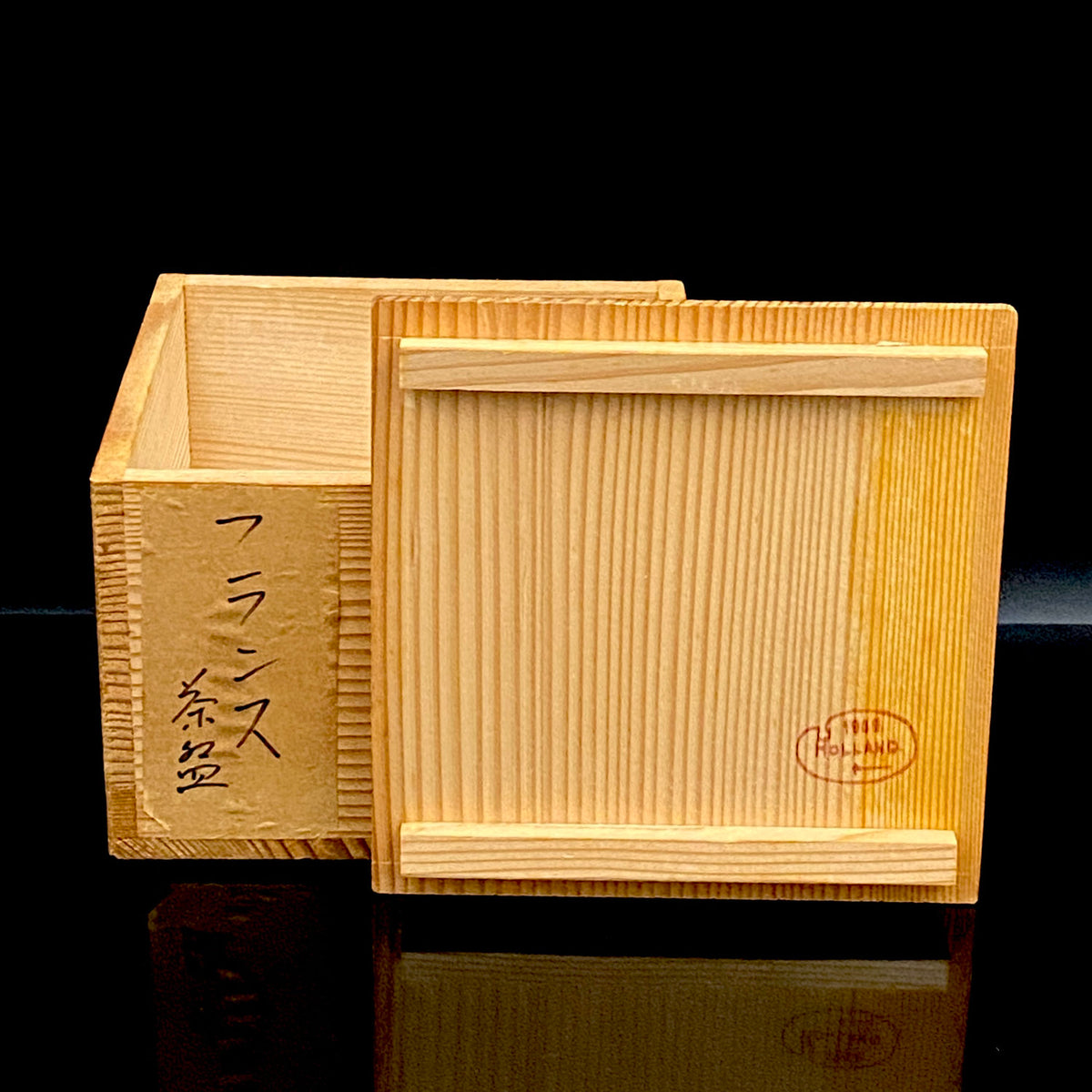
The box of this white bowl left only one such clue. On a small slip of paper pasted to its side, written vertically, are two words: 「フランス」 (“France”) and 「茶盌」 (“tea bowl”). There is no maker’s name and no place of origin. Inside lies a single bowl of reddish-brown clay brushed with white glaze. Turn it over, and inside the foot ring “a.K. / Vallauris” is incised in cursive script. The bowl was made by the potter Alexandre Kostanda (1921–2007) in Vallauris, the pottery town in the south of France.
Its maker probably never imagined that matcha would one day be whisked in it. A bowl most likely made for everyday life in France crossed the sea, caught someone’s eye in Japan, was given a box made to fit it, and came to be called a tea bowl. In the world of tea, this kind of rebirth of a vessel’s role has long been called mitate.
As art dealers, and as lovers of ceramics, we ask ourselves the same question each time we take this bowl in hand: what did that person see in it that made it a tea bowl? In this article we look for the answer by examining our white-glazed bowl (#555) step by step — its box, its form, its mark, its maker, and finally the history of mitate.
What a Single Paper Label Tells Us
When we examine an old piece, the first thing we look at is the box. Japanese ceramics often come with a tomobako, a box on which the maker writes the title of the work, signs it and stamps a seal; with tea utensils, a box inscribed by a tea master with the piece’s name and history conveys its standing. A box identifies the object, and it is also a record of its provenance.
The box of this bowl is neither. It is an awasebako, a box made later to fit the piece, and the only writing on it is the two words on the label (盌 is a variant of the character 碗, “bowl”). Neither the maker’s name nor the name Vallauris appears. All the writer seems to have wanted to record was that the bowl came from France, together with a declaration of mitate: this is a tea bowl. Boxes are made by people who want to protect an object and pass it on to its next owner. Even a nameless fitted box holds the feelings of someone who cared for the piece.
It is not an inscription by a famous tea master, just a few words by someone unknown. Yet through this one slip of paper, a foreign bowl crossed over from the dining table to the world of tea utensils. When it came to Japan, who brought it and who boxed it are not known. What remains is the clear trace of a judgment: someone looked at this bowl and decided, “This can be a tea bowl.”
In the Hand — Form, Clay and Glaze
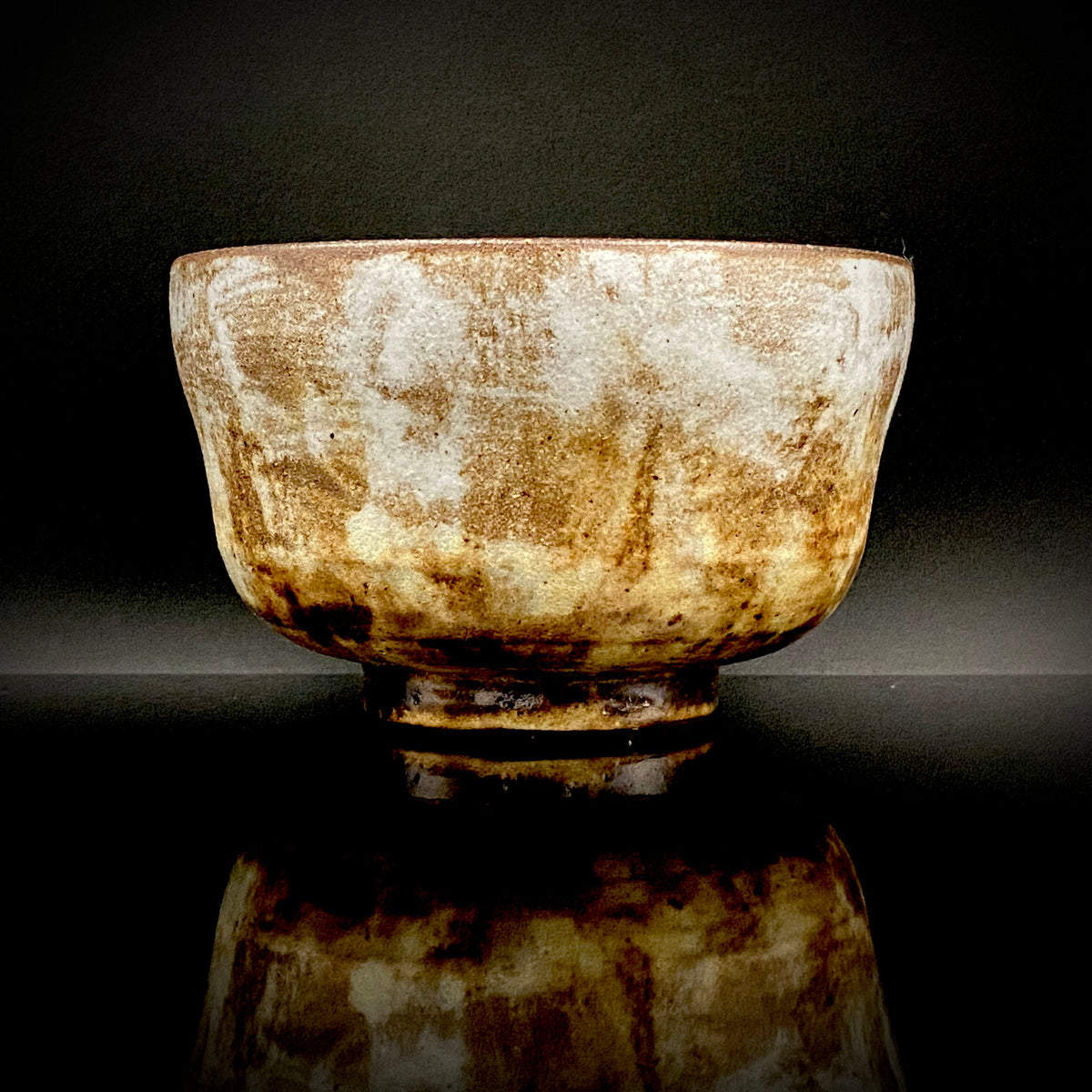
When a tea bowl is examined, one first takes in its overall form, looks at the scenery of the body, the well and the rim, and finally turns the bowl over to look at the foot. Let us look at this bowl in the same order. It stands about 7.2 cm high, with a rim about 11.8 cm across. From the rim the walls rise almost straight, then draw in firmly at the waist and continue down to a low foot ring. Held in both hands it settles neatly into the palms, and the foot gives the fingers a natural hold. This is a size often seen in matcha bowls; a size larger, and it might have looked like a serving bowl.
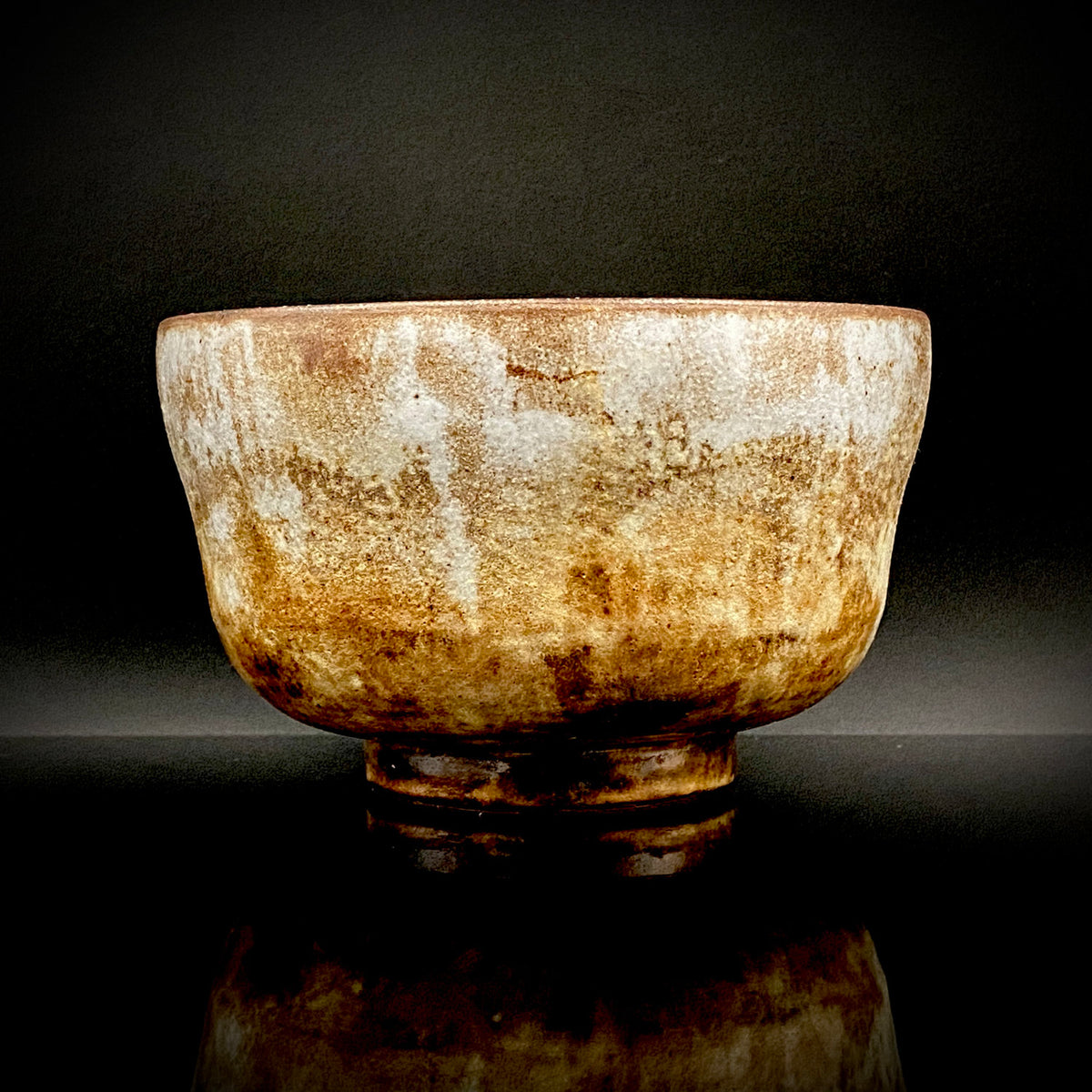
Next, the clay and the glaze. White glaze has been brushed thinly over a coarse, reddish-brown clay. Along the brush strokes the white breaks off, and the brown clay shows through the gaps. The interplay of white and brown can look like clouds drifting across the sky, or like snow lingering on a field.
Japanese tea people have long loved wares in which white is laid over the colour of the clay, such as Korean kohiki (white slip) and hakeme (brushed slip). In postwar Vallauris, where brightly coloured ceramics were in fashion, Kostanda is said to have favoured subdued tones close to the colour of the clay throughout a whole career. That this sensibility should resonate, across the sea, with the Japanese aesthetic of wabi is a happy coincidence indeed.
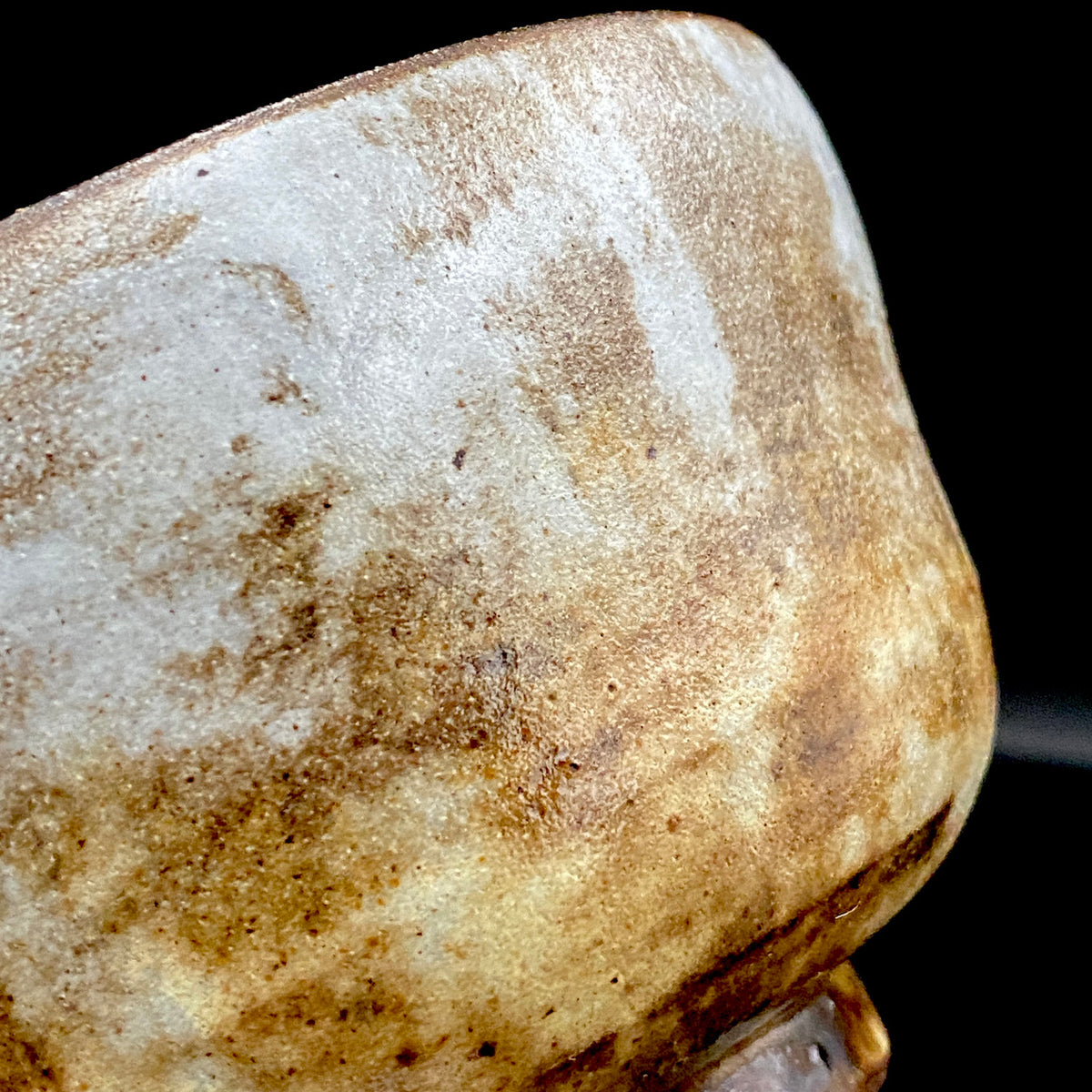
Turn the bowl slowly and the brushwork shows a different character on each side: on some faces the white remains in broad areas, on others the brown prevails. In the tea ceremony, the host presents a bowl with its “front” facing the guest, and the guest turns it so as not to drink from the front. Which side should be this bowl’s front? That, too, is the owner’s mitate.
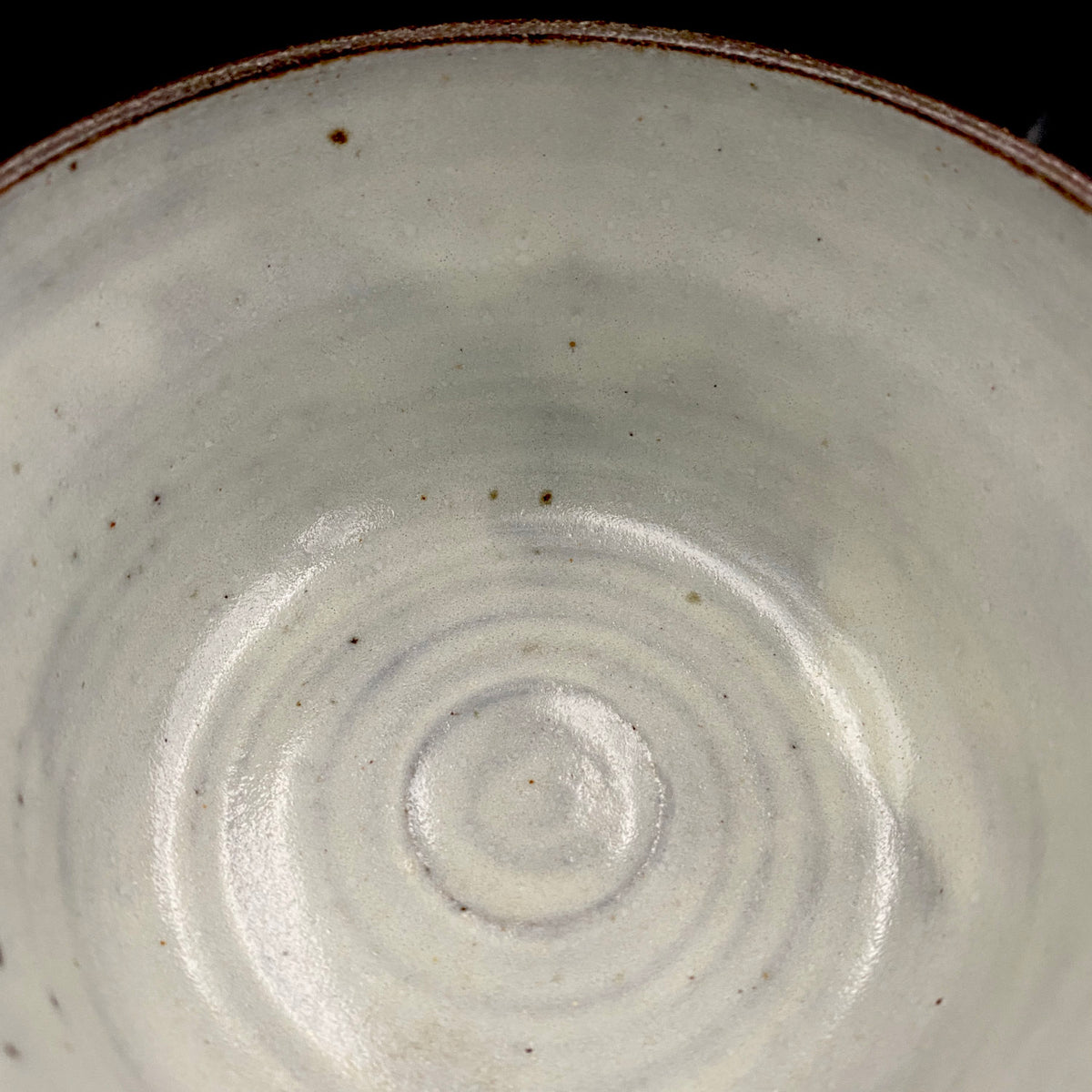
Inside, throwing rings form concentric circles beneath the white glaze, with small iron specks here and there. At the centre of the well the spiral left by the wheel curls into a small eddy, creating a scene around the spot tea people call the chadamari, the “tea pool.” Whisk matcha in it and the green and the white set each other off; once the tea is drunk, the spiral reappears with the last traces of tea. At the rim the glaze thins and the brown clay shows through, giving the white bowl a crisp outline.
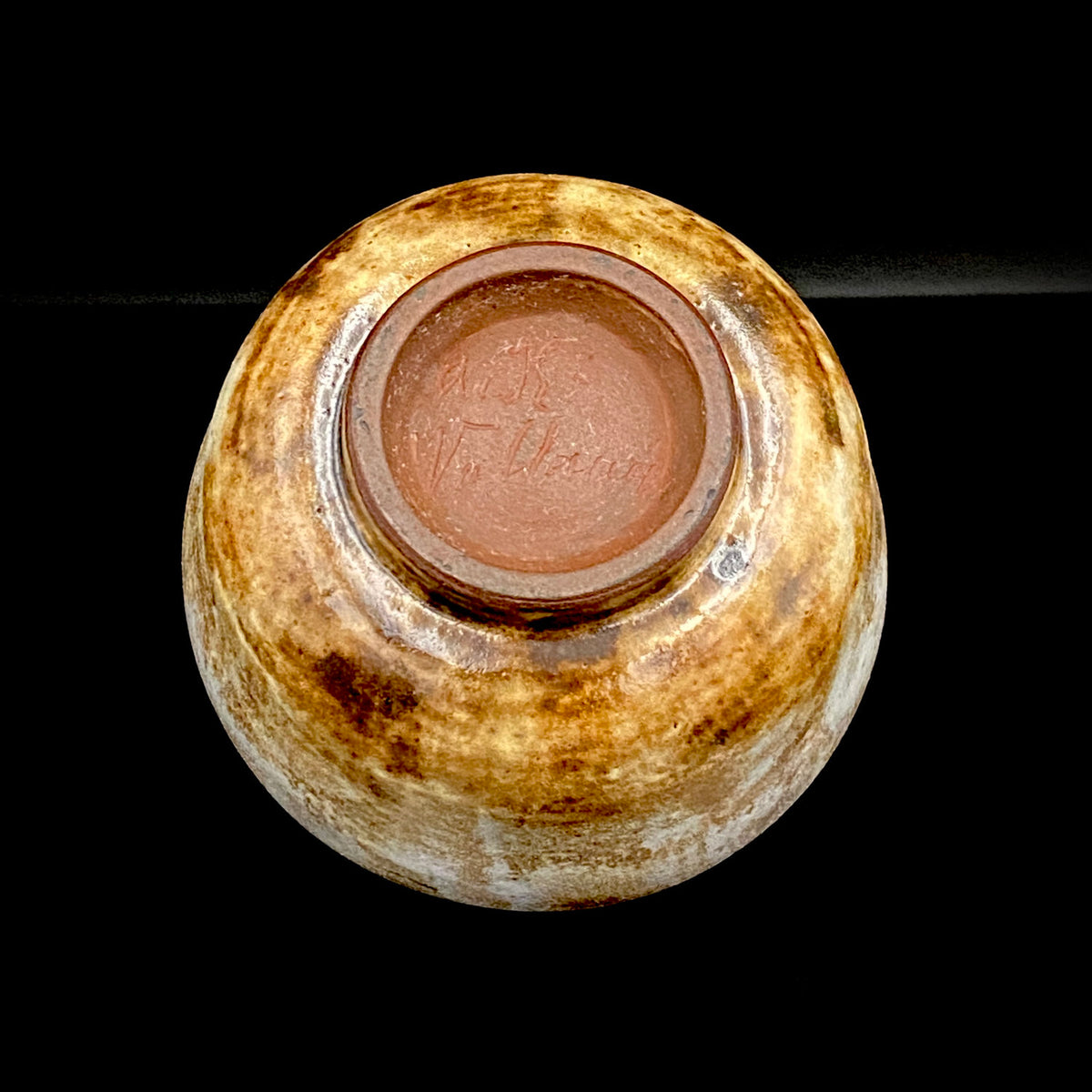
And then the foot. At a tea gathering, guests look at the foot when admiring a bowl after drinking. The unglazed foot shows the grain of the clay just as it is, and around it the glaze turns a dark, iron-brown colour.
The Mark on the Foot, and the Maker
Inside the foot ring is the hand-incised cursive “a.K. / Vallauris.” Where a tea master would expect a potter’s seal or kiln mark, the name of a town in the south of France has been dashed off instead. This small surprise at the end of the viewing may well have been the true charm of the “French tea bowl.”
As dealers, however, we had to check carefully who “a.K.” refers to, because Vallauris had two potters with the same initials, A.K.: the father, Alexandre Kostanda, and the son, Alexis Kostanda (born 1953). We compared photographs of both marks. The “V” that begins with a small hook and draws a long stroke to the right, the tall, right-leaning “ll,” the cursive “K” and the open “a” with a dot all match the father’s mark, and in the main points they do not match the son’s. On this basis we attribute the bowl to Alexandre. This attribution rests on photographs and published material and is not accompanied by a certificate of authenticity.
Kostanda is said to have been born in Poland in 1921, while the family was moving from Russia to France. The family settled in Vallauris in 1929, and from the following year the artist’s mother, Irène, worked as a painter at the Louis Giraud workshop. Kostanda trained as a decorator at the same workshop from 1936 to 1938. During the Second World War Kostanda joined the Resistance in Mâcon and was wounded, and after the war set up a studio in Cluny, Burgundy. Kostanda is said to have kept ordering the stoneware clay first encountered there even after returning to Vallauris. In Mâcon and Cluny, Kostanda taught the young people who would later found the Accolay pottery, and in 1949 introduced the potter’s wheel to Daniel de Montmollin, a brother of the Taizé Community who went on to become one of France’s leading stoneware potters.
In 1949 Kostanda returned to Vallauris and became head of the Giraud workshop. Vallauris had long been known for cooking pots and other kitchen earthenware, and after the war it drew many artists, once Pablo Picasso had begun working in ceramics at the Madoura workshop in 1947 and lived in the town from 1948 to 1955. In the sources we have examined, we have found no record of a direct collaboration with Picasso. Kostanda, however, opened an independent studio in 1953, co-founded the Friends of the Vallauris Museum (later the potters’ association) in 1954 and served as its president from 1972, and took part in founding the Vallauris International Ceramics Biennale, which began in 1968. Kostanda was also a member of the International Academy of Ceramics (AIC), and two works are listed in the catalogue of the Sèvres contemporary ceramics collection — one of those who supported, from within, the pottery town that welcomed Picasso.
Kostanda’s workshop made a wide range of everyday wares, from plain breakfast pieces to vessels painted with flowers and figures. It is natural to see this small, undecorated bowl as part of that output, and no material has been found to suggest that Kostanda made pieces with the Japanese tea ceremony in mind. That is why, at the beginning of this article, we described the bowl as most likely made for everyday life in France.
The glaze of this piece, white with brown and black specks, is close to works from around 1949 to 1953, when Kostanda headed the Giraud workshop. Taking into account the word “Vallauris” in the mark (works from the Cluny years are marked “Cluny”) and the plain, undecorated form, we estimate that the bowl was made between 1949 and the 1950s.
The name Vallauris is not unrelated to Japanese ceramics, either. The title of a work we have offered by Suzuki Osamu (1926–2001) of the Sodeisha group (#271) includes the words 「プラハ・ヴァロリス国際展金賞」 (gold medal, Prague and Vallauris international exhibitions). In the postwar world of ceramics, this small town in the south of France and Japan were already joined by a slender thread.
The Lineage of Mitate — A Fish Basket, Korean Tea Bowls and “Oranda” Wares
Mitate means seeing one thing as another. In tea, it refers to taking up an object originally made for another purpose and using it as a tea utensil. From a dealer’s point of view, the history of mitate is also a history of eyes that found new value in vessels.
A well-known story concerns Sen no Rikyu and a fish basket. Rikyu is said to have taken a basket used by a fisherman on the Katsura River and made it into a flower container, and baskets copied from its shape are still loved today as “Katsuragawa baskets.” How much of this is historical fact remains in the realm of legend, but the leap of imagination — arranging flowers in a basket meant for fish — clearly captured the hearts of later generations.
Perhaps nothing shows the power of mitate better than Korean tea bowls (Korai chawan). In the Momoyama period, as wabi tea spread, the leading role among tea bowls passed from Chinese tenmoku to Korean tea bowls brought from the Korean Peninsula and to wares made in Japan. In the early days of their import, Korean tea bowls were vessels not made as tea bowls but seen as tea bowls. Later some were made to Japanese order, but the starting point was mitate.
As for Ido tea bowls, the most celebrated of them, theories still differ on whether they were everyday local wares, ritual vessels or pieces ordered from Japan. The great Ido tea bowl named “Kizaemon,” a National Treasure kept at Kohoan in Daitokuji, is counted among the very finest tea bowls in Japan. A vessel of uncertain origin became a supreme tea bowl through the eyes of those who looked at it. The worth of a vessel does not lie only in the purpose for which it was made.
Welcoming Western vessels into tea is not a new idea, either. In the early Edo period, European ceramics brought by Dutch ships were called “Oranda” (Dutch) and found their way into tea masters’ sets of utensils. In the written record, the phrase “Oranda flower vase” in Gosukidogu no cho, an inventory of the tea utensils owned by Oda Urakusai (1547–1622) whose cover inscription is dated 1638 (Kan’ei 15), is thought to be the earliest appearance. The diary Kakumeiki of Horin Shosho records, in an entry for 1651 (Keian 4), the gift of a small “Oranda-yaki” sake flask. There are also examples of albarelli — jars made in Europe to hold medicines — being used in Japan as water jars (mizusashi). A medicine jar becomes a water jar: another fine example of mitate.
Interestingly, not every vessel called “Oranda” was made in the Netherlands. A handled “Oranda-yaki” water jar handed down in the Owari Tokugawa family has been identified by research as German salt-glazed stoneware. People of the time generously called vessels from far across the sea “Oranda.”
The words 「フランス茶盌」 (“French tea bowl”) on this box have the same ring as “Oranda.” Without knowing the name of the town of Vallauris or of the potter Kostanda, someone simply received the bowl as “a tea bowl from France.” If we imagine that the gaze Edo tea masters turned on foreign jars was passed down across the centuries to the person who made this box, a single paper label takes on still greater depth.
The “HOLLAND” Stamp Inside the Lid
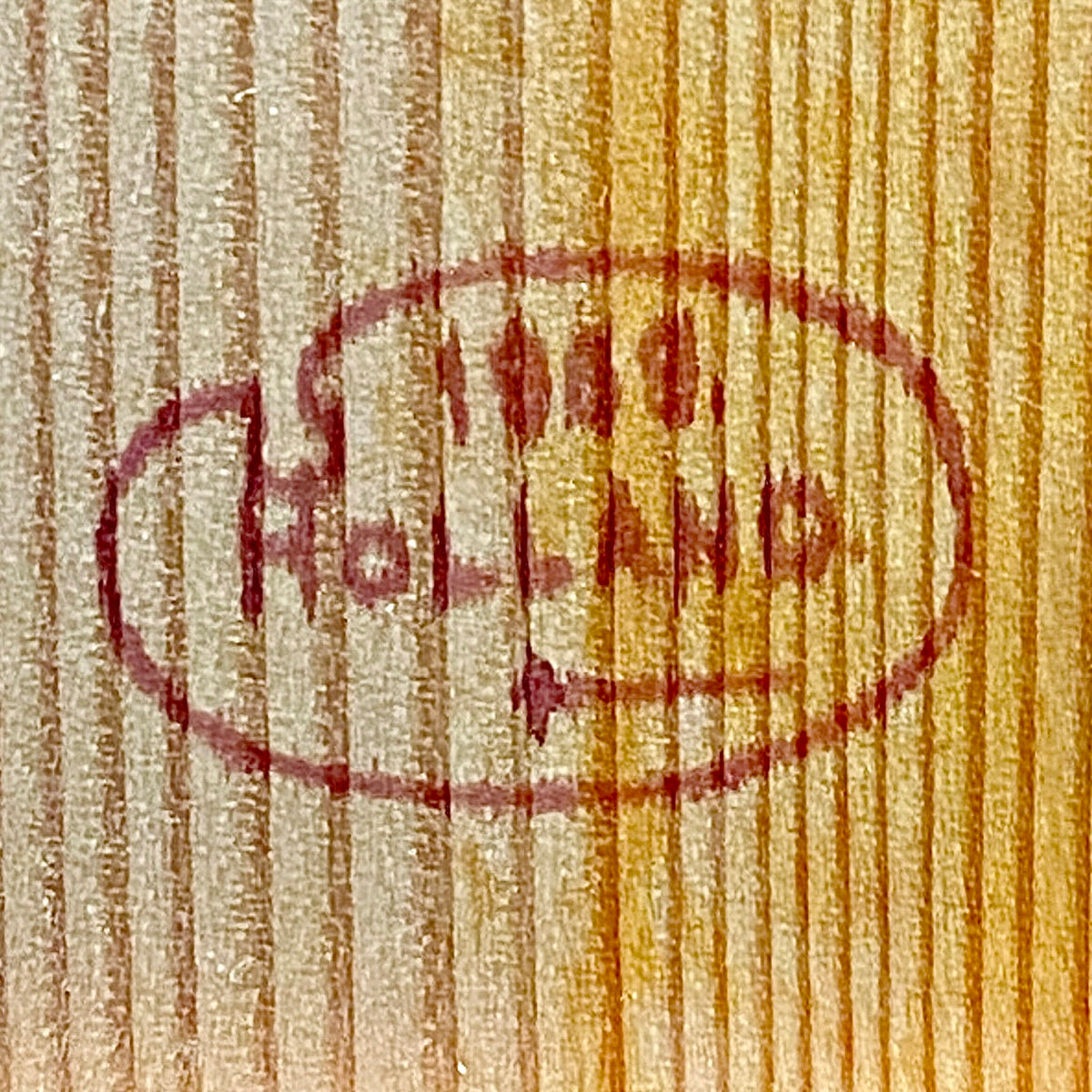
This box holds one more mystery. On the underside of the lid, between the two battens, an oval red stamp bears the word “HOLLAND.” The figures above it are blurred by the wood grain and hard to make out, but we read them as “1949.”
Dutch words on the box of a French bowl. What the stamp means is, for now, unknown. Whether it relates to the wood of the box or the handling of a shipment, or to a former owner — and even whether the figures indicate a year — is uncertain. If they do read “1949,” that is the year Kostanda returned to Vallauris, but this may be a coincidence. We do not date the bowl on the basis of this stamp; we estimate its date from the mark and the glaze.
Unanswered questions are one of the pleasures of old vessels. Just as Edo tea masters called foreign wares “Oranda,” this box happens to bear the word “HOLLAND” — a coincidence that cannot help but make us smile. If you have any clues about this stamp, we would be delighted to hear from you.
Enjoying the Bowl Today
Part of the pleasure of mitate is that it never happens just once. Just as a fish basket became a flower container and a medicine jar became a water jar, vessels have been given new roles each time the era or the owner changed.
First, as a tea bowl. The bowl has come down to us in very good condition, with no chips or cracks. It is a size often seen in matcha bowls, and the low foot sits steadily in the hand. The white well will show off the green of freshly whisked tea beautifully.
At Antique Liquor we also propose tea bowls and cups by master craftsmen as Japanese rocks glasses, for enjoying aged spirits and whisky over a large piece of ice. With its wide mouth, this bowl holds even a large ice ball with room to spare. Imagine how amber whisky and ice would look inside this bowl of southern French clay brushed with white. A French bowl became a tea bowl in Japan, and now takes on yet another form as a drinking vessel — this, too, is a modern mitate. The pleasure of bringing drinking vessels into a tea setting is introduced in “A Whisky Tea Gathering,” and mitate that welcomes water droppers, tea bowls and confectionery bowls to the drinking table is covered in detail in “Mitate Drinking Vessels — Bringing Water Droppers, Tea Bowls and Confectionery Bowls Back into Use.”
After use, please let the bowl dry thoroughly, so that no moisture remains in the unglazed foot, before returning it to its fitted box.
Closing
Alexandre Kostanda’s white-glazed bowl was born in a workshop in the south of France, crossed the sea, and became a “French tea bowl” through a single paper label. The maker surely never knew, and the person who made the box may never have known the maker’s name. The work of two people who never knew each other meets inside one box.
A dealer’s work is to establish a vessel’s history and pass it on to its next owner. But what truly matters for a vessel is to be discovered by someone beyond that point, and to be used. Not only to ask “What was this made for?” but also “What can this become?” — this bowl teaches us that mitate is a way of seeing that creates new encounters between vessels and people.
You can see the bowl on its product page (#555).