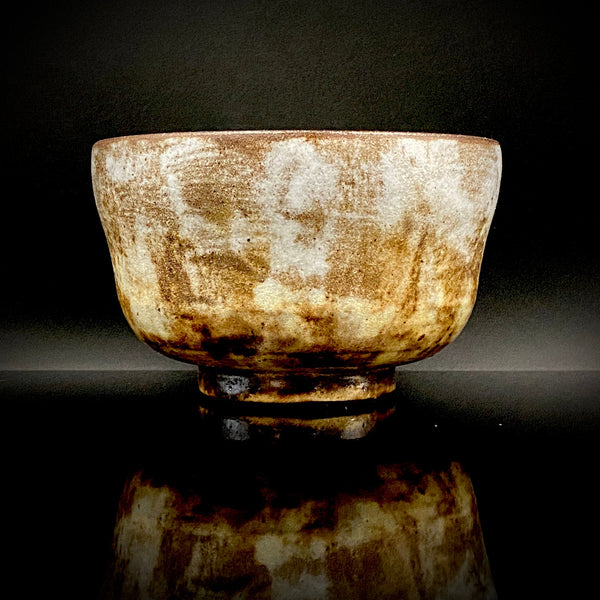
This white-glazed bowl is the work of Alexandre Kostanda (1921–2007), a potter of the southern French ceramics town of Vallauris who helped sustain, from within, the postwar "golden age of Vallauris" that welcomed Pablo Picasso. After reaching Japan the bowl was placed in a wooden box, and a paper label on the box reads "French Tea Bowl" (フランス茶盌). Born as a vessel for everyday life in France, it appears to have been taken up in Japan as a bowl for matcha, and it stands where the ceramic cultures of East and West meet. The inscription "a.K. / Vallauris" is hand-incised inside the foot ring. The son, Alexis Kostanda (born 1953), was also a potter in Vallauris with the same initials, "A.K." We compared this inscription with photographs of the marks of both father and son. The "V" that opens with a small hook and draws a long bar to the right, the slender right-leaning loops of "ll", the cursive hooked "K" and the open lower-case "a" with its dot all agree with the father's marks and differ from the son's on the main points, so we attribute the piece to Alexandre. This judgment rests on photographs and published sources and is not accompanied by a certificate of appraisal.
Kostanda is said to have been born on December 24, 1921, at Tuchola in Poland, while the family was travelling from Russia to France (some sources give 1917 or 1924; we follow a local-history article from Cluny based on Kostanda's own testimony). The family moved to Vallauris in 1929, and the mother, Irène, worked as a decorator at the Louis Giraud workshop from 1930. Kostanda trained in decoration at the same workshop from 1936 to 1938. During the Second World War Kostanda joined the Resistance at Mâcon, was wounded in fighting in August 1944, and then served as a signals officer on the Alsace front. After the war Kostanda set up a workshop at Cluny in Burgundy and, even after returning to Vallauris, kept sending for the stoneware clay discovered there. At Mâcon and Cluny Kostanda taught the young people who later founded the Accolay pottery, and in 1949 gave a first lesson on the wheel to Daniel de Montmollin, a brother of the Taizé community who became one of France's leading stoneware potters.
In 1949 Kostanda returned to Vallauris as head of the Giraud workshop. Picasso had begun working in ceramics at the Madoura workshop in 1947 and lived in the town from 1948 to 1955, so this was exactly when artists were gathering there (we have found no record of direct collaboration with Picasso in the sources we consulted). In 1953 Kostanda opened an independent workshop together with Irène, in 1954 helped found the Friends of the Vallauris Museum, later the potters' guild, and led it from 1972. Kostanda also took part in founding the first Vallauris International Ceramics Biennale in 1968 and is said to have served as its general commissioner. Kostanda was a member of the International Academy of Ceramics (AIC), and works appear in the catalogue of the Sèvres contemporary ceramics collection. In a town where bright colors were in fashion, a lifelong use of muted tones close to the color of the earth, such as beige, gray and reddish brown, marks this potter's individuality.
Looking closely at the piece, a gently swelling body rises from a low foot ring in a bowl form that sits comfortably in the hands. The body is a reddish-brown clay with visible grit. The inside is covered with white glaze, and throwing rings remain in concentric circles in the well. On the outside the white glaze was brushed on thinly, so that the brown ground shows through along the strokes, and white and brown overlap like clouds. At the rim the glaze thins and the earthy brown appears as an outline, while dark iron spots show near the foot. The foot ring and the area within it are unglazed, leaving the texture of the clay in plain view. A white glaze with brown and black flecks like this one is close to Kostanda's work from around 1949 to 1953, the years as head of the Giraud workshop. This look of white brushed over the color of the earth must have appealed to the eyes of Japanese tea practitioners, who had long treasured the kohiki and hakeme wares of the Korean peninsula.
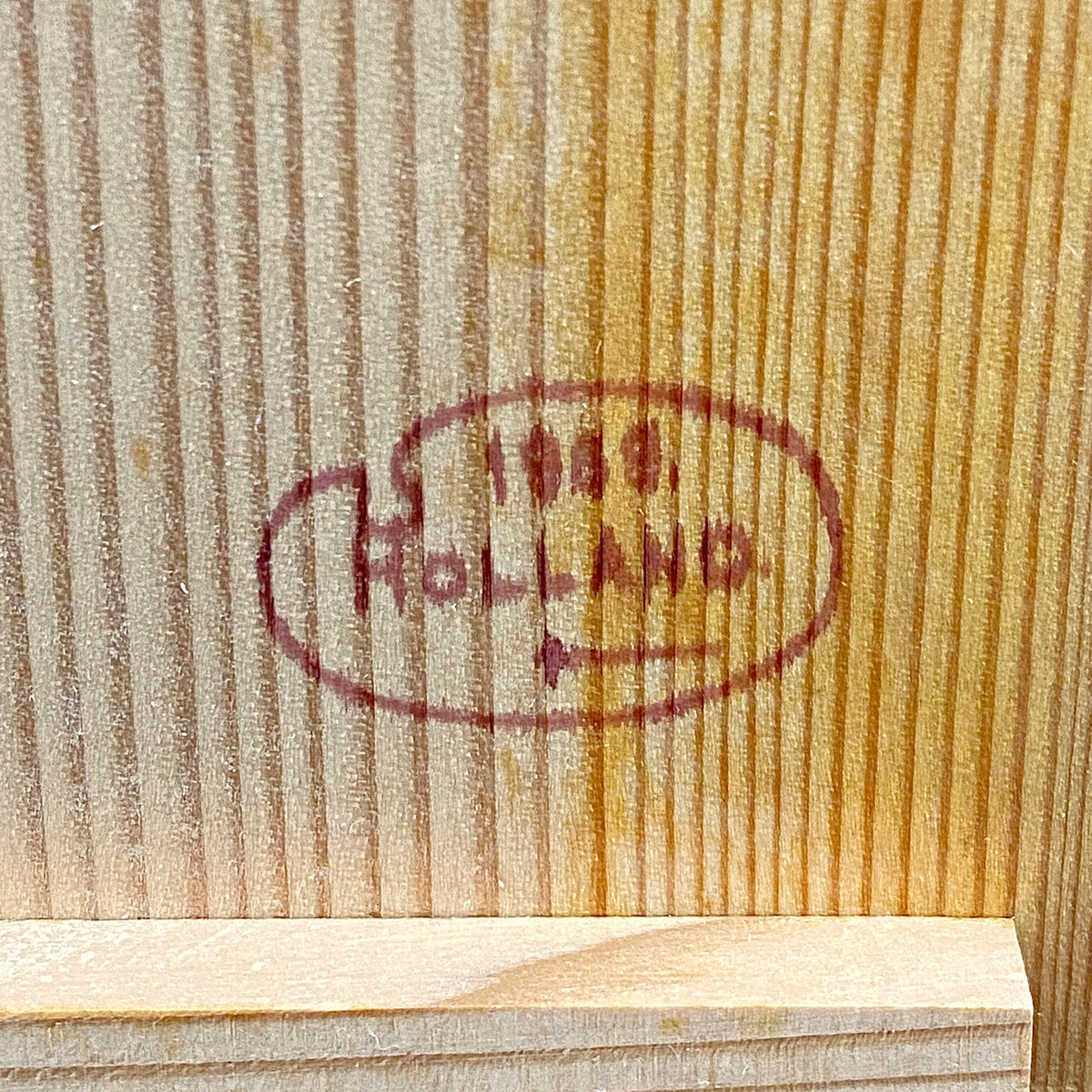
The piece was probably not made as a tea bowl but as a bowl for use in French daily life. Once it reached Japan, someone saw a matcha bowl in it, had a box made to fit, and left a paper label reading "French Tea Bowl." We do not know when it arrived, who brought it, or who boxed it. Yet finding a new role for a vessel apart from its original purpose, the practice called mitate, is the very aesthetic that the tea ceremony has cultivated. The box also bears an oval red stamp reading "1949 HOLLAND." The meaning of the stamp is unknown and it cannot be confirmed as a date, but it remains as a clue to the history of this bowl.
We estimate the production period as 1949 to the 1950s, based on the word "Vallauris" in the inscription (marks from the Cluny period read "Cluny"), the flecked white glaze and the undecorated form. A date of up to around 1960 remains possible.
We offer this piece, about 7.2 cm high with a mouth diameter of about 11.8 cm, as a bowl for matcha and also as a "Japanese-style rocks glass (vessel for aged spirits)" for enjoying aged sake, matured spirits and whisky over a large piece of ice. Born in southern France and made a tea bowl in Japan, it invites you to give it yet another role.
- Artist: Alexandre Kostanda (1921–2007)
- Career Highlights: 1936–38: trained in decoration at the Louis Giraud workshop. 1941–45: joined the Resistance at Mâcon. 1946: set up a workshop at Cluny. 1949: returned to Vallauris as head of the Giraud workshop. 1953: opened an independent workshop. 1954: helped found the Friends of the Vallauris Museum (later the potters' guild), leading it from 1972. 1968: took part in founding the first Vallauris International Ceramics Biennale. Member of the International Academy of Ceramics (AIC).
- Public Collections: Sèvres contemporary ceramics collection (two works in the catalogue)
- Date: 1949–1950s (estimated from the "Vallauris" inscription, the glaze and the undecorated form; up to around 1960 is possible)
- Condition: Very good (no chips, no cracks). Please regard the crazing that forms in firing, other characteristics of ceramics and the patina of age as part of the pleasure of an antique piece.
- Accompanied by: Fitted wooden box, not by the artist (paper label "French Tea Bowl"; oval red stamp "1949 HOLLAND")
- Medium: Ceramic / Pottery (Vallauris, France; reddish-brown clay, white glaze)
- Dimensions: Height approx. 7.2 cm, Mouth diameter approx. 11.8 cm
- Please Note: The items provided by our shop were produced a very long time ago and are all listed as pre-owned items. Please understand and confirm the age-related changes before considering your purchase.
- About the Photographs: We prepare every description with great care, but errors may still remain in the text. Please examine the photos carefully before purchasing. Where the photos and the description differ, please take the photos as the basis for the product information.



 When a French Bowl Becomes a Tea Bowl — Mitate and Alexandre Kostanda’s White-Glazed BowlA single paper label on the side of the fitted box reads, in vertical writing...
 Japanese Pottery Seals, Box Signatures and Marks: A Photo Index of 160 MakersThe seal or incised signature on the base of a piece, and the signature and s...
 A Whisky Tea Gathering — Hosting with Master Craftsmen's Tea Utensils and Old Bottle WhiskyNovember, when the hearth is opened and the year's new tea is unsealed, is ca...
