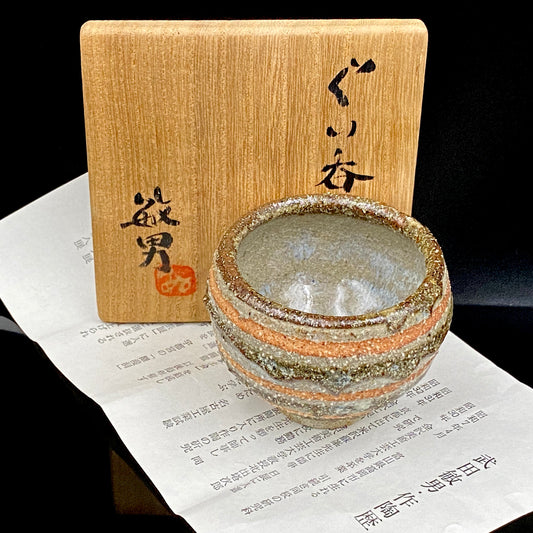
This brushed-slip (hakeme) guinomi by the Mashiko potter Takeda Toshio (武田敏男, born 1932) shows a flower reminiscent of a thistle, picked out in pale tones against a dark brown ground. The lid of the fitted box (tomobako) bears the inscription "ぐい呑" (guinomi), the signature "敏男" (Toshio) and a red seal.
Takeda Toshio's name appears in "1958– The Dawn of Studio Pottery in Mashiko," an exhibition held in 2023 by the Mashiko Museum of Ceramic Art to mark its 30th anniversary, alongside Kamoda Shoji, Seto Hiroshi, Hirosaki Yuya and others. The exhibition featured potters who came to Mashiko as trainees between 1958 and about 1970. It presented them as makers who pursued styles of their own, distinct from the Mashiko that Hamada Shoji had built, and who shaped an era of Mashiko pottery.
The trainee system began at the Tsukamoto pottery in Mashiko (now Tsukamoto Co., Ltd.). Trainees worked the same hours as employees during the day, and after work they could practise on the wheel in the factory until 10 p.m. The system lasted until 1993, and more than 100 trainees studied under it. According to an essay by a curator of the museum, trainees learned throwing, glaze mixing and firing first-hand from veteran craftsmen, and were even given lodgings. The essay goes so far as to say that without this system the generation after Hamada would not have grown.
A work by Takeda is also in the National Museum of Modern Art, Kyoto: the 1971 large dish "Plate with Susuki Grass Design" (地掛芒文皿), 57.5 cm wide.
Now to this piece. The rim rises straight, the body narrows at the middle and then swells out roundly at the waist, and a fairly tall foot ring sits firmly beneath. The body is decorated with hakeme, a technique that leaves the marks of the brush as the pattern itself. Here the strokes, swept sideways, overlap in many layers, and an olive-tinged yellow-brown and a deep dark brown shift like bands. The traces of the bristles and the throwing lines remain as they are, so the movement of the maker's hand becomes the face of the vessel.
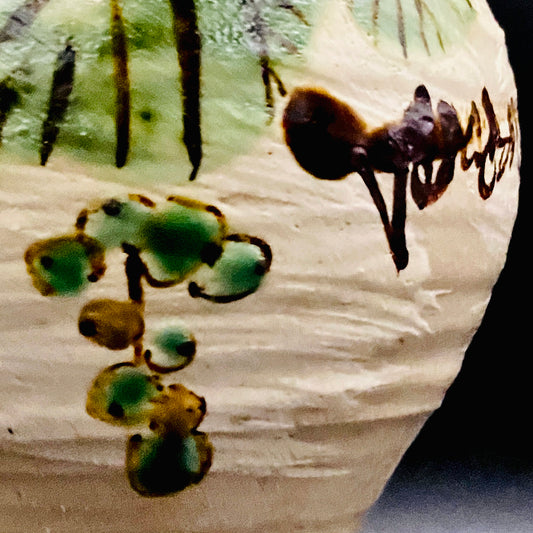
On the side with the flower, the flower is picked out in a pale grey-brown close to the clay against the dark brown ground. The plump flower head keeps dark brown inside an oval outline, with three small dots left pale, and recalls a thistle flower. Small leaves sit at its base, and from there a long, narrow leaf sweeps sharply up at an angle. The leaf tip splits finely with the force of the brush and has the sharpness of a thorny thistle leaf. The pale areas have a gritty, sandy texture that sets off the glossy dark brown all the more. The flower is gathered on one side, and the other side is made only of the light and dark of the brushwork, so the view changes each time the cup is turned in the hand.
The inside is covered with a pale grey-brown glaze with small iron specks, and glaze has pooled at the bottom with a gloss. At one point inside the rim, a streak of the outer dark brown runs in. A square potter's seal is impressed at one point on the waist, with glaze over it, and its characters cannot be read. The foot shows a coarse grey clay surface with brown iron specks and a slight sheen. Turning marks remain inside the foot ring, and the resting edge has white granular deposits and rough spots.
The title of the dish in the National Museum of Modern Art, Kyoto shows that Takeda took susuki, a wild grass, as a motif. Together with the wildflower-like flower of this piece, it gives a glimpse of the artist's work depicting familiar plants. No curator's commentary on Takeda's techniques or designs has been found, however, so the hakeme and flower design of this piece cannot be compared with any published assessment. For an artist with few surviving records, this piece, handed down with a fitted box bearing both signature and red seal, is a valuable clue to the work.
Neither the box nor the cup is dated. According to the Mashiko Museum of Ceramic Art, Takeda came to Mashiko as a trainee sometime between 1958 and about 1970. If it was made in Mashiko, it dates from 1958 or later, but there is nothing to narrow the date further.
Made as a guinomi, this piece is offered by our shop as a Japanese-style shot glass for sipping aged spirits, whisky or other spirits neat, a little at a time. Poured into the light interior, the amber colour of the spirit will show beautifully.
-
Artist: Takeda Toshio (武田敏男, born 1932)
-
Representative Career Highlights: [1932] Born; [c. 1958–1970] came to Mashiko as a trainee at the Tsukamoto pottery; [1971] made "Plate with Susuki Grass Design" (National Museum of Modern Art, Kyoto); [2023] featured in the Mashiko Museum of Ceramic Art exhibition "30th Anniversary: 1958– The Dawn of Studio Pottery in Mashiko"
-
Public Collections: National Museum of Modern Art, Kyoto ("Plate with Susuki Grass Design," 1971)
-
Production Period: 1958 or later (estimated from when the artist came to Mashiko as a trainee; no date on the box or the cup)
-
Item Condition: Very good (no chips, no cracks)
-
Accessories: Tomobako (fitted, signed box)
-
Material: Pottery
-
Dimensions: Height approx. 5.5 cm, mouth diameter approx. 6.3 cm
-
Note: Even if the products provided by our shop are unused, they were produced a very long time ago and are all listed as pre-owned items. Please understand and confirm that the item may have age-related wear before considering your purchase.