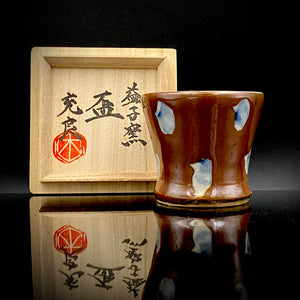
This yunomi (teacup) by the Mashiko potter Kimura Ichiro (木村一郎, 1915–1978) has a single flower painted freely in the red of shinsha (copper red) on a clear white glaze ground. One face of the fitted box (tomobako) lid reads "木村一郎作 辰砂湯呑" (Shinsha teacup, made by Kimura Ichiro); the other face, with the cleat, bears the inscription "辰砂湯呑" (shinsha teacup), the signature and a round red seal that reads "木". Inside the bottom of the box, "昭和四十五年" (Showa 45, 1970) is written in ink, followed by the month and year. It has come down complete with its wrapping cloth and a shiori (leaflet) printed with the artist's career.
Kimura Ichiro was born in Mashiko. After finishing middle school, the young potter helped at the post office run by a grandfather while learning the craft at a local pottery. Later, moved by the ceramics of Kawai Kanjiro and others, Kimura overcame the objections of those around and went to study at the Ministry of Commerce and Industry's Ceramics Testing Institute in Kyoto, under the guidance of Mizumachi Wasaburo, Sawamura Shigeo and others. Among the classmates was Yagi Kazuo, who later founded the Sodeisha and led postwar avant-garde ceramics. Through an introduction by Hamada Shoji, Kimura also learned the nerikomi (layered clay) technique from Kawai Kanjiro.
Back in Mashiko, Kimura brought in glazes and techniques Mashiko had not known before, such as shinsha (copper red) glaze, glass glaze and nerikomi. The Mashiko Museum of Ceramic Art describes Kimura as a figure who stood out in the Mashiko of the time. The mingei master Hamada Shoji is said to have come to every one of Kimura's kiln openings, yet seems to have disapproved of the shinsha and nerikomi, and never used either in Mashiko. In a Mashiko overflowing with wares that could be called imitations of Hamada, Kimura is counted among the first to work with shinsha glaze. The title of the museum's 2014 exhibition, "The Modernist of Mashiko," aptly conveys that position.
The Tochigi Prefectural Museum of Fine Arts calls nerikomi, in which clays with different shrinkage rates are joined and must be kept from separating in the firing, "a difficult ceramic technique," and judges that Kimura had reached the point of handling it freely. The technique was passed on to Matsui Kosei of Kasama, later a Living National Treasure. Matsubara Naoyuki was among Kimura's pupils, and Kamoda Shoji, on first coming to Mashiko, rented a room in a detached building of the Kimura household.
In 1965 Kimura had the honour of receiving an order for works from the Crown Prince's Palace (Togu Gosho). In the same year, however, Kimura left the Japan Kogei Association, and the name quietly disappeared from the main stage of modern ceramic history. In recent years exhibitions and curators' essays at the Mashiko Museum of Ceramic Art have brought the work back into the light.
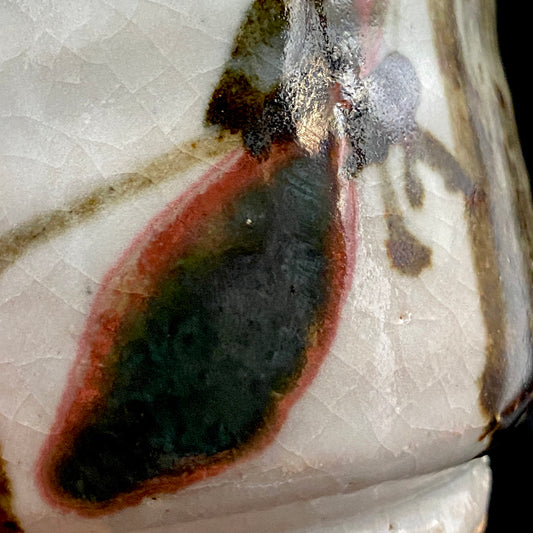
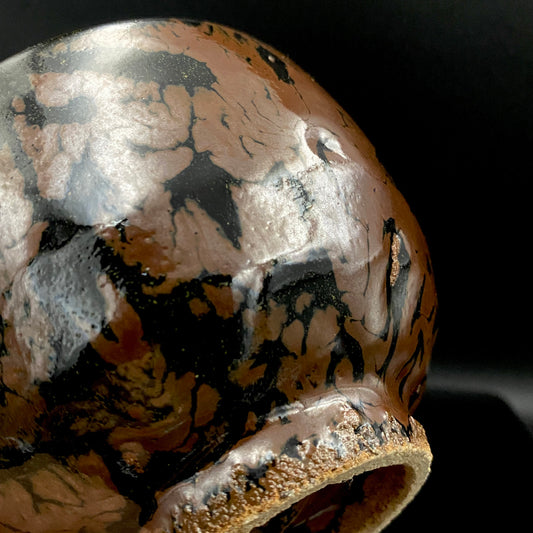
Now to this piece. The cylindrical body, swelling very slightly, is covered in white glaze, while the waist down to the foot is tightened with a glossy dark brown glaze. The border between the two glazes is drawn as a clean horizontal line. Fine crazing runs over the whole white ground, with small iron specks here and there. Blooming on one face of the body is a flower painted in shinsha red, just as the box inscription says. Shinsha uses copper as the colourant and turns red in reduction firing. The petals show a deep red in the middle and become a pale red at the edges, blurring softly into the white glaze. The flower centre is dotted in dark brown, two grey-blue leaves sweep out to left and right, and a thin red line runs from the flower toward the rim. The design is set to one side, leaving ample white space on the other, so its expression changes each time the cup is turned in the hand.
At one point on the body is a shallow vertical dent where glaze has pooled, showing that it was made at the forming stage before firing. The inside is white glaze, with iron specks and small glaze pinholes. The resting edge of the foot shows clay mixed with grains of sand. Inside the foot ring, turning marks form concentric circles, finished in a tokin shape whose centre rises to a cone. The dark brown glaze shows fine reddish-brown speckles and bluish passages, with white glaze pooled here and there, so the cup rewards a look even when turned over.
Of Kimura's techniques, nerikomi and shinsha are the ones whose public assessments are the most specific. This piece is not a nerikomi work, but it clearly shows, on both the box inscription and the vessel, the shinsha that the Mashiko Museum of Ceramic Art names as one of Kimura's representative glazes. The museum's "Square Jar with Shinsha Painting" is covered entirely in shinsha, with a bamboo-grass design rendered in wax resist and iron painting. Here shinsha is used to paint a flower on a white ground, a different face of the same glaze. Kimura is recorded as having worked mainly in shinsha and iron painting in later years.
The production date is estimated at around 1970 (Showa 45), from the ink inscription inside the bottom of the box. The enclosed shiori is a printed career sheet titled "Career of Mr. Kimura Ichiro." Since it describes the 1964 (Showa 39) invitation to the International Ceramics Exhibition as "to be held this autumn," it is thought to have been printed in that year. At the end, Kimura's death on 21 August 1978 (Showa 53) has been added later by hand. That date matches the date of death in the "Yearbook of Japanese Art" collected by the Tokyo National Research Institute for Cultural Properties. This line, added in later years, also tells of the time this piece has passed through.
Made as a teacup, this piece is offered by our shop as a Japanese-style rocks glass (a vessel for aged spirits), for enjoying aged spirits, matured liquors or whisky over ice. Pour an amber spirit into the white-glazed cup, and its pairing with the shinsha red should make for another pleasure.
"Enclosed shiori: Career of Mr. Kimura Ichiro"
Career of Mr. Kimura Ichiro
Registered domicile: Uchimachi, Mashiko
Address: same as above
Born 1915 (Taisho 4); March 1933 (Showa 8): graduated from Moka Middle School (now a high school)
March 1937 (Showa 12): entered the Ministry of Commerce and Industry's National Ceramics Testing Institute
April 1938 (Showa 13): completed the course there (20th class)
Same year: selected for the 24th Ministry of Commerce and Industry Craft Exhibition
Same year: selected for the 1st Japan Folk Crafts Exhibition
Same year: selected for the 3rd Kyoto City Art Exhibition, Section 4 (Crafts)
1940 (Showa 15): selected for the Kokuten
1941 (Showa 16): selected for the Kokuten
1949 (Showa 24): selected for the 2nd Tokyo Craft Exhibition
1953 (Showa 28): selected for the National Ceramics Exhibition
1955 (Showa 30): selected for the Contemporary Japanese Ceramics Exhibition
Same year: selected for the Japan Craft Exhibition
1957 (Showa 32): selected for the 4th Japan Traditional Art Crafts Exhibition
1958 (Showa 33): 5th, ditto
1959 (Showa 34): 6th, ditto
1960 (Showa 35): 7th, ditto
1961 (Showa 36): 8th, ditto
1962 (Showa 37): selected for the Japan Kogei Association Tokyo Branch Exhibition
1964 (Showa 39): invited to the International Ceramics Exhibition (to be held this autumn)
21 August 1978 (Showa 53): died (handwritten)
-
Artist: Kimura Ichiro (木村一郎, 1915–1978)
-
Representative Career Highlights: [1915] Born in Mashiko, Tochigi Prefecture; [1937] entered the Ministry of Commerce and Industry's Ceramics Testing Institute in Kyoto and studied under Mizumachi Wasaburo, Sawamura Shigeo and others; [1938] completed the course there, selected for the Ministry of Commerce and Industry Craft Exhibition; [1941] "Inlaid Ceramic Box" selected for the Kokuga Sosaku Kyokai exhibition; [1946] built a climbing kiln in Mashiko; [1949] first prize at the 2nd General Craft Exhibition; [1953] Director-General of the Small and Medium Enterprise Agency Prize for "Large Plate with Persimmon Glaze and Net Design"; [1957] selected for the 4th Japan Traditional Art Crafts Exhibition (selected every year through the 8th in 1961); [1959] Encouragement Prize at the 6th Japan Traditional Art Crafts Exhibition, shown in "Contemporary Japanese Ceramics" at the National Museum of Modern Art, Tokyo; [1964] invited to the International Contemporary Ceramics Exhibition; [1965] invited to an international ceramics exhibition held by a Marseille museum, received an order for works from the Crown Prince's Palace; [1978] died (aged 63); [2014] donation commemorative exhibition "The Modernist of Mashiko: Kimura Ichiro" at the Mashiko Museum of Ceramic Art
-
Public Collections: Mashiko Museum of Ceramic Art ("Inlaid Ceramic Box," "Square Jar with Shinsha Painting" and others), Tochigi Prefectural Museum of Fine Arts ("Nerikomi Jar")
-
Production Period: c. 1970 (Showa 45) (estimated from the date inside the bottom of the box)
-
Item Condition: Very good (no chips, no cracks)
-
Accessories: Tomobako (fitted, signed box), wrapping cloth, shiori (leaflet)
-
Material: Pottery (Mashiko ware)
-
Dimensions: Height approx. 8.0 cm, mouth diameter approx. 7.5 cm
-
Note: Even if the products provided by our shop are unused, they were produced a very long time ago and are all listed as pre-owned items. Please understand and confirm that the item may have age-related wear before considering your purchase.





 Japanese Pottery Seals, Box Signatures and Marks: A Photo Index of 153 MakersThe seal or incised signature on the base of a piece, and the signature and s...
 Letters from Teachers: Potters' Mentors and Friendships, Read Through the Recommendations in Their LeafletsA leaflet lying at the bottom of a fitted box sometimes carries words by some...
