When we first picked up this cup, our eye went straight to the handle. Where does it begin? Looking closely, it was not attached afterwards. The wall of the cylindrical body continues without a break at the rim, folds outward and extends as a flat plate. This is a kiseto cup by Inoue Takeo (井上猛雄, 1950–), a potter who works in a studio on the shore of Lake Inba (Inba-numa) in Chiba Prefecture, Japan. Drawing on a paper the artist wrote about the artist’s own work, we trace the thinking behind the clay, the kilns and the forms, and then show, in the order a collector examines a piece, how that thinking appears in this cup.
Inoue Takeo was born in 1950 in Asahikawa, Hokkaido, and learned the basics of ceramics under the potter Kamiya Norio (神谷紀雄), who was born into a family running a Mashiko ware kiln and works in Chiba City. From the studio by Lake Inba, Inoue has made a wide range of work in ceramics, from flower vases and vessels to sculptural objects and ceramic murals. In 2018, the artist published the paper “Process of Making Pottery through my works” (やきもの制作の過程 ―自作をもとに―) in the Bulletin of the Faculty of Education, Chiba University (the artist’s affiliation at the time was the Faculty of Education, Chiba University). The paper records in detail, through the artist’s own works, how themes are chosen and which materials, techniques and processes are used. The same issue also carries a co-authored paper on practical ceramics classes in a teacher-training course. Inoue’s work was shown in 1989 in “Today’s Clay Work: Various Forms of ‘Earth’” (今日のクレイ・ワーク展 ―さまざまな「土」のかたち―) at the Kanagawa Prefectural Civic Hall Gallery, and in 1992 the artist was one of five potters featured in volume 58 (Tokyo 1) of Toh: The Best Selections of Contemporary Ceramics in Japan, published by Kyoto Shoin. In 2015, Inoue held a solo exhibition at Gallery Mutsu in Chiba City, showing works such as “Doma” (土間, an earthen floor cast from the floor of the artist’s workshop and fired), “Twisting Form” and “Form that Draws Close.”
In the paper, Inoue writes that what the artist is most conscious of when making work is “something that could only be made in ceramics.” The artist pursues the interest of the thickness of the clay, of composition and structure, and of curves and straight lines, and takes cues for expression from the nature of the satoyama countryside: light in the woods, changes in the rice paddies and the people who live there. Of works shown in the 2015 exhibition, such as “Form Going from H to S” and “Form Going from O to S,” the artist explains that they were made “with awareness of change while connecting, without dividing, curve to curve, straight line to straight line, and straight line to curve.”
Inoue prepares the clay personally. The base is a blend of “tōban clay” (陶板土, a clay for tiles and large works rich in silica and feldspar that fires to a whitish color) and “Shigaraki red clay” (信楽赤土, rich in iron and firing red), with kibushi clay (木節粘土, a sedimentary clay) added. Forming is mainly by coil building, with slab building and hand-building also used. For firing, the artist uses a kerosene kiln and a climbing kiln (noborigama) fired with both wood and kerosene. The main firing takes 22 hours in the kerosene kiln and about 24 to 30 hours in the climbing kiln, and afterwards the kiln is cooled slowly over about twice the firing time. After the bisque firing, the pieces are coated with glaze or with “fubasami,” said to be a natural alumina, before the main firing. The artist notes that some pieces are given their main firing without any glaze.
Now let us look at the cup in the order a collector examines a piece. First, its overall form. A flat, plate-like handle is attached to a cylindrical body. As noted at the beginning, the handle continues from the wall of the body without a break. The curve of the round body flows into the straight line of the flat handle with no seam. This appears to be the artist’s idea of “connecting, without dividing,” described in the paper, expressed in a vessel that fits in the palm of the hand. A small slit remains between the lower end of the handle and the body, suggesting that the form was raised from a slab of clay.
Next, the body. The outside is an unglazed, reddish-brown yakishime (high-fired, unglazed stoneware) surface. Fine white and gray grains are scattered all over it, and the color shifts from reddish to deep brown depending on how the flames struck it. Here and there a soft sheen can also be seen. The clay recipe described in the paper, combining tōban clay rich in silica and feldspar with iron-rich Shigaraki red clay, and the practice of sometimes firing without glaze, show directly in this surface.
Then, the inside and the rim. The inside is covered with the yellow glaze of kiseto. In the well, whitish streaks radiate outward from the center. Near the rim the glaze thins and takes on a greenish gray tone. The top edge of the rim is left in the color of the clay, so the boundary between the red clay outside and the yellow inside stands out clearly. Kiseto (黄瀬戸, literally “yellow Seto”) takes its name from yellow-glazed wares fired in Mino (present-day Gifu Prefecture) in the Momoyama period, and classic pieces often show tanpan (胆礬, green spots of copper), koge (焦げ, scorched patches), incised lines or stamped decoration. These are not seen on this piece. Instead, the contrast between the fired red clay outside and the soft yellow inside is the greatest charm of this cup.
Finally, the base. The base is flat and unglazed, and arc-shaped marks remain on it. No potter’s seal or incised signature can be found on the cup itself. The maker is identified by the signature and red seal on the lid of the tomobako.
Our shop proposes this cup as a drinking vessel of Japanese kogei (Japanese crafts) for savoring aged spirits slowly: a Japanese rocks glass. The cylinder, with a rim diameter of about 8.0 cm, is a good size for a single large piece of ice and a pour of whisky. With your fingers resting on the plate-like handle, the cup settles comfortably in the hand. The yellow glaze inside gently receives the amber color of an aged spirit, while the rough clay surface outside passes on a warmth that a glass tumbler cannot. After use, wash the cup in lukewarm water and dry it well. Because the outside is unglazed, please avoid long soaking and do not use a dishwasher.
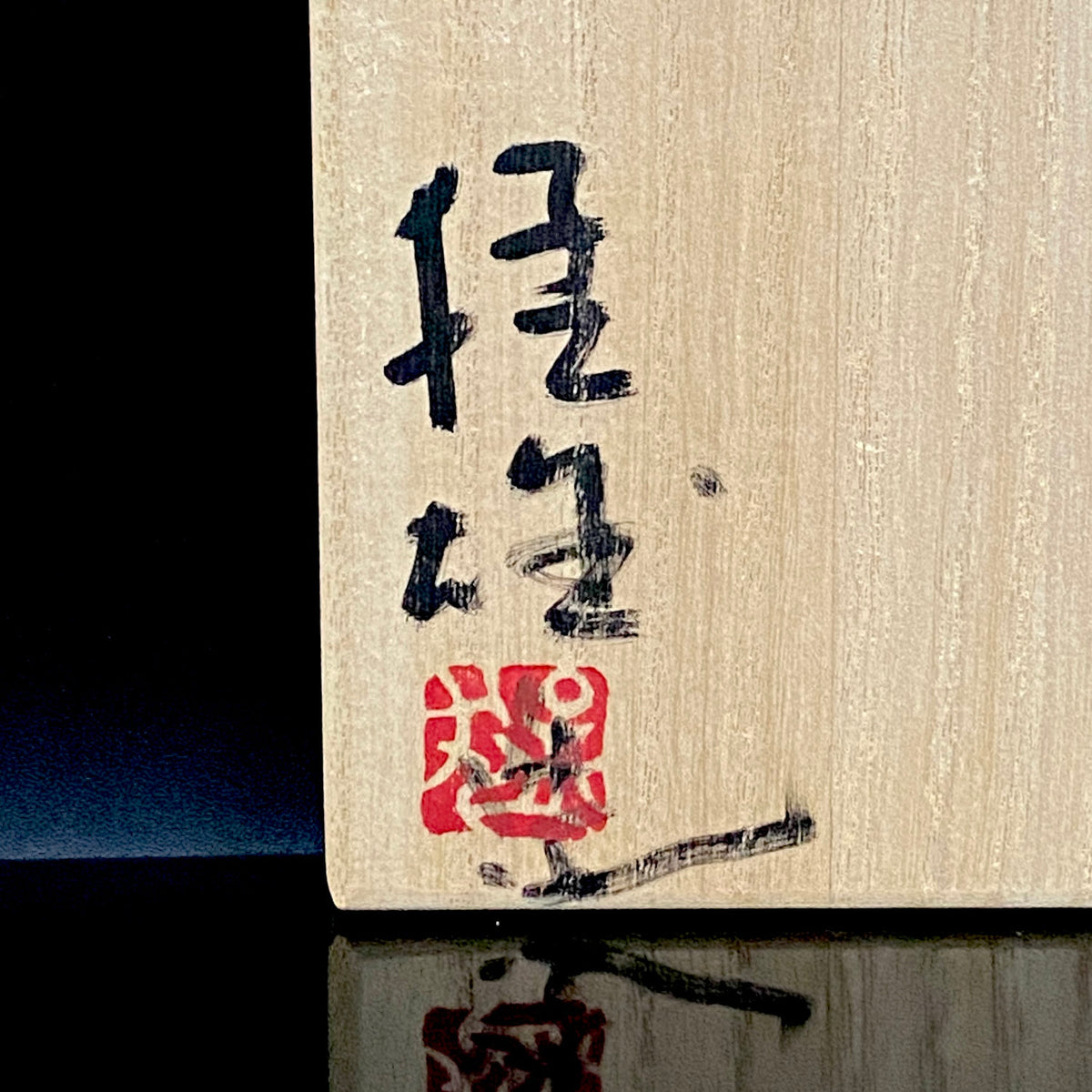
The cup comes with a tomobako (the artist’s own wooden box). The lid of the paulownia box is inscribed in ink “黄瀬戸カップ” (kiseto cup), with the signature “猛雄” (Takeo) and a square red seal. The characters of the seal are stylized, and as our shop could not read them with certainty, they are not given here. The box is wrapped in paper and tied with a cord. The cup is in very good condition, with no chips or cracks.
- Artist: Inoue Takeo (井上猛雄, 1950–)
- Career Highlights: [1950] Born in Asahikawa, Hokkaido (later studied the basics of ceramics under Kamiya Norio); [1989] Exhibited in “Today’s Clay Work: Various Forms of ‘Earth’” (Kanagawa Prefectural Civic Hall Gallery); [1992] Featured in Toh: The Best Selections of Contemporary Ceramics in Japan, vol. 58 (Tokyo 1, Kyoto Shoin); [2015] Solo exhibition (Gallery Mutsu, Chiba City); [2018] Paper “Process of Making Pottery through my works” (Bulletin of the Faculty of Education, Chiba University, vol. 66, no. 2)
- Date: c. 2015 – early 2020s (estimated, on two grounds: the handle continues from the wall of the body without a break, the same idea as works such as “Form Going from O to S,” which the artist showed in the 2015 solo exhibition and presented in the 2018 paper; and the paulownia tomobako and its wrapping paper show almost no soiling or wear from age)
- Condition: Very good (no chips, no cracks). Please regard the crazing that forms in firing, other characteristics of ceramics and the patina of age as part of the pleasure of an antique piece.
- Accompanied by: Tomobako (lid inscribed in ink “黄瀬戸カップ” (kiseto cup), with signature and red seal)
- Medium: Pottery (kiseto glaze inside; unglazed yakishime outside)
- Dimensions: Rim diameter approx. 8.0 cm, width approx. 12.0 cm (including handle), height approx. 7.0 cm
- Please Note: All items offered by our shop, even those that are new and unused, were produced a very long time ago and are therefore listed as pre-owned. Items may show damage from age, so please understand and review this before considering your purchase.
- About the Photographs: We prepare every description with great care, but errors may still remain in the text. Please examine the photos carefully before purchasing. Where the photos and the description differ, please take the photos as the basis for the product information.



 Mitate Drinking Vessels — Bringing Water Droppers, Tea Bowls and Confectionery Bowls Back into UseThe more beautiful a vessel, the more likely it is to be kept on display as “...
 Japanese Pottery Seals, Box Signatures and Marks: A Photo Index of 161 MakersThe seal or incised signature on the base of a piece, and the signature and s...
