

How the Shape of a Cup Changes the Taste — Choosing Flat Cups, Stem Cups, Footed Cups, Cylindrical Cups and Guinomi
The same drink tastes different when the vessel changes — anyone who enjoys sake or whisky has probably experienced this at least once. The width of the mouth, the depth, the thickness of the rim, the weight and the material: small differences in each of these change, to a surprising degree, the way the aroma rises and the impression the drink makes in your mouth.
Japanese drinking vessels come in a remarkable variety of shapes: the flat cup (hirasakazuki), the stem cup (bajohai), the footed cup (kodai-hai), the cylindrical cup and the guinomi, among others. In this article we introduce the characteristics of each shape, and how to choose one to suit your drink, using artist-made vessels from our shop as examples. Knowing the differences between shapes should make choosing vessels freer and more enjoyable. All the vessels shown are items from our shop, photographed by us, so you can see every detail on the product pages. Please take your time and enjoy.
Sakazuki and guinomi — what's in a name
There are several families of names for sake vessels. Generally, a sakazuki is a small, shallow cup with a wide mouth, used at ceremonies and for tasting small amounts. A guinomi, by contrast, is deeper and larger than a sakazuki, holding enough to drink in one hearty gulp (“gui” in Japanese). Today the boundary between the two is loose, and different artists often use different names.
What matters more than the name is understanding how the shape of a vessel affects the way you perceive a drink. Let us look at the characteristics of each shape in turn.
The flat cup — spreading the aroma, admiring the colour
A hirasakazuki is a shallow cup with a wide-open mouth. Because a broad surface of liquid is exposed to the air, the aroma spreads softly and the temperature of the drink changes easily. It suits crisp chilled sake, or occasions when you want to enjoy the painting in the mikomi (the inside of the cup).
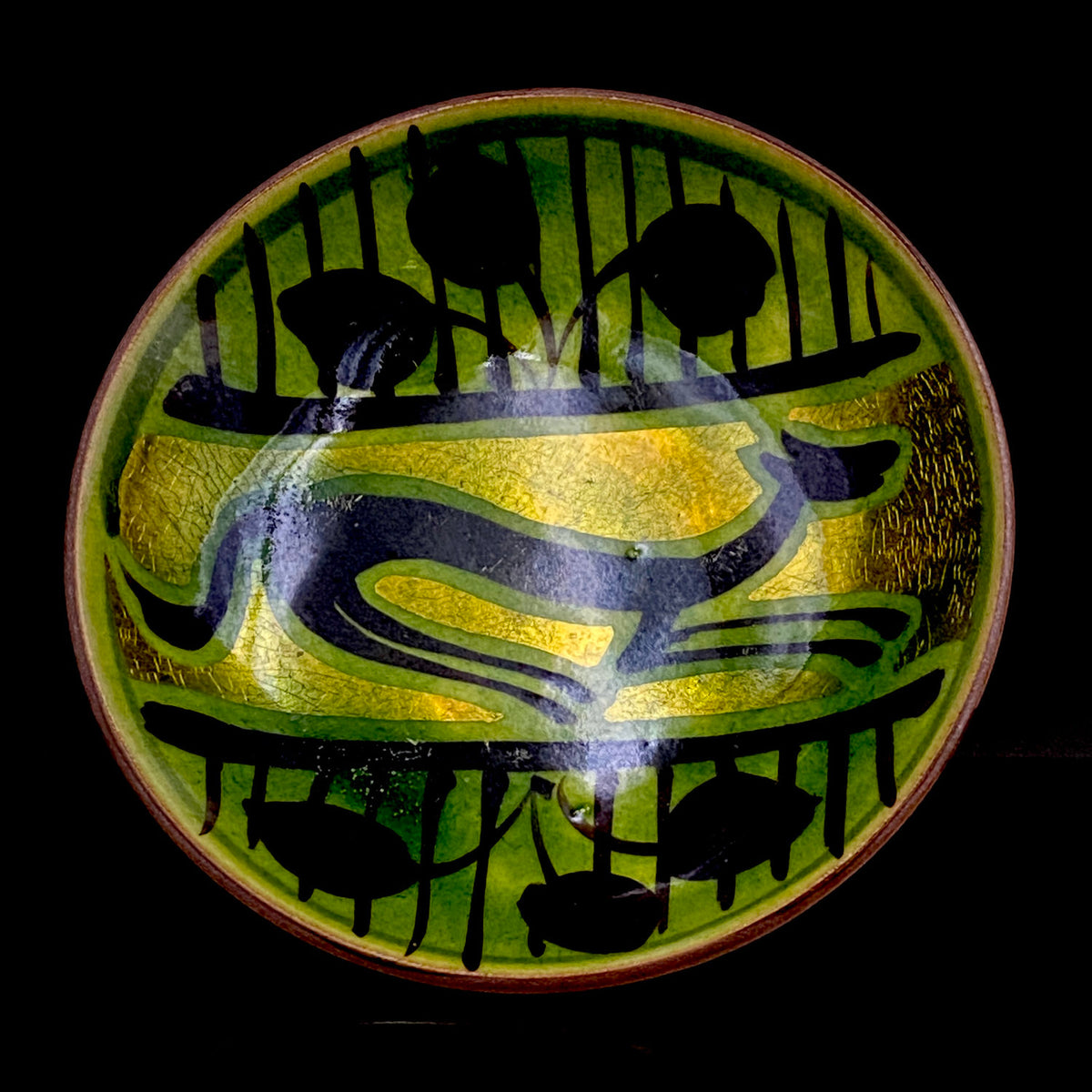
Our flat cup with gold, green and black painting in inlay style by Matsumoto Saichi (松本佐一) is a Kutani cup by an artist who held Ishikawa Prefecture Intangible Cultural Property status and received a special award at the Nitten exhibition. The gold, green and black painting on its flat interior shimmers through the surface when sake is poured, and reappears each time you drain the cup. The flat cup may be the shape that offers the greatest “pleasure of looking”, letting you enjoy the painting of the vessel and the colour of the drink at the same time.
With its wide mouth, a flat cup spills easily if filled to the brim. Pour to about seventy per cent full and hold it from below with both hands, and you can savour the drink calmly while admiring the vessel. Since the shape lets aroma spread readily, it also pairs well with sake with a lavish ginjo aroma, or with a light malt with notes of citrus.
The stem cup — a dignified presence on a tall foot
A bajohai is a tall vessel with a cup set on a long stem (foot). Its name, “cup on horseback”, is said to come from a shape that allowed one to hold it and drink even while riding; the form originated in China and was transmitted to Japan. Because you hold the stem between your fingers, the warmth of your hand passes less readily to the liquid, so it keeps chilled drinks cool.
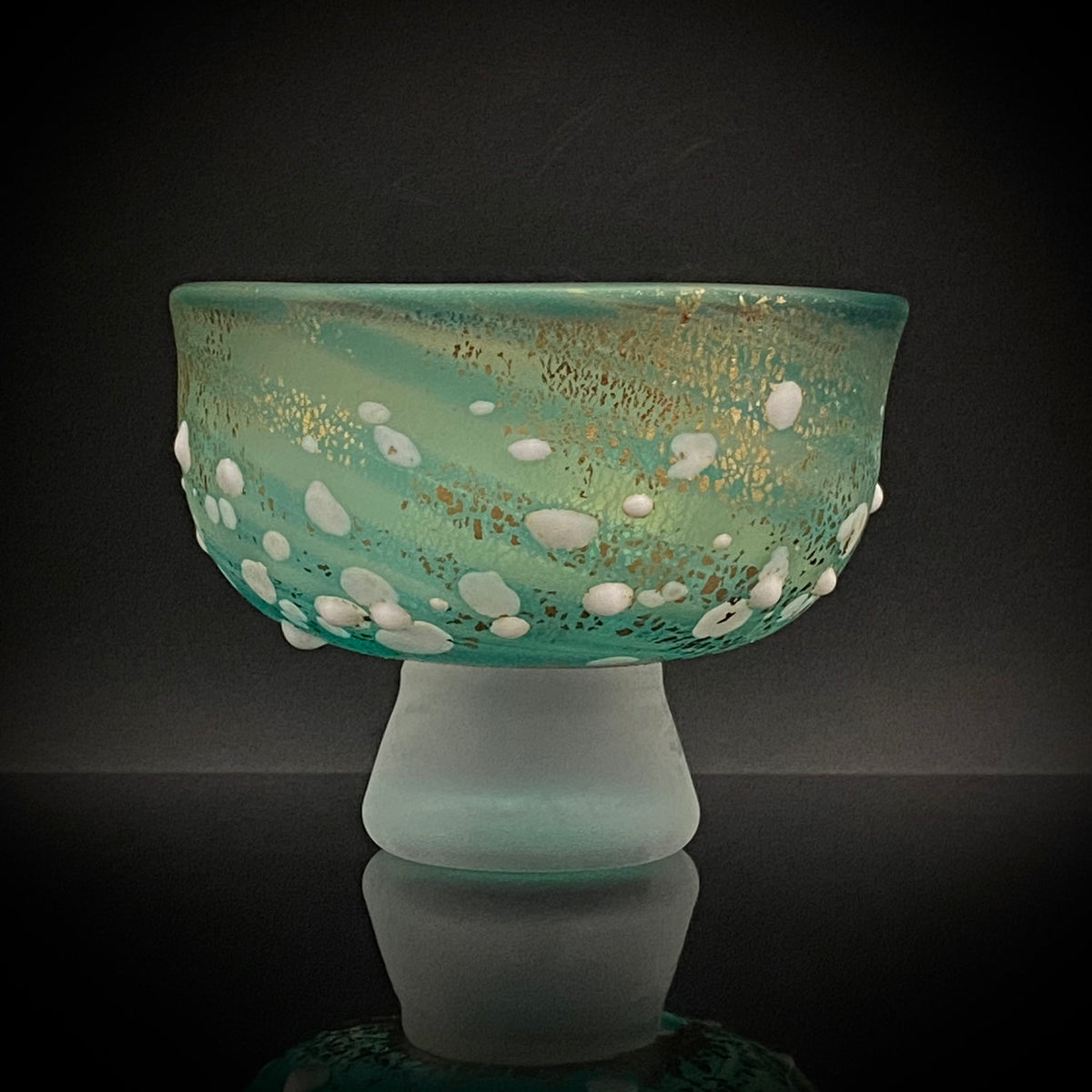
We have several stem cups by Okawa Kaoru (大川薫), made at Hokuyo Glass, the maker of Tsugaru Vidro. #484 in frosted blue-green glass scattered with gold-tone foil and white dots, #471 with applied glass beads, and #485 in milky-white glass with blue dots let you enjoy differences of colour and pattern among stem cups by the same artist. Their soft frosted surface sits comfortably in the hand, and they are well suited to slowly savouring chilled sake, or whisky chilled without ice.
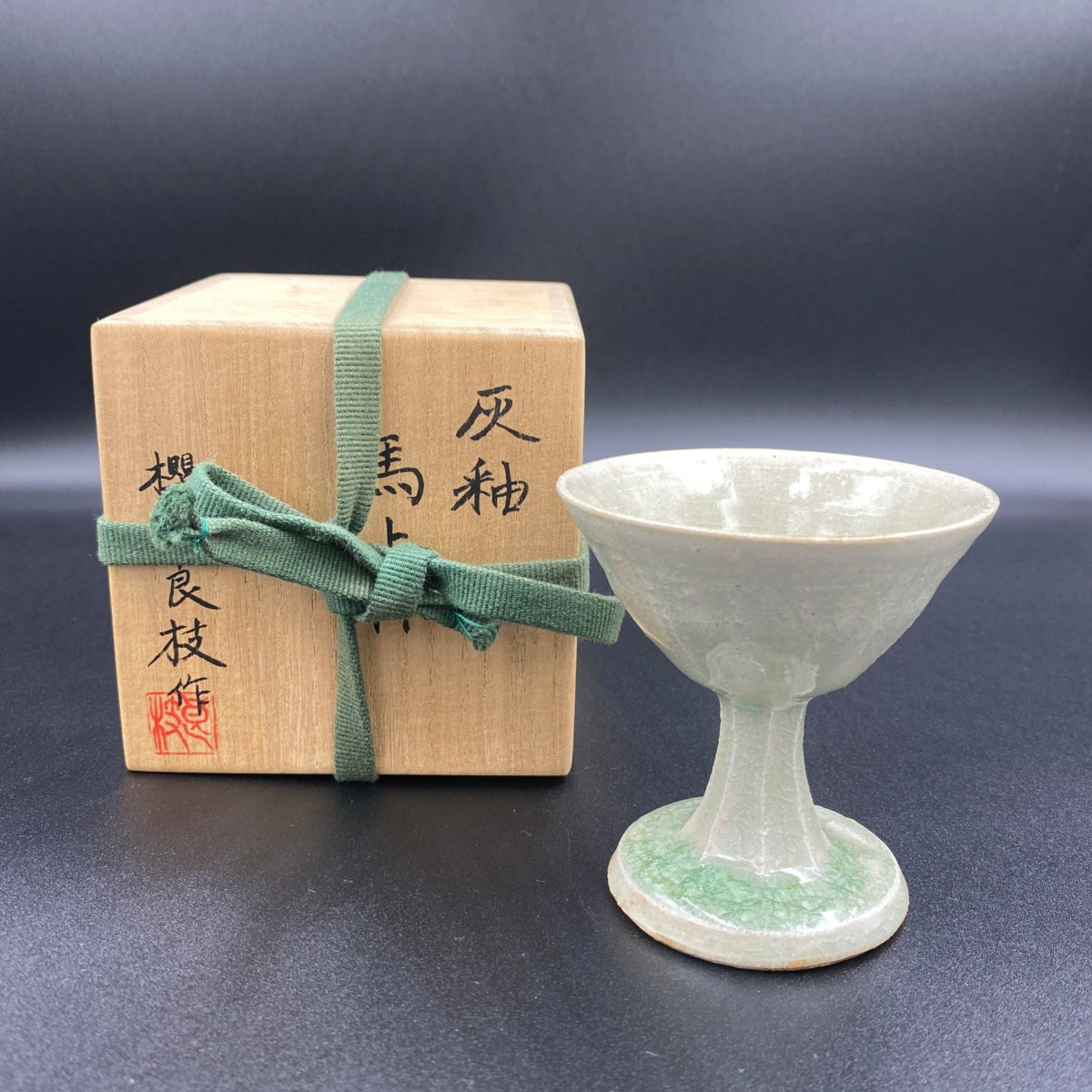
There are ceramic stem cups too. The ash-glazed stem cup by Sakurai Yoshie (櫻井良枝) has a warmth that comes from the gentle tones of its ash glaze. The pair of stem cups from the Nanzan Kiln (南山窯) in Arita is an unusual work combining porcelain and glass, adding a touch of glamour to drinks for two.
The footed cup — stability and grace
A kodai-hai is a cup with a sturdy foot ring (the base of the vessel). Its foot is not as tall as a stem cup's, but it lifts the vessel and gives it a dignified presence on the table. It feels stable in the hand, and is a shape that can be used widely, from ceremonial occasions to the everyday evening drink.
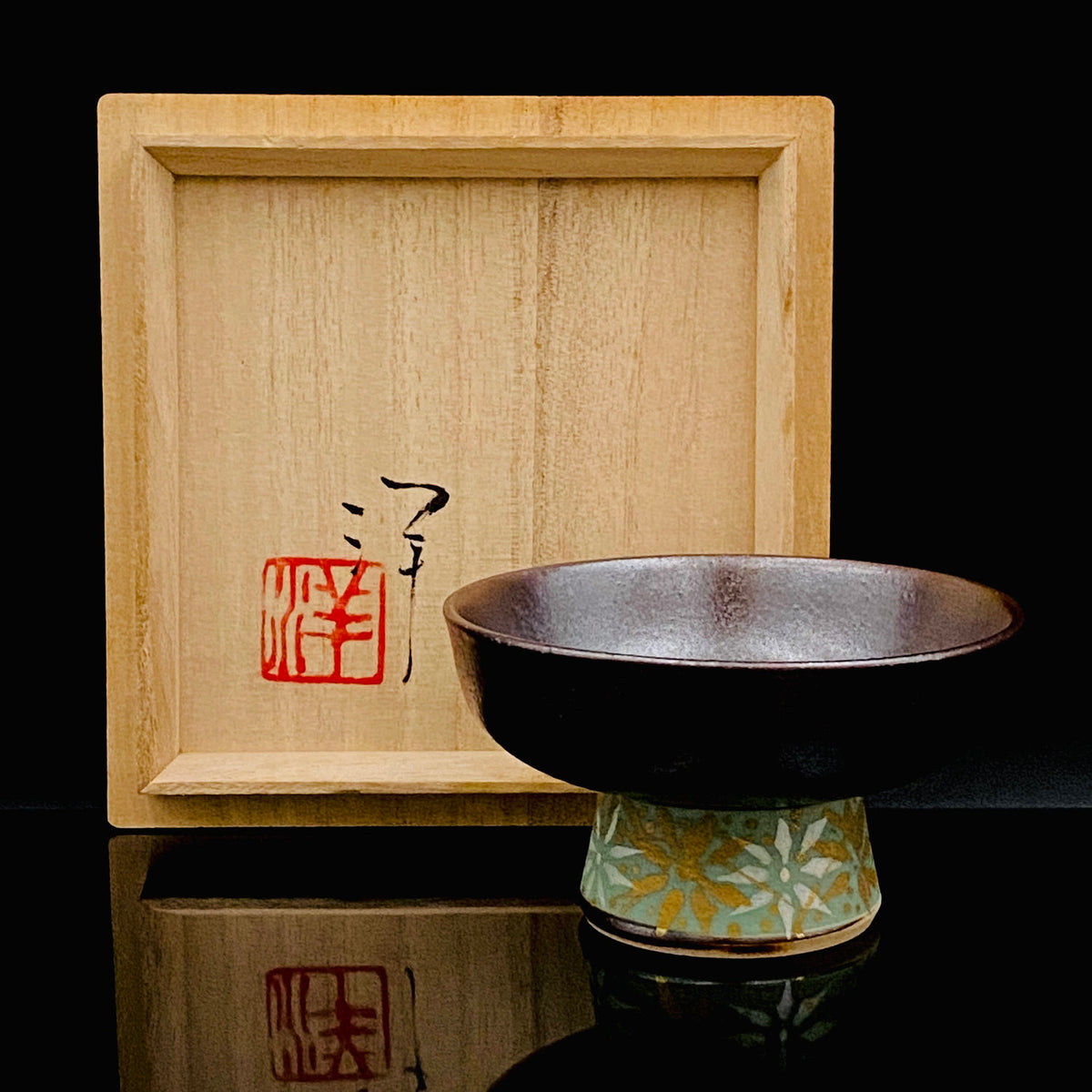
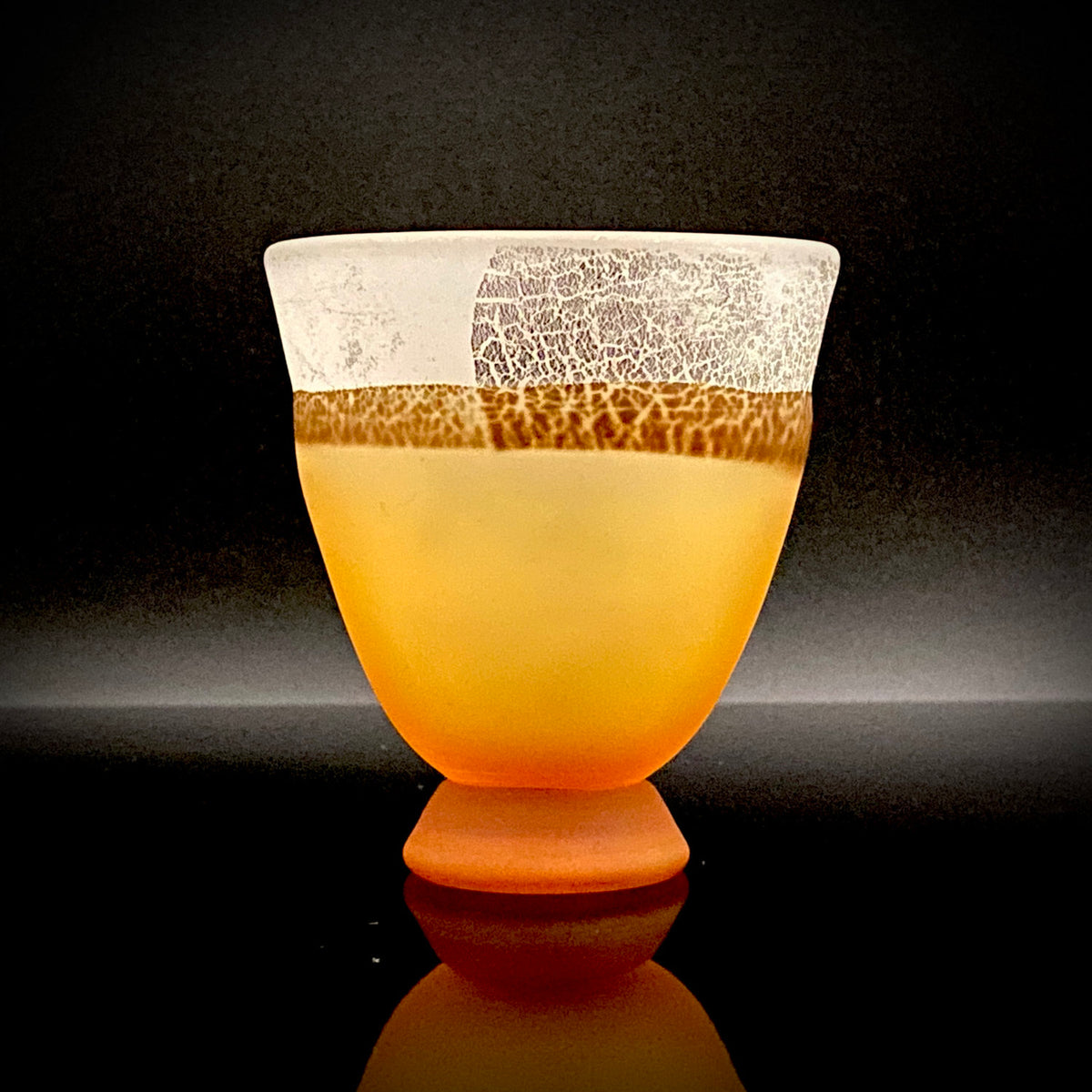
The Suisaka-de footed cup with round-window design in overglaze enamels and gold by Kawashima Hiroshi (河島洋), a certified traditional craftsman of Kutani ware who studied under Tokuda Yasokichi III, is a splendid work with enamels and gold set within round windows. Inside the foot is a mark that can be read as “洋” (Hiroshi), and the lid of its tomobako (artist-signed box) bears the ink inscriptions “吸坂手” (Suisaka-de) and “盃” (cup). In glass, the frosted amber glass footed cup with silver-tone and brown-tone foil by Okawa Kaoru has a colour that resonates with amber whisky, making a neat pour something special.
In addition, the set of three cups from the Mumyoi Jozan Kohei Kiln on Sado Island — the kiln of the family into which Living National Treasure Miura Koheiji was born — combines footed and cylindrical cups. Each cup is stamped on the base with the kiln mark “小平” (Kohei). Cups from the same kiln let you check how the shape alone changes the drinking experience, making this an ideal set for learning about shapes.
The cylindrical cup — aroma rising straight up
A cylindrical vessel has a mouth and base of almost the same diameter, and is relatively tall. With a narrow surface and some depth, it lets the aroma rise straight up, and the temperature changes little. A small cylindrical cup is good for examining aroma closely, while a large tsutsu-chawan (cylindrical tea bowl) also serves as a glass for whisky on the rocks or a highball.
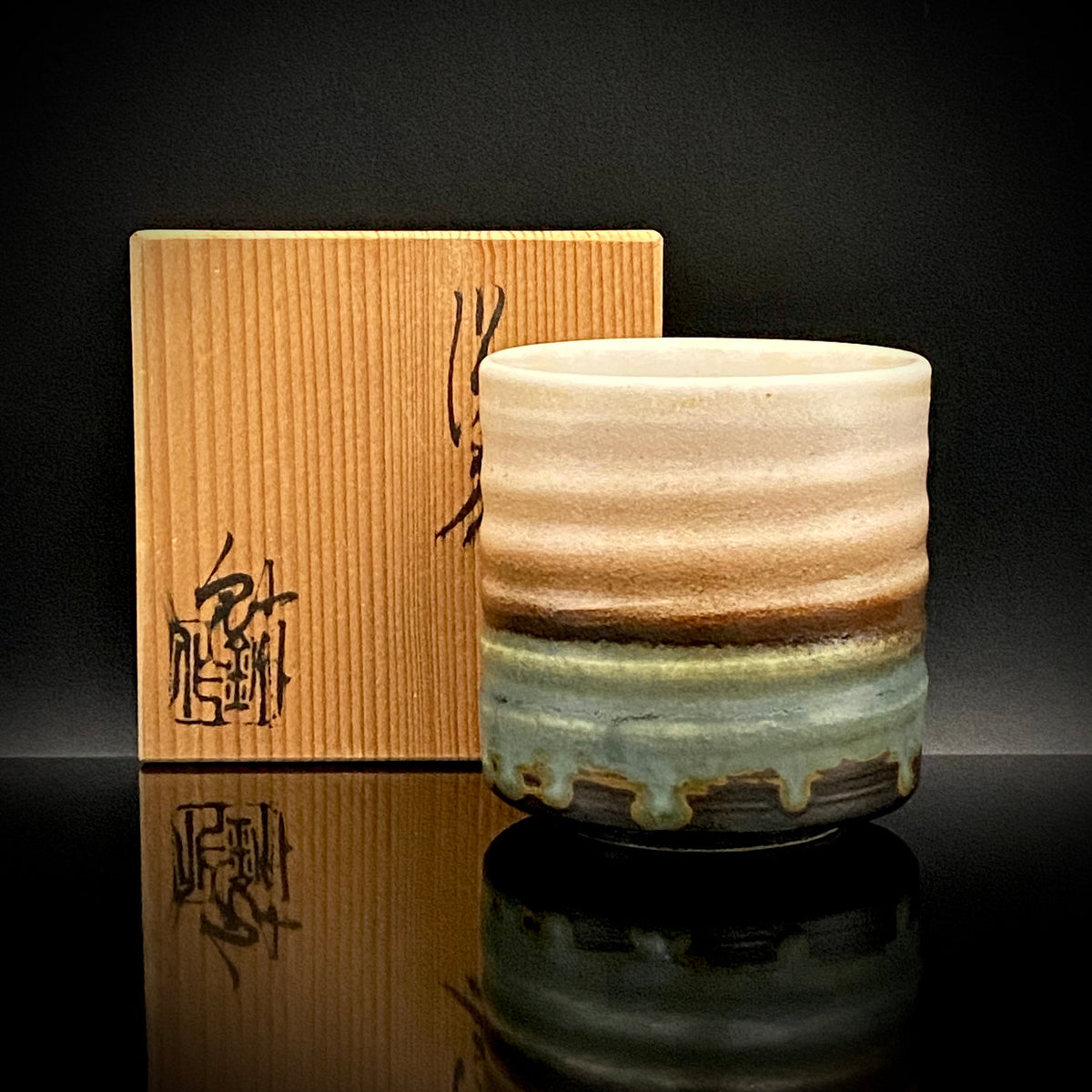
The Oribe cylindrical tea bowl with slip decoration by Kato Sho (加藤釥), a master of Seto ware, is a powerful cylindrical work with the green of Oribe glaze and the landscape of its slip decoration. Add ice and pour whisky, and the contrast between the green glaze and the amber is beautiful, while the aroma rises gently. Among cylindrical pieces, the iron-brushed hakeme cylindrical tea bowl by Kano Mitsuo (叶光夫), whose work is in the collection of the Museum of Fine Arts, Boston, is appealing for the vigour of its brushwork, and the shinyote cylindrical tea bowl by Isomi Tadashi (磯見忠司) of Noto for the calm expression of its clay — showing how much the impression of the same cylindrical form varies with the maker.
The guinomi — a satisfying presence that fits in the palm
A guinomi is deeper and larger than a sakazuki, a shape you can cradle in your palm. It holds more at a time, and the vessel itself has a stronger presence, so it can be called the drinking vessel in which an artist's individuality shows most readily. It suits not only sake but also neat whisky and shochu.
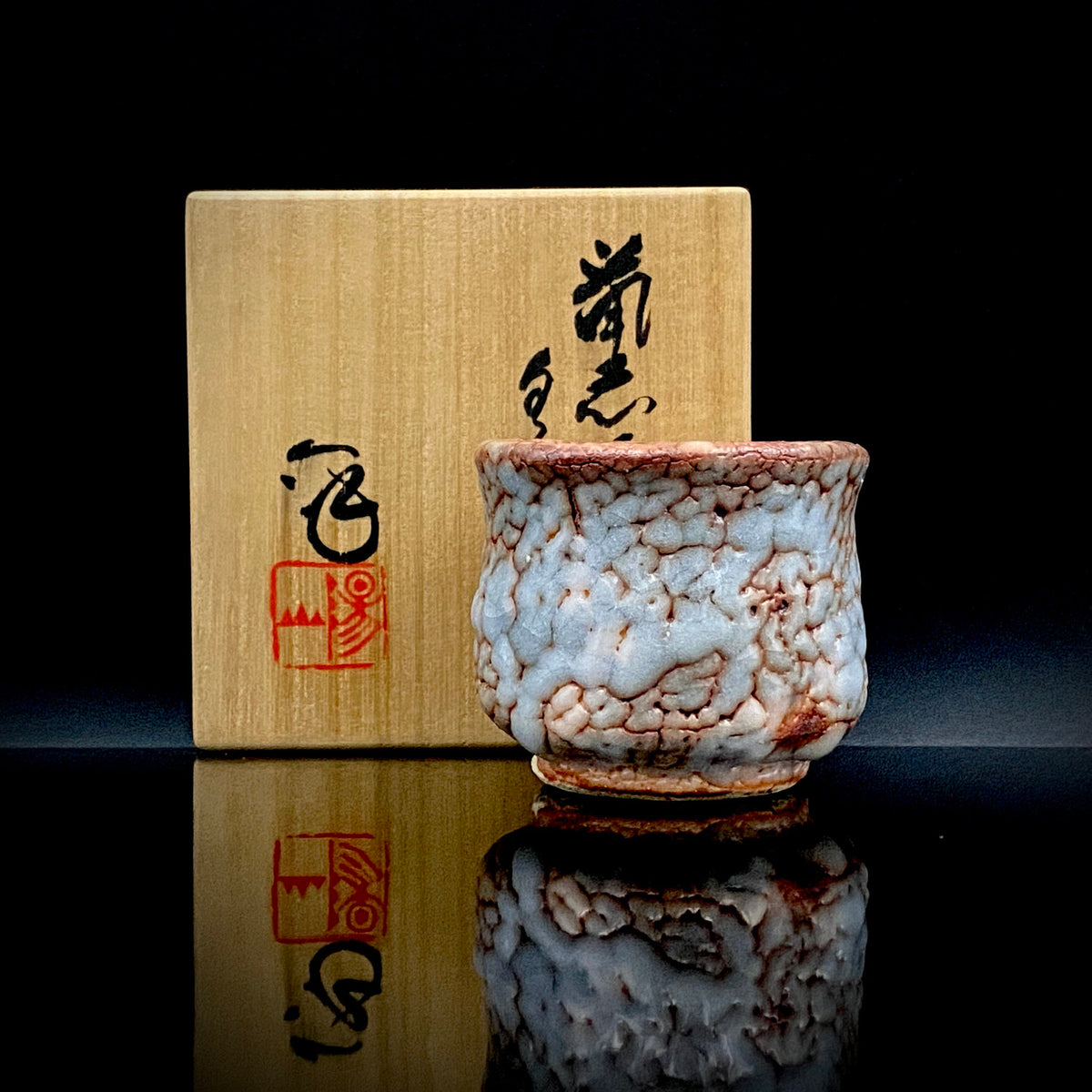
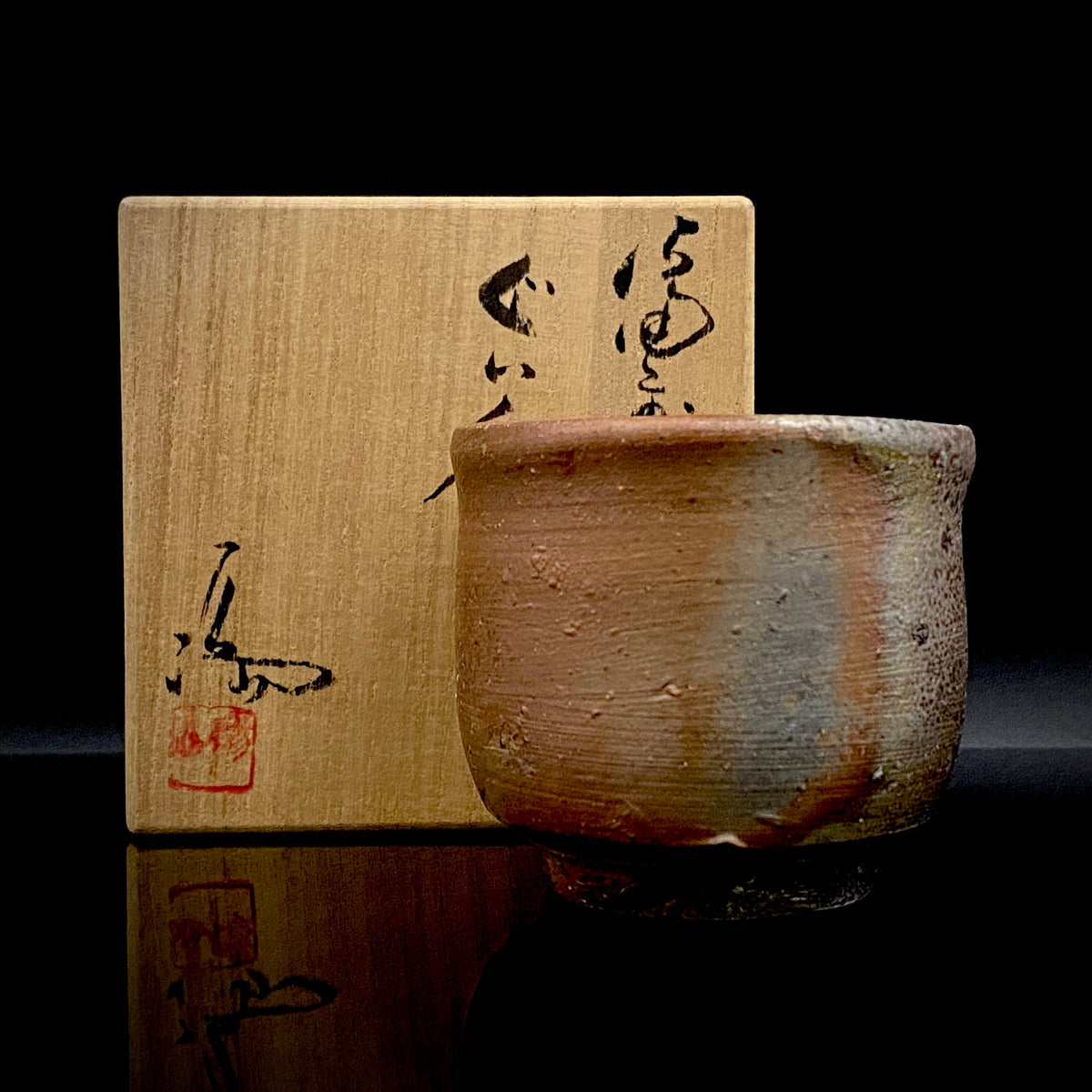
From Mino ware, we introduce the Nezumi-Shino guinomi by Mizuno Takuzo (水野澤三), holder of Toki City Intangible Cultural Property status. In Nezumi-Shino (grey Shino), white patterns emerge from a mouse-grey ground, and the plump Shino surface softens the feel on the lips. In Bizen ware, the guinomi by Isezaki Mitsuru (伊勢崎満) has powerful kiln effects and goma ash glaze from anagama firing, and its unglazed yakishime surface makes the drink feel rounder. In glass, the large hand-blown glass guinomi by Fujita Jun (藤田潤) lets you enjoy the colour of your drink through its transparent body.
Vessels beyond the categories of shape
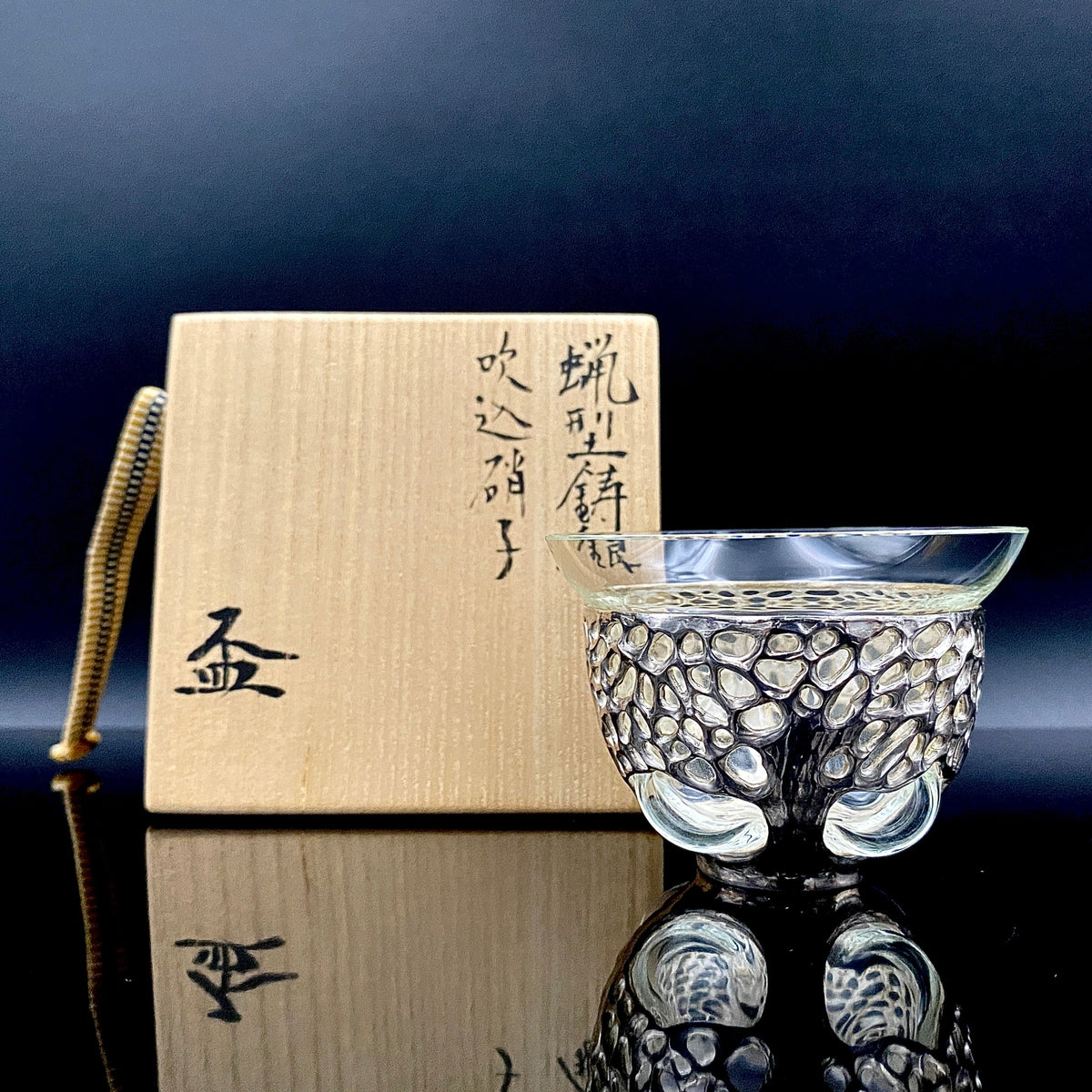
Among artist-made drinking vessels there are also works of original form that do not fit the categories introduced so far. The lost-wax cast silver and blown glass cup “Ginju” (Silver Tree) by Living National Treasure Kitamura Shinichi (北村眞一) is a work in which glass was blown into a silver vessel made by lost-wax casting: two different materials, metal and glass, meet within a single cup. A vessel in which the weight of metal and the transparency of glass coexist feels special the moment you pick it up.
The polychrome flower-and-bird stem cup by Mitsui Tamekichi III (三代 三ッ井為吉) in Kutani ware applies polychrome flowers and birds to the traditional stem-cup form, and is designed as a vessel that can also be used for tasting Western spirits. And “Sanpai”, in which Sodeisha artists took on the challenge of the tiniest of vessels, is a set that might be called an experiment in form, showing what the standard-bearers of avant-garde ceramics attempted to express in a vessel as small as a sake cup.
Shape and gesture — how to hold the vessel
The shape of a drinking vessel is closely tied to the gestures of holding and drinking. A flat cup is stable when supported from below with both hands, letting you admire the interior as you drink. Hold a stem cup by pinching the stem between thumb and forefinger, and the warmth of your hand passes less to the drink, making for a graceful, upright gesture. Hold a footed cup with your fingers against the foot, and the vessel's centre of gravity settles in your hand so you can bring it steadily to your lips. Cradle a guinomi in your whole palm, and you can feel its weight and surface texture as you drink.
The gestures that arise naturally when you take a vessel in your hand are another of the pleasures of drinking vessels. Using vessels of different shapes brings small changes and richness to your everyday evening drink.
What the details of shape change
Besides the overall shape, differences in detail also affect the taste.
- Thickness of the rim: a thin rim lets the drink slip into the mouth, giving a crisp impression. A thick rim feels soft on the lips, giving a fuller impression.
- Narrowing of the mouth: a vessel that narrows at the mouth gathers the aroma, while an open one spreads it. Choose a narrowing vessel to examine the aroma, and an open one to enjoy the drink lightly.
- Depth of the interior: a deep vessel keeps the temperature steady, while a shallow one lets it change easily. Deeper suits warm sake enjoyed slowly; shallower suits chilled sake enjoyed briskly.
- Weight: a weighty vessel gives a calm impression, a light one an airy impression. The weight in your hand becomes part of the memory of the taste.
- Material and surface: glass, porcelain, stoneware, yakishime, metal — the material and surface texture change the temperature and sensation when the vessel touches your lips.
Choosing by drink
| Drink and serve | Recommended shapes | Why |
|---|---|---|
| Chilled sake | Flat cup, stem cup (glass, porcelain) | Keeps the drink cool, for a crisp impression |
| Warm sake | Guinomi, cylindrical cup (stoneware, yakishime) | Holds the warmth, which you feel in your hand |
| Whisky (neat) | Guinomi with a narrowing mouth, footed cup | Gathers the aroma; for tasting small amounts |
| Whisky (on the rocks) | Cylindrical tea bowl, chawan | Takes a large ice cube; the aroma spreads gently |
| Shochu, awamori | Guinomi, cylindrical cup | Lets you savour distinctive aromas |
The character of shapes by region
The shapes of drinking vessels also reflect the clays and techniques of their regions. In Kutani ware, known for overglaze enamels and gold, many flat and footed cups are made to show off the painting, and the patterns on the interior or body take centre stage. In Mino ware, typified by Shino and Oribe, guinomi and cylindrical shapes that display the landscape of thickly applied glazes are favoured, and their plump volume in the hand is part of their appeal.
In Bizen ware, which uses no glaze, shapes of a certain size and three-dimensionality, such as guinomi and tokkuri, are common, to receive the kiln effects and goma created by flame and ash in the kiln. In glassmaking regions such as Tsugaru Vidro, stem cups and footed cups are made to bring out the beauty of coloured glass, and the translucency when held up to the light enhances the appeal of the form. To search by region, the Kutani ware, Mino ware, Bizen ware and Tsugaru Vidro collections are convenient.
The history held in the shapes of drinking vessels
The shapes of drinking vessels mirror the life and culture of their times. The set of three cups used at Shinto rites and weddings is shallow and flat, refined for the ritual of exchanging sake one sip at a time. In kaiseki for the tea ceremony, the cups and tokkuri with which host and guests exchange sake have been chosen according to the theme of each season. And from the modern era onward, as artists began making drinking vessels as personal expression, the guinomi came to be cherished as “art in the palm of the hand”, concentrating an artist's individuality in a small vessel.
Many of the drinking vessels we handle are works by artists of the Showa and Heisei eras. While inheriting traditional shapes, the artists of those times pursued all kinds of experiments within small drinking vessels, such as fusing glass with ceramics or developing new glaze effects. Pick up a vessel with the history of its shape in mind, and you can see where its maker stood between tradition and innovation.
The pleasure of collecting different shapes by the same artist
One way of enjoying drinking vessels is to collect different shapes by the same artist. Line up a flat cup and a guinomi, or a stem cup and a footed cup, by the same maker, and you can see what ingenuity that artist brought to each shape. The way the glaze is applied, the finish of the rim, the trimming of the foot — noticing the variety of expression within a single artist also trains your eye for vessels.
We have collection pages for each maker with several works. For example, the Okawa Kaoru collection gathers stem cups, footed cups and tokkuri by this artist in one place. When you find an artist you like, follow their works from All Makers & Studios.
Points to check before you buy
- Dimensions: check the height and mouth diameter, and compare them with vessels you already own. For a guinomi, a mouth of around 6–8cm is a good guide to a size that sits comfortably in the hand.
- Photo angles: photographs from directly to the side show the shape and the foot; photographs from directly above show the interior.
- Condition: chips or cracks on the rim and the presence of crackle are recorded under “Note”. Some pieces sold as-is can be enjoyed as a basis for kintsugi repair.
- Accessories: whether a tomobako or shiori (leaflet) is included is shown under “Accessories”.
Our suggestion — a comparative tasting across shapes
The best way to experience how shape makes a difference is to pour the same drink into vessels of different shapes and compare. Even among works by the same Okawa Kaoru, for example, the stem cup and the footed cup differ in mouthfeel and in how the aroma rises. Some works, like the set of three cups from the Kohei Kiln, include cups of different shapes within a single set.
Choose one favourite bottle and line up two or three cups of different shapes. A drink that shows a new face every time the vessel changes, and a vessel whose presence grows in your hand: enjoying both is the true delight of artist-made drinking vessels.
Summary — know the shapes, and choosing vessels becomes freer
The flat cup spreads the aroma and lets you admire the colour; the stem cup keeps the drink cool with a dignified bearing; the footed cup offers stability and grace; the cylindrical cup sends the aroma rising; and the guinomi gives a satisfying presence that fits in the palm. No shape is the right one: choosing a vessel to suit the day's drink and your mood is the real secret of enjoying drinking vessels. We hope you will find among our vessels a shape to keep you company at your evening drink.
Frequently asked questions
Q. Which shape do you recommend for a first cup?
A guinomi that fits in the palm is easy to use for both sake and whisky. Choose one with a slightly narrowing mouth, and you can enjoy the aroma as well.
Q. Can glass vessels be used for warm sake?
Hand-blown glass that is not heat-resistant can crack with sudden changes in temperature. For warm sake, we recommend stoneware or porcelain vessels.
Q. Where can I check the size of a vessel?
The height and mouth diameter are given under “Dimensions” on each product page. Please compare them with vessels you own when choosing.
Browse drinking vessels in ceramic cups and glasses and art glass cups and glasses, or by maker in All Makers & Studios.