Crafted by Shigeo Kojima (born 1950 in Ashikaga City, Tochigi Prefecture), a ceramic artist who developed his pottery practice based in Mashiko, this is a matcha bowl featuring banded clay slip decoration. After undergoing training at Mashiko Toen and Tsuboya in Okinawa, Shigeo Kojima studied directly under Shoji Kamoda—a legendary giant of 20th-century Japanese ceramics—in Tono, Iwate Prefecture, in 1978. Possessing a fierce creative ethos of "completely denying his own style every six months and never repeating a past approach," Shoji Kamoda pursued meticulous clay slip techniques that admitted no division of labor. Coupled with his withdrawal from society when he relinquished his status in the Japan Art Crafts Association in 1969 to seclude himself in the wilderness of Tono, it was inherently impossible for him to teach techniques to disciples as repeatable patterns. Consequently, only a minuscule number of potters throughout ceramic history were ever able to study under Kamoda directly. Studying directly during that arduous Tono era, Shigeo Kojima was one of the few orthodox successors to receive the true essence of Kamoda's almost fanatical sculptural aesthetic and advanced ceramic techniques rather than mere stylistic imitation. As a figure carrying forward the lineage of Kamoda—one of the greatest potters of the 20th century—his style and achievements are deeply recorded and preserved in the ceramic history archives and regional collections of Mashiko Town. After establishing an independent kiln in Mashiko in 1980, he steadfastly maintained the rigorous manual artistry inherited from his master, refusing any mass production in favor of fully handcrafted, end-to-end creation. As a result, his lifetime output remains exceedingly small, with opportunities for his works to circulate in the market being exceptionally rare. In particular, works from his peak period—marked by three selections for the Asahi Ceramic Art Exhibition (1984, 1986, and 1987), a gateway for modern ceramic art—as well as his matcha bowls produced in limited numbers, are masterpieces of extraordinarily high rarity that are extremely difficult to acquire. Our shop presents this bowl, endowed with modern sculptural beauty reminiscent of earth-toned geological strata, to the global market not only as a vessel for enjoying traditional tea preparation, but also as a vintage rocks glass (Japanese free cup) for luxuriously savoring aged sake or matured whisky over large ice cubes.
Shigeo Kojima's representative artistic style lies in fusing the rustic clay character and dynamic handwork cultivated in Mashiko and Tsuboya, Okinawa, with the essence of Kamoda ceramics: hand-carving, faceting, incised motifs, and advanced clay slip (deisai) techniques layering different colors of colored engobes. Observing the details of this piece highlights the abstract sculptural expressions and specialized coloring techniques that vividly reflect the aesthetic of Shoji Kamoda's "Tono Period." Around the outer circumference of the body, a layered clay slip decoration featuring natural earth tones—such as black slip, beige, and gray—boldly overlaid in multiple bands creates a beautiful, sculptural color composition evocative of geological strata and natural landscapes. On the other hand, the inner well (mikomi) is coated with a deep emerald-green vitreous glaze, creating a whimsical landscape where a web-like black pattern emerges from fine crackles and contraction differences during firing. From the lower body down to the base, the unglazed raw clay exposes a rustic soil texture, while a distinct seal impression unique to Shigeo Kojima is clearly stamped inside the foot ring, certifying it as an authentic work.
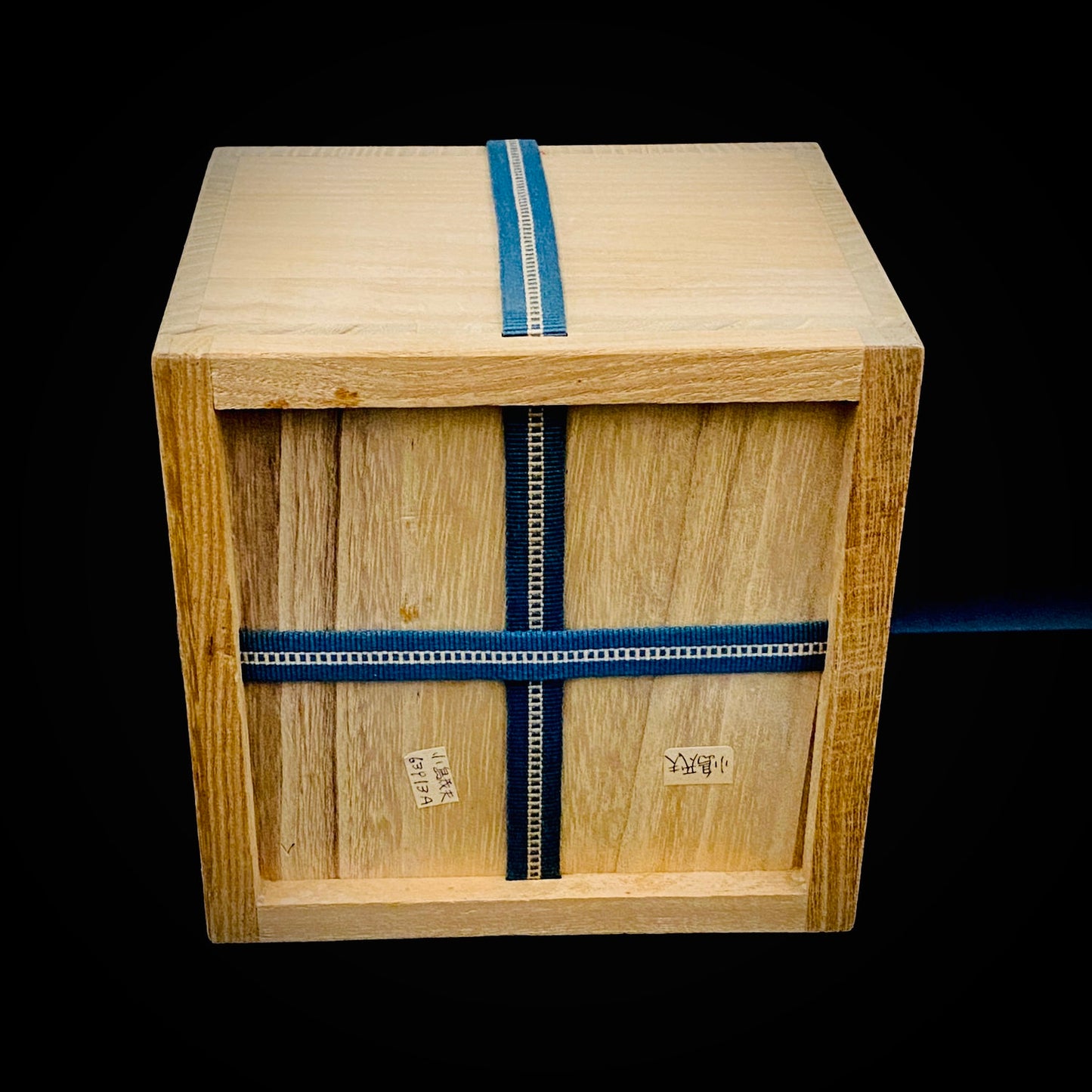
Regarding the period of production, taking the biography in the accompanying brochure—which concludes with his selection for the Asahi Ceramic Art Exhibition in Showa 62 (1987)—as a decisive clue, it is estimated to be a work created between 1987 and circa 1992 (Showa 62 to early Heisei period), his peak era when his artistic style matured and he achieved consecutive selections for the Asahi Exhibition. The vessel itself has no cracks or chips, maintaining extremely good condition in its layered slip textures and glaze coloration in the inner well. It arrives in complete condition, accompanied by its dedicated Tomobako (wooden box) boldly inscribed on the lid with "Chawan" in ink and signed "Shigeo" with a seal stamped on the lower left, alongside a brochure recording his career up to 1987.
- Artist: Shigeo Kojima (born. 1950)
- Artist's Key Activities: [1978] Studied under Shoji Kamoda in Tono, Iwate Prefecture; [1980] Established an independent kiln in Mashiko; [1984, 1986, 1987] Selected for the Asahi Ceramic Art Exhibition, etc.
- Works Housed In: Mashiko Museum of Ceramic Art / Regional Cultural Archives, Private Connoisseur Collections, etc.
- Period of Production: Circa 1987–1992 (Estimated)
- Condition: Very good (no chips, no cracks)
- Accessories: Dedicated Tomobako, brochure included
- Material: Ceramic (Mashiko ware, banded clay slip, polychrome glazes, hand-carved, stamped seal)
- Dimensions: Height approx. 8.5 cm, Width (mouth diameter) approx. 11.5 cm
- Caution: All products offered by our shop are pre-owned items due to their historical production period, even if unused. Products may have age-related damage, so please consider purchasing after understanding and verifying these condition details.