When we first lifted this cup from its box, what stayed in the hand was the feel of the grains in the clay. Small white grains rise all over the round, full body, and a greenish-gray glaze gathers over them in islands. This is a cup by Inoue Takeo (井上猛雄, b. 1950), a potter who works in a studio on the shore of Lake Inba (Inba-numa) in Chiba Prefecture, Japan. The lid of the tomobako simply says “カップ” (cup). Taking as our guide what the artist wrote about clay and kilns in a published paper, we look at the cup in the order a collector examines a piece, and then suggest how to enjoy it as a vessel for Western spirits.
Inoue Takeo was born in 1950 in Asahikawa, Hokkaido, and learned the basics of ceramics under the potter Kamiya Norio (神谷紀雄), who was born into a family running a Mashiko ware kiln and works in Chiba City. From the studio by Lake Inba, Inoue has made a wide range of work in ceramics, from flower vases and vessels to sculptural objects and ceramic murals. In 2018, the artist published the paper “Process of Making Pottery through my works” (やきもの制作の過程 ―自作をもとに―) in the Bulletin of the Faculty of Education, Chiba University (the artist’s affiliation at the time was the Faculty of Education, Chiba University). The paper records in detail, through the artist’s own works, how themes are chosen and which materials, techniques and processes are used. The same issue also carries a co-authored paper on practical ceramics classes in a teacher-training course. Inoue’s work was shown in 1989 in “Today’s Clay Work: Various Forms of ‘Earth’” (今日のクレイ・ワーク展 ―さまざまな「土」のかたち―) at the Kanagawa Prefectural Civic Hall Gallery, and in 1992 the artist was one of five potters featured in volume 58 (Tokyo 1) of Toh: The Best Selections of Contemporary Ceramics in Japan, published by Kyoto Shoin. In 2015, Inoue held a solo exhibition at Gallery Mutsu in Chiba City, showing works such as “Doma” (土間, an earthen floor cast from the floor of the artist’s workshop and fired), “Twisting Form” and “Form that Draws Close.”
According to the paper, Inoue prepares the clay personally. The base is “tōban clay” (陶板土, a clay rich in silica and feldspar that fires to a whitish color) and “Shigaraki red clay” (信楽赤土, rich in iron and firing red), with kibushi clay (木節粘土, a sedimentary clay) added. After the bisque firing, the pieces are coated with glaze or with “fubasami,” said to be a natural alumina, before the main firing. For kilns, the artist uses both a kerosene kiln and a climbing kiln (noborigama) fired with wood and kerosene. The artist also names “something that could only be made in ceramics” as what matters most in making work, and writes of pursuing the interest of the thickness of the clay, of composition and of structure.
Now let us look at the cup in the order a collector examines a piece. First, its overall form. The body swells into a round shape and, toward the rim, rises with a slight inward turn, as if holding something in. The rim diameter is about 8.2 to 8.5 cm, so the mouth is very slightly oval. The handle is a loop made from a coil of clay that is round in section. It springs outward from the rim in a wide arc and returns to the lower part of the body. In the artist’s kiseto cup (#522), the wall of the body itself became a plate-like handle; this cup is made quite differently, with a ring of clay attached to the body. With one finger passed through the loop, the weight of the cup settles easily in the hand.
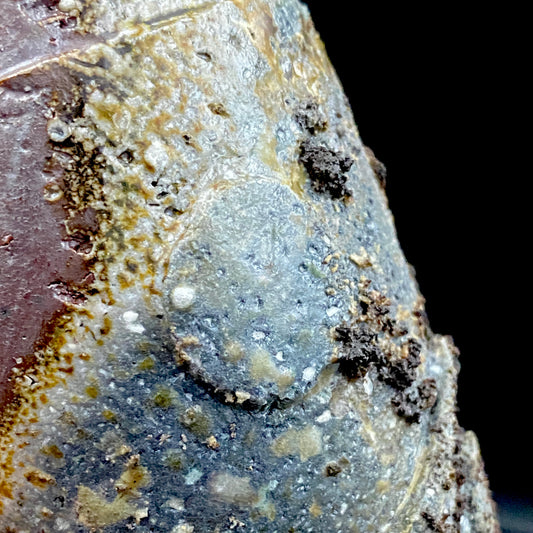
Next, the body. Over a reddish-brown clay surface, a glassy, greenish-gray glaze has gathered into islands, as if it had crawled, and the red of the clay shows through the gaps. The glaze is thickest on the upper half of the body, and toward the foot the reddish-brown clay shows more and more. White and gray grains stand out over the whole surface, and the cup feels rough under the fingers. These grains appear to come from the clay rich in silica and feldspar described in the paper. The name of the glaze is not written on the tomobako, so our shop gives it no name here and describes it simply as it appears.
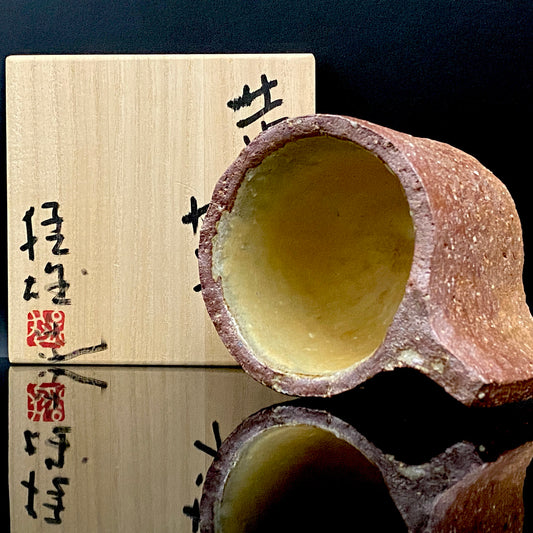
Then, the inside and the rim. The inside is covered from rim to base with an olive glaze with a yellowish cast. Fine crazing runs through the glaze. At the center of the well, the glaze has pooled into a whitish, transparent glassy pool that holds small bubbles. At the rim the glaze thins and turns more yellow, so that it looks like a narrow border joining the gray-green outside and the olive inside.
The handle carries the same glaze, but on the inner side of the loop the glaze is thin, and the orange color of the clay appears in stripes. Finally, the base. The base is flat and unglazed, and a whitish layer remains in patches over the red clay. No potter’s seal or incised signature can be found on the cup itself. The maker is identified by the signature and red seal on the lid of the tomobako.
Our shop proposes this cup as a vessel for Western spirits, for savoring brandy and other aged spirits slowly. Like a brandy glass, the round, full body and the slightly inturned rim tend to keep the aroma inside the cup. Pour a small measure of Calvados or aged rum, hook a finger through the loop handle and begin with the aroma: in our view, this is the way of drinking that suits this cup best. On a cold night, it also suits whisky with hot water or a hot toddy; thanks to the handle, the cup is easy to hold even with a warm drink. When pouring something hot, it is a sensible precaution to warm the cup first with lukewarm water. It can also hold a single large piece of ice for whisky on the rocks. After use, wash the cup in lukewarm water and dry it well. Because much of the outside shows bare clay, please avoid long soaking and do not use a dishwasher.
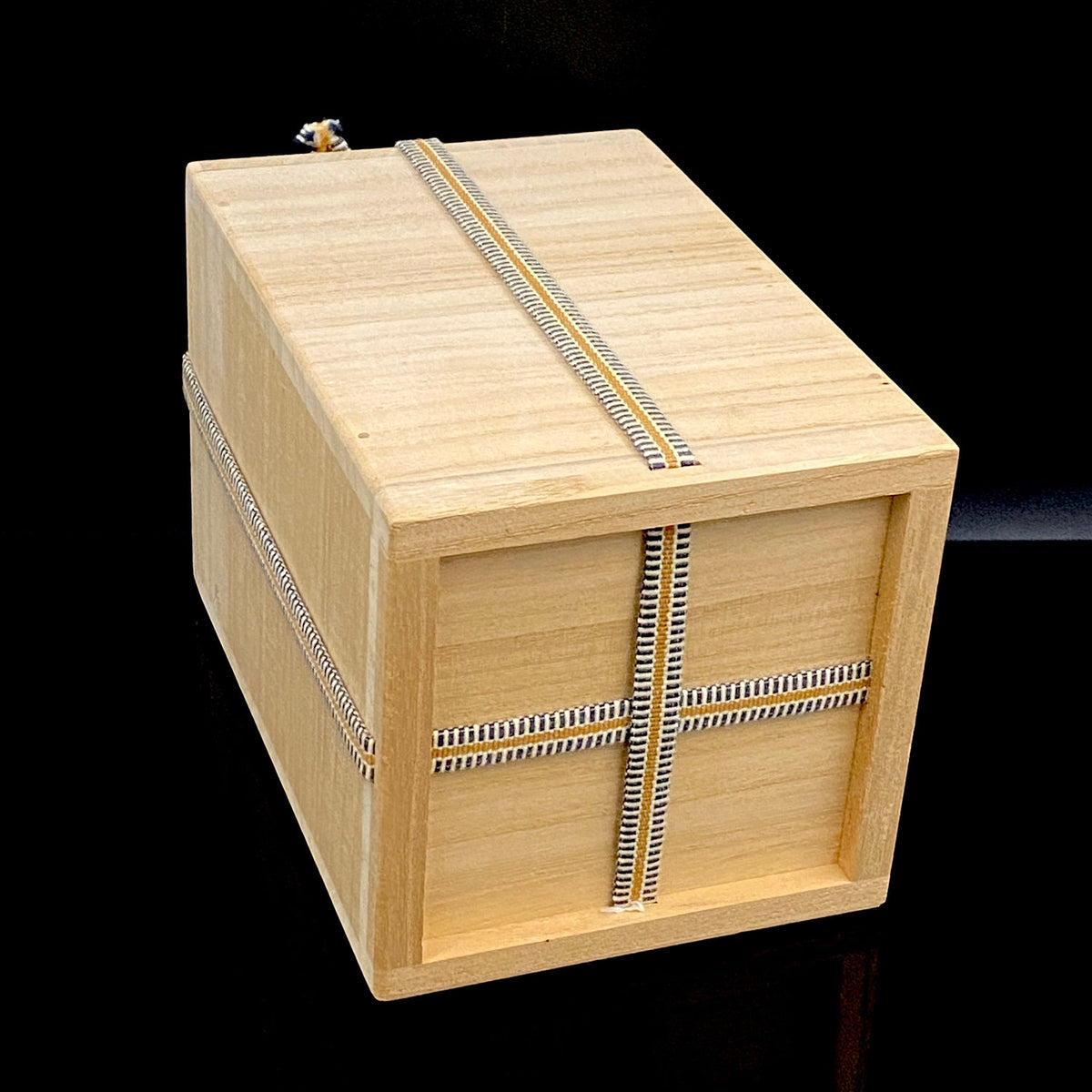
The cup comes with a tomobako (the artist’s own wooden box). The lid of the paulownia box is inscribed in ink “カップ” (cup), with the artist’s signature and a square red seal. The characters of both the signature and the seal are stylized, and as our shop could not read them with certainty, they are not given here. The seal has the same form as the one on the tomobako of #522. The box is tied with a sanada-himo (a flat woven cotton cord). The cup is in very good condition, with no chips or cracks.
- Artist: Inoue Takeo (井上猛雄, b. 1950)
- Career Highlights: [1950] Born in Asahikawa, Hokkaido (later studied the basics of ceramics under Kamiya Norio); [1989] Exhibited in “Today’s Clay Work: Various Forms of ‘Earth’” (Kanagawa Prefectural Civic Hall Gallery); [1992] Featured in Toh: The Best Selections of Contemporary Ceramics in Japan, vol. 58 (Tokyo 1, Kyoto Shoin); [2015] Solo exhibition (Gallery Mutsu, Chiba City); [2018] Paper “Process of Making Pottery through my works” (Bulletin of the Faculty of Education, Chiba University, vol. 66, no. 2)
- Date: 2010s – early 2020s (estimated, on two grounds: the square red seal on the tomobako has the same form as the seal on the tomobako of the artist’s kiseto cup (#522), which is estimated to date from c. 2015 to the early 2020s; and the paulownia tomobako and its cord show almost no soiling or wear from age)
- Condition: Very good (no chips, no cracks). Please regard the crazing that forms in firing, other characteristics of ceramics and the patina of age as part of the pleasure of an antique piece.
- Accompanied by: Tomobako (lid inscribed in ink “カップ” (cup), with signature and red seal)
- Medium: Glazed pottery (glazed inside and out; the reddish-brown clay shows through outside)
- Dimensions: Rim diameter approx. 8.2–8.5 cm, width approx. 12.5 cm (including handle), height approx. 7.3 cm
- Please Note: All items offered by our shop, even those that are new and unused, were produced a very long time ago and are therefore listed as pre-owned. Items may show damage from age, so please understand and review this before considering your purchase.
- About the Photographs: We prepare every description with great care, but errors may still remain in the text. Please examine the photos carefully before purchasing. Where the photos and the description differ, please take the photos as the basis for the product information.





 Mitate Drinking Vessels — Bringing Water Droppers, Tea Bowls and Confectionery Bowls Back into UseThe more beautiful a vessel, the more likely it is to be kept on display as “...
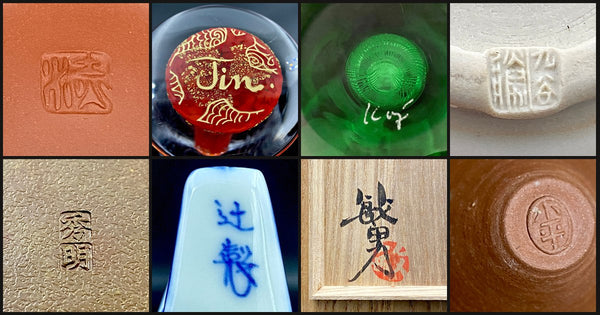 Japanese Pottery Seals, Box Signatures and Marks: A Photo Index of 162 MakersThe seal or incised signature on the base of a piece, and the signature and s...
