Created by Oe Bunsho (大江文象, 1898–1979), a master of Seto ware born in Chita District, Aichi Prefecture in 1898 (Meiji 31) and passed away in 1979 (Showa 54), this is a masterpiece Red Frost-Dappled Glaze Evening Geese Tea Bowl. Oe Bunsho studied Japanese painting under Undo Kotera as a young artist, polishing a delicate eye for sketching and a sense of composition, before studying under Kitaoji Rosanjin—a monumental figure in modern ceramics—to master the essence of ceramic techniques and formal beauty. In addition to being selected nine times in total for the Teiten, Bunten, and Nitten exhibitions, the artist earned numerous selections and awards across various exhibitions, and in 1975, Oe's outstanding skills were recognized when Oe was designated as a Holder of Aichi Prefecture Designated Intangible Cultural Property (Craft Technique: "Kushimemon" Combed Pattern). Oe's works are officially housed and specially purchased by public institutions such as the Aichi Prefectural Ceramic Museum and Seto City. Our shop presents this dignified creation, in which tradition and pictorial sophistication fuse to a high degree, to the global market not only as a tea utensil for whisking matcha, but also as a supreme vintage rocks glass (a Japanese free cup) for slowly savoring aged sake or matured Japanese sake with large ice cubes, enveloped in rich depth and amber radiance over time.
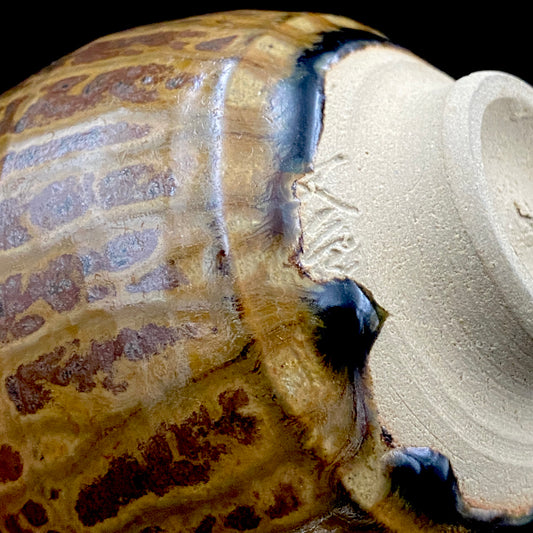
This work expresses at an exceptionally high level the chorie (carved pictorial design) motif originating from Japanese painting—Oe Bunsho’s greatest specialty—alongside the expression of benisobora-yu (red frost-dappled glaze), the culmination of the artist's many years of glaze research. On the surface of the vessel, which possesses an excellent tactile grip measuring approximately 9.2 cm in height and 12.0 cm in diameter, Oe's original red frost-dappled glaze is applied, featuring white crystals scattered like frost across a deep reddish-brown base evocative of an evening sky. On the vessel's exterior, a delicate carved drawing of "YUkari" (Evening Geese) is rendered, depicting geese flying in flocks across the dusk sky. YUkari is a traditional seasonal motif that has symbolized the deepening of autumn, travel sentiment, and refined nostalgia in Japanese waka poetry and Japanese painting since ancient times, brilliantly showcasing the exquisite line carving unique to Bunsho, who was so adept at animal and bird-and-flower designs that the artist was praised as "Bunsho of Quails." A gentle glaze texture spreads inside the interior base (mikomi), while the artist's own seal is firmly incised into the unglazed clay beside the foot ring, demonstrating a splendid harmony between the bold yet refined form taking advantage of the clay's natural character inherited from Rosanjin and the delicate pictorial expression.
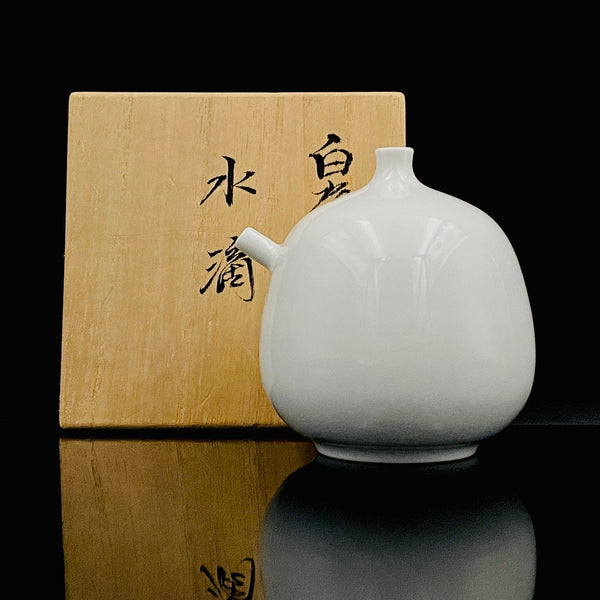
Regarding the period of production, taking clues from the inclusion of "Selected nine times for Teiten, Bunten, Nitten, etc." in the accompanying biography leaflet and the absence of any mention of Oe's Aichi Prefecture Designated Intangible Cultural Property designation (1975), it is identified as an authentic work produced between the 1960s and circa 1974, a mature period when the artist repeatedly won selections at Nitten and perfected Oe's unique red frost-dappled glaze and carved pictorial expression styles. The vessel itself has no chips or cracks, maintaining excellent condition in both glaze coloration and carved drawing preservation. It arrives as a complete masterpiece accompanied by its dedicated Tomobako (wooden box) inscribed in ink on the lid "Red Frost-Dappled Glaze, Evening Geese Tea Cup" with a red seal stamped, along with a biography leaflet.
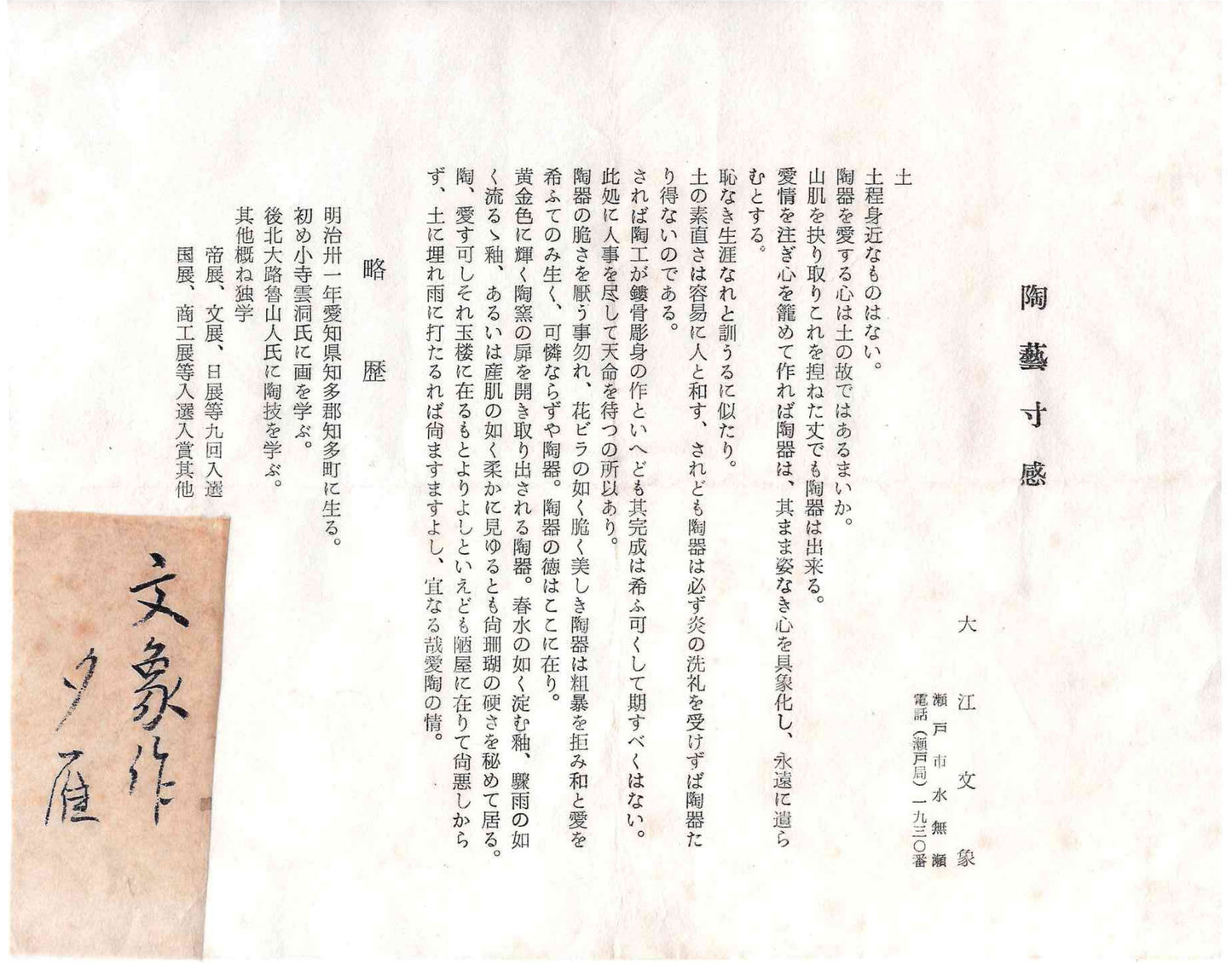
Artist’s Leaflet (Original Text)
Nothing is closer to us than clay.
Is it not because of clay that we come to love ceramics?
Simply scraping earth from a mountainside and kneading it is enough to make a pot.
Yet when a pot is made with affection and with one’s whole heart, it gives form to a heart that has no form, and seeks to endure forever.
It is as if it were teaching us to live a life without shame.
Clay is honest and readily yields to the human hand. But a pot cannot become a pot without first undergoing a baptism of fire.
Thus even a work into which the potter has poured every ounce of effort can only be hoped for, never assured, in its completion.
Herein lies the meaning of the saying, “Do all that you can, then leave the rest to Heaven.”
Do not despise the fragility of ceramics. Fragile and beautiful as flower petals, a pot rejects rough handling and lives only by seeking harmony and love. How endearing it is. Herein lies the virtue of ceramics.
Pots are drawn out when the door of the kiln, glowing gold, is opened. There is glaze that pools as still as spring water, and glaze that runs like a sudden shower. Even where a pot looks as soft as newborn skin, it still holds within it the hardness of coral.
Ceramics are worthy of love. They are of course fine in a splendid mansion, yet no less fine in a humble hut, and buried in the earth and beaten by rain, they become finer still. Small wonder, then, that we love ceramics.
- Artist: Oe Bunsho (大江文象, 1898–1979)
- Artist's Key Activities: [1933] First selected for the 14th Teiten Exhibition (subsequently selected 9 times in total for Teiten, Bunten, Nitten, etc.); [1972] Received the CBC Club Cultural Award; [1975] Designated as a Holder of Aichi Prefecture Designated Intangible Cultural Property (Kushimemon Combed Pattern)
- Public Collections: Aichi Prefectural Museum of Art ("Warizansho Mukozuke," c. 1940), Aichi Prefectural Ceramic Museum, Seto City (Specially Purchased for Permanent Preservation), etc.
- Period of Production: Circa 1960s–1974 (Estimated)
- Condition: Very good (no chips, no cracks)
- Accessories: Dedicated Tomobako, biography leaflet included
- Material: Ceramic (Seto ware, red frost-dappled glaze, carved pictorial design, incised seal)
- Dimensions: Height approx. 9.2 cm, Mouth diameter approx. 12.0 cm
- Caution: All products offered by our shop are pre-owned items due to their historical production period, even if unused. Products may have age-related damage, so please consider purchasing after understanding and verifying these condition details.
- Please check the photos: We prepare every description with great care, but errors may still remain in the text. Please examine the photos carefully before purchasing. Where the photos and the description differ, please take the photos as the basis for the product information.




 Mitate Drinking Vessels — Bringing Water Droppers, Tea Bowls and Confectionery Bowls Back into UseThe more beautiful a vessel, the more likely it is to be kept on display as “...
 Reading Tomobako, Shiori and Signatures — A Guide to Verifying Artist-Made Drinking VesselsThe tomobako box and shiori leaflet that accompany an artist-made drinking ve...
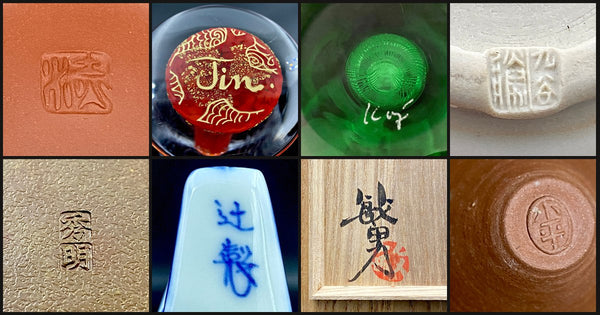 Japanese Pottery Seals, Box Signatures and Marks: A Photo Index of 153 MakersThe seal or incised signature on the base of a piece, and the signature and s...

