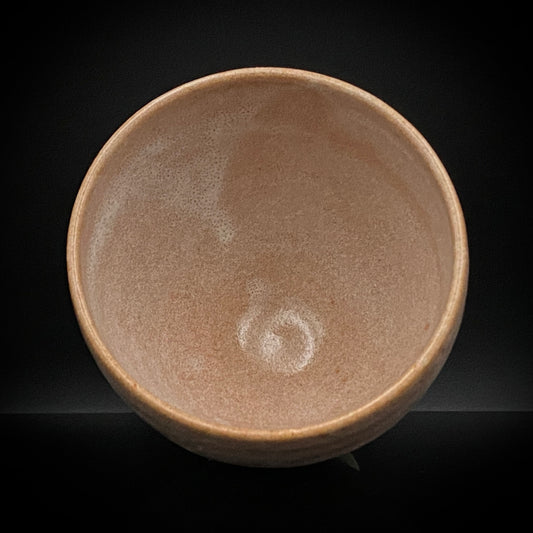
This irabo-glazed tea bowl is by Oe Bunsho (大江文象, 1898–1979), a potter of Seto who was the holder of an Aichi Prefecture Designated Intangible Cultural Property (craft technique: kushime-mon, comb-pattern decoration). The lid of the fitted box (tomobako) bears the inscription "伊羅保釉 茶盌" (irabo-glaze tea bowl), the signature "文象" (Bunsho) and a red seal, with a small oval ink seal at the upper right. The box is made of wood with a strong reddish grain, which suits the mingled brown and yellow-brown of the glaze. The wrapping cloth and a shiori (leaflet) printed with the artist's essay and career have also come down with it.
Oe Bunsho was born in 1898 in Chita District, Aichi Prefecture (now Chita City). As a child Oe learned Nihonga painting from Kodera Undo, and later studied under Kitaoji Rosanjin. The leaflet's career summary describes the rest of the training as "largely self-taught." Oe was first selected for the 14th Teiten in 1933 and was selected nine times in all for the Teiten, Bunten and Nitten. According to the leaflet, Oe also won selections and prizes at the Kokuten, the Shoko-ten and other exhibitions. Oe perfected a distinctive comb technique and excelled in patterns of massed wheat and incised quail, earning the name "Bunsho of the Quail." Major works include "Kiseto-Glaze Vase with Wheat Design" and "Comb-Pattern Vase with Flowers and Birds." On 26 December 1975 Oe was designated the holder of an Aichi Prefecture Intangible Cultural Property (craft technique: kushime-mon). Oe also served as an adviser to the Seto Ceramic Art Association, and died on 23 January 1979 at the age of 80.
A work is in the Aichi Prefectural Museum of Art: the "Warizansho Mukozuke" side dish (c. 1940) in the Fujii Tatsukichi Collection. Records of the National Museum of Modern Art, Tokyo also show that Oe's work appeared in its exhibitions.
Our shop offers this piece, whose neat form holds a rich landscape of glaze, not only as a tea bowl for whisking matcha but also as a Japanese-style rocks glass for slowly enjoying aged spirits, matured liquors and whisky over a large piece of ice.
The piece has a rounded, deep bowl form, with a rim that rises cleanly and a small, fairly tall foot. It is thinly made, so it feels lighter in the hand than its solid look suggests. Irabo is a type of Korai tea bowl fired on the Korean Peninsula, with a yellow-brown glaze and a rough surface, and the name is said to come from that feel. On the outside of this piece, yellow-brown glaze spreads like a net over a reddish-brown ground, and brown mottling runs down in vertical lines. Near the rim the brown deepens into a band, and several shallow vertical lines run along the body. The glaze stops irregularly above the foot, where dark brown glaze has pooled thickly at the edge, turning bluish in places.
The highlight is the interior. From the centre of the bottom, yellow-brown glaze branches out radially, with small black spots scattered over the reddish-brown ground. A bluish-grey glassy glaze has pooled at the bottom, ringed by a white, frost-like border. This landscape of mingled brown and yellow-brown recalls the taihi tenmoku of China's Jizhou kilns, a tenmoku tea bowl with tortoiseshell-like mottling made by layering another glaze over a black glaze. The essay in the leaflet has the line "glaze pooling like spring water, glaze running like a sudden shower," and the glaze resting quietly at the bottom and streaming down the walls shows exactly that expression. The foot and its surroundings are unglazed, revealing a fine, pale grey-brown clay. Concentric turning marks remain on the foot, and the exposed clay beside the foot bears the mark "文象" (Bunsho) incised with a spatula.
Note that public sources name comb decoration, wheat patterns and incised quail as Oe's specialities. This piece, whose subject is the landscape of the glaze, has no incised pictures or wheat patterns. As for the vertical lines on the body, the box inscription makes no mention of comb decoration, so we refrain from calling them kushime-mon.
The production date can be estimated from the enclosed leaflet. Its career summary includes the Nitten among the exhibitions, so it was printed after the Nitten began in 1946. It also gives the birthplace as "Chita-machi, Chita District, Aichi Prefecture." Chita-machi became Chita City on 1 September 1970, so the leaflet is thought to have been printed before then. It does not mention the 1975 Intangible Cultural Property designation either. Since this piece was kept in its fitted box with this leaflet, we estimate that it dates from 1946 to about 1970, although the leaflet may have continued to be used in later years. It is a complete set with fitted box, wrapping cloth and leaflet.
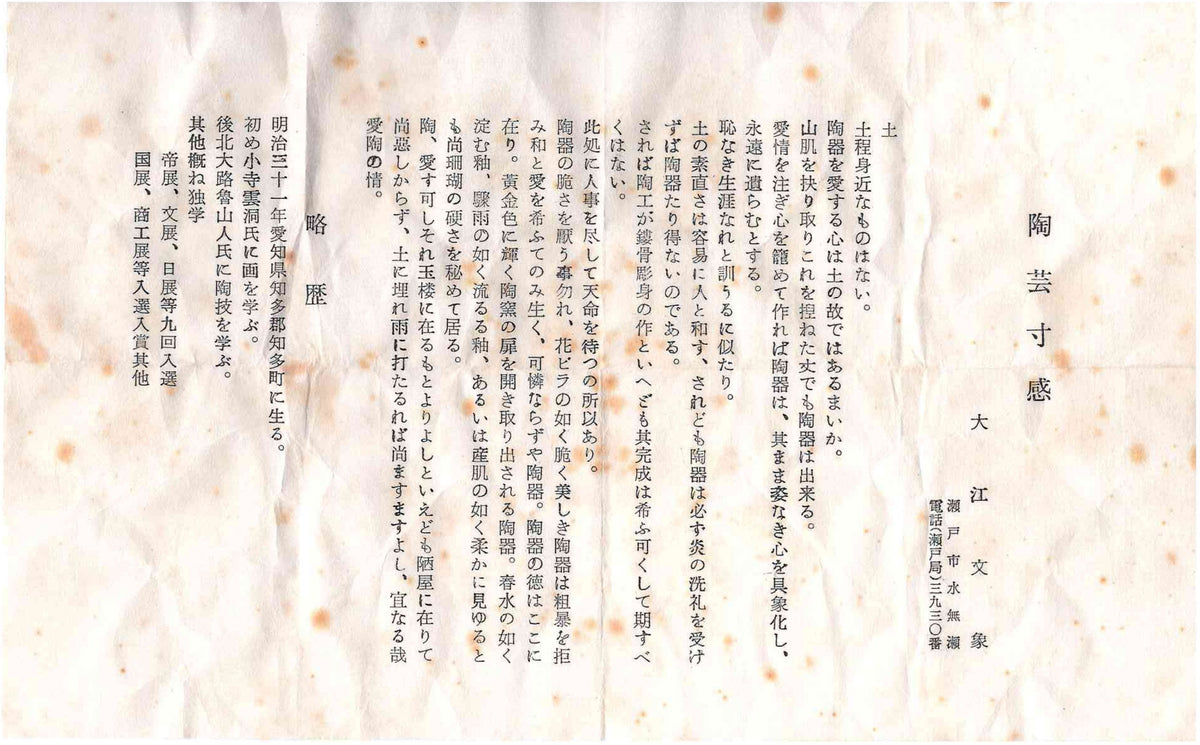
Artist’s Leaflet (Original Text)
Nothing is closer to us than clay.
Is it not because of clay that we come to love ceramics?
Simply scraping earth from a mountainside and kneading it is enough to make a pot.
Yet when a pot is made with affection and with one’s whole heart, it gives form to a heart that has no form, and seeks to endure forever.
It is as if it were teaching us to live a life without shame.
Clay is honest and readily yields to the human hand. But a pot cannot become a pot without first undergoing a baptism of fire.
Thus even a work into which the potter has poured every ounce of effort can only be hoped for, never assured, in its completion.
Herein lies the meaning of the saying, “Do all that you can, then leave the rest to Heaven.”
Do not despise the fragility of ceramics. Fragile and beautiful as flower petals, a pot rejects rough handling and lives only by seeking harmony and love. How endearing it is. Herein lies the virtue of ceramics.
Pots are drawn out when the door of the kiln, glowing gold, is opened. There is glaze that pools as still as spring water, and glaze that runs like a sudden shower. Even where a pot looks as soft as newborn skin, it still holds within it the hardness of coral.
Ceramics are worthy of love. They are of course fine in a splendid mansion, yet no less fine in a humble hut, and buried in the earth and beaten by rain, they become finer still. Small wonder, then, that we love ceramics.
-
Artist: Oe Bunsho (大江文象, 1898–1979)
-
Representative Career Highlights: [1898] Born in Chita District, Aichi Prefecture (now Chita City); [1933] first selected for the 14th Teiten (selected nine times in all for the Teiten, Bunten and Nitten); [1975] designated holder of an Aichi Prefecture Intangible Cultural Property (craft technique: kushime-mon); [1979] died (aged 80)
-
Public Collections: Aichi Prefectural Museum of Art ("Warizansho Mukozuke," c. 1940, Fujii Tatsukichi Collection)
-
Production Period: c. 1946–1970 (estimated from the enclosed leaflet)
-
Item Condition: Very good (no chips, no cracks)
-
Accessories: Tomobako (fitted, signed box), wrapping cloth, shiori (leaflet)
-
Material: Pottery (irabo glaze)
-
Dimensions: Height approx. 8.5 cm, mouth diameter approx. 11.8 cm
-
Note: Even if the products provided by our shop are unused, they were produced a very long time ago and are all listed as pre-owned items. Please understand and confirm that the item may have age-related wear before considering your purchase.
-
Please check the photos: We prepare every description with great care, but errors may still remain in the text. Please examine the photos carefully before purchasing. Where the photos and the description differ, please take the photos as the basis for the product information.




 Mitate Drinking Vessels — Bringing Water Droppers, Tea Bowls and Confectionery Bowls Back into UseThe more beautiful a vessel, the more likely it is to be kept on display as “...
 Reading Tomobako, Shiori and Signatures — A Guide to Verifying Artist-Made Drinking VesselsThe tomobako box and shiori leaflet that accompany an artist-made drinking ve...
 Japanese Pottery Seals, Box Signatures and Marks: A Photo Index of 153 MakersThe seal or incised signature on the base of a piece, and the signature and s...

