

Reading Tomobako, Shiori and Signatures — A Guide to Verifying Artist-Made Drinking Vessels
When you acquire an artist-made drinking vessel, just as important as the vessel itself are the tomobako (the artist-signed box) and the shiori (leaflet) that accompany it, and the signature marked on the vessel. Together they tell you by whose hand, when, and with what intention the vessel was made: they are, so to speak, the vessel's identity papers and its curriculum vitae.
For each work, we check the box inscription, the incised signature or kiln mark on the vessel and the contents of the shiori one by one, and record them in the product description. In this article, drawing on actual examples from works in our shop, we explain how to read tomobako, shiori and signatures, and how they relate to a vessel's value and the ways you can enjoy it. Whether you are holding an artist-made vessel for the first time or already treasure a collection, we hope this offers you a new way of looking at vessels. All the works introduced are items from our shop, and you can enlarge the photographs of the boxes and signatures on the product pages.
Terms worth knowing first
| Term | Meaning |
|---|---|
| Tomobako (共箱) | A box on which the artist personally wrote the title of the work and a signature, and applied a seal. The most important accessory linking a work to its maker. |
| Shikibako (識箱) | A box inscribed about the work by someone other than the artist (such as a successor or an appraiser). There are cases in which a successor wrote one after the artist's death. |
| Hakogaki (箱書き) | A general term for the writing on a box. Typically the title of the work is written on the outside of the lid (futa-omote), and the artist's signature and seal on the inside of the lid (futa-ura). |
| Tomonuno (共布) / wrapping cloth | The cloth in which the vessel is wrapped. Some bear the artist's seal. |
| Shiori (栞) | A booklet or slip of paper describing the artist's career or the work. It may contain the artist's career history, the background of the work, or a contributed essay. |
| Kokumei (刻銘) / kakimei (書き銘) | The artist's signature, incised or written on the base of the vessel or beside the foot. |
| Kamajirushi (窯印) | A mark identifying the kiln that made the vessel. Common on works from established kilns. |
| Rakkan (落款) | A general term for signature and seal, written on box inscriptions and cloths. |
The material and construction of the tomobako
Boxes for artist-made vessels are in most cases made of paulownia (kiri). Light, able to regulate humidity and resistant to fire, paulownia has long been prized as the material for boxes holding precious things. There are several ways of constructing the box, including the kabuse-buta lid that fits down over the box, and the inro-buta and sashi-buta lids that slot in along grooves.
The cord that ties the box is often sanada-himo, a flat, strongly woven cord whose colour and pattern can express the standing of the box or the owner's taste. Particularly important works may be housed in a nijubako (double box), with the tomobako placed inside an outer box. The construction of the box and the condition of its cord are also clues to how the work has been treated and handed down.
Reading the tomobako — outside and inside of the lid
When you pick up a tomobako, look first at the outside of the lid. In most cases the name of the work is written there. The name concisely states the technique, glaze and type of vessel, and shows how the artist regarded it. Then look at the inside of the lid, where you will find the artist's signature and seal. This signature and seal are the most direct clue to who made the vessel.
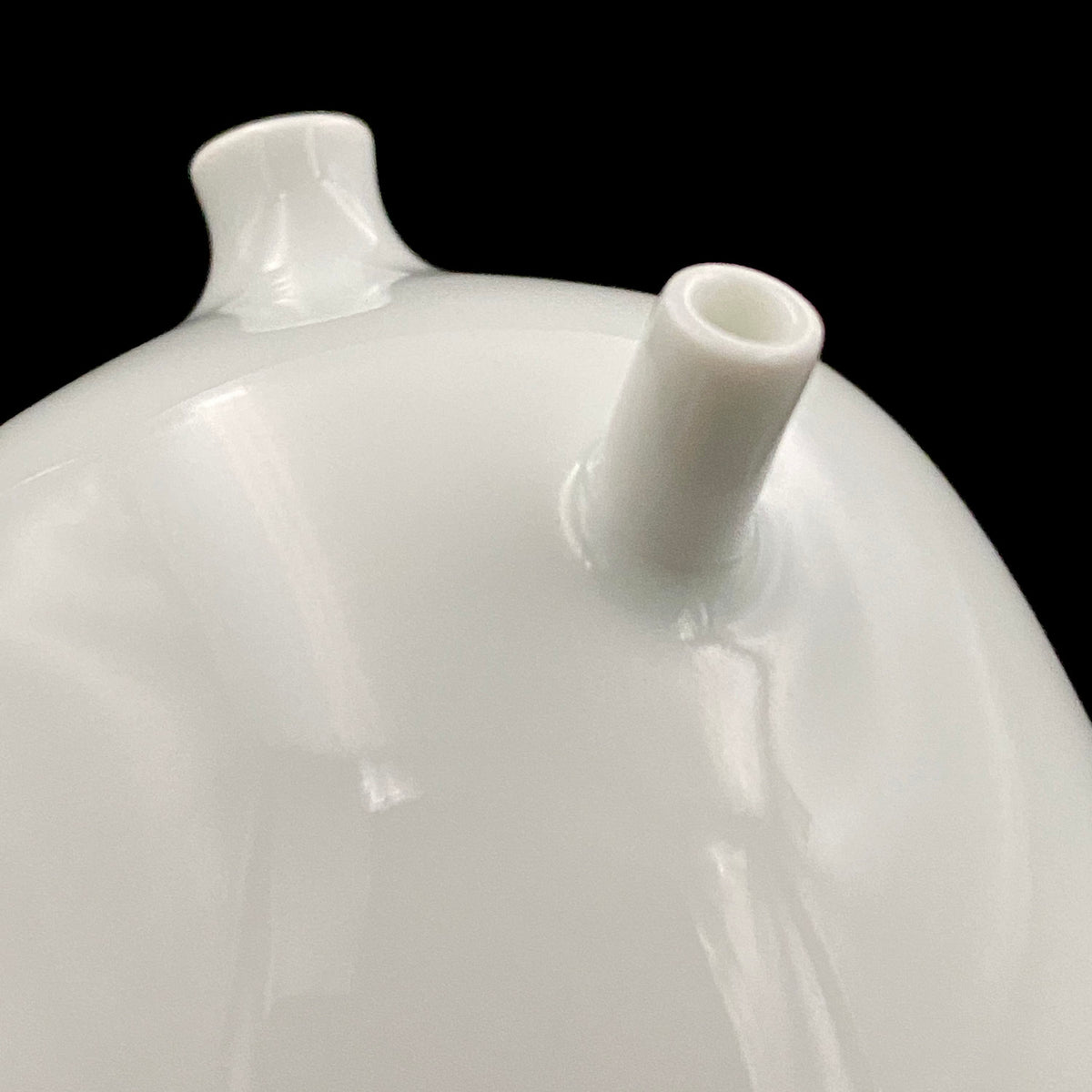
On our white porcelain water dropper by Inoue Manji (井上萬二), the outside of the tomobako lid reads “白磁 水滴” (white porcelain water dropper), the inside bears the signature “井上萬二 作” (made by Inoue Manji) and a red seal, and inside the foot ring of the vessel is a mark written in gosu (a blue pigment). It is a typical example of a tomobako, with clues to the maker present on both the box and the vessel.
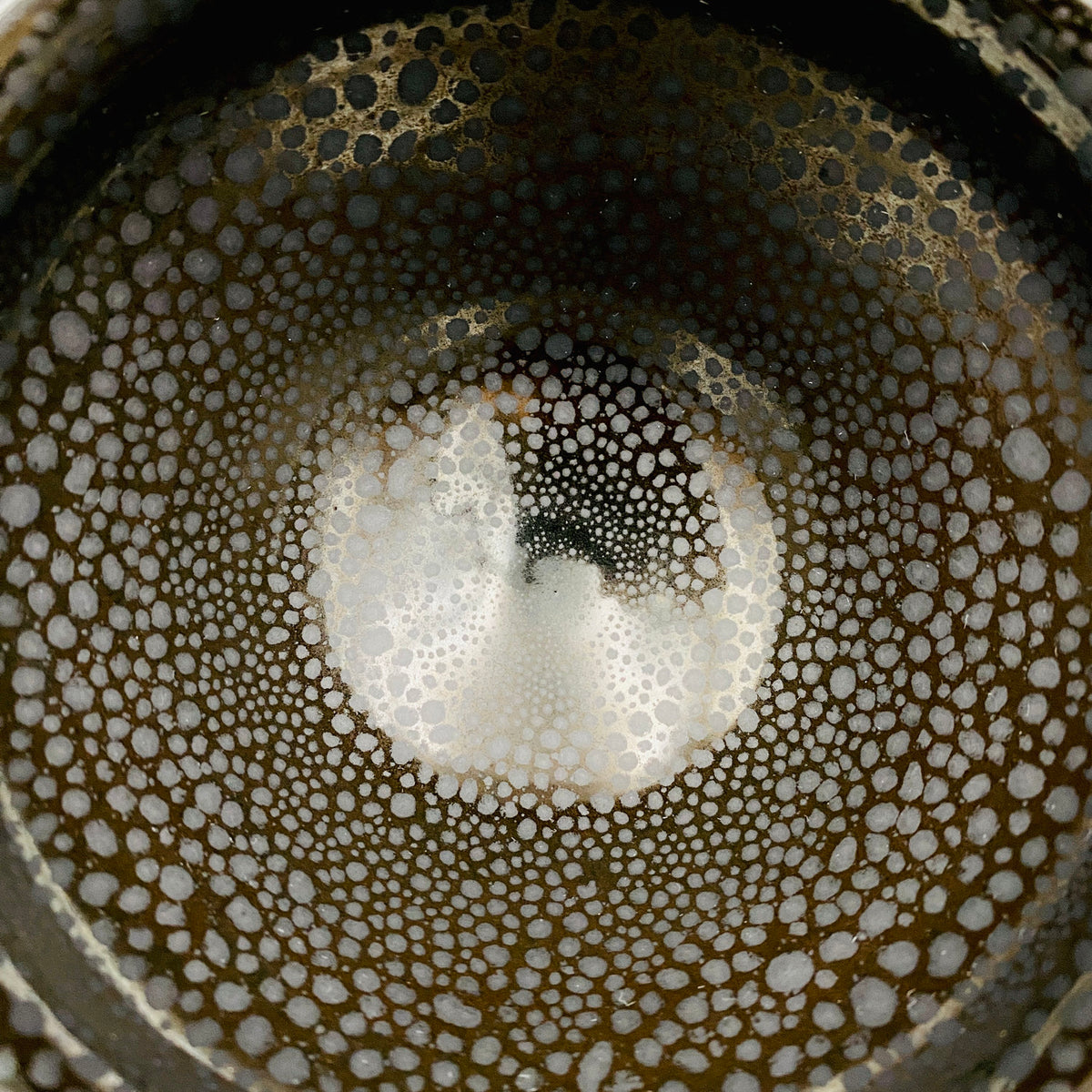
On the oil-spot tenmoku chawan by Kato Yasuhiro (加藤恭博), the outside of the lid is inscribed in ink “油滴天目茶碗” (oil-spot tenmoku tea bowl), with “恭博作” (made by Yasuhiro) at the lower left and a red seal. Beside the vessel's foot is the stamped mark “恭” (Yasu), so you can compare the signature on the box with the mark on the vessel.
The artist's own words in the title of a work
The title written on the box is in the artist's own words. The tomobako of Sakata Jinnai's (坂田甚内) salt-glazed tomoe-pattern bowl is inscribed in ink “塩釉巴文噐” (salt-glazed tomoe-pattern vessel) on the outside of the lid and “甚内” (Jinnai) on the inside, with a red seal. A tomonuno bearing the artist's seal is also included. The tomobako of the inscribed ash-glazed yohen bowl, also by Sakata Jinnai, has “灰釉窯変盌” (ash-glazed yohen bowl) written on the outside of the lid in the artist's own hand. Even the choice of characters for “bowl” or “vessel” — 碗, 盌 or 噐 — reflects the artist's sense of beauty.
On the “Koso-han” evening-geese chawan by Oe Bunsho (大江文象), the outside of the tomobako lid is inscribed in ink “紅霜斑 夕雁茶の盃” (red-frost-dappled evening-geese cup for tea), with the artist's signature and seal. Since the piece is called a 盃 (cup) even though it is a tea bowl, it appears the artist conceived of it as a vessel equally suited to tea and to sake. A box inscription can also be the artist's message about how to use the vessel.
The box tells who did what
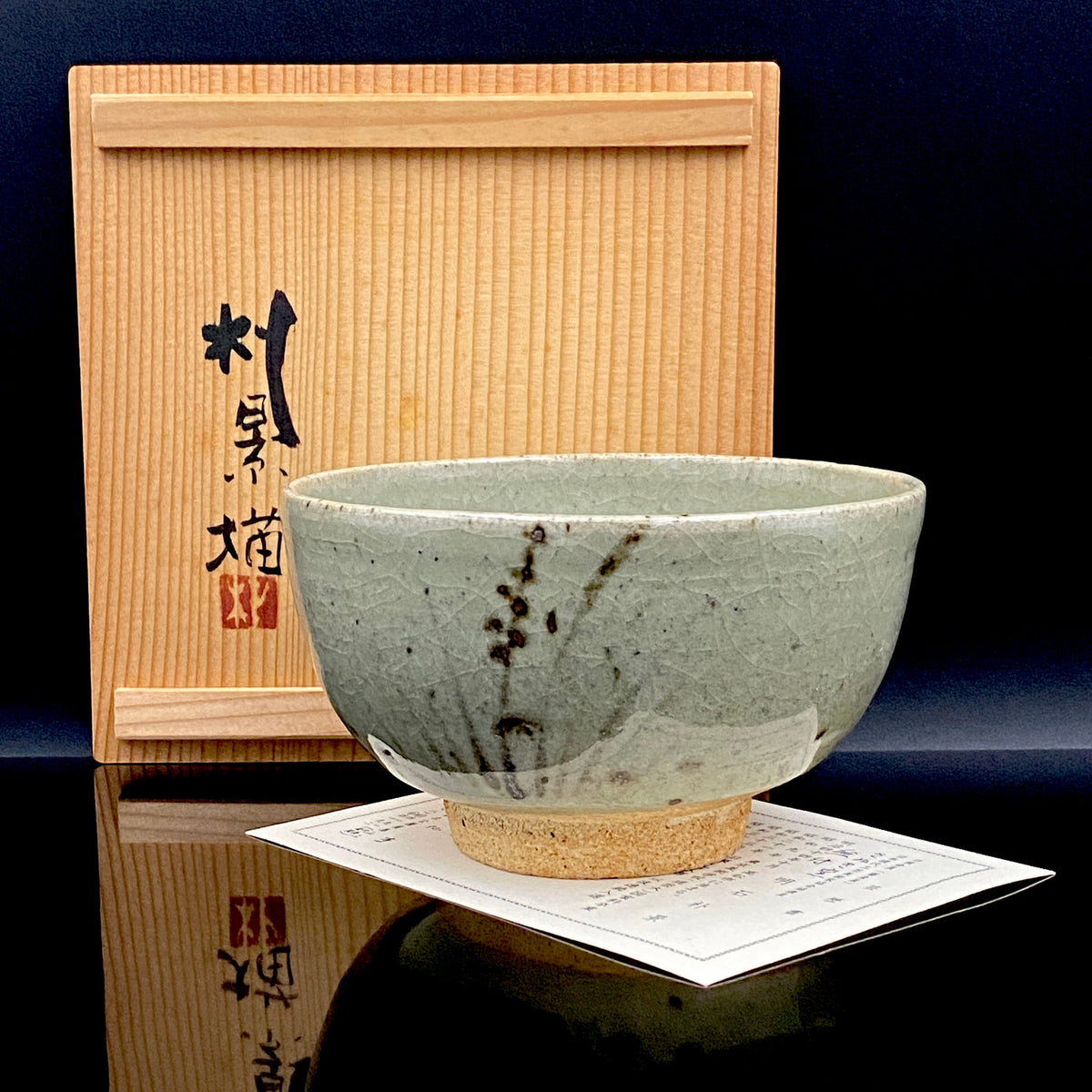
Box inscriptions can also reveal a division of labour in making a vessel. The wooden box of the Sanuki Kiln bowl with grass design bears “讃岐窯 盌” (Sanuki Kiln bowl) on the outside of the lid and “朴景描” (painted by Bokkei) in ink with a red seal on the inside, showing that it is a bowl made at the Sanuki Kiln and painted by the lacquer artist Akashi Bokkei (明石朴景). On the other hand, the name of the potter who formed the vessel is recorded neither on the box nor in the artist's résumé. In cases like this, our product descriptions distinguish what is on record from what is not.
How to look at seals
Seals applied to box inscriptions are either shubun, in which the characters appear in red, or hakubun, in which the characters appear in white against red. Some artists use several seals according to the type of work or the period, and the same artist's seal may differ between early and late works. The shape and script of a seal can therefore be a clue to when a work was made. A seal alone cannot fix the date of a work, however, so we always judge it together with the content of the box inscription and the style of the vessel.
Shikibako — provenance passed on by a successor
A box on which a successor inscribed a work after examining it, following the artist's death, is called a shikibako. Our celadon sake cup with clouds and cranes, a posthumous work by Miyagawa Kozan I (初代 宮川香山), comes with a shikibako by Miyagawa Kozan II. It is a box on which the second-generation Kozan, heir to the techniques, examined and inscribed a work by the first Miyagawa Kozan, who was active as an Imperial Household Artist in the Meiji era.
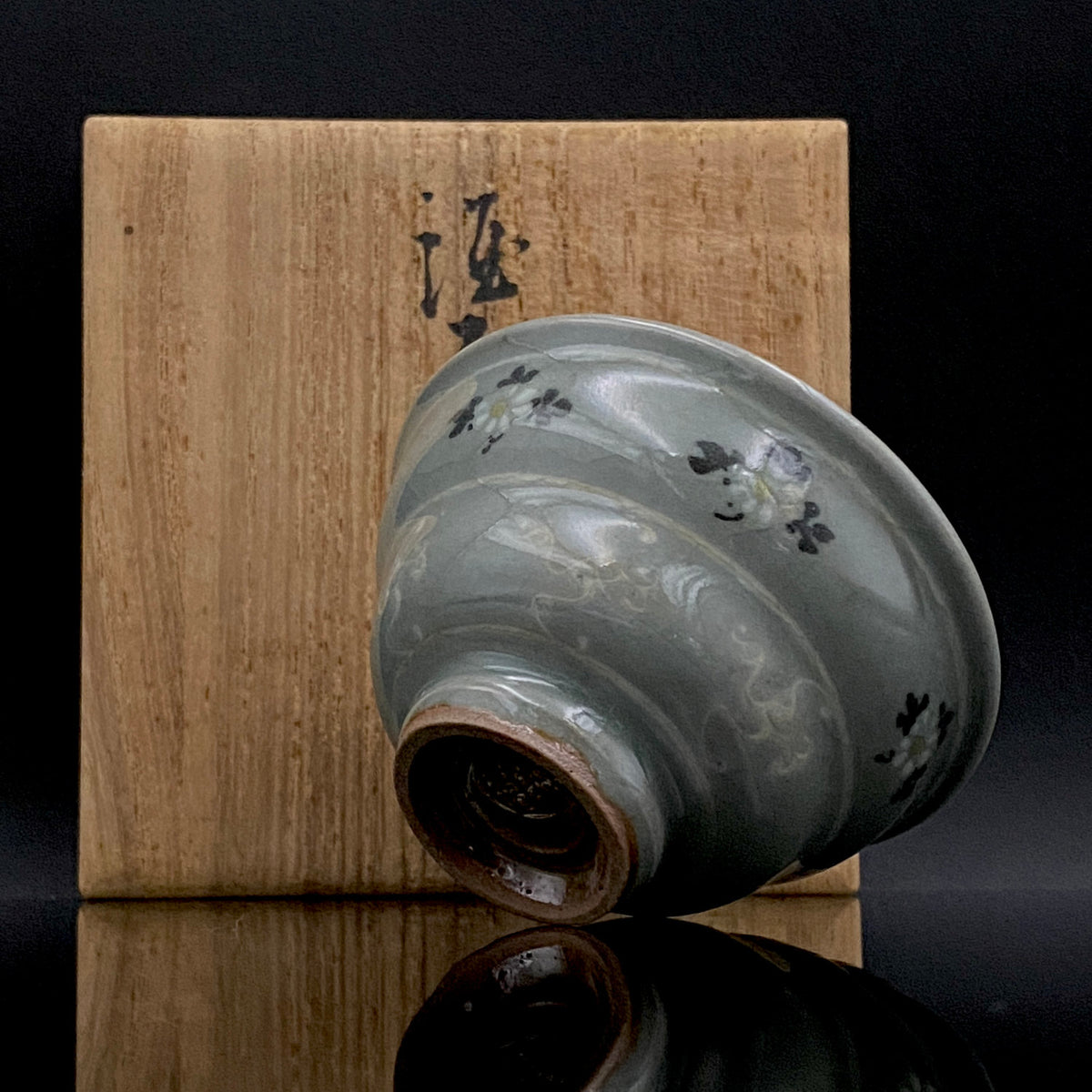
Inside the foot ring of this sake cup is a kiln mark in relief, the two characters “眞葛” (Makuzu) raised within an oval frame. Together with the title on the box, “雲鶴青磁” (celadon with clouds and cranes), this suggests that the pattern on the vessel represents clouds and cranes. Two clues, the shikibako and the kiln mark, give the work a firm provenance.
Signatures and kiln marks on the vessel
Signatures left on the vessel itself are another important clue to its maker. They include kokumei incised with a spatula or similar tool, kokuin pressed with a stamp, and kakimei written with a brush.
- Sakata Jinnai, salt-glazed tomoe-pattern bowl: the stamped mark “甚” (Jin), applied by the artist, on the base inside the foot ring.
- Yanai Sai (矢内齊), incised coloured-slip inlay chawan: the stamped mark “齊” (Sai) on the base beside the foot. The inside of the tomobako lid bears “矢内齊” in ink and a red seal.
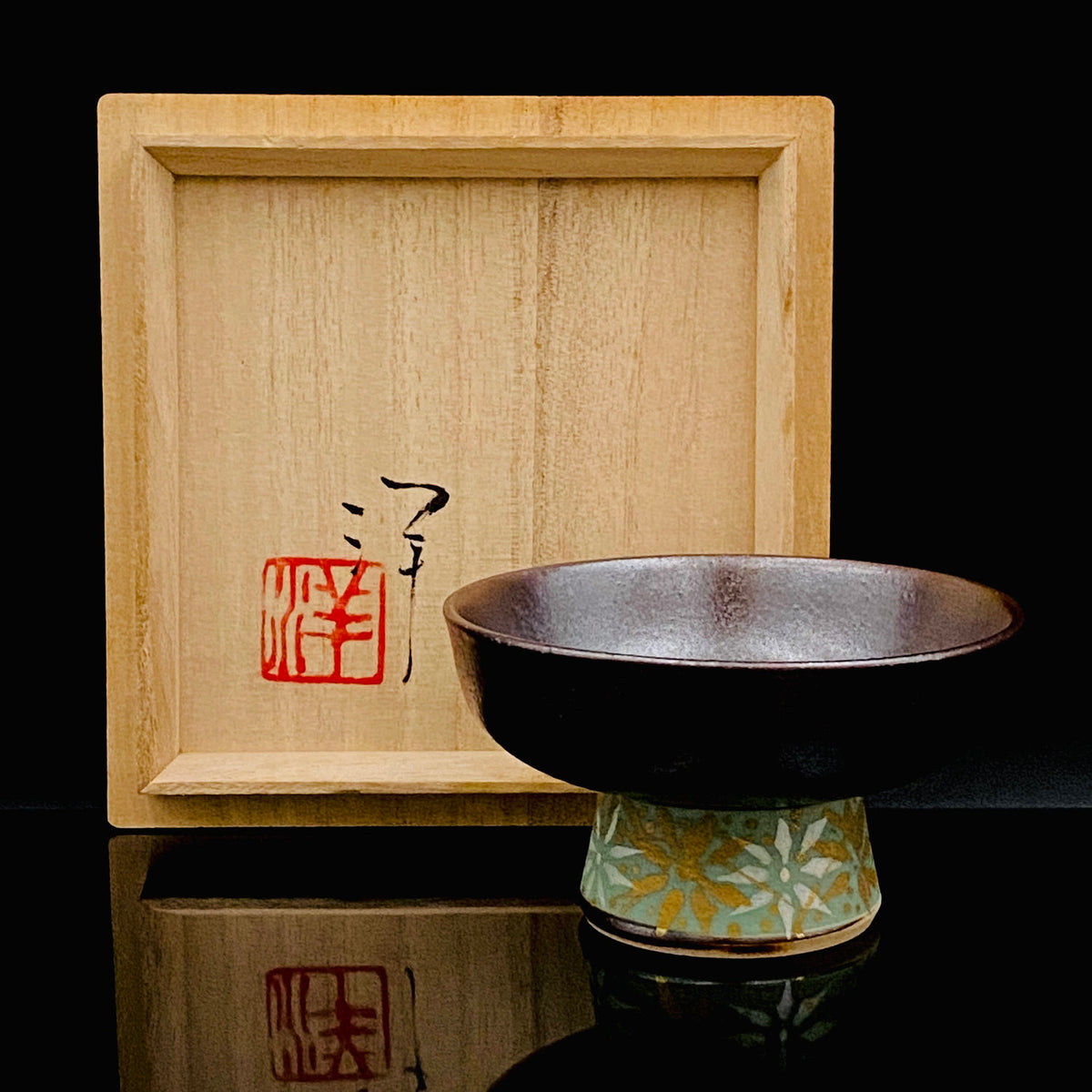
- Kawashima Hiroshi (河島洋), Suisaka-de footed cup with round-window design in overglaze enamels and gold: a mark that can be read as “洋” (Hiroshi) inside the foot. The inside of the tomobako lid bears the signature “洋” and a red seal, and the wrapping cloth is also stamped with a red seal.
- Oketani Teiichi II (二代 桶谷定一), white tenmoku chawan: an incised mark identifying the maker inside the foot.
- Kitagawa Hiroyuki (北川宏幸), yakishime three-footed water dropper with stamped pattern: the artist's signature on the base.
- Sakata Jinnai, “Shinjin-mon” glass cup: the signature “Jin”, the artist's nickname, written in gold on the underside of the base.
- Mumyoi Jozan Kohei Kiln, set of three sake cups: the kiln mark “小平” (Kohei) on the base of each cup.
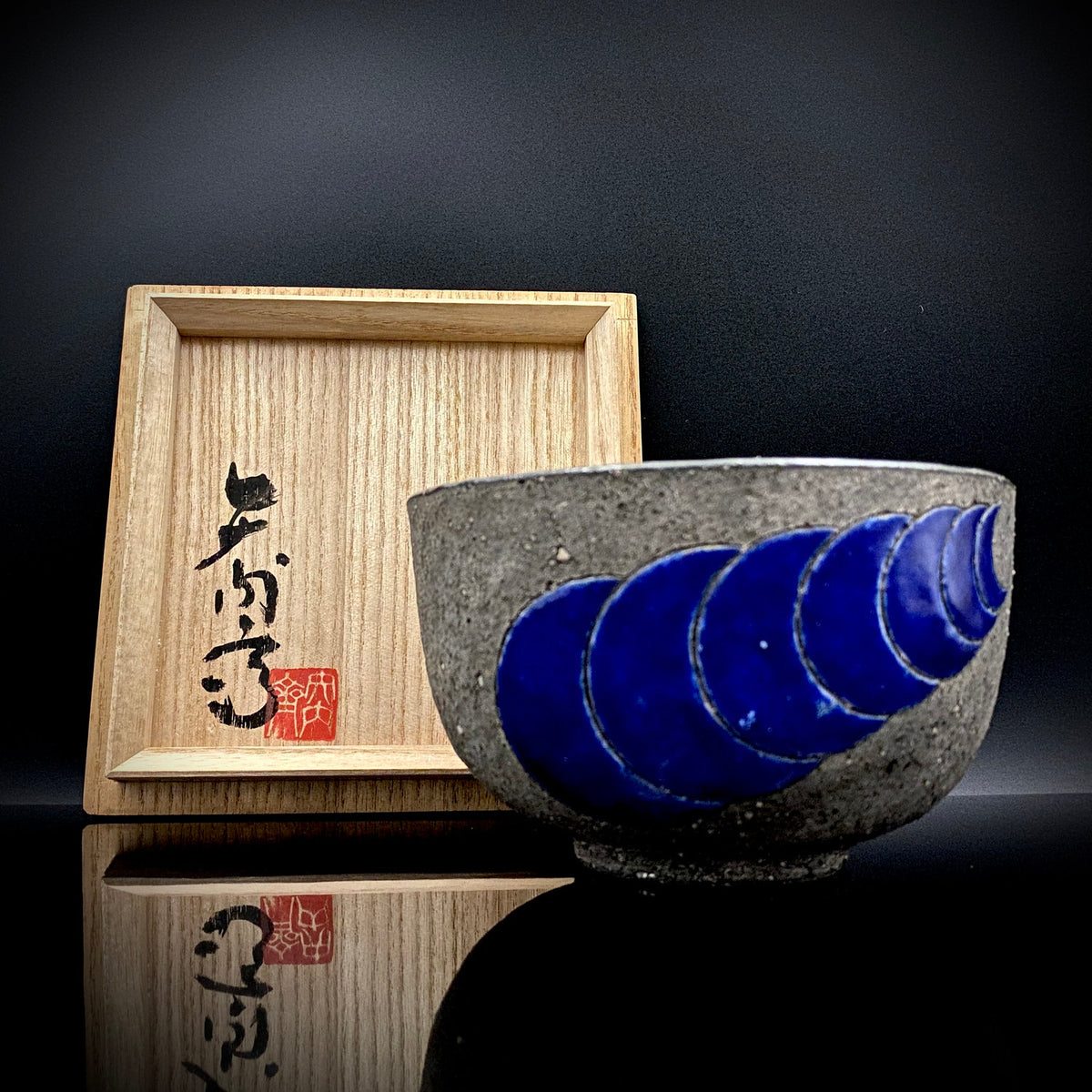
It is also interesting that the potter Sakata Jinnai used different marks for different materials: “甚” on ceramics and “Jin” on glass. The difference in signature speaks of the attitude with which the artist approached each material.
Primary information told by the shiori
A shiori may record the artist's own words or the reception the work received when it was first shown. Unlike commentary written later, this is “primary information” from the same period as the work.
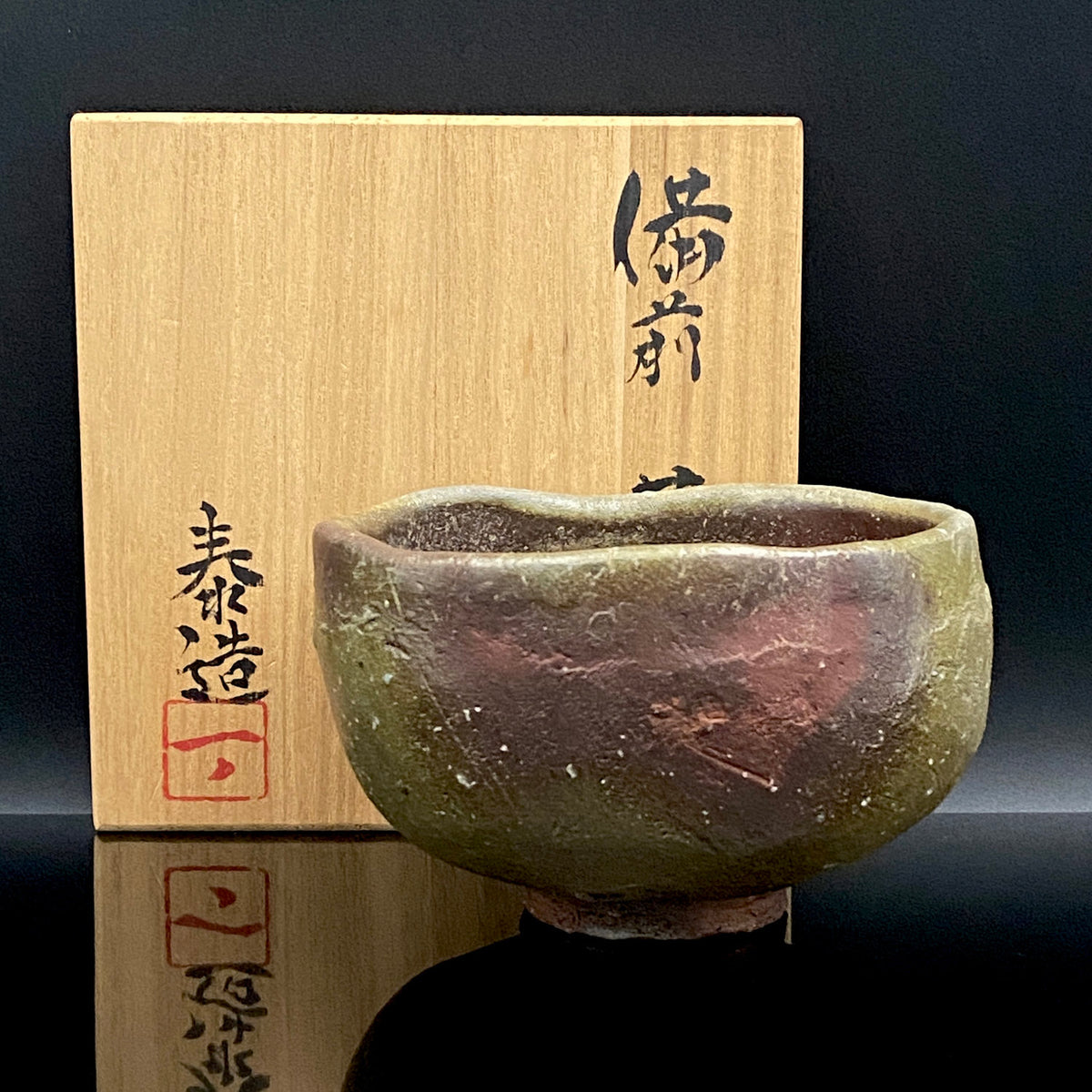
The Bizen chawan by Ishino Taizo (石野泰造) comes with a shiori to which the Akutagawa Prize-winning author Miura Tetsuro contributed an essay. The shiori also contains the artist's own “greeting”, which tells how the artist was drawn to Bizen ware, with its flavour of the clay itself, and so entered the path of pottery. Words written in the same era as the vessel deepen the way we see it.
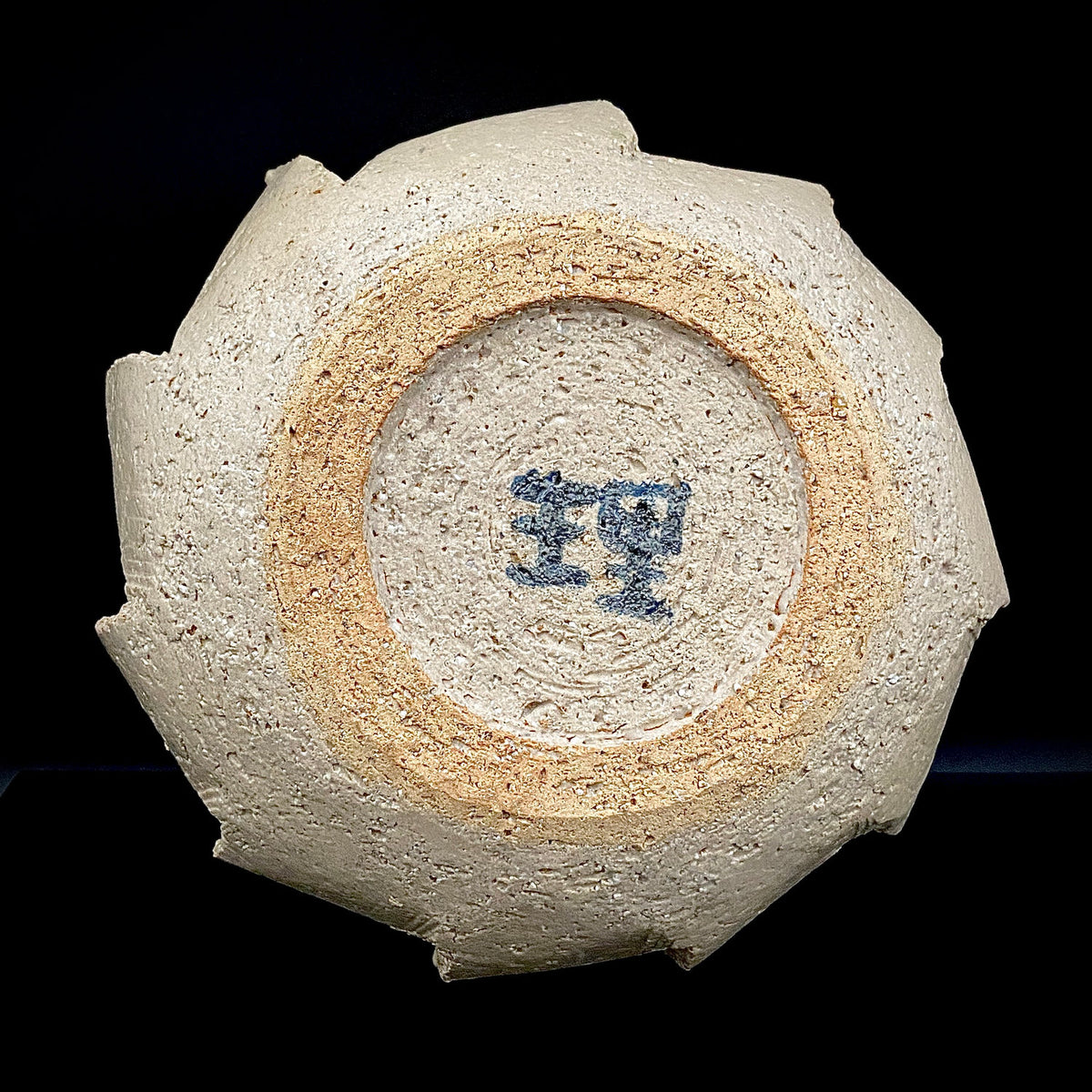
For the yatou coloured-glaze incised bowl by Miyanaga Tozan III (三代 宮永東山, Miyanaga Rikichi), known as a member of Sodeisha, the accompanying shiori has made it possible to identify the piece as an early work, shown at a solo exhibition in 1966, in which the artist explored the fusion of function and sculpture. The tomobako is titled “矢透彩釉 刻之鉢” (yatou coloured-glaze incised bowl), and on the base of the work the mark “理” (Ri) can be seen, painted in gosu. It is a good example of how the shiori, the box and the vessel together bring a work's place into clear view.
The shiori accompanying the set of three sake cups from the Mumyoi Jozan Kohei Kiln on Sado introduces Living National Treasure Miura Koheiji as the second generation of the kiln. The wooden box bears “盃” (cups) in ink and a square red seal on the outside of the lid, and on the inside an ink inscription beginning “佐渡” (Sado) and the red seal “小平” (Kohei); together with the shiori describing the kiln's origins, it conveys the history of the kiln.
Types of shiori
There are several types of shiori: those giving the artist's career and awards (a “career history” shiori), those doubling as an invitation to a solo exhibition, those explaining the technique or intention of the work, and those with essays contributed by critics or writers. Yanai Sai's chawan and Kitagawa Hiroyuki's water dropper come with shiori giving the artists' career histories, so you can learn the path each artist followed to arrive at the work. The content of shiori is also one of the sources for the “Representative Career Highlights” in our product descriptions.
Examples of tomobako, signatures and shiori in our works
| Work | Box inscription | Signature / mark on the vessel | Shiori / other |
|---|---|---|---|
| Inoue Manji, white porcelain water dropper | Outside: “白磁 水滴” / inside: “井上萬二 作”, red seal | Mark in gosu inside the foot | — |
| Kato Yasuhiro, oil-spot tenmoku chawan | Outside: “油滴天目茶碗”, “恭博作”, red seal | “恭” beside the foot | — |
| Sakata Jinnai, salt-glazed tomoe-pattern bowl | Outside: “塩釉巴文噐” / inside: “甚内”, red seal | “甚” inside the foot | Tomonuno with seal |
| Yanai Sai, incised coloured-slip inlay chawan | Inside: “矢内齊”, red seal | “齊” beside the foot | Career-history shiori, tomonuno |
| Kawashima Hiroshi, footed cup | Outside: “吸坂手”, “盃” / inside: “洋”, red seal | “洋” inside the foot | Red seal on the wrapping cloth |
| Miyagawa Kozan I, celadon sake cup with clouds and cranes | Shikibako by Miyagawa Kozan II | Kiln mark “眞葛” in relief | — |
| Miyanaga Tozan III, yatou coloured-glaze incised bowl | “矢透彩釉 刻之鉢” | Mark “理” on the base | Shiori from the 1966 solo exhibition |
| Kohei Kiln, set of three sake cups | Outside: “盃” / inside: “小平”, red seal | “小平” on the base of each cup | Shiori on the kiln's origins |
When there is no tomobako: boxes added later
Some old vessels have lost their tomobako, or were later placed in a different box. A box made afterwards is called an atobako, and was prepared by an owner who took good care of the work. An atobako does not deny a work's value; on the contrary, it is often evidence that the vessel has been cherished for a long time.
In our product descriptions, we state whether a box is a tomobako, a shikibako or another kind of box, as far as we have been able to confirm. Where the origin of a box is unclear, we avoid definitive statements and report only the facts we know.
Tips for reading box inscriptions
Box inscriptions are often written in cursive brush script and may feel hard to read at first. When deciphering one, the shortcut is to look first for familiar characters related to vessels and makers, such as “作” (made by), “造” (made), “窯” (kiln), “盃” (cup) and “碗” (bowl). Then read on character by character, comparing with the product name and the artist's name. Artists often have their own way of abbreviating their names, and by comparing several works by the same artist you will gradually become able to read them. Our product photographs show box inscriptions large, so do enjoy reading them while comparing them with the readings given in our product descriptions.
How we check and record
We check and record tomobako, shiori and signatures according to the following policy.
- Record what we see: we transcribe the characters of box inscriptions and signatures accurately as far as they can be read, and say so clearly where they are hard to decipher.
- Separate evidence from inference: we distinguish between facts recorded on the box or in the shiori and what we infer from the characteristics of the vessel.
- Make it visible in photographs: we include the outside and inside of the tomobako lid, the signature on the vessel and the shiori in the product photographs wherever possible.
- State the accessories: whether a tomobako, tomonuno or shiori is included is shown under “Accessories” on each product page.
A work without a tomobako or shiori is no less valuable as a vessel. But a work that comes with documents conveying its provenance can pass its story on accurately when it is handed down to the next generation.
Handing down the tomobako and shiori
- Keep the vessel and box together: even while you use the vessel every day, keep the tomobako, tomonuno and shiori together with it.
- Avoid humidity and direct sunlight: paulownia boxes help regulate humidity, but heat, high humidity and direct sunlight lead to deterioration of the ink and paper of the inscription.
- Store the shiori flat in the box: keep the shiori in the box without folding it, so that it is not lost.
- Keep a record: a brief note of when and how you acquired the piece, placed with the box, makes the vessel's provenance richer still.
Summary — receiving a vessel's story and passing it on
The inscription on the tomobako, the signature on the vessel, the words left in the shiori: these are precious records conveying the feelings the maker put into the vessel and the time it has travelled through. To take a vessel into your hands is also to receive its story. And when you use it, keep it with care, and one day hand it on to its next owner, the tomobako and shiori will once again play their part in telling that story.
We read each box inscription and signature and record them in our product descriptions because we want to deliver each vessel's story, unbroken, to its next owner. Please do look at the tomobako and shiori that arrive with your vessel. Thinking of the maker and their era each time you open the box is another of the great joys of living with artist-made vessels.
Frequently asked questions
Q. Does a tomobako guarantee that a work is genuine?
A tomobako is an important clue to the maker, but it is important not to judge by it alone and to check the style of the vessel, its signature and documents such as the shiori together. We record the evidence we have been able to confirm in the product description.
Q. Which is more valuable, a shikibako or a tomobako?
It cannot be said in general. A tomobako is inscribed by the artist; a shikibako is inscribed by a successor or other person who examined the work; each has its own significance. A shikibako serves to convey a work's provenance after the artist's death.
Q. I can't read the box inscription.
Box inscriptions are often written in cursive script and can be hard to decipher if you are not used to them. We record what we have been able to read in the product description, so please refer to it. If anything is unclear, please feel free to contact us.
Browse works by maker in All Makers & Studios, and works by Living National Treasures in Works by Living National Treasures.