Created by Sakuma Totaro (佐久間藤太郎, 1900–1976), a master who, alongside Living National Treasure Hamada Shoji, elevated Mashiko ware from everyday utilitarian items to folk craft (Mingei) works combining beauty and healthiness. Born in 1900 as the eldest son of the historic Sakuma Kiln in Mashiko, Sakuma Totaro established a deep fellowship with Hamada Shoji after inviting Hamada to lodge at the Sakuma family home upon Hamada's return from the UK in 1924, stepping into the spotlight as a leading folk craft potter in Mashiko. Leaving a solid record of achievements—including selections for the Ministry of Commerce and Industry Crafts Exhibition, receiving the Tochigi Prefecture Cultural Merit Award, and being awarded the Fifth Class Order of the Sacred Treasure—the artist's works are preserved in public institutions such as the Tochigi Prefectural Museum of Fine Arts, the Mashiko Museum of Ceramic Art, and The Japan Folk Crafts Museum. Dating from the period when Hamada Shoji praised Sakuma's free and expansive ladle-poured glaze and brushed slip work in writing, and bearing the carved "Fuji" (藤) mark inside the foot ring, this piece is identified as a precious authentic creation from Sakuma Totaro's most mature artistic phase between 1955 and 1968 (the mid-1950s to late 1960s).
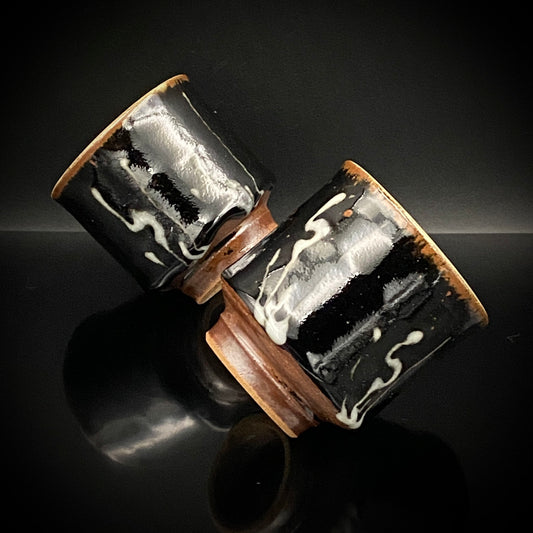
From the lower portion of the body down to the side of the foot, a dense, heavy poured amber glaze—a signature technique of Sakuma Totaro—is applied, creating a powerful scene where the glaze pools into a large droplet right at the edge of the foot. The soft expression of the rustic rice-husk ash white glaze (nukajiro glaze) on the upper body contrasts boldly with the strong gradient of the lustrous black-amber glaze below, while the coarse texture of the local Mashiko clay gives the piece a commanding presence. The foot ring is dynamically carved, leaving the raw clay exposed (rotai), with the artist's mark "Fuji" (藤) clearly incised inside the foot. On the interior, soft radial shadows and a pool of glaze at the bottom (mikomi) can be seen, beautifully expressing a rustic, warm, and healthy form born from wood firing in a climbing kiln (noborigama).
Possessing a large, stable form measuring approximately 7.5 cm in height and 13.0 cm in mouth diameter, our shop proposes this piece as a dignified Japanese-style rocks glass (large sake cup) tailored to modern lifestyles for enjoying aged spirits, matured sake, or whisky on the rocks. The warmth of the raw clay felt when held in hand, combined with the heavy texture of the glazes, beautifully highlights the ice floating in a rocks glass or the amber color of aged spirits, adding an elegant refinement to luxurious drinking occasions.
As a special note regarding this piece, a deep crack (craquelure/expansion seam formed during firing) runs along the interior from the bottom to the side, where a fingernail slightly catches on a portion of the inner surface. This crack does not reach the exterior of the vessel at all, nor does it affect water tightness or structural integrity; however, considering the condition of the interior, this piece is offered at a special price as an item with flaw. You can enjoy this authentic craft beauty, which tells the history of Mashiko Mingei, as a special vessel for everyday use.
<Artist's Message>
For over one hundred and ten years, the kilns of Mashiko have continued to fire ceramics, digging clay from the hills behind and cutting firewood from the mountains across. It has already been more than thirty years since Hamada Shoji came here to create new works alongside traditional kitchen utensils, and young potters gradually joined us. While excellent folk kilns preserving tradition remain throughout Japan, I believe our kiln was among the earliest to attempt—and create in abundance—vessels for flower arrangement and tableware for modern living using age-old techniques. The strength of work accomplished with good raw materials, natural fuel, and correct techniques imparts sufficient healthiness to the items and even reflects the essence of the land itself. As an inevitable result of being blessed with such favorable conditions, the texture of the clay and the state of the glaze improve the longer the piece is used—a rare characteristic in this day and age. I hope those who purchase Mashiko ware will put it to daily use from the very first day, and if you let us know your thoughts after using it, it will help us bring together the perspectives of maker and user for further learning, for which I would be most grateful.
Mashiko Folk Kiln, Sakuma Totaro (1900–1976)
<A Comment from a Master Potter Who Knew Sakuma Totaro Well>
Sakuma Totaro has surely struck underground water right underfoot, and needs no priming water. It is said that potters become fully fledged when their personality begins to shine through their works, but Sakuma's recent work shows the local character seeping through even more strongly, and that is what strikes people in particular. The work has gained an expansiveness, like a garden tree growing into a mountain tree. Though the potter freely incorporates methods not previously found in traditional Mashiko, the pieces remain full of the true scent of Mashiko. In these days, I am deeply moved by the many things I learn from Sakuma, and I consider it a great blessing for Mashiko to have gained such a potter over these thirty-some years.
Hamada Shoji (濱田庄司, 1894–1978)
- Artist: Sakuma Totaro (佐久間藤太郎, 1900–1976)
- Career Highlights: [1924] Established a deep friendship with Hamada Shoji who lodged in Mashiko, commencing folk craft pottery, [1927] Selected for the Ministry of Commerce and Industry Crafts Exhibition, [1959] Received the Tochigi Prefecture Cultural Merit Award, [1973] Awarded the Fifth Class Order of the Sacred Treasure
- Public Collections: Tochigi Prefectural Museum of Fine Arts, Mashiko Museum of Ceramic Art, The Japan Folk Crafts Museum, etc.
- Date: c. 1955–1968 (Mature period of Mashiko Mingei)
- Condition: Fair (Deep internal craquelure where a fingernail catches on the interior, no effect on the exterior, offered as an item with flaw). Please regard the crazing that forms in firing, other characteristics of ceramics and the patina of age as part of the pleasure of an antique piece.
- Accompanied by: Dedicated original wooden box included (with paper label "Sakuma Totaro Chawan"), Sanada-himo cord included
- Medium: Ceramics (Mashiko clay, amber glaze, rice-husk ash white glaze)
- Dimensions: Mouth diameter approx. 13.0 cm, Height approx. 7.5 cm
- Please Note: The items provided by our shop were produced a very long time ago and are all listed as pre-owned items. Please understand and confirm the age-related changes and the special note regarding the internal craquelure before considering your purchase.
- About the Photographs: We prepare every description with great care, but errors may still remain in the text. Please examine the photos carefully before purchasing. Where the photos and the description differ, please take the photos as the basis for the product information.





 Japanese Pottery Seals, Box Signatures and Marks: A Photo Index of 160 MakersThe seal or incised signature on the base of a piece, and the signature and s...
 Mitate Drinking Vessels — Bringing Water Droppers, Tea Bowls and Confectionery Bowls Back into UseThe more beautiful a vessel, the more likely it is to be kept on display as “...
 Letters from Teachers: Potters' Mentors and Friendships, Read Through the Recommendations in Their LeafletsA leaflet lying at the bottom of a fitted box sometimes carries words by some...
 Whisky Warmed Like Sake — Hot Whisky in Japanese Vessels, from Hitohada-kan to Jo-kanIn the world of sake, warmed sake is named in five-degree steps — hinata-kan,...

