Height approx. 5.3 cm, Mouth diameter approx. 6.0 cm
Condition
Very Good (No chips, no cracks). Please regard the crazing that forms in firing, other characteristics of ceramics and the patina of age as part of the pleasure of an antique piece.
Accompanied by
Dedicated paulownia wooden box (Tomobako) included (with calligraphy "Shuhai, Tadashi" and seal), wrapping cloth (with seal) included, work explanation pamphlets (ceramic history, Shinyote) included
Free within Japan. We also ship overseas for a flat fee (see our Shipping Policy).
Dispatch
Within 5 business days after payment is confirmed (excluding weekends, Japanese public holidays and our closing days).
Payment
Credit cards, Apple Pay, Google Pay and more. You can choose at checkout.
Returns
As our items are antiques and vintage spirits, we cannot accept returns or cancellations for a change of mind. If an item arrives significantly damaged through our clear fault, we refund the full amount once it is returned (Refund Policy).
Delivery to your hotel while visiting Japan
If you are visiting Japan, we can also deliver to your hotel or other accommodation in Japan.
In that case, after placing your order and at least 5 days before your preferred delivery date, please send us the reservation holder's details, your check-in date, and whether you have confirmed that the hotel will accept the parcel, by email (support@antiqueliquor1926.com) or via our contact form.
About this piece
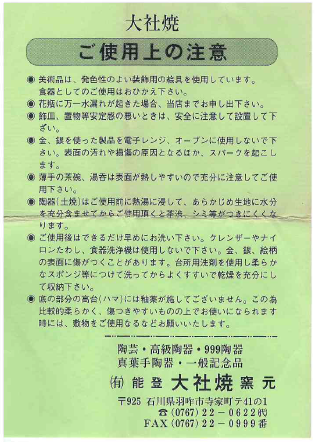
This sake cup is a work of Noto Taisha Ware (Taisha Kiln) created by the ceramic artist Isomi Tadashi (磯見忠司, 1923–1999). Isomi studied under Ishii Hakutei, a prominent figure in the Western-style painting world, to learn pictorial composition techniques, and mastered advanced ceramic artistry under Kitade Tojiro, a master of modern Kutani ware. After graduating from the Imperial Military Academy, Isomi graduated from the Ceramic Arts Department of the Ishikawa Institute of Arts and Crafts, the predecessor of Kanazawa College of Art. Opening the artist's kiln in 1948 (Showa 23) in Jike-machi, Hakui City, Ishikawa Prefecture, at the foot of Keta Taisha, the Ichinomiya (principal shrine) of Noto, Isomi repeatedly selected for and received awards at the Nitten, Asahi Ceramic Art Exhibition, and Contemporary Art Exhibition. Isomi exhibited as a representative of Ishikawa Prefecture at the 5th Ministry of Education Selected Exhibition and received the Ishikawa Prefecture Cultural Activity Encouragement Award as well as the 7th Hokkoku Fusetsu Award. Furthermore, the artist was an accomplished master who crafted numerous large ceramic wall reliefs for public facilities such as the National Noto Youth Center and Hakui City Hall. As the enclosed ceramic history pamphlet is updated up to Isomi's receipt of the 7th Hokkoku Fusetsu Award in 1989 (Heisei 1) and the 40th Anniversary Exhibition of the opening of Taisha Kiln, this work is identified as an authentic piece produced during the artist's mature period from 1989 to the early 1990s (around the beginning of the Heisei era). The lid of the accompanying dedicated paulownia wooden box (tomobako) is inscribed on the front with the handwritten calligraphy "Sake Cup" (Shuhai) and on the lower left with "Tadashi" along with the artist's red seal stamp, and it comes complete with an inscribed cloth bearing a red seal stamp and detailed work explanation pamphlets.
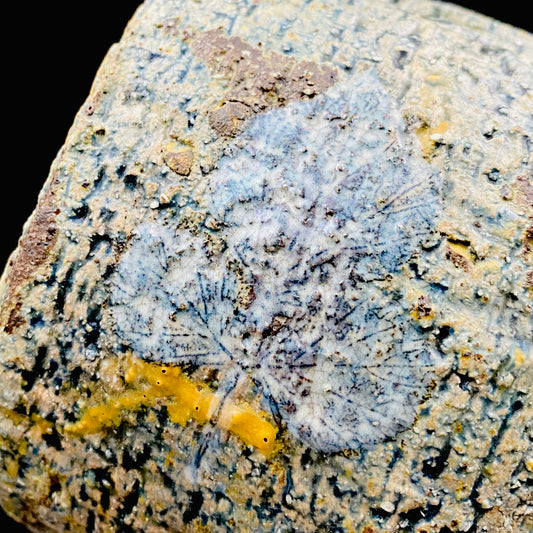
The greatest visual highlight of this work is "Shinyote" (real leaf technique), a representative method independently developed and established by the Taisha Kiln. This is an extraordinarily difficult, original technique in which actual leaves from plants growing wild around the primeval forest of Keta Taisha, a Nationally Designated Natural Monument, are adhered to the vessel and burned away inside a kiln exceeding 1,000°C, leaving the contours of the leaves and intricate leaf veins three-dimensionally embossed directly onto the surface of the vessel. Examining the provided image, each fine leaf vein of the actual leaf is distinctly and precisely fixed on the front surface of the warm yellowish-brown ash-glazed ground, beautifully capturing the artistic beauty of nature's creation. The vessel is formed into an elegant stemmed cup (bajou-hai) shape, with an unglazed raw clay (rotai) finish on the foot area, exposing the rustic and robust clay texture of the iron-rich ceramic body. Inside the foot ring, the "Taisha" stamp, proof of the Taisha Kiln, is clearly impressed, demonstrating high perfection as a handcrafted, one-of-a-kind piece.
Measuring a compact and refined dimension of approx. 5.3 cm in height and approx. 6.0 cm in mouth diameter that fits comfortably in the hand, our shop proposes this work as a dignified "Japanese-style shot glass (Japanese liquor vessel)" for slowly savoring aged spirits, premium whisky, matured sake, or liquor straight neat, tailored to modern drinking culture and refined lifestyles. The warm texture of the ash-glazed ground, the vivid leaf pattern of the Shinyote technique, and the subdued, robust clay texture of the foot ring beautifully complement the colors of poured amber-toned aged spirits or clear liquors. An authentic masterpiece born from the fusion of nature from the sacred grounds of Keta Taisha with Western-style painting and Kutani ceramic techniques, this piece allows one to savor the true essence of traditional Japanese craft through both sight and touch.
Career Highlights: Studied under Ishii Hakutei and Kitade Tojiro. After graduating from the predecessor of Kanazawa College of Art, opened Noto Taisha Ware in 1948. Selected for Nitten numerous times, exhibited as Ishikawa Prefecture representative at the 5th Ministry of Education Selected Exhibition, received Ishikawa Prefecture Cultural Activity Encouragement Award and the 7th Hokkoku Fusetsu Award.
Public Collections & Murals: Created numerous large ceramic wall reliefs for public facilities such as National Noto Youth Center, Hakui City Cultural Hall, and Hakui City Hall.
Date: 1989–early 1990s (around early Heisei era)
Condition: Very Good (No chips, no cracks). Please regard the crazing that forms in firing, other characteristics of ceramics and the patina of age as part of the pleasure of an antique piece.
Accompanied by: Dedicated paulownia wooden box (Tomobako) included (with calligraphy "Shuhai, Tadashi" and seal), wrapping cloth (with seal) included, work explanation pamphlets (ceramic history, Shinyote) included
Medium: Ceramic / Porcelain (Shinyote real leaf technique, ash glaze)
Dimensions: Height approx. 5.3 cm, Mouth diameter approx. 6.0 cm
Please Note: The items provided by our shop were produced a very long time ago and are all listed as pre-owned items. Please understand and confirm the age-related changes before considering your purchase.
About the Photographs: We prepare every description with great care, but errors may still remain in the text. Please examine the photos carefully before purchasing. Where the photos and the description differ, please take the photos as the basis for the product information.





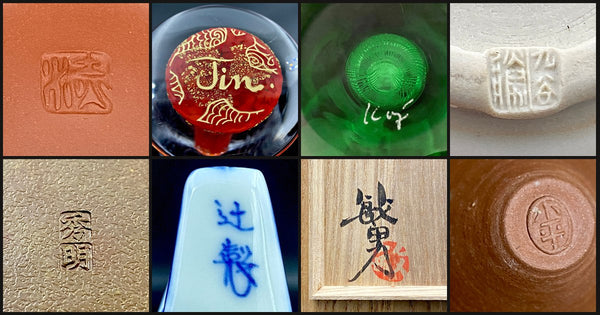 Japanese Pottery Seals, Box Signatures and Marks: A Photo Index of 160 MakersThe seal or incised signature on the base of a piece, and the signature and s...
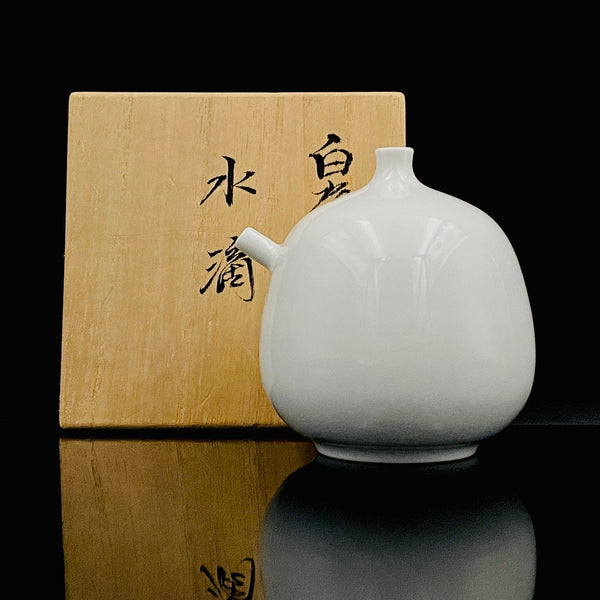 Mitate Drinking Vessels — Bringing Water Droppers, Tea Bowls and Confectionery Bowls Back into UseThe more beautiful a vessel, the more likely it is to be kept on display as “...
 How the Shape of a Cup Changes the Taste — Choosing Flat Cups, Stem Cups, Footed Cups, Cylindrical Cups and GuinomiThe same drink can smell and feel remarkably different depending on the vesse...
