
Dating Old Bottles by Their Volume and Strength Markings — 4/5 Quart, 760ml, 750ml and 1 Litre
When you pick up an old bottle of whisky, your eye probably goes first to the brand name and the age statement. Yet when it comes to working out the era in which a bottle was sold, the most telling clues are often the small volume and strength markings printed in a corner of the label. “4/5 QUART”, “26 2/3 FL.OZS.”, “86.8 PROOF”, “760ml”, “1,000ml” — these figures tell you, with surprising precision, under which country's laws and trading customs, and in which period, the bottle was filled.
In this article we explain how to read the distribution period from the volume and strength markings, using bottles from the 1960s to the 1990s that we actually carry. All photographs were taken by us for our product pages, where you can zoom in on every detail of each label.
Why volume and strength reveal the era
How whisky volume and strength are stated has always been closely regulated by each country's weights-and-measures and liquor tax laws. In the second half of the twentieth century, the world's major markets switched one after another from traditional units to the metric system. Because each country changed over at a different time, the units printed on a bottle let you narrow down considerably which market it was bottled for, and roughly when.
A brand may keep its label design unchanged for many years, but the volume and strength statements must be rewritten whenever the law changes. So even when the label design alone is hard to date, the figures are often what settles the question.
4/5 QUART (about 757ml) — the American “fifth”
A marking often seen on Scotch from the 1970s and earlier is “4/5 QUART”. This is a US liquid measure meaning four-fifths of a quart, or one-fifth of a gallon (about 757ml). In the United States this size was called a “fifth”, and it was long the standard bottle for spirits.
The US moved to metric sizes in the late 1970s, and spirits bottled on or after 1 January 1980 were restricted to metric sizes such as 750ml. A bottle marked “4/5 QUART” can therefore, as a rule, be taken to have been bottled in 1979 or earlier.
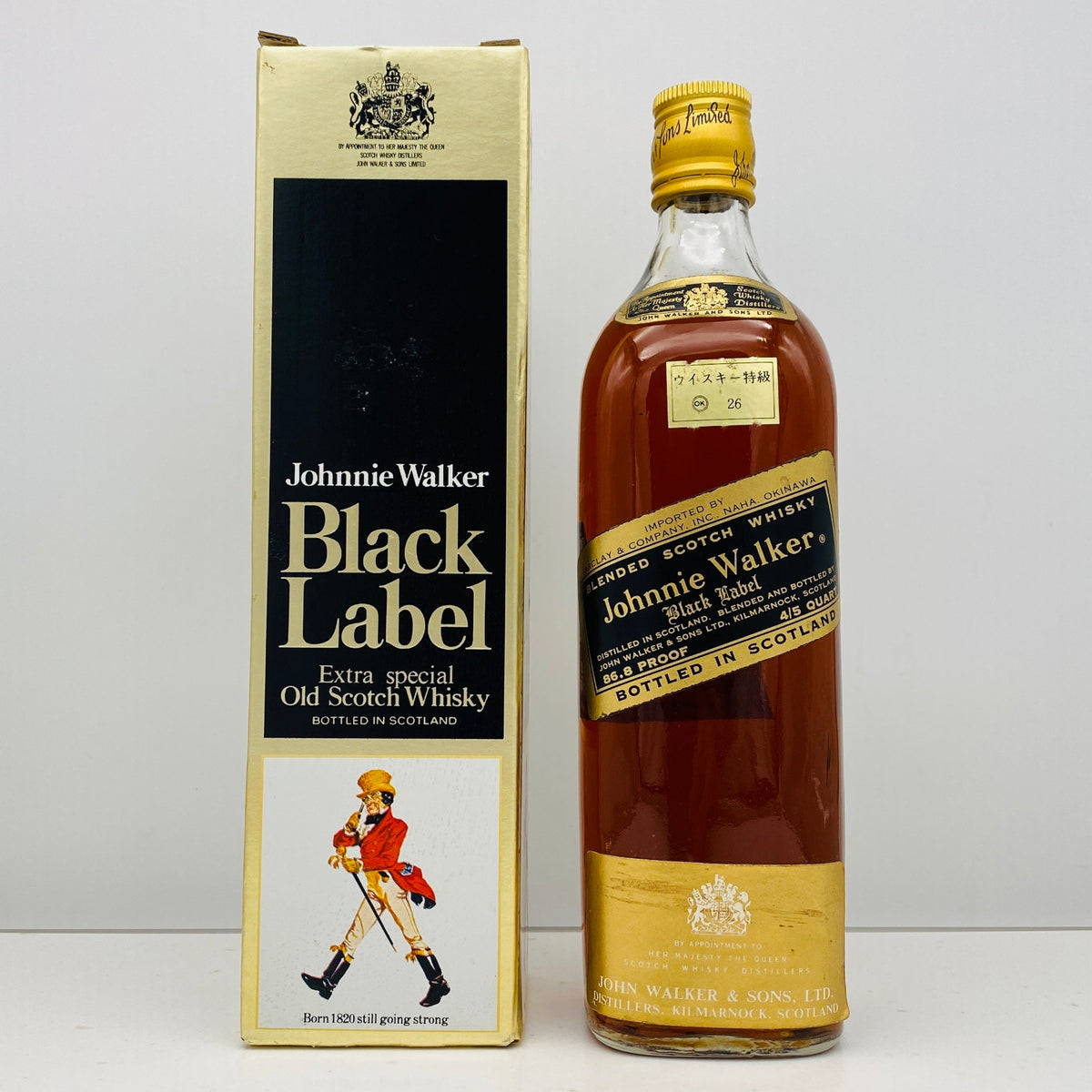
Our Johnnie Walker Black Label #95 is a bottle from exactly this period. Its label carries both “86.8 PROOF” and “4/5 QUART”, and our product listing gives its capacity as 757ml and its alcohol content as 43.4%. On the Black Label #93, distributed in the mid-1970s, the marking has changed to “760ml, 43%”; placing the two side by side shows clearly how the markings evolved.
“760ml” on Japanese labels is another way of saying 4/5 quart
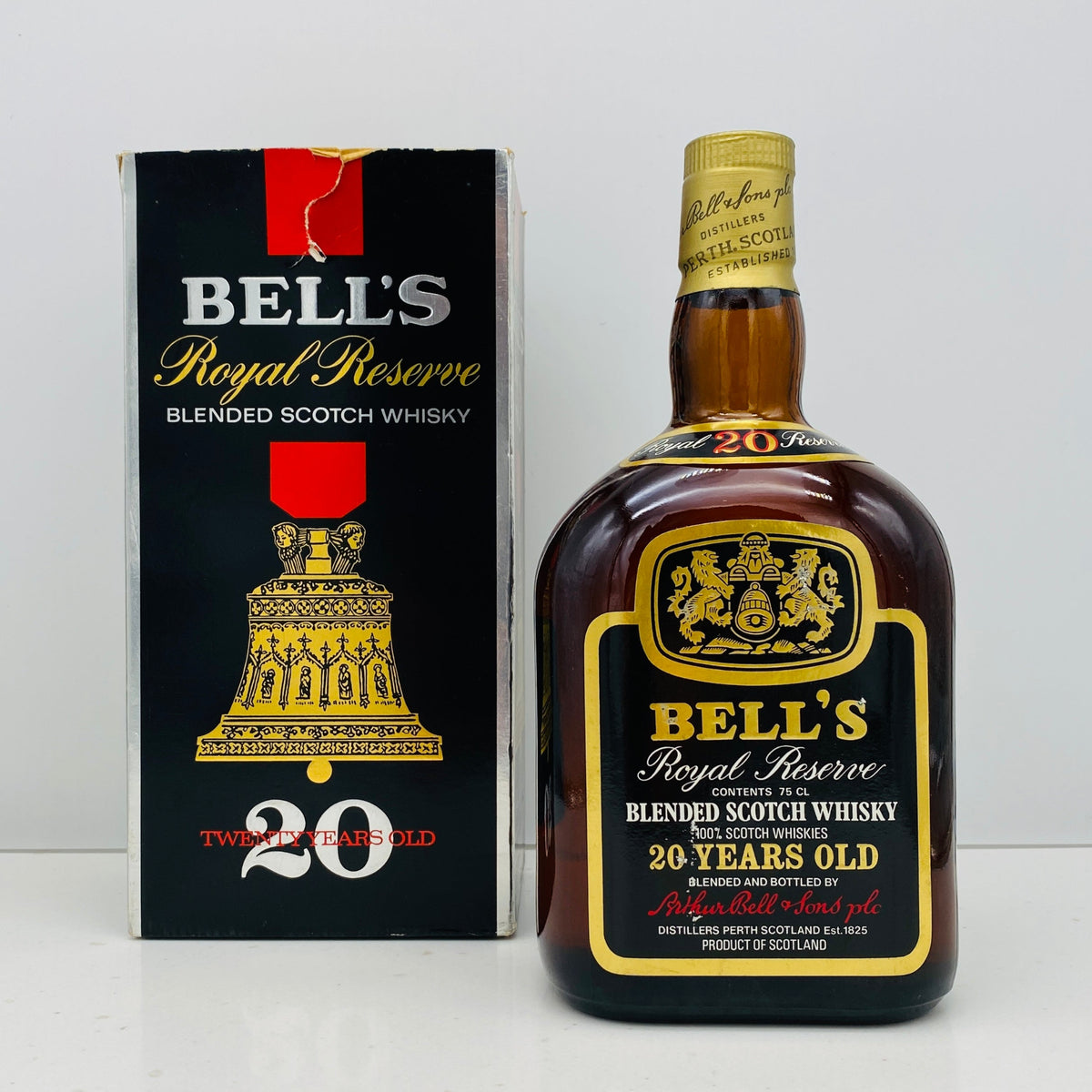
Interestingly, many bottles imported into Japan are marked “760ml”. On our Bell's Royal Reserve 20 Year Old #53 and Ballantine's 17 Year Old Blue-Red Flag label #63, “4/5 Quart” and “760ml” appear together. It seems the roughly 757ml of a 4/5 quart was restated on Japanese labelling as the round metric figure of “760ml”.
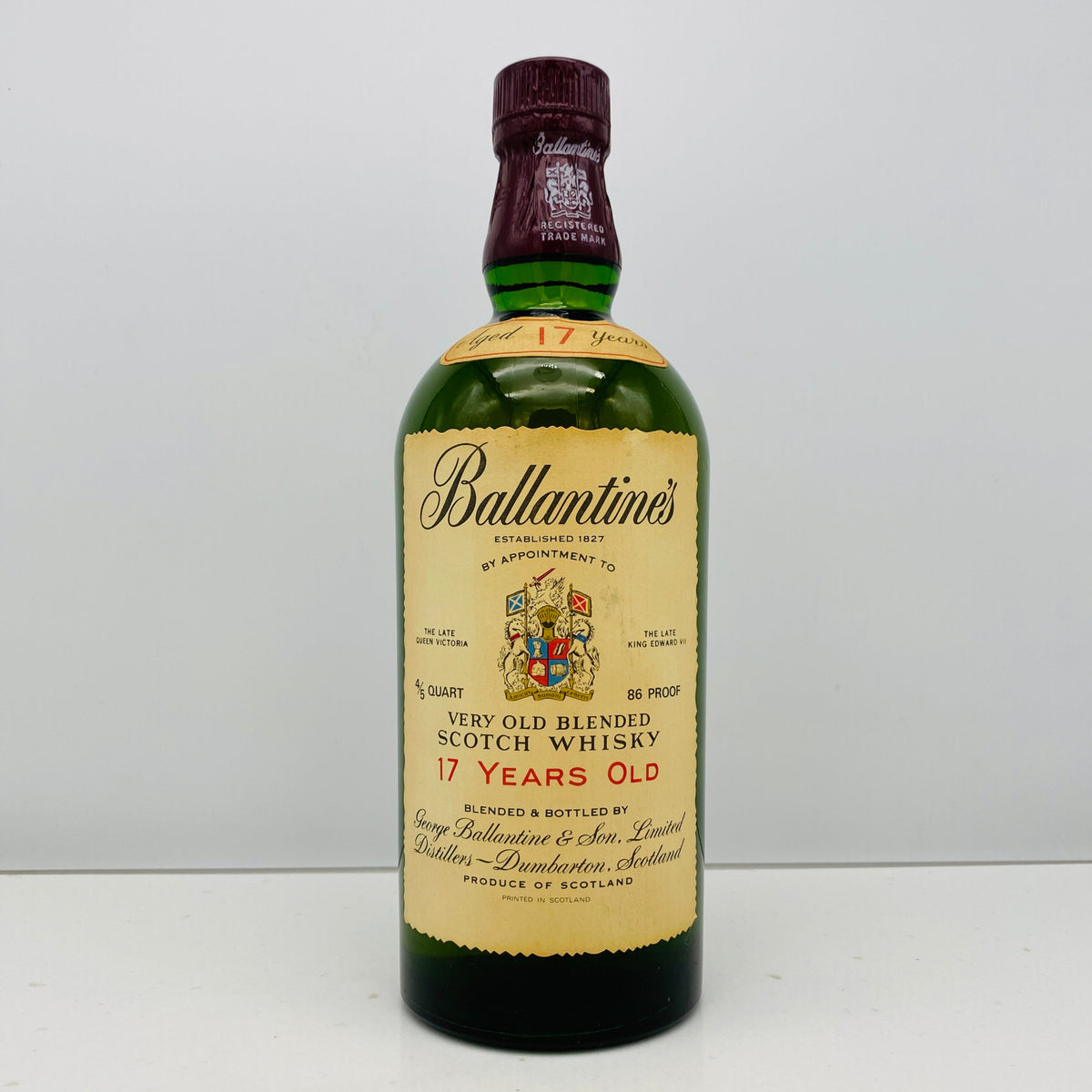
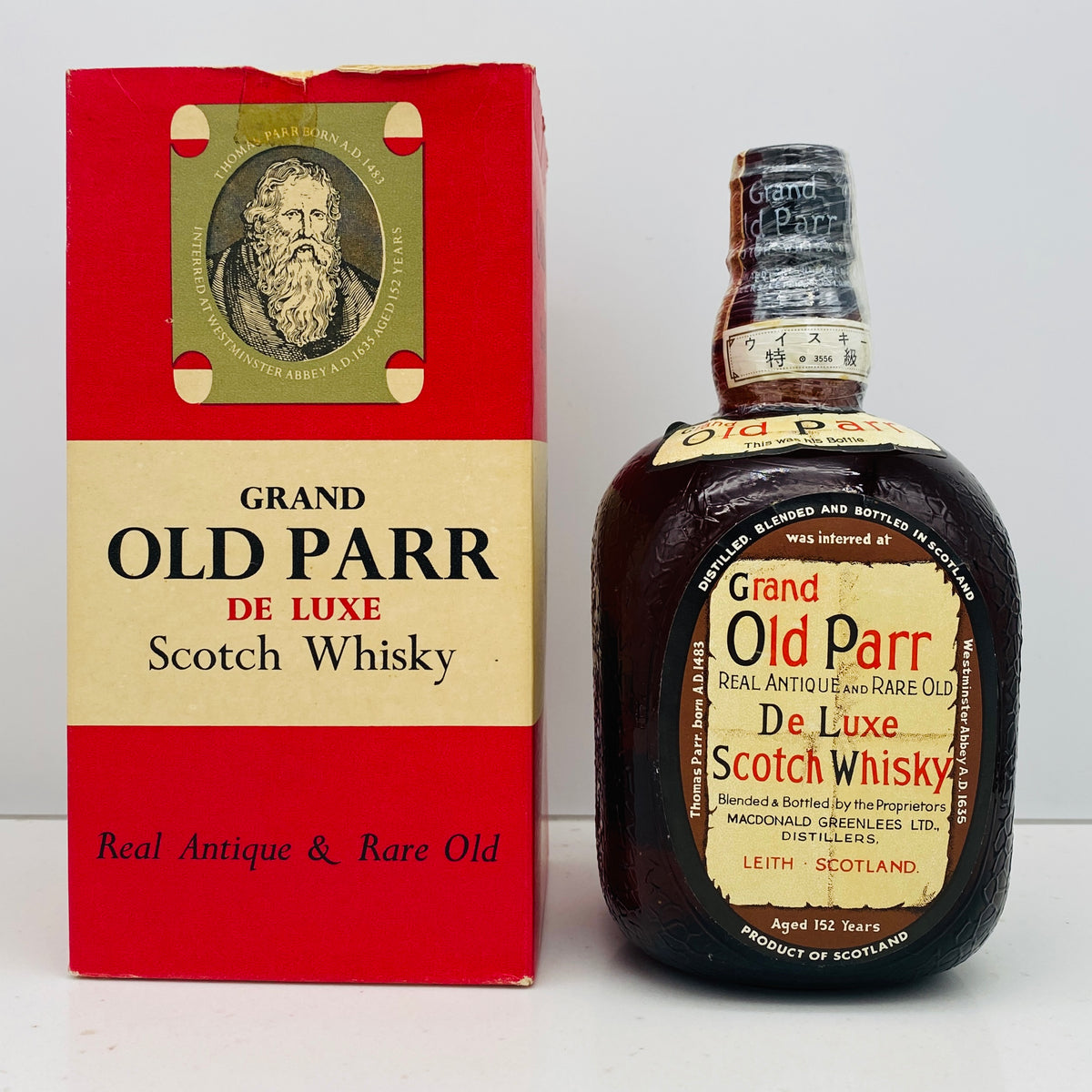
For old bottles sold on the Japanese market, then, a “760ml” marking is one indication of the 1970s to the early 1980s. Indeed, our Grand Old Parr #46 (1960s), #84 and #96 (early 1970s), and Ballantine's 17 Year Old #45 (from 1975 onward) are all 760ml.
26 2/3 FL.OZS. — the British fluid ounce
Another old marking is “26 2/3 FL.OZS.”. These are fluid ounces in the British imperial system: one-sixth of an imperial gallon, or about 757ml. As this is almost exactly the same as the American 4/5 quart, it shows that a “bottle” held virtually the same amount on both sides of the Atlantic.
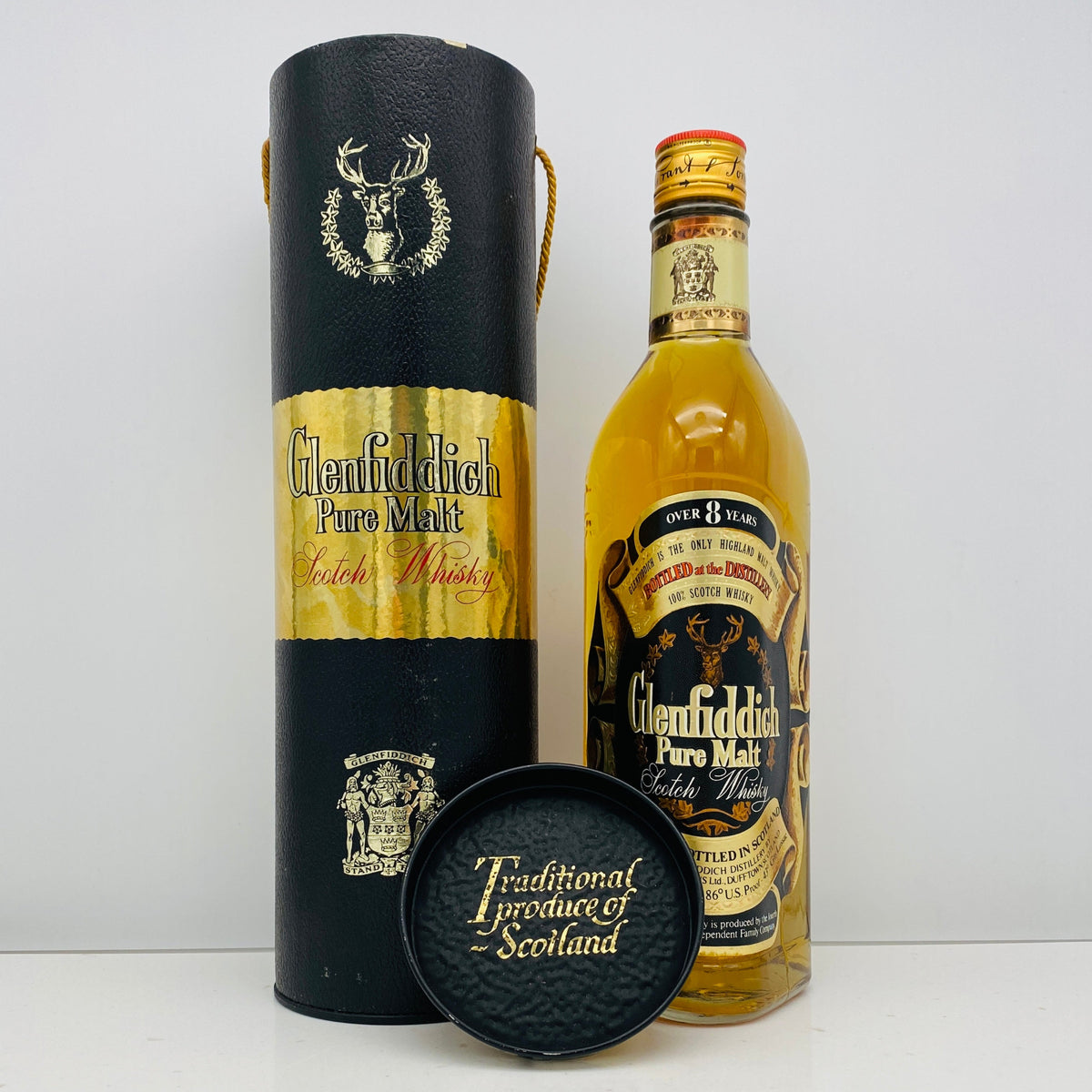
Our Glenfiddich 8 Year Old Pure Malt #117 carries the British “26 2/3 Fl.ozs.” and the American “86° U.S. Proof” on the same label. A British volume statement alongside an American strength statement is typical of an era when labels were tailored to each export market. It is a combination you will almost never see on a modern bottle, and details like this are part of the pleasure of studying old bottles.
Converting PROOF to %
Strength markings reflect their era too. American (U.S.) proof is exactly twice the alcohol by volume (%). So “86.8 PROOF” is 43.4%, and “86 PROOF” is 43%. Our Ballantine's 17 Year Old Blue-Blue Flag label #61 is marked “750ml (25.4 FL. OZ.)” and “86 PROOF (43%)”; both its volume and its strength show that it was bottled after the US went metric.
Britain, by contrast, long used its own proof system (British proof), in which 70° proof corresponded to about 40% and 75° proof to about 43%. British proof was replaced by percentages around 1980. Whenever you see a figure with a “°”, the first step to knowing the true strength is to establish whether it is American or British proof.
| Label marking | Meaning | Approx. alcohol content |
|---|---|---|
| 86.8 PROOF (American) | Twice the % ABV | 43.4% |
| 86 PROOF (American) | Twice the % ABV | 43% |
| 80 PROOF (American) | Twice the % ABV | 40% |
| 70° PROOF (British) | British standard | approx. 40% |
| 75° PROOF (British) | British standard | approx. 43% |
750ml, 700ml, 1,000ml — reading bottles after metrication
After metrication, bottles for the US settled at 750ml, while those for Europe later moved to 70cl. Around 1990, 70cl became the standard size for spirits in Europe, and to this day bottles are made in 70cl for the European market and in 75cl for North America.
Among bottles sold in Japan, 750ml became more common from the 1980s, and 700ml later became the norm. Looking at our Bell's Royal Reserve 20 Year Old, the 1970s bottles #53 and #52 read “4/5Quart, 760ml”, while the 1980s bottle #51 reads “750ml” — a clear switch within the same brand.
1,000ml points to duty-free and particular markets
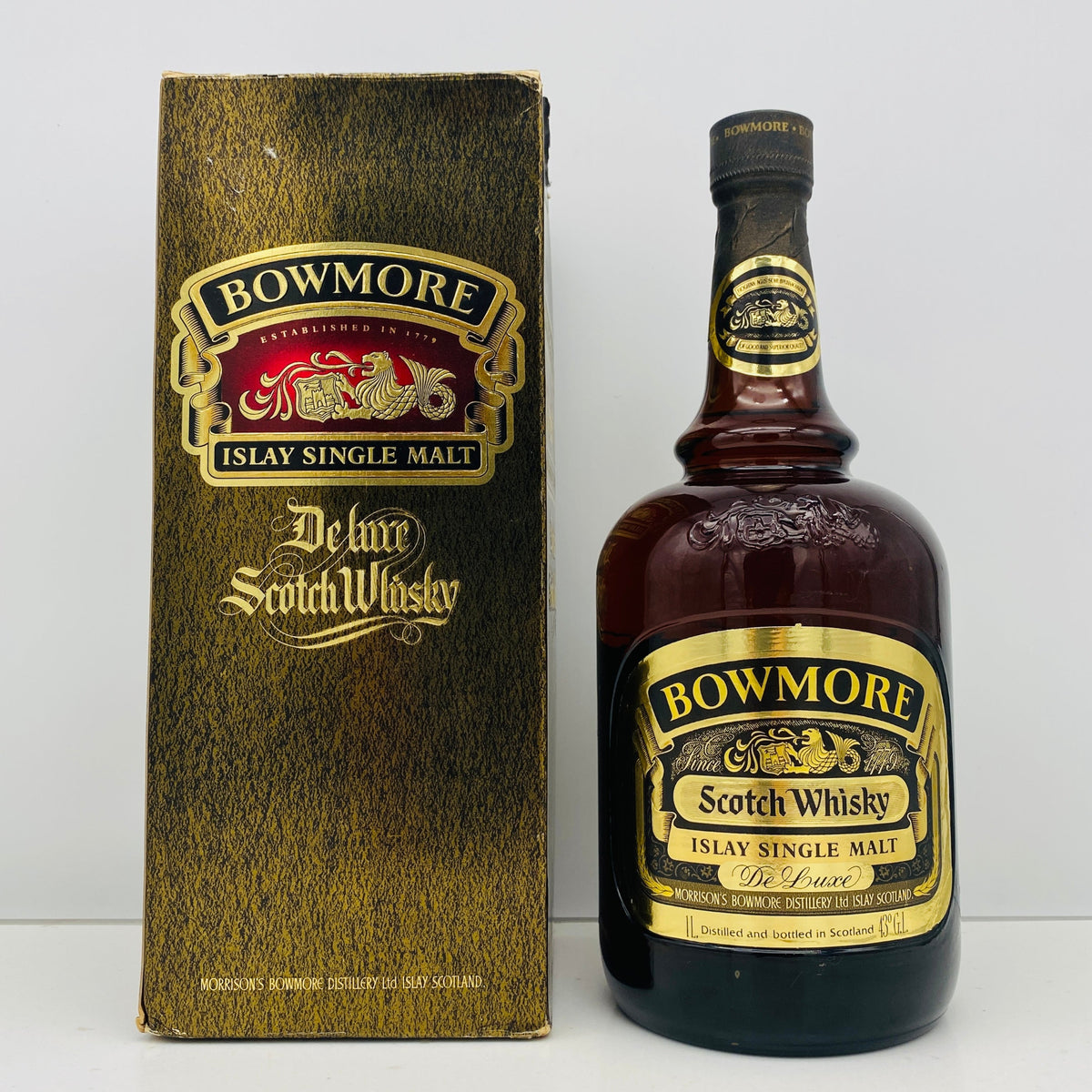
The one-litre bottle is a size made mainly for duty-free shops and certain markets. In our range, Bowmore Deluxe #38 (from 1979 onward), Bowmore 12 Year Old #119 (early 1980s), Dufftown 12 Year Old #55 and The Dufftown Glenlivet 10 Year Old #124 are all 1,000ml. Such bottles often reached the market through different channels from the regular 750ml and 760ml bottles, and their labels or closures sometimes differ from the standard versions.
500ml, 350ml — and 4.5 litres
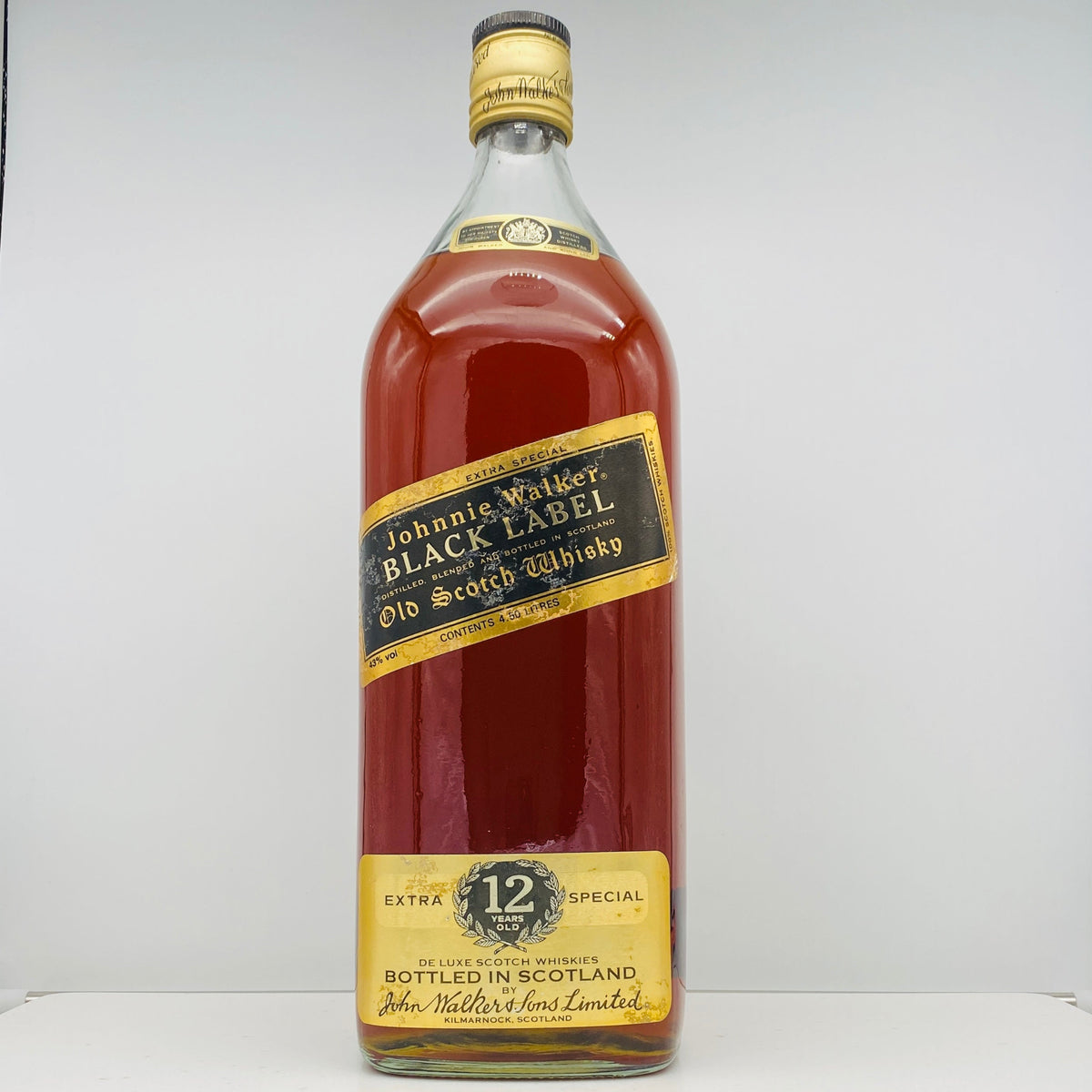
The wide range of sizes is another fascination of old bottles. The Japanese market also had 500ml and 350ml (half-bottle) sizes; examples in our range include Glenmorangie 10 Year Old 500ml #142, St. Mary's Loch 8 Year Old 500ml #140 and Bowmore 12 Year Old 350ml #148. At the other extreme, an oversized gallon bottle such as the Johnnie Walker Black Label 12 Year Old 4.5L #85 was a special piece made for shop displays or as a commemorative item.
Clues unique to bottles sold in Japan — the “special grade” mark and importer labels
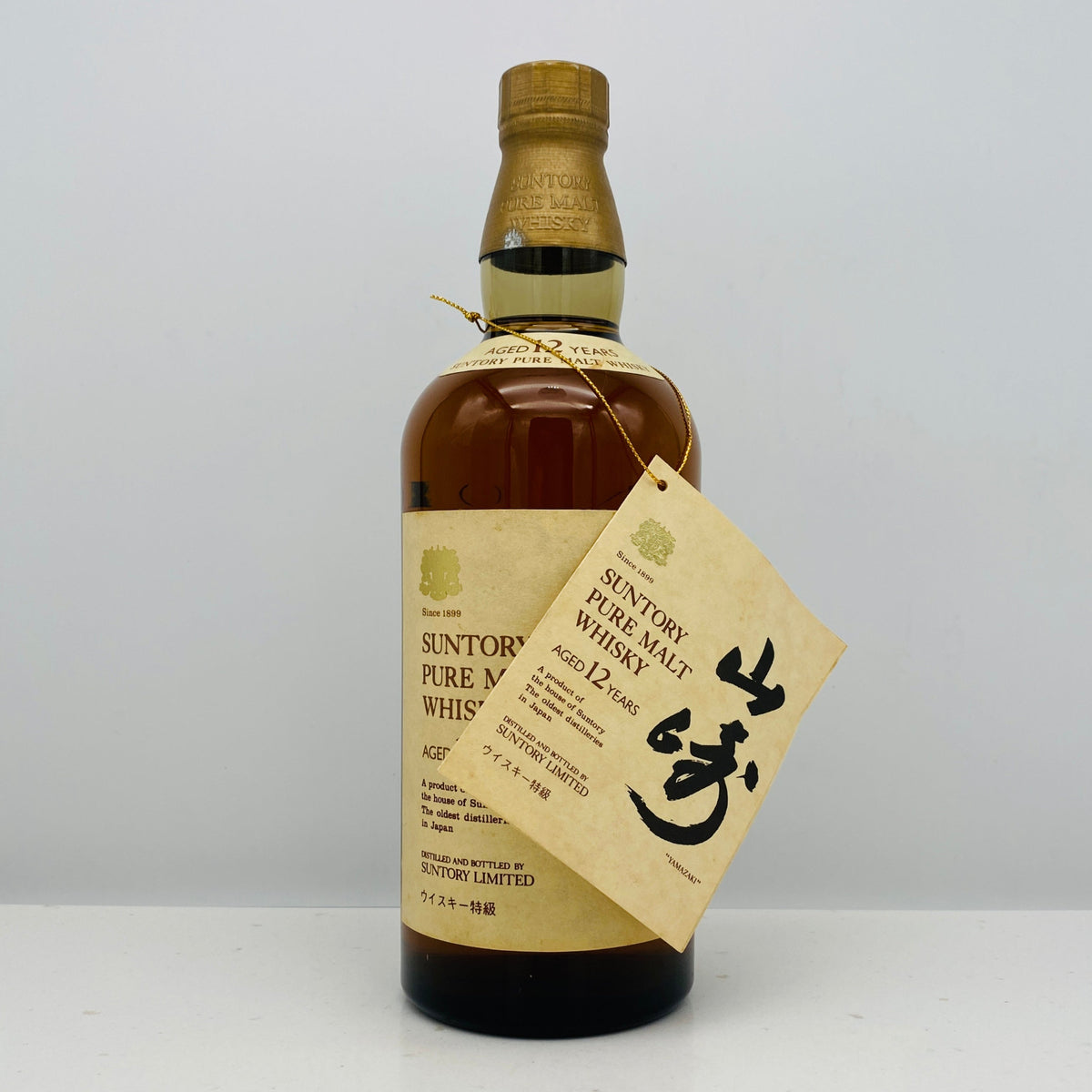
Bottles sold in Japan carry further clues to their era beyond volume and strength. The best known is the “Whisky Tokkyu” (special grade) mark. Until the grading system was abolished by the 1989 revision of Japan's Liquor Tax Act, whisky in Japan was classified as special grade, first grade or second grade. Most imported whisky fell into the special grade, shown as “特級” on the back label or a shoulder seal. If this mark is present, it is strong evidence that the bottle entered Japan in 1989 or earlier.
Compare our Yamazaki 12 Year Old Pure Malt, Special Grade, 760ml (late 1980s) with the Yamazaki 12 Year Old Pure Malt, 750ml (early 1990s) from after the grading system ended, and you will see that the disappearance of the “special grade” mark and the change from 760ml to 750ml happened at the same time. It is a good example of how, even for Japanese whisky, changes in volume and labelling are decisive for dating.
Also worth checking is the Japanese back label naming the importer or distributor. Importers' company names and addresses, and the labelling conventions of the day, changed over time, so combining them with the volume and strength markings lets you narrow down the period of distribution even further.
Look at the closure as well
Besides volume and strength, the type of closure is an important clue for dating. Taking our Grand Old Parr as an example, the 1960s bottle #46 has the older specification of a metal tin cap fitted over a spring cap, while the early-1970s bottles #84 and #96 combine a spring cap with a screw cap. All three are 760ml, but the closure lets you narrow down the period still further.
Stated volume versus actual fill level — a point to watch with old bottles
The volume on the label is the amount at the time of bottling. In an old bottle that has spent several decades on a shelf, alcohol and water can slowly escape through tiny gaps in the closure, and the fill level may have dropped. Old bottles with screw caps or corks in particular tend to vary in fill level depending on how they were stored.
A slightly lower fill level does not in itself mean the quality has suffered. On the other hand, a bottle with a large drop may have changed in aroma or strength from its original state. We photograph our bottles so that the fill level can be seen, and record anything you should be aware of under “Note” in the product description. Please check the fill level in the photographs together with the stated capacity. For storage after purchase, see also our guide How to store old bottle whisky properly and our article measuring the effect of Parafilm.
For the US, the UK or Japan — which bottle to choose
Even within the same brand, strength, volume and label specifications can differ by export market. For example, a US bottle at “86.8 PROOF” (43.4%) and a Japanese bottle at “43%” differ not only slightly in strength but also in when they were shipped and how they were distributed. Such differences can show up directly as individual character in aroma and mouthfeel.
This is not to say that bottles for any one market are better. What matters is to read from the label the path a bottle has travelled, and to enjoy the differences. Wherever possible, we offer bottles of the same brand from different markets and eras side by side. Compare the “Distribution period”, “Capacity” and “Alcohol content” entries on our product pages to find the bottle that suits you.
A checklist for dating a bottle
- Check the unit of volume: “4/5 QUART” or “26 2/3 FL.OZS.” suggests the 1970s or earlier; “750ml” or “70cl” means after metrication.
- Look out for “760ml” on bottles for Japan: a restatement of the 4/5 quart, often seen on bottles sold in Japan from the 1970s to the early 1980s.
- Check the strength marking: for “PROOF”, establish whether it is American or British, and convert it to %.
- Look for the “special grade” (特級) mark: if present, the bottle was most likely sold in Japan in 1989 or earlier.
- Look at the cap and seal: the differences between tin caps, spring caps and screw caps help to tell apart generations of the same brand.
- Combine several clues: do not rely on a single marking; judge from the label, volume, strength, closure and importer information together.
Our suggestion — line up different eras of the same brand
Once you understand volume and strength markings, old bottles offer one more way to enjoy them. We recommend lining up and tasting different eras of the same brand. For example, set Bell's Royal Reserve 20 Year Old from the 1970s (4/5Quart, 760ml) beside the 1980s bottle (750ml), or Ballantine's 17 Year Old with the Blue-Red Flag label beside the Blue-Blue Flag label, and you can experience not only the differences in labelling but also how the character of the whisky changed with the era.
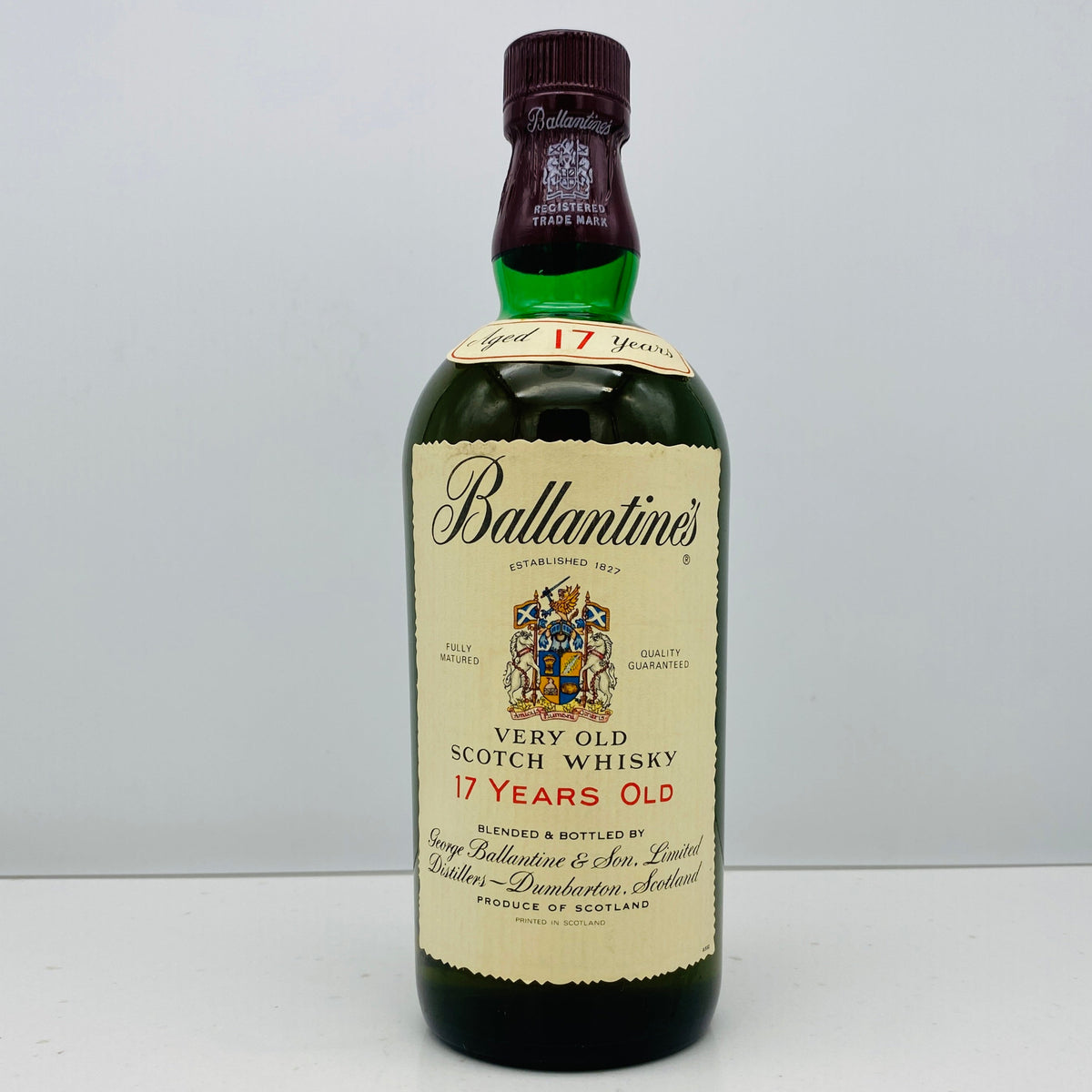
What you see when you line up the bottles is more than a difference in numbers. It is the story of how each bottle crossed the sea, under which country's laws it was filled, and in which era it reached a table in Japan. Paying attention to the small figures on a label will make the whisky in your glass all the more rewarding.
Products featured in this article
- Johnnie Walker Black Label 86.8 Proof 4/5 Quart (early 1970s) #95
- Johnnie Walker Black Label Extra Special 760ml (mid-1970s) #93
- Ballantine's 17 Year Old, Blue-Red Flag label, 4/5 Quart (1970s) #63
- Ballantine's 17 Year Old, Blue-Blue Flag label, 750ml (mid-1980s) #62
- Bell's Royal Reserve 20 Year Old, 4/5Quart, 760ml (early 1970s) #53
- Bell's Royal Reserve 20 Year Old, 750ml (1980s) #51
- Glenfiddich 8 Year Old Pure Malt, 26 2/3 Fl.ozs. (1970s) #117
- Grand Old Parr 760ml, tin cap (1960s) #46
- Bowmore Deluxe 1,000ml (from 1979 onward) #38
- Johnnie Walker Black Label 12 Year Old 4.5L (early 1980s) #85
Browse by era in 1970s items and 1980s items, or by type in Blended Whisky, Single Malt Whisky and Old Bottle Whisky.