This is a pair of cylindrical Nezumi-Shino (grey Shino) yunomi cups by Ando Hidetake, a ceramic artist designated as a Holder of Gifu Prefecture Important Intangible Cultural Property “Kiseto” (Yellow Seto). The set consists of one large and one small cup and was originally made as meoto-yunomi, a matched pair of teacups for a couple. We present them as Japanese-style rocks glasses for two, to savor vintage spirits neat or over a large piece of ice.
Ando Hidetake was born in 1938 (Showa 13) in Tajimi, Gifu Prefecture. Ando is the third generation of the Sentaro Kiln, founded in Ichinokura by the first-generation Sentaro in the early Meiji era, and in artist biographies the artist is also introduced under the name “Sensan Kiln.” According to the Sentaro Kiln’s artist profile, the earlier generations ran a workshop producing small porcelain sake cups and small dishes. The artist’s turning point came at around the age of 22, when Kato Tokuro, who had come to visit Ando’s father, told the young Ando, “If you are going to make pottery, you must make the pottery that was born in Mino.” From then on Ando was devoted to the study of the Momoyama-period wares of Shino, Kiseto, and Oribe.
Ando had no particular teacher. The artist walked the mountains of Mino, dug at old kiln sites, and learned from potsherds how the clay was used and how the designs and firings were achieved. Convinced that gas kilns could never fully achieve Momoyama pottery, Ando built a semi-underground anagama kiln on open land in Kukuri Kakishita, Kani City, near the Taihei old kiln site, preserving the natural slope of the terrain. According to the Museum of Modern Ceramic Art, Gifu, each firing lasts six days and nights and consumes 1,500 bundles of firewood. Ando insists on making both clay and glazes personally from natural materials, and the museum highly regards Ando’s distinctive style, “Ko-Mino,” forged with the clay of the Tono region and this anagama, as having reached “the realm of antique refinement.”
Ando’s principal achievements include first selections for the 1st Asahi Ceramic Art Exhibition in 1963, the 11th Japan Traditional Art Crafts Exhibition in 1964, and the 1st Japan Ceramic Art Exhibition in 1971, each followed by further selections. In 1970 the artist received the Governor’s Prize at the 8th Asahi Ceramic Art Exhibition and exhibited a large Shino platter at the Life Industry Pavilion of the Japan World Exposition. In 1973 Ando received the Encouragement Prize at the 11th Asahi Ceramic Art Exhibition, in 1974 the artist became a regular member of the Japan Kogei Association, and in 1990 Ando received the 8th Kobei Prize.
In 1993 the artist’s “Ko-Mino Large Jar” was designated a Mino Ceramic Art Permanent Preservation Work. In 1998 Ando’s “Ko-Mino Tea Bowl” received the Grand Prize at the Mino Ceramic Art Shoroku Prize Tea Bowl Exhibition, and in the same year the artist was certified as a Holder of Tajimi City Intangible Cultural Property. In 2003 the artist was designated a Holder of Gifu Prefecture Important Intangible Cultural Property “Kiseto,” and Ando went on to receive the Gifu Prefecture Cultural Merit Honor in 2013 and the Order of the Rising Sun, Gold and Silver Rays, in 2016.
In its commentary, Gifu Prefecture describes Ando’s Kiseto as a distinctive style of the artist’s own, with a depth and gravity unlike conventional Kiseto. From 2025 to 2026, the Museum of Modern Ceramic Art, Gifu, held the exhibition “The Lineage of Mino Ceramics: Ando Hidetake.” The exhibition introduced the artist’s representative and recent works, presenting Ando as an artist who has continued to make Momoyama-style Kiseto and Shino using the same clays and firing methods as in that era.
Shino is a ware representative of Mino in the Momoyama period, fired with a thick coating of white glaze composed mainly of feldspar. It is characterized by a milky-white warmth and the expressive “landscapes” that emerge in firing. Nezumi-Shino is made by coating the clay with an iron-rich slip (onita), scratching away a design and then applying Shino glaze: where the slip remains, the ground fires a mouse-grey, while the scratched-away design appears in white.
These pieces are a large and a small cylindrical cup of differing sizes. Plum blossoms stand out in white against the grey ground, with touches of scarlet here and there, and a generous coat of feldspar glaze gives them a substantial texture. The surface is densely covered, from the exterior to the interior, with the fine pinhole marks known as yuzu-hada (citron-skin texture), characteristic of Shino. On the body, a plum blossom design stands out as a white reserved motif. Around the rim, the lower body, and near the base, vivid orange hiiro (fire color) appears in gradations, and its contrast with the white feldspar glaze creates a natural landscape. The cylindrical form, which fits comfortably in the hand, is also well suited to enjoying the deep flavor of vintage spirits and the sound of ice.
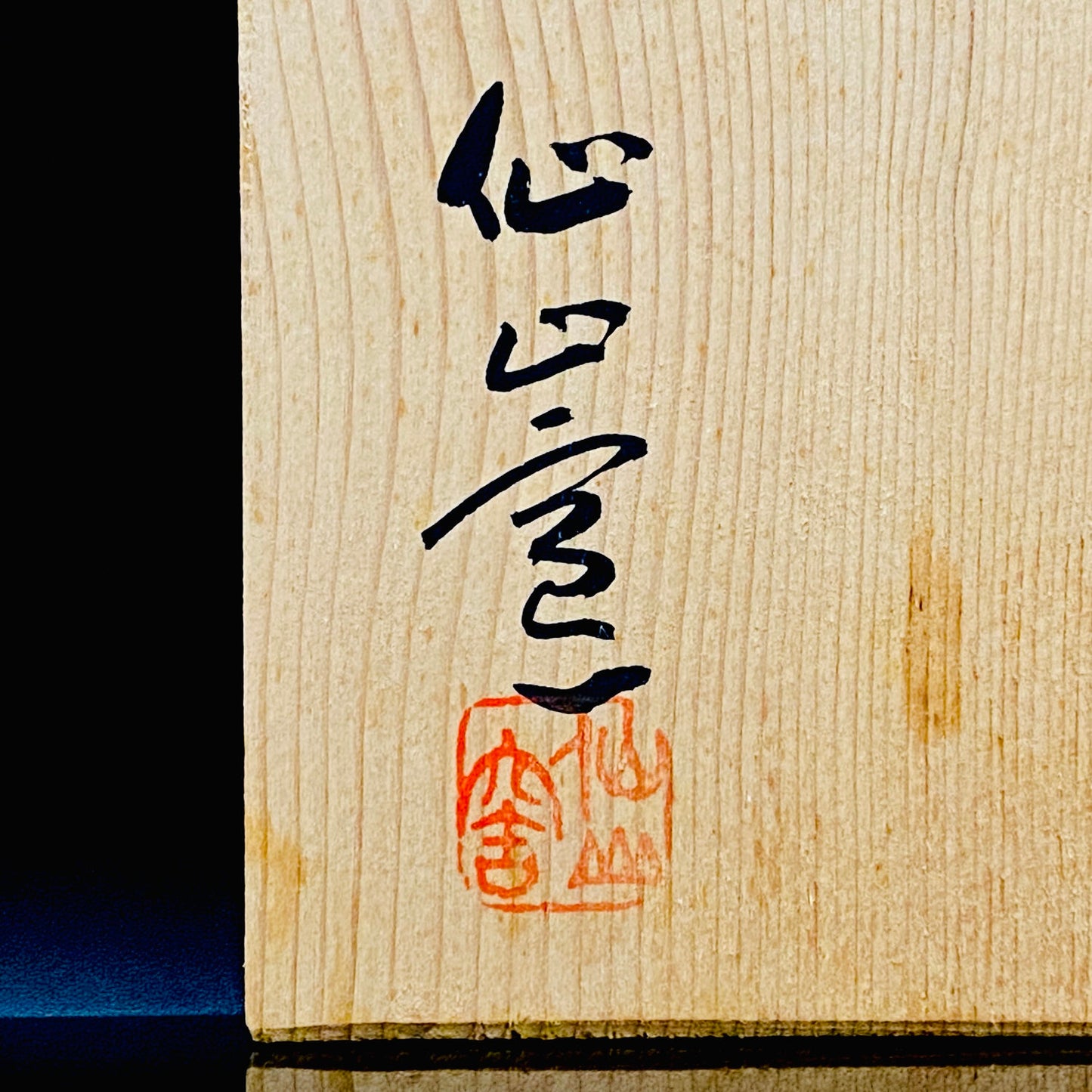
There is no date on the tomobako, but both the signature and the seal read "Senzan kiln". Senzan kiln is the name of the kiln founded in the early Meiji era by Ando Hidetake's grandfather Sentaro; among the artist's leaflets we have handled, those from the late 1970s to the 1980s are printed under this name, while those from 1999 onward use the name "Sentaro kiln". We therefore estimate that these pieces were made between the 1960s and the 1990s, before the kiln took the name Sentaro kiln. The cups themselves are free of cracks and chips, and the glaze color, yuzu-hada, and hiiro are all in excellent condition. They come with the dedicated tomobako (the original wooden box signed by the artist), inscribed in ink on the lid with what reads "Nezumi-Shino Yunomi", signed "Senzan kiln" and bearing the red seal of the Senzan kiln.
- Artist: Ando Hidetake (安藤日出武, b. 1938)
- Career Highlights: [1963] First selection, 1st Asahi Ceramic Art Exhibition; [1964] First selection, 11th Japan Traditional Art Crafts Exhibition; [1970] Governor’s Prize, 8th Asahi Ceramic Art Exhibition; large Shino platter exhibited at the Life Industry Pavilion, Japan World Exposition; [1971] First selection, 1st Japan Ceramic Art Exhibition; [1973] Encouragement Prize, 11th Asahi Ceramic Art Exhibition; [1974] Regular member of the Japan Kogei Association; [1975] First selection, 1st Chunichi International Ceramic Art Exhibition; [1990] 8th Kobei Prize; [1992] Tajimi City Culture and Arts Merit Award; [1993] “Ko-Mino Large Jar” designated a Mino Ceramic Art Permanent Preservation Work; [1998] Grand Prize for “Ko-Mino Tea Bowl,” Mino Ceramic Art Shoroku Prize Tea Bowl Exhibition; certified as a Holder of Tajimi City Intangible Cultural Property; [2002] Gifu Shimbun Grand Prize, Culture Award; [2003] Designated a Holder of Gifu Prefecture Important Intangible Cultural Property “Kiseto”; [2011] Gifu Prefecture Education and Culture Merit Award; [2013] Gifu Prefecture Cultural Merit Honor; [2016] Order of the Rising Sun, Gold and Silver Rays; Tokai TV Culture Prize; [2017] Publication of “Mikan no Mama ni” (Chubu Keizai Shimbun); [2025] “The Lineage of Mino Ceramics: Ando Hidetake,” Museum of Modern Ceramic Art, Gifu (through 2026)
- Public Collections: Museum of Modern Ceramic Art, Gifu (“Kiseto Tea Bowl,” “Kiseto Large Jar”)
- Date: c. 1960s–1990s (estimate: the signature and seal on the tomobako read "Senzan kiln", the kiln's name before it became "Sentaro kiln"; Ando Hidetake's leaflets from the late 1970s–1980s are printed under the Senzan kiln name, and those from 1999 onward under the Sentaro kiln name)
- Condition: Very good (no chips, no cracks). Please regard the crazing that forms in firing, other characteristics of ceramics and the patina of age as part of the pleasure of an antique piece.
- Accompanied by: Dedicated tomobako
- Medium: Stoneware (Mino ware, Nezumi-Shino, plum blossom design)
- Dimensions: Large: height approx. 10.0 cm, mouth diameter approx. 7.0 cm / Small: height approx. 9.5 cm, mouth diameter approx. 6.5 cm
- Please Note: All items offered by our shop, even if new and unused, were produced a very long time ago, and all are therefore listed as pre-owned. Items may show age-related wear or damage. Please understand and confirm this before considering a purchase.
- About the Photographs: We prepare every description with great care, but errors may still remain in the text. Please examine the photos carefully before purchasing. Where the photos and the description differ, please take the photos as the basis for the product information.





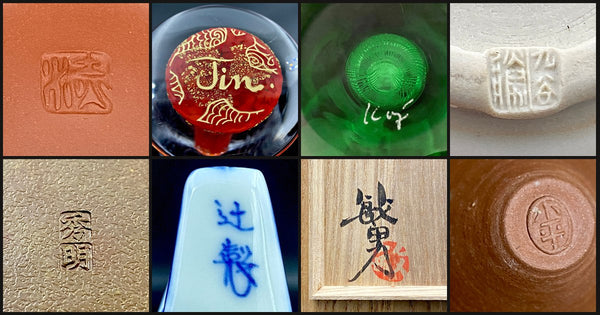 Japanese Pottery Seals, Box Signatures and Marks: A Photo Index of 162 MakersThe seal or incised signature on the base of a piece, and the signature and s...
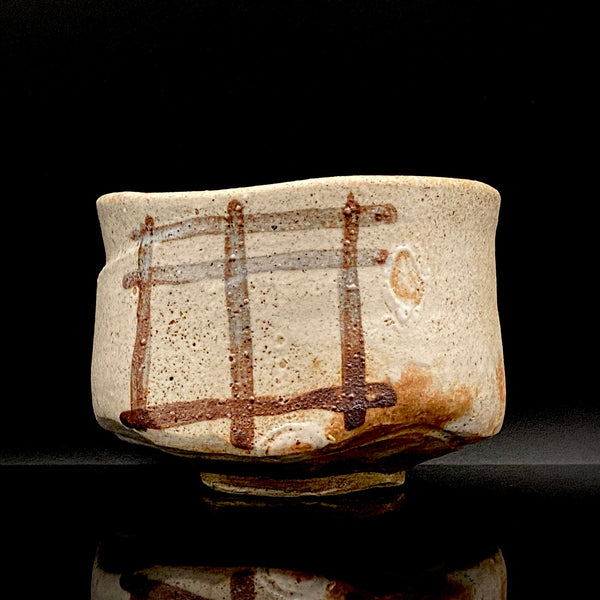 A Whisky Tea Gathering — Hosting with Master Craftsmen's Tea Utensils and Old Bottle WhiskyNovember, when the hearth is opened and the year's new tea is unsealed, is ca...
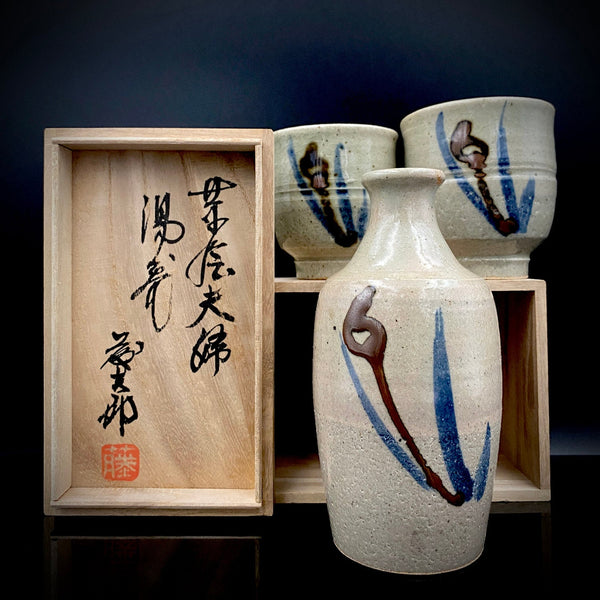 Whisky Warmed Like Sake — Hot Whisky in Japanese Vessels, from Hitohada-kan to Jo-kanIn the world of sake, warmed sake is named in five-degree steps — hinata-kan,...
